The quick answer: Ticket to Ride plays 2 to 5 players, and it’s best at 4. Yes, you can play it with two, but the original North America map is flat at two. Play Europe or Nordic Countries instead and a two-player game gets tense.
Some links below are Amazon affiliate links — as an Amazon Associate, King Panda Games earns from qualifying purchases at no extra cost to you. Full disclosure.
Ticket to Ride won the Spiel des Jahres in 2004, the award that turned it into a gateway staple. See the jury’s entry.
Below: what every version seats, what each player count actually feels like, the double-route rule most small groups get wrong, and how to make two-player games work.
Every Version, and What It Seats
The number on the box isn’t the same across the line, and this trips people up constantly — someone plays the small London box at a friend’s house, buys “Ticket to Ride,” and ends up with a different game that seats a different group.
| Version | Players | Age | Time |
|---|---|---|---|
| Ticket to Ride (North America) | 2–5 | 8+ | 30–60 min |
| Ticket to Ride: Europe | 2–5 | 8+ | 30–60 min |
| Ticket to Ride: Germany | 2–5 | 8+ | 30–60 min |
| Ticket to Ride: Rails & Sails | 2–5 | 10+ | 90–120 min |
| Ticket to Ride Legacy: Legends of the West | 2–5 | 10+ | 20–90 min |
| Ticket to Ride: Nordic Countries | 2–3 | 8+ | 30–60 min |
| City editions (London, New York, Amsterdam, San Francisco, Berlin, Paris) | 2–4 | 8+ | 10–15 min |
| Ticket to Ride: First Journey | 2–4 | 6+ | 15–30 min |
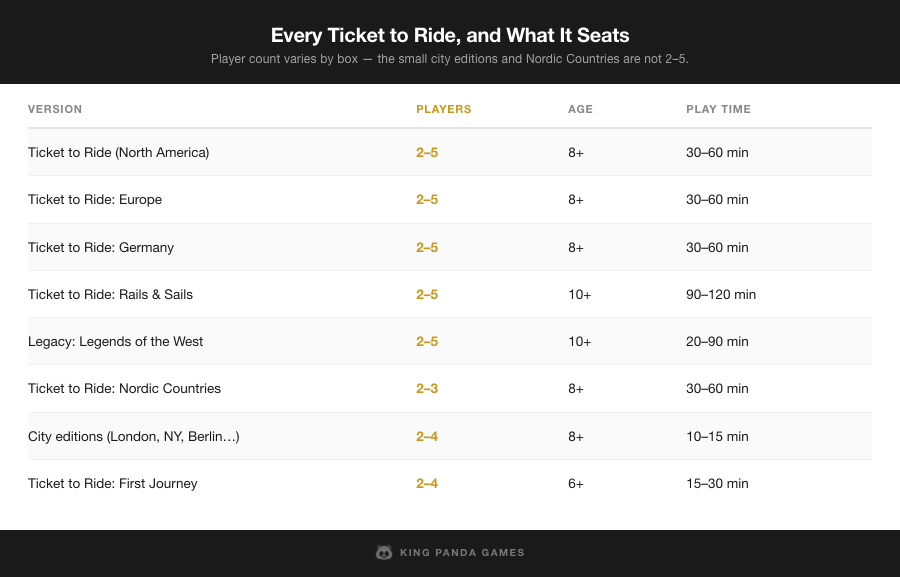
Nordic Countries is the only mainline Ticket to Ride that caps at three players — it’s the one box you can buy that will not seat a group of four.
Four Is the Sweet Spot
Four players is the count the North America map was drawn for. The board reaches the density where routes actually get taken out from under you, the Chicago–Pittsburgh–New York corridor turns into a genuine knife fight, and you still get your turn back fast enough to have a plan when it arrives.
What makes four work is that it’s the last count where blocking is incidental. Somebody takes the route you wanted because they needed it, not because they were hunting you. At five, blocking becomes deliberate and the game gets meaner.
Four players, round nine. You’ve been building a Seattle-to-Chicago spine and you need one more 6-space stretch. Two other players have been fighting over the Southeast all game and haven’t looked at the northern route once. Then the player to your left draws their third destination ticket, glances at the top of the board for the first time all game, and takes it. That moment — genuine competition that arrived by accident — is Ticket to Ride at four players.
The Full Breakdown, Count by Count
Five players is the loudest and the luckiest. Every desirable route is gone by the midgame, the face-up card display gets picked over before it comes back around to you, and plans made two turns ago are frequently dead on arrival. It’s a great time with the right crowd and a frustrating one with people who want to optimize. Turn downtime is the real cost — expect to wait a couple of minutes between decisions.
Four players is the recommendation. See above.
Three players is the underrated count and the one we’d defend hardest. The eastern half of the board gets properly contested while the west stays open enough that a blocked player always has somewhere to go. Games run fast, everyone stays in it, and the route-scoring math gets to matter because you can actually execute a plan. If your regular group is three, you don’t need to buy anything special.
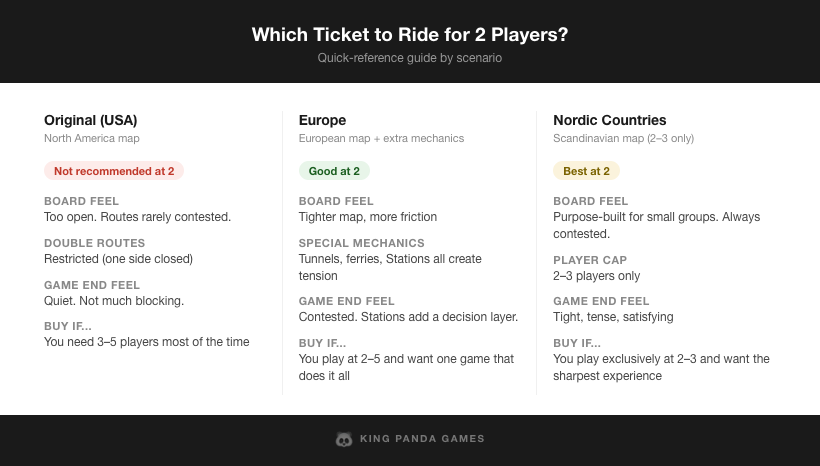
Two players on North America is the weak spot. The map is too big, nobody gets blocked, and the game ends with two tidy networks that never touched. It works — it just doesn’t produce a story. The fix isn’t a house rule, it’s a different map: Europe or Nordic Countries both turn two-player Ticket to Ride into a genuinely tense game.
Why the Base Game Struggles at Two
The North America map was designed for 3–5 players. At full count, the board fills up, routes get contested, and double routes create meaningful strategic tension. At two players, the same map produces a different experience entirely.
The critical rule: in 2-3 player games, only one of any double-route pair can be used by either player. So the two blue routes from Chicago to Pittsburgh become a single contested route. This is correct per the rules and intended to increase competition — but it doesn’t fully compensate for how much open space remains on the board.
You’re playing two players on the North America map. It’s round 8. Both players have built well-connected networks. Your opponent hasn’t touched the West Coast. You haven’t touched the South. The board looks half-empty. Neither player has been blocked once. The game ends shortly after with clean scores and no drama. It worked — it just didn’t feel like much.
This isn’t a rules problem. It’s a design-fit problem. The map simply doesn’t create friction with two players in a way that produces memorable moments.
What Works at Two (Ticket to Ride Europe)
Europe is the right answer for two-player Ticket to Ride — not as a band-aid, but as a genuinely better game at this player count.
Three reasons:
Tunnels create uncertainty. On a standard route, you know exactly what a claim costs. Tunnel routes flip three additional draw pile cards and charge you for any that match your claimed color. Even with two players, tunnel routes feel risky and contested because the cost is variable. You can’t just assume you’ll have enough cards — you need buffer.
Ferries require Locomotive wildcards. Ferry connections in Europe need at least one Locomotive card per ferry segment. With only 14 Locomotives in the deck (same supply as the original), two players actively compete for a limited resource. The moment your opponent draws the Locomotive you needed from the face-up display, the impact is immediate and felt.
Stations change the calculus. Each player starts with three Stations in Europe. If a route you need is blocked, you can place a Station in one of its cities and use the route anyway — at a cost of 4 points per Station spent. At two players, Stations turn blocking from a game-ending frustration into a meaningful decision: is the route worth the 4-point penalty, or do I reroute? This dynamic is exactly what two-player Ticket to Ride needs.
The Purpose-Built Two-Player Map (Nordic Countries)
If two-player Ticket to Ride is your primary use case, Nordic Countries is the best purchase you can make. It’s a standalone game designed specifically for 2–3 players — not adapted from a larger map, but purpose-built for smaller groups.
The Scandinavian geography creates natural bottlenecks. The ferry routes through the Norwegian archipelago require Locomotives. The map is compact enough that both players are constantly aware of what the other is building. It plays in 45–60 minutes and produces consistently contested games.
The trade-off: it caps at three players. If you ever need to play with four or five, you need a different game. For dedicated two-player households, that’s not a trade-off at all.
Tips for Two Players on the Base Map
If you’re committed to the original map at two players, a few adjustments make it more interesting:
Standard rules at two: Double routes restricted, everything else as written. Results in a quiet, uncrowded game.
House rule some groups use: Open both halves of every double route (drop the 2–3 player restriction). This makes the game friendlier, not tenser: nobody gets shut out of a corridor, but you lose the main source of friction at two.
It isn’t an official variant. If your two-player games feel flat, keep the restriction and use the next tip instead, because that’s the fix that actually adds competition.
A second adjustment: encourage both players to draw Destination Tickets aggressively early. More tickets means more geographic spread, which means more route overlap, which means actual competition. Two players each holding only two tickets rarely cross paths. Two players each holding four or five tickets are building all over the map.
The Rule Most Groups Get Wrong at Low Counts
What most groups do: play two or three players with all the double routes open, then conclude Ticket to Ride is boring with a small group.
What the rules actually say: in 2- and 3-player games, only one of any double route may be used. When either player claims one half of a parallel pair, the other half is closed permanently — to both of you.
This single rule is the difference between a small-count game that has friction and one that doesn’t. It’s printed in the rulebook and skipped constantly, usually by groups who learned the game at four or five players and never re-read the setup section.
Some groups drop it on purpose for a friendlier game. That’s fine as a house rule, just know it removes most of the tension at two (see our two-player tips).
Playing With 6 or More
You can’t, straight out of a standard box. Every mainline copy of Ticket to Ride contains exactly five sets of 45 trains, so five is a hard physical ceiling.
The one official route to six players is Map Collection Volume 1: Team Asia, which restructures the game into two-player teams that share a card holder alongside their private hands. It requires a copy of Ticket to Ride or Ticket to Ride Europe to play, since it ships as maps and tickets only. It genuinely works — the shared-hand mechanic is clever, and teams keep the downtime tolerable — but it’s a specific purchase for a specific problem.
Buying two base sets and merging them doesn’t solve this. You’d have two boards, two card decks, and no shared map.
Worth knowing: if your group is regularly six or more, the honest answer is that Ticket to Ride is the wrong tool. Run two parallel games of a city edition — they take 15 minutes each — or pick something from our games for big groups list instead of forcing a five-player game to stretch.
How Long It Takes at Each Count
Two players finish in roughly 30–40 minutes. Five players run closer to 60. That’s a much smaller spread than most games, and the reason is structural: every player has the same 45 trains no matter what, and the game ends when any one player drops to two trains or fewer.
More players doesn’t lengthen the arc of the game. It just adds waiting inside it. Heat: Pedal to the Metal is the rare game that seats six straight out of the box and still lands on four as its best count — our Heat player count guide ranks every count, solo included.
Check Ticket to Ride: Team Asia price on Amazon →
The Verdict
Don’t buy the original Ticket to Ride as a two-player game. Buy Europe. If two players is your only scenario and you want the sharpest possible experience, buy Nordic Countries. If you already own the original and play exclusively at two, keep the double-route restriction and have both players draw more Destination Tickets early.
The game itself is not the problem at two. The map is the problem. Match the map to your player count and Ticket to Ride works at any size. And if the two players are you and your partner, Ticket to Ride still makes our best board games for couples list — on the Europe map, not the one in most people’s closets.
Check Ticket to Ride: Europe price on Amazon →
For the full picture on the base game’s strengths and weaknesses across all player counts, check out our complete Ticket to Ride review. For a direct comparison between the original and Europe, we’ve got that breakdown here, and our full Europe review covers why it’s the version we recommend to most buyers.
What the critics said about Ticket to Ride
We play these games ourselves, but it’s worth knowing where the rest of the hobby lands.
-
“I’ve always thought this game was amazing, so why not invest in a very nice version of it?”
— The Dice Tower. From the Dice Tower’s 10th Anniversary edition review — the base game’s standing is not in question.
-
Shut Up & Sit Down — SU&SD’s review covers the base game alongside Rails & Sails, and is the best single argument for why the route-claiming loop still holds up.
Going straight to the source: Read the official Ticket to Ride rules, plus the background and history.
📕 Grabbing the rules? Grab this too.
The KPG Budget Board Games Guide — 9 games under $30, each with player counts, play time, and who it’s actually for. Free PDF, no email gymnastics.
Playing as a pair tonight? Our free Game Night Picker shows Ticket to Ride alongside every other game we rate that works for two.
If you remember one line: Ticket to Ride is a 2–5 player game that’s happiest at 4, fine at 3, chaotic at 5, and needs a different map at 2. Still deciding whether it belongs on your shelf at all? The full review settles that, and our guide to every version settles which box to actually buy.
Frequently Asked Questions
How many players can play Ticket to Ride?
The original Ticket to Ride and Ticket to Ride Europe both play 2 to 5 players. The small city editions — London, New York, Amsterdam, San Francisco, Berlin and Paris — play 2 to 4, and Nordic Countries plays 2 to 3. No standard box goes above 5 without an expansion.
What is the best player count for Ticket to Ride?
Four players on the North America map. The board fills to roughly the density the map was drawn for, routes get genuinely contested around the Midwest hubs, and turns still come back fast enough that you can plan. Three is the close runner-up and five is the loudest, luckiest version.
Can you play Ticket to Ride with two people?
Yes — every standard version of Ticket to Ride can be played with two people. The base game and Europe both officially support 2–5 players, and Nordic Countries is built specifically for 2–3. One rule changes with two people: only one route of any double-route pair can be claimed. Map choice matters more than the rules — Europe and Nordic Countries stay tense with two, while the original North America map plays quiet and open.
Is Ticket to Ride fun with 2 players?
On the Europe map or Nordic Countries map, yes — genuinely. On the original North America map, it works but feels flat. The base game’s map is too large and routes too uncrowded at two players to create the competitive tension that makes Ticket to Ride engaging. Europe’s tunnels, ferries, and Stations solve this problem.
What’s the best Ticket to Ride version for two players?
Nordic Countries if you play exclusively at 2–3 players. Ticket to Ride Europe if you want something that handles 2–5 players well. The original North America map is the weakest two-player experience in the franchise.
What is the double route rule at 2 and 3 players?
In games with two or three players, only one of any double route may be used. Once either player claims one half of a parallel pair, the second half is closed to everyone for the rest of the game. This rule exists to keep a half-empty board competitive, and skipping it is the most common reason low-count games feel dull.
Is Ticket to Ride good with 3 players?
Very good, and underrated. Three players on North America produces real route competition in the eastern half of the board while leaving enough western space that nobody gets completely locked out. If your regular group is three, you do not need a different map.
Can you play Ticket to Ride with 6 players?
Not with a standard box. The Map Collection Volume 1: Team Asia expansion adds a six-player team mode where players compete as three pairs sharing a card holder, but it requires a copy of Ticket to Ride or Ticket to Ride Europe to play. Merging two base sets doesn’t work either: one map built for five players doesn’t have enough routes for six.
Does Ticket to Ride take longer with more players?
Yes, but less than you would expect. Two players finish in about 30 to 40 minutes and five players in about 60, because everyone still has only 45 trains to spend and the endgame trigger is one player dropping to two or fewer. More players means more waiting, not a longer game arc.
How long does a 2-player game of Ticket to Ride take?
Typically 30–45 minutes. With two players, trains are placed slower and the game clock (triggered when someone reaches 0–2 trains) takes longer to expire. Europe or Nordic Countries at two players runs about the same length, occasionally 50–60 minutes if both players are building large, ambitious networks.
How many trains does each player get in Ticket to Ride?
Forty-five colored train cars each, regardless of how many people are playing. The count never scales, which is why the board feels emptier at two players and gridlocked at five — the same 45 trains per person are competing for a fixed number of routes.