

Playing with exactly four? Four-player games are their own art — we ranked the games that peak at four separately. This page is for the bigger crowds: five, six, and the full family-reunion table.
Group games have one major problem: most of them don’t actually get better as you add players. Some get worse. Long wait times between turns, rules complexity that leaves half the table confused, or a design so dependent on player count that adding two more people breaks the whole thing.
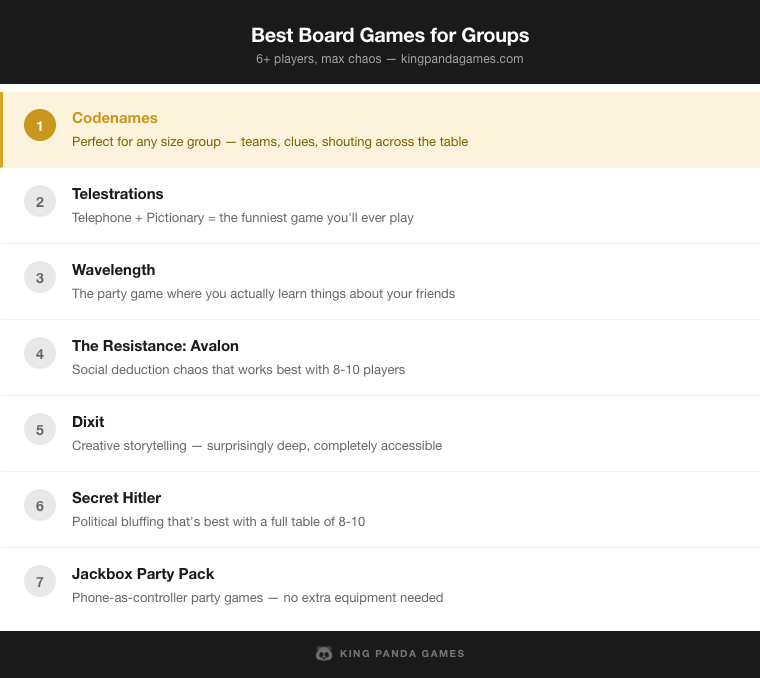
These games are the exceptions. They scale well, play fast enough that downtime doesn’t kill momentum, and hold up after you’ve played them ten times. Last verified: August 2026.
Some links below are Amazon affiliate links — as an Amazon Associate, King Panda Games earns from qualifying purchases at no extra cost to you. Full disclosure.
Our Top Picks
1. Codenames
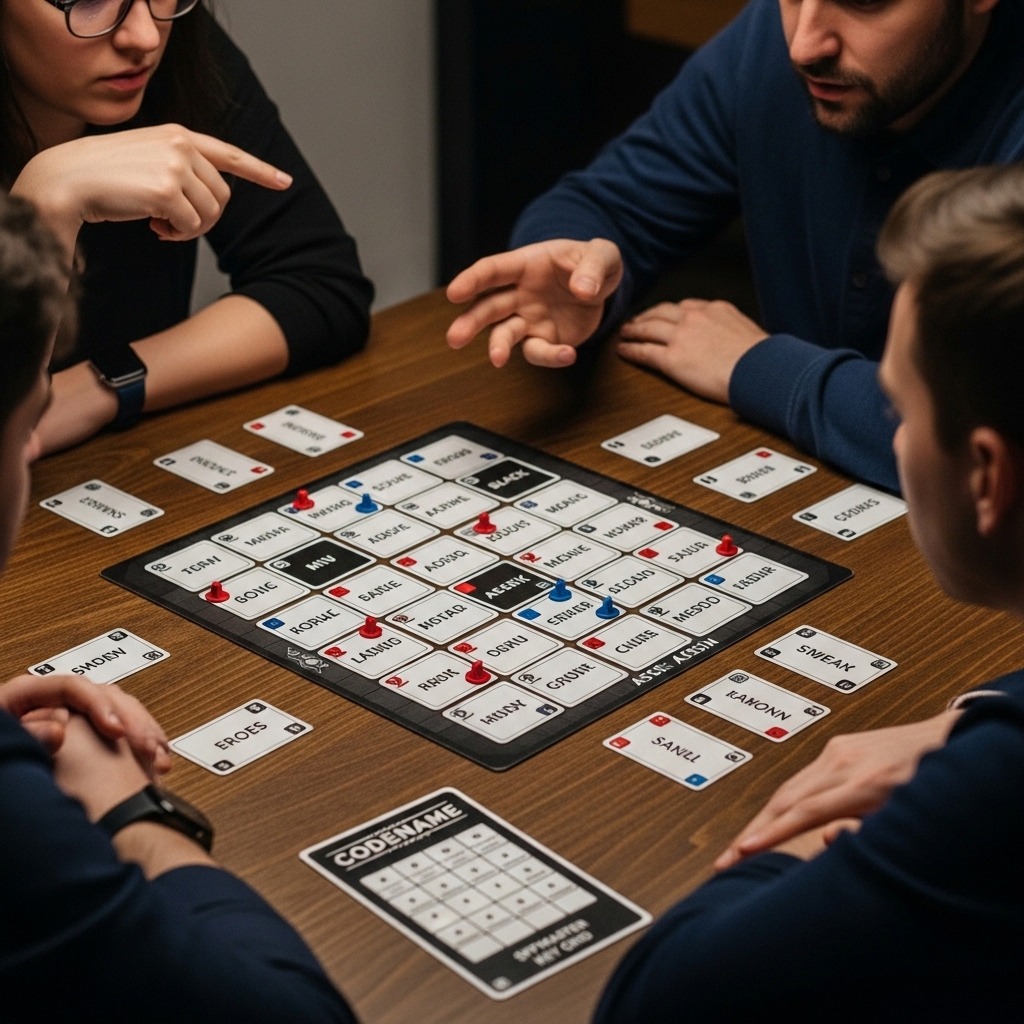
Two teams. A grid of 25 words. A spymaster on each side who knows which words belong to which team. Their job: give one-word clues that lead their team to the right words without accidentally pointing to the assassin word that ends the game instantly.
Codenames works at 4 and it works at 10. Larger teams just mean more voices debating whether the clue “WATER” points to River, Bridge, or Glass — and that debate is half the fun. The back-and-forth between teammates trying to read their spymaster’s mind is where the game lives.
It plays in 20 minutes and a second round is almost always immediately requested.
Verdict: Buy it. Codenames Pictures is worth it too if you want a variant that plays faster and works with younger players. Playing with a bigger group? here’s exactly how the game changes from 4 to 10+ players — and if you’re the one giving clues, our Spymaster tips will cut your team’s losses fast.
Check Codenames price on Amazon →
2. Telestrations

Telephone meets Pictionary, and it is consistently the funniest game we’ve played. Everyone starts with a word, draws it, passes it, the next person guesses what the drawing is, passes it, the next person draws that guess, and so on. At the end, everyone reveals how their chain of drawings and guesses evolved from the original word.
You don’t need to be good at drawing. In fact, being bad at drawing makes this game better. The moments when “fire truck” becomes “angry sandwich” becomes “the sun” by the end of the chain are the kind of thing people bring up months later.
It scales to 12 players without losing anything. If anything, bigger groups mean more chaos and more laughs.
Verdict: Buy it. The After Dark edition adds adult prompt cards if your group skews older.
Check Telestrations price on Amazon →
3. Wavelength
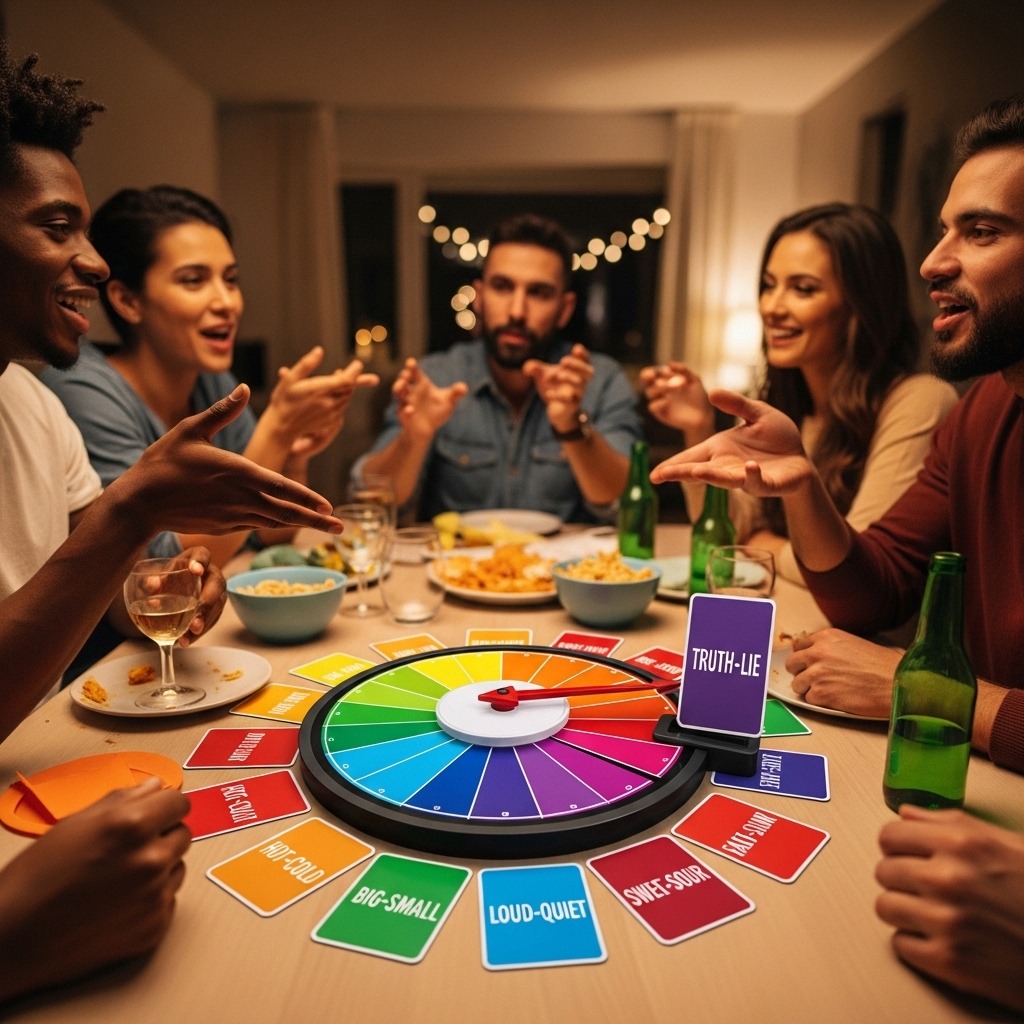
A clue-giving game built around spectrums. One player sees where a hidden target sits on a spectrum (like “Hot — Cold” or “Overrated — Underrated”) and gives a single clue. Their team then debates where on the spectrum the target sits and places a dial.
The debates are the game. Is “lukewarm shower” closer to Hot or Cold? Is “Google” closer to Overrated or Underrated? Where does “rain on a wedding day” sit on the Good Thing — Bad Thing spectrum? The scoring rewards accuracy, but the conversations are where Wavelength actually lives.
It handles large groups cleanly because the clue-giver mechanic keeps one person engaged at all times and the team discussion involves everyone.
Verdict: Buy it. One of the most original games of the last five years.
Check Wavelength price on Amazon →
4. The Resistance: Avalon
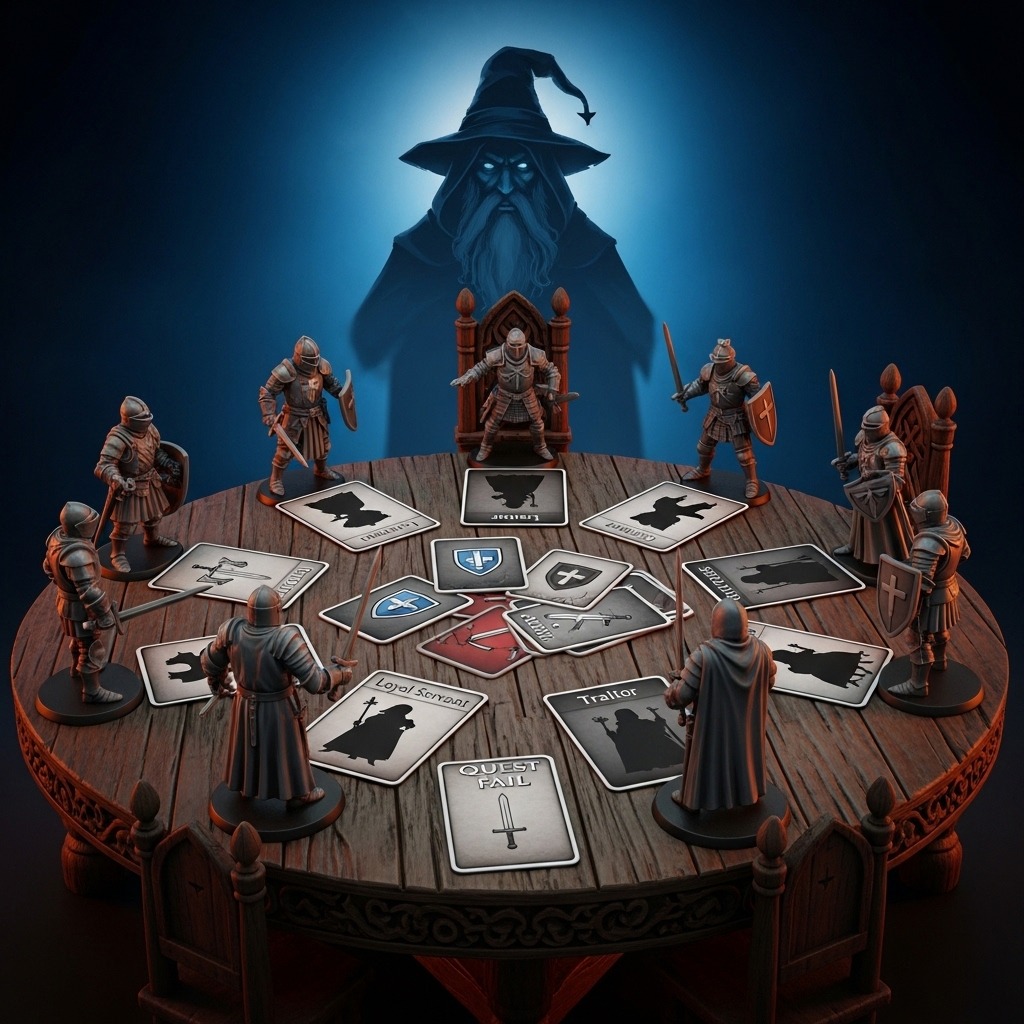
Social deduction. Spies hidden among resistance fighters, missions to complete or sabotage, and one player (Merlin) who knows the truth but can’t say it directly. The best session of this game you’ll ever play will be with 8–10 people who all know the rules.
It takes a full game to click, but once it does, you’ll want to play it every time the group gets together. Watching someone hold a straight face through an accusation, or correctly reading a bluff from across the table — these are the moments group games exist to create.
Verdict: Buy Avalon over the base Resistance. The Merlin role adds a crucial layer and the game is better for it.
Check The Resistance: Avalon price on Amazon →
5. Dixit
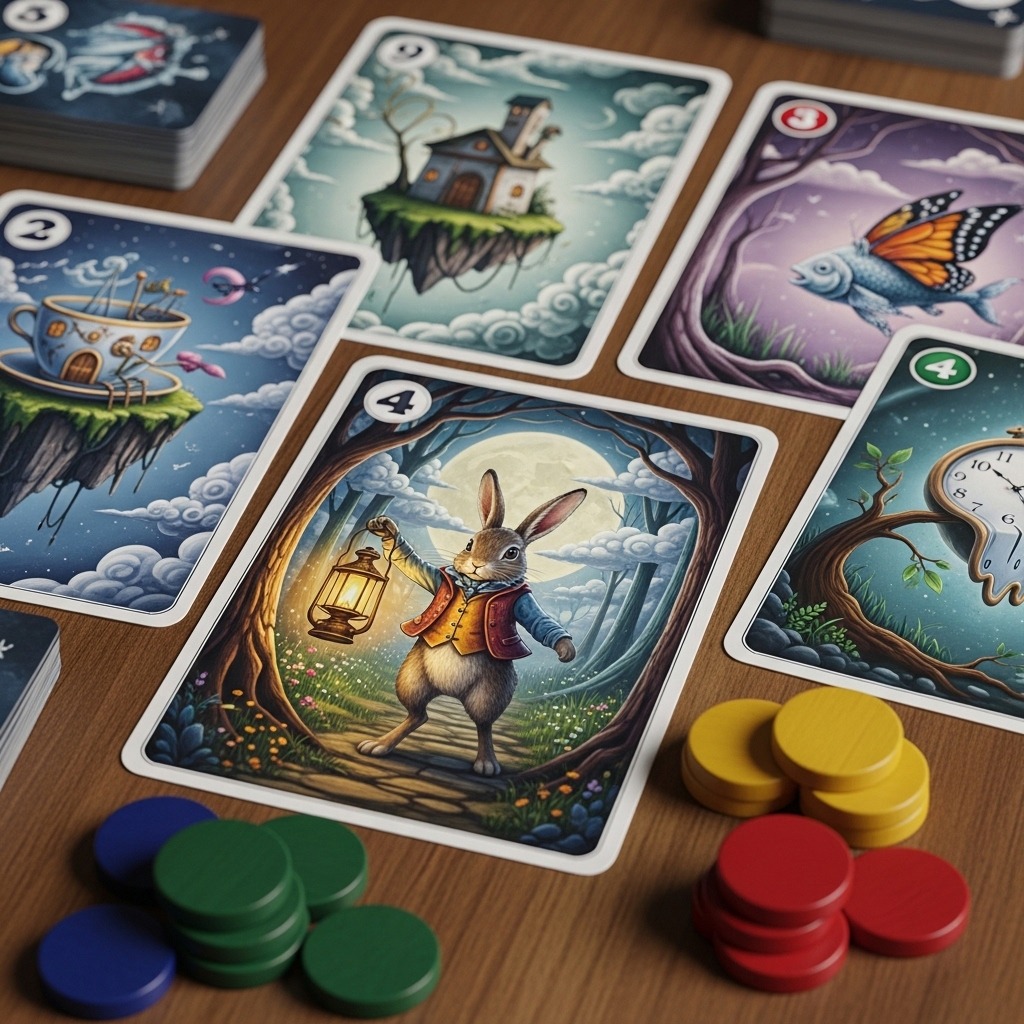
Each player has a hand of surreal, beautifully illustrated cards. On your turn, you give a clue — a word, a phrase, a sound — and everyone plays a card they think matches it. Players vote on which card was yours. You want some people to guess right but not everyone (otherwise you score nothing).
The art is genuinely stunning and the clue-giving pushes people to be creative in ways other games don’t. It also has essentially no ceiling on player age — we’ve played it with an 8-year-old and a 75-year-old in the same game and both were engaged.
The current 2021 box ships eight voting dials and eight rabbit pawns, so it plays up to 8 — the 3–6 figure you still see quoted is the original 2010 edition. Dixit Odyssey scales to 12. Our full Dixit review has the scores and the one group it does not work for.
Verdict: Buy it. Best first game for groups that haven’t played together before.
6. Secret Hitler
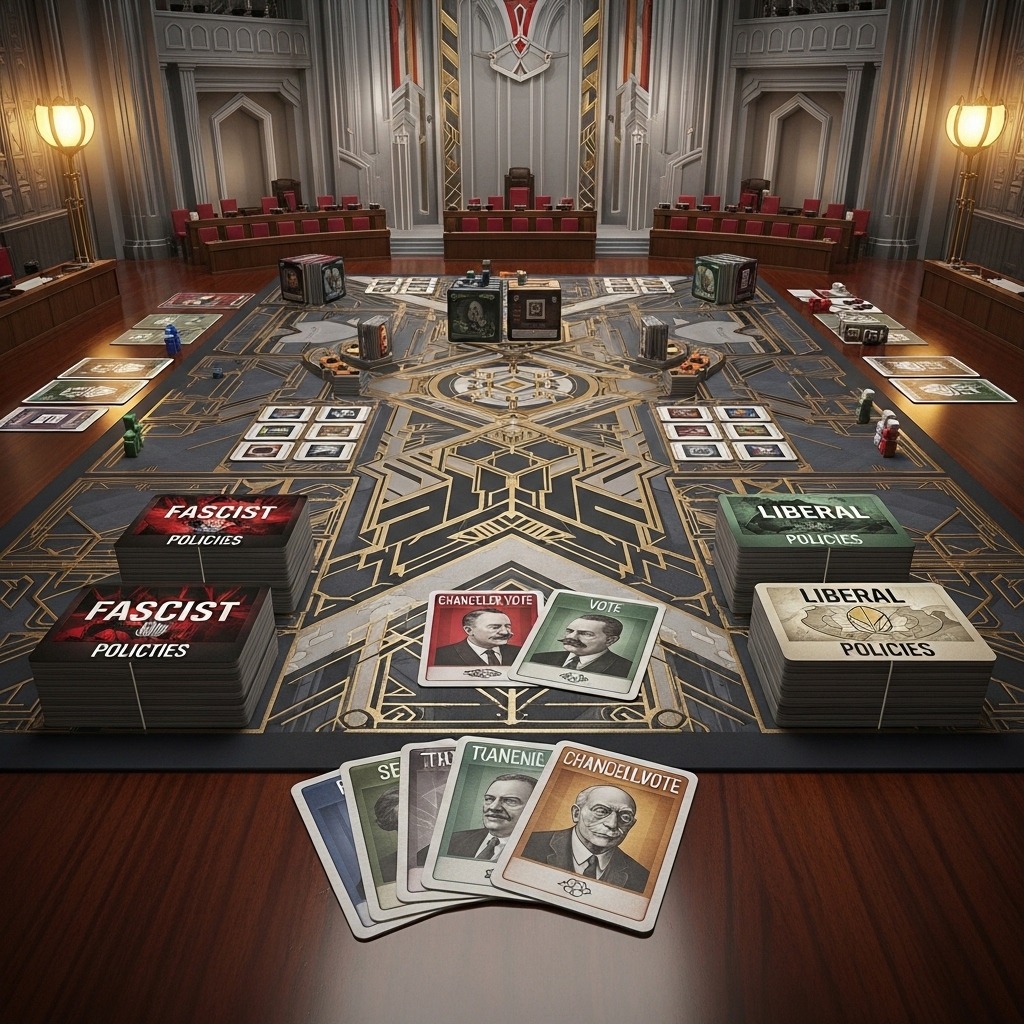
The group game with the most dramatic moments per session of anything we’ve played. Hidden roles, policy passing, accusations, and a fascist team trying to slip their leader into the Chancellor seat.
The theme keeps this off some people’s lists. For the groups it works for, it’s one of the best hidden-role games available. Scales best at 7–9 players.
Verdict: Right group, right night — buy it. Print-and-play version is free online if you want to test it first. Read our full Secret Hitler review.
Check Secret Hitler price on Amazon →
7. Jackbox Party Pack

Technically not a board game, but it belongs on this list. Players use their phones as controllers. No setup, no learning rules, works on any TV. Quiplash, Drawful, Trivia Murder Party — the Jackbox games are purpose-built for large groups who want something accessible and funny without any friction.
The Pandas score would be higher if every game in the pack were consistently strong — they’re not, some are filler. But the highlights are worth it.
Verdict: Buy Pack 3 or Pack 6 as your first. They have the strongest individual games.
Check the Jackbox Party Pack price on Amazon →
8. Hot Streak
Players: 3–8 core game, with 2-player and 9+ variants · Age: 6+ · Play time: 20 min
Every other game on this list gives each person a job. Hot Streak takes the jobs away. You draft a betting ticket on one of four off-brand mascots, sneak one card into an eighteen-card race deck, and then nobody decides anything — the Dealer flips cards while the mascots fall over, turn around and wander off the track, and the room does the rest.
It earns its place here on one number. The race deck is always 18 cards, and the share of it you were allowed to see drops from 83% at three players to 56% at eight, because every extra player adds a secret card and removes a public one. This is the rare group game that is designed to get better as the table gets worse to predict.
The catch is worth knowing before you buy: at nine or more the rulebook switches you to a different game entirely — no money, no betting tickets, no secret cards, just everyone writing two bets on paper and splitting four fixed pots. It still works. It is just not what the box taught you.
Verdict: Buy it if you host big. Skip it if you want a game with turns in it. Full breakdown in our Hot Streak review.
Check Hot Streak price on Amazon →
The Holiday Table (8 to 12 People, Three Generations)
Three games on this list survive a table that seats a 75-year-old and a 15-year-old at once, and all three teach in under five minutes.
Telestrations is the safest. It scales to 12 without losing anything, nobody needs to draw well, and the end-of-round reveal is the part of the night people quote back in the car. Dixit is our pick when the age gap is widest. We have had an 8-year-old and a 75-year-old engaged in the same game, and Dixit: Odyssey pushes the cap from 6 players to 12. Codenames works because the spymaster can be anyone and the team debate does the rest. Grab Codenames Pictures if young kids are playing.
Past 10 people, the trick is teams. Split the table in two for Codenames or Wavelength and nobody sits out waiting on a turn, because the whole team argues over every clue. The other option past ten is Hot Streak, whose 9+ variant drops the money and the tickets and just has everybody write two bets on a scrap of paper. Skip Secret Hitler and Avalon here. Both need a table that already knows the rules, and the Secret Hitler theme is a hard sell at grandma’s table.
Hosting on the day itself? Our best Christmas board games is built for exactly this table. Once the kids are in bed, the best board games for adults has the heavier picks. Bringing a game as a gift rather than hosting? Our board game gift guide sorts picks by budget and recipient.
Our Top Pick for Large Groups
Telestrations if you want maximum laughs with zero barrier to entry. Codenames if you want something competitive with replay value. Both are worth owning.
Also check out our Best Card Games for Adults — Coup and Exploding Kittens both play well with bigger groups too.
🎋 Budget Board Games
Best Board Games Under $30
Codenames is our top pick for groups and costs around $20. See all our budget picks below.
Frequently Asked Questions
Do you need to be an artist to enjoy Telestrations?
Absolutely not! Being terrible at drawing actually makes Telestrations funnier, leading to hilariously garbled chains of drawings and guesses. The game thrives on misinterpretations and creative chaos, not artistic talent.
How well does Codenames actually play with a large group?
Codenames scales beautifully, working just as well with four players as it does with ten or more. Larger teams simply mean more lively debate among teammates trying to decipher their spymaster's clue, which is where the game truly shines.
What makes Telestrations so consistently funny?
Telestrations is a laugh riot because it perfectly blends Telephone with Pictionary, creating absurd and unforgettable drawing chains. Watching 'fire truck' morph into 'angry sandwich' by the end of the round is the kind of comedic gold you'll talk about for months.
Should I get Codenames Pictures instead of the original Codenames?
Codenames Pictures is a fantastic variant, especially if you want a game that plays a bit faster or works better with younger players. While the original is a classic, Pictures offers a fresh twist that's equally engaging and highly recommended.
Is Wavelength more about strategy or just guessing?
Wavelength is less about precise strategy and more about the fascinating, often hilarious, debates it sparks within your team. The real fun comes from trying to perfectly align your team's thinking on a subjective spectrum, making the discussions far more engaging than the final score.
What's the biggest problem with most 'group games'?
The major issue is that most 'group games' don't actually improve with more players; many get worse. They often suffer from excessive downtime between turns, overly complex rules for large groups, or a design that simply breaks under the weight of too many participants.
What's the difference with Telestrations After Dark?
Telestrations After Dark is essentially the same incredibly funny game but comes with adult-themed prompt cards. If your group enjoys a more mature sense of humor and isn't afraid of some risqué suggestions, it's the perfect edition to ramp up the laughs.
What board games work for a big family gathering at Thanksgiving or Christmas?
Telestrations, Dixit, and Codenames. Telestrations scales to 12 players and rewards bad drawing, Dixit works with an 8-year-old and a 75-year-old in the same game (get Dixit: Odyssey for 12 players), and Codenames splits any size table into two teams. Skip hidden-role games like Secret Hitler and Avalon unless everyone already knows the rules.