

Heat Player Count: Best at 4, Ranked From Solo to Six
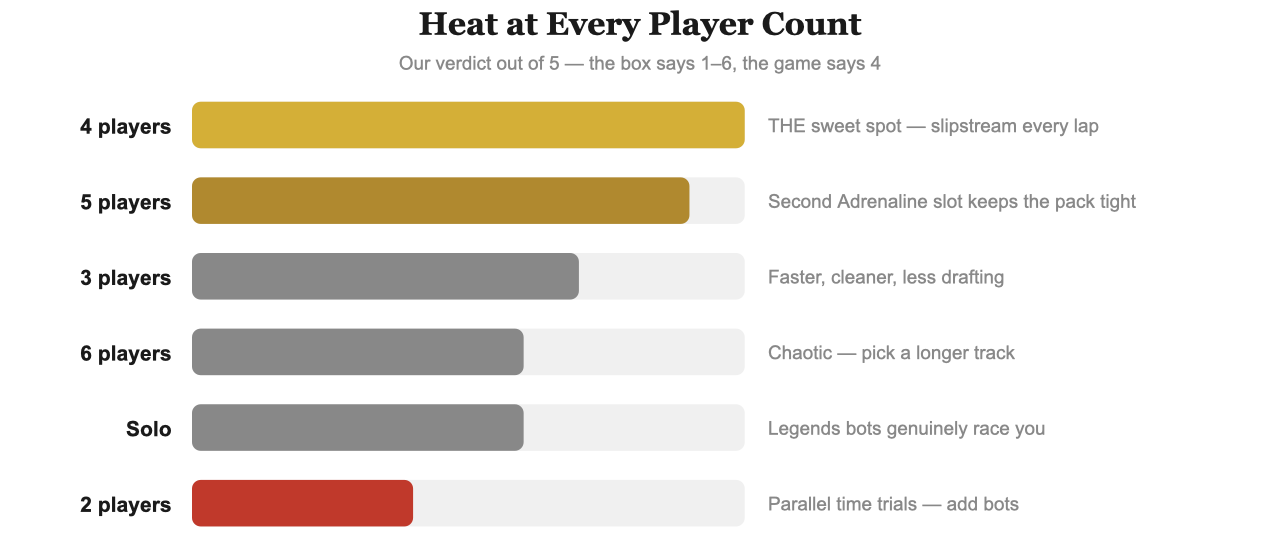
Heat is best with 4 players. It supports 1 to 6 out of the box, and the honest ranking runs 4, then 5, then 3, then 6, then solo, then 2. Every count works — this is a well-scaled game — but the difference between four players and two is the difference between a race and two people driving in the same direction. That scaling is one of the clearest wins in our Heat vs Formula D comparison, where the dice-driven alternative asks for a longer evening.
Some links below are Amazon affiliate links — as an Amazon Associate, King Panda Games earns from qualifying purchases at no extra cost to you. Full disclosure.
4 Players: The Sweet Spot
Four is where Heat’s two best systems fire on every lap. The pack stays tight enough that there’s almost always a car within slipstream range, and the board never gets so crowded that you’re stuck behind traffic you can’t pass.
Adrenaline also rotates properly at four. With a single last-place bonus in play, it moves between drivers as the race develops rather than living permanently with one unlucky person — which is exactly the catch-up pressure the design wants.
Games run about 45–55 minutes at this count, including setup. If someone asks how many people to invite for Heat, the answer is three more.
5 Players: Nearly As Good, Slightly Longer
Five gets a second Adrenaline slot — the last two cars each get the bonus — which keeps a bigger pack from stringing out. It’s a smart scaling rule and it works.
The cost is a few extra minutes and slightly more traffic in corners. It’s a genuinely close second, and if five is who you have, don’t hesitate.
3 Players: Faster, Cleaner, Less Drafting
Three plays quickly and gives everyone room to drive their own race. The tradeoff is fewer slipstream opportunities — with only two rivals, you’ll often find nobody in tow range when you want one.
Is that a downgrade? Mildly. Heat at three is a cleaner, more strategic time trial where Heat management dominates and jockeying matters less. Good game, quieter game.
6 Players: Chaotic Fun, Real Traffic
Six is the demolition-derby count. The board gets genuinely congested, corners become bottlenecks, and you will spend rounds stuck behind cars you simply cannot get around.
Some tables love that — the blocking is funny, the pack is dense, and slipstream chains form three cars deep. But racing lines get decided by traffic more than driving, and the round takes noticeably longer with six cars resolving one at a time.
Worth knowing: at six players, pick one of the longer tracks (Great Britain or Italy) rather than the shorter USA circuit. More spaces per lap gives the field somewhere to spread out, and it meaningfully cuts the traffic jams.
Solo: Better Than It Has Any Right to Be
Heat’s solo mode uses the Legends module from the advanced rulebook — bot cars driven by a simple deck that requires almost no upkeep. They follow their own racing line, they respond to corners, and they’re genuinely capable of beating you.
It’s a real solo experience rather than a beat-your-score exercise, and a solo race runs about half an hour. The only reason it ranks fifth is that Heat’s best moments are social — the groan when someone spins out is half the game.
What people expect from a racing game’s solo mode: a time trial where you race the clock.
What Heat actually gives you: opponents that draft, block, and take corners badly — a race, not a stopwatch.
2 Players: It Works, But It’s Not the Game
At two, Heat becomes parallel time trials. Slipstream requires a car to draft behind, and with a single opponent you’ll frequently be nowhere near them. Adrenaline goes to the same person every round they’re behind, which flattens the catch-up drama.
It’s playable and it’s fine, and we’d still rather play it than most two-player racing options. But nothing about Heat’s design sings at this count — our best 2-player games list has better options for couples.
The workaround: play two-player with Legends bots filling two more slots. That restores the traffic and the drafting, and it’s how we’d run a two-person Heat night.
Don’t own Heat: Pedal to the Metal yet? This guide assumes the base game.
Check Heat: Pedal to the Metal price on Amazon →
Frequently Asked Questions
What is the best player count for Heat: Pedal to the Metal?
Four. The pack stays tight enough that slipstreaming is available on every lap, the board doesn’t get congested, and the Adrenaline catch-up bonus rotates between drivers as the race develops.
How many players can play Heat?
One to six with the base game, and all counts are supported without expansions. Solo play uses the Legends bot module included in the advanced rulebook.
Is Heat good with 2 players?
It works but it’s the weakest count — with only one opponent, slipstreaming rarely comes up and the race turns into parallel time trials. Adding two Legends bots restores the traffic and drafting that make the game shine.
Is Heat good solo?
Yes. The Legends bots drive their own racing line with minimal upkeep and can genuinely beat you, making solo Heat a real race rather than a time trial. A solo game takes about 30 minutes.
Does Heat work with 6 players?
Yes, and it’s chaotic fun — but the board gets congested and you’ll spend rounds stuck in traffic. Choose a longer track like Great Britain or Italy at six players to give the field room to spread out.
How long does Heat take at different player counts?
Roughly 30 minutes solo, 40 at three players, 45–55 at four, and around an hour at six. Because gear selection is simultaneous, adding players costs far less time than in most games.
Whatever your count, the game underneath is the same one we rated 5/5 Pandas in our full Heat review — just know that “1–6 players” on the box and “best at four” are two different claims, and the second one is ours.