

Ticket to Ride earns 4/5 Pandas and 4/5 Bamboo Plants from us — and if you’ve been putting off buying it, stop waiting. This is the rare game that genuinely works for almost any group, at almost any experience level, without watering anything down. It’s not a party game that bores the serious players, and it’s not a strategy game that loses the casual ones.
The 4/5 on both counts comes with clear reasoning. The Bamboo Plants score reflects how quickly you can get into it: one read-through of the four-page rulebook and you’re playing. The Pandas score reflects how much game is actually in there once you do: route competition, hand management, destination ticket risk, and a clock that ticks down from 45 trains. It’s not a 5/5 because it has a player count sweet spot — two players on the base game is flat, and the blocking dynamics in a full five-player game can feel punishing in a way beginners don’t see coming.
Some links below are Amazon affiliate links — as an Amazon Associate, King Panda Games earns from qualifying purchases at no extra cost to you. Full disclosure.
| Detail | Info |
|---|---|
| Players | 2–5 (best at 3–4) |
| Age | 8+ |
| Play time | 30–60 min |
| Bamboo Plants | 4/5 — playing in one sitting, every time |
| Pandas | 4/5 — strategic depth without the rulebook headache |
| Official site | daysofwonder.com |
How It Works
It’s your second turn. You have four Train Car cards in hand — two yellows and two wildcards — and you’re eyeing a four-space route between Kansas City and Saint Louis. But the player to your left keeps glancing at the same stretch of map. Do you claim it now with what you have, or spend another turn drawing cards to build toward the six-space route from Denver to Oklahoma City that nobody’s looking at yet?
That decision — claim now or wait for something better — is the core of Ticket to Ride. Every turn you do exactly one thing: draw two Train Car cards, claim a route, or draw new Destination Tickets. That’s the whole turn structure. What makes it interesting is that those three simple actions are constantly in tension with each other.
Each player starts with 45 colored plastic trains and 4 cards from a deck of 110 (8 colors, 12 per color, plus 14 Locomotive wildcards). You also start with 3 Destination Tickets — cards that show two cities and a point value — and must keep at least 2. Complete that connection by the end of the game and you add the points; fail and you lose them. The tension of holding a big destination ticket worth 21 points while a key route keeps getting claimed under you is the best kind of board game stress.
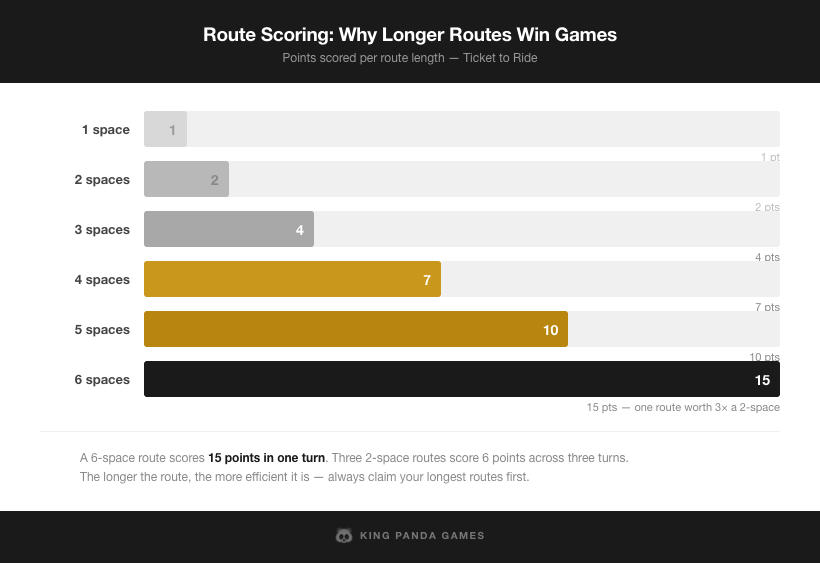
Routes score by length: 1 space earns 1 point, 2 spaces earn 2, 3 earn 4, 4 earn 7, 5 earn 10, and 6 earn 15. That steep curve is deliberate — long routes are worth going for.
 The game ends when any player gets down to 0, 1, or 2 remaining trains, at which point everyone (including that player) gets one final turn. Then you add or subtract your Destination Ticket points, and a 10-point bonus goes to whoever built the Longest Continuous Path.
What We Liked
The tension never lets up. Every time you draw cards instead of claiming a route, someone else might take the route you need. Every time you claim a route, you’re not drawing toward your next big play. Most board games have lull turns — filler turns where you’re just going through motions. Ticket to Ride almost never has those.
The Locomotive wildcards are perfectly balanced. There are only 14 in the 110-card deck. Drawing one from the face-up display costs you your second card draw for that turn — a real cost that makes Locomotives feel genuinely valuable rather than “just grab the wild whenever you see one.” The first time a player learns this rule mid-game, you can almost see their strategy recalculate in real time.
Route competition in a three or four-player game hits a particular sweet spot. You’re not scrapping over every city, but you’re also not just building in isolation. The moments when two players visibly want the same route — when both are drawing cards and watching each other — create a kind of silent standoff that’s rare in games this accessible.
What most people expect: A relaxed, low-stakes family game where everyone builds their trains and nobody gets too competitive.
What actually happens: By round 4, someone’s blocked a critical route and the table has developed opinions about it. The friendliness of the theme wraps around surprisingly sharp competition.
The scoring tracks during play. Every time you claim a route, you advance your marker on the board’s scoring track immediately. No mental math, no hidden scores, no final-tally surprise. You always know roughly where you stand — you just don’t know anyone’s Destination Ticket totals. That hidden layer is exactly the right amount of mystery.
What We Disliked
Two players on the base map is underwhelming. The North America map is built for 3–5. With two players, double routes are restricted (each city pair is effectively a single route), competition is lower, and the map never fills up enough to create real pressure. It still works, but it’s not what the game was designed for. If you’re buying this primarily as a two-player game, look at Ticket to Ride Europe instead — the tunnels and ferries create natural tension even at two.
The Destination Tickets can create runaway luck at the wrong moments. Draw three tickets early and all three happen to form a connected network across the East Coast — you’re in a great position and you didn’t earn it. Draw three tickets that pull you in opposite directions across a crowded board at a bad stage in the game and you’re grinding. The variance is manageable but real, and occasionally a player will just have a bad ticket run that the game can’t fully compensate for.
The 2-3 player double route rule catches beginners every time. In games with fewer than four players, only one of any double route can be used at all — the second route between those cities is simply closed off. This is clearly stated in the rules but almost universally missed on first plays, leading to arguments mid-game. We put it here not to knock the game, but to save you from that table moment.
Who It’s For
Ticket to Ride is the closest thing to a universal recommendation we make at KPG. Specifically:
Families with kids 8 and up. The rulebook takes four pages. The mechanics — draw cards, play cards to claim routes — click within two turns. There’s no reading required during play (the Destination Tickets have city names, but you can point those out). Children learn spatial thinking and basic hand management without it feeling like a lesson.
Groups with mixed experience levels. This is Ticket to Ride’s real superpower. A first-time player can genuinely compete with experienced ones because the game rewards planning your own network more than it rewards knowing optimal counter-plays. You can play solidly without ever thinking about what your opponents are building.
Couples and pairs — with a caveat. Play the Europe version, not the base game, at two players. The additional mechanics (tunnels, ferries, stations) create the friction that makes a two-player game feel contested rather than parallel.
Anyone new to hobby board games. If someone in your life plays only Monopoly or Uno and you want to introduce them to something with more strategic weight, Ticket to Ride is the bridge. It feels familiar (collect sets, place pieces, score points) but teaches the kind of planning that makes heavier games click later.
Awards
Ticket to Ride won the Spiel des Jahres — the German Game of the Year — in 2004, which is the most prestigious award in board gaming. It has since sold over 10 million copies and spawned a franchise of over 30 maps and editions. The Spiel des Jahres is a useful signal: it’s judged on accessibility, elegance, and play experience, not complexity. The award explains a lot about why this game lands so consistently across different groups.
How It Compares
Ticket to Ride vs. Carcassonne — both are gateway games, both won the Spiel des Jahres, both are legitimate first answers to “what should I buy?” The difference is texture. Carcassonne is quieter — tile placement, meeple deployment, slow-burn competition for features. Ticket to Ride is more active and more visible: you can see the routes being claimed, you know when you’ve been blocked, the board tells a story by the end. For groups who want something to talk about mid-game, Ticket to Ride. For groups who want something meditative with a competitive undercurrent, Carcassonne.
Ticket to Ride vs. Pandemic — Pandemic is cooperative; Ticket to Ride is competitive. This is the core difference, and it matters for group fit. Families with conflict-averse members, or couples who find competitive games stressful, should lean toward Pandemic. Groups who enjoy light competition and don’t mind occasional blocking should go with Ticket to Ride.
Ticket to Ride vs. the Europe edition — same core game, different map, extra mechanics. Europe adds tunnels (draw extra cards to pay a random toll), ferries (require Locomotive wildcards), and stations (use an opponent’s route once at the cost of points). These additions make Europe slightly harder to learn but better at two players and better at higher player counts where blocking is more aggressive. We’d recommend the base game for pure beginners, Europe for anyone who’s played before or primarily plays at two.
If Ticket to Ride feels like too much setup for your group, try Sequence first. Sequence teaches in one round, plays in 20 minutes, and works for groups of 2–12 with zero gateway-game friction. Once a group is comfortable with game night, Ticket to Ride is a natural next step. Read our Sequence review.
Tips & Tricks
1. Claim long routes early, short ones late.
The 6-space route scores 15 points — more than three 2-space routes combined. Long routes also require more cards to accumulate, which means your window to claim them before someone else does is longer. Short 1- and 2-space routes can be scooped up with whatever’s left in your hand late in the game. Prioritize the long ones while the board is still open.
2. Don’t draw Destination Tickets unless you’re ahead on your current ones.
The rule: only draw new Destination Tickets when you’re already on track to complete the ones you’re holding.
Drawing more tickets mid-game when you’re already struggling to complete your current ones is how players fall behind. More tickets mean more obligations, and obligations you can’t complete cost you points. The temptation to draw when the deck is available is real — resist it unless you’re in a strong position.
3. Watch what your opponents are collecting.
You can’t see their hands, but you can watch the face-up card display. If the same player keeps drawing blue cards and there’s a blue route you both need, they’re probably going for it. The face-up display is the only public information you have about what everyone’s building — use it.
You need the blue route from Montreal to New York (3 spaces). You have two blue cards. The player to your right has drawn two blue cards from the display in the last three turns. You can wait one more turn to draw a third blue — or you can claim the route now with two blues and a Locomotive wildcard. Wait, and the route might be gone. Claim it now, and you’ve spent your wildcard. This is the single most common fork in the game, and the right answer depends entirely on how many trains that player has left and whether they have an alternate path.
4. Locomotives from the face-up display cost both draws.
This trips up nearly every new player. If you take a Locomotive from the five face-up cards, that’s your entire turn of drawing — you don’t get a second card. Locomotives drawn blind from the top of the deck don’t have this restriction. It’s not intuitive, but it’s what keeps wildcards from dominating the game.
5. The end-game clock is faster than it looks.
When someone gets to 8–10 trains remaining, start watching. The game ends when any player hits 0, 1, or 2 trains at the end of their turn — and everyone including that player gets one final turn. If you’re sitting on a long route you haven’t built and another player is burning through their trains, you may run out of time. Don’t assume you have more turns than you do.
Check Ticket to Ride price on Amazon →
Frequently Asked Questions
Is Ticket to Ride worth buying?
Yes, for most groups — it’s one of the best-designed gateway games ever made. The rules take minutes to learn, the game plays in 45-60 minutes, and it works across experience levels. If you’re buying your first serious board game or looking for something the whole family can play, Ticket to Ride is the safest recommendation we make.
What’s the best player count for Ticket to Ride?
Three or four players is the sweet spot on the base North America map. At three, there’s enough competition without the board feeling cramped. At four, routes start getting contested in a satisfying way. Five players creates aggressive blocking that surprises people expecting a friendly game. Two players is technically fine but flat — the Europe edition is much better at two. Full breakdown of what actually works at two players here.
Is Ticket to Ride good for kids?
Ages 8 and up is accurate. By that age, most kids can understand the card-matching mechanic and plan a route between two cities. Younger children (5–7) can play a simplified version where an adult handles the Destination Tickets. The game has no reading required during play beyond city names, which helps.
How long does a game actually take?
The box says 30–60 minutes. In practice, a first play with four players takes about 75–90 minutes. Once everyone knows the rules, 45–60 minutes is realistic. Two-player games run faster, closer to 30–40 minutes. The game gets quicker as players get more comfortable skipping deliberation.
What’s the difference between Ticket to Ride and Ticket to Ride Europe?
The core game is identical, but Europe adds three mechanics: tunnels (pay an extra random toll when building through mountains), ferries (require Locomotive wildcards), and stations (allow one route-sharing rescue at a points cost). Europe is slightly harder to learn but plays better at two players and handles five players more gracefully. The base game is better for total beginners; Europe is better once someone’s played the original.
Can you draw a Locomotive and another card on the same turn?
Only if the Locomotive comes from the top of the deck (a blind draw). If you take a Locomotive from the five face-up cards, that counts as both of your card draws for the turn — you don’t get a second card. This rule catches almost every new player, so it’s worth flagging before the first game starts.
What happens if you can’t complete a Destination Ticket?
You subtract the ticket’s point value from your score at the end of the game. A ticket worth 21 points (like Los Angeles to Miami) that you fail to complete costs you 21 points — a massive swing. This is the most painful part of the game, and it’s why experienced players are cautious about drawing new tickets when their existing routes are already in trouble.
Does the Longest Path bonus matter?
More than beginners realize. The bonus is worth 10 points — equivalent to claiming a five-space route. In close games it regularly determines the winner. It’s worth keeping in mind when you’re building a route plan: two paths that connect at both ends and form a long continuous chain score the bonus; two disconnected networks of the same total length don’t.
Want to Go Deeper?
- Ticket to Ride Strategy Guide — The plays that separate experienced players from beginners: when to claim, when to hoard cards, and how to read the board. Read it here
- Ticket to Ride Europe vs. Original — Same game, different feel. Which one should be your first buy? Read it here
- Best Ticket to Ride Expansions, Ranked — From Nordic Countries to Rails & Sails, we ranked every major expansion so you know exactly what to grab next. Read it here
- Ticket to Ride with 2 Players — Does the base game hold up at two, or do you need Europe? Honest answer inside. Read it here
- Ticket to Ride for Kids and Families — What age is it actually for, and how do you make the first game work with younger players? Read it here
- Ticket to Ride Player Count — How many people can play, what changes at every count, and the rule most groups miss at two and three. Read it here
- Ticket to Ride Europe Review — The version we hand to first-time buyers, and why it beats the original outright. Read it here
- Which Ticket to Ride Should You Buy? — Every standalone version ranked, from Europe down to First Journey. Read it here
Verdict
Buy it if you want a game that works with almost any group and teaches itself in one play. It earns a spot on any shelf — beginner or experienced. Buy Europe instead if you’re playing primarily at two players or want more tactical depth out of the box. Skip it if your group has already played it extensively and is ready for something with more complexity — at that point, look at Catan or Spirit Island. Try before you buy if you’re unsure whether your group likes competitive games — the blocking dynamic surprises people who were expecting something purely cooperative.
Ticket to Ride official site: daysofwonder.com/ticket-to-ride