

Bottom Line
Azul is best for couples, families with kids 8 and up, and friends who want a short, good-looking strategy game. Skip it if your group wants lots of talking, trading or bluffing, because Azul is a quiet game of careful choices. Its biggest strength is that every turn is a simple choice with a real consequence. Its biggest weakness is that interaction is limited to taking the tiles other players want.
Azul gets 4/5 Bamboo Plants and 4/5 Pandas from us. We own the original Azul and have played it a few times. It’s one of the best-looking games on any shelf.
The Bamboo is a 4 because a turn takes seconds to explain: take every tile of one color, put them on one line. The scoring and the floor-line penalties take a game to understand. The Pandas are a 4 because the drafting is tense and the tiles are a pleasure to handle, though the game itself is quiet and calm.
Some links below are Amazon affiliate links — as an Amazon Associate, King Panda Games earns from qualifying purchases at no extra cost to you. Full disclosure.
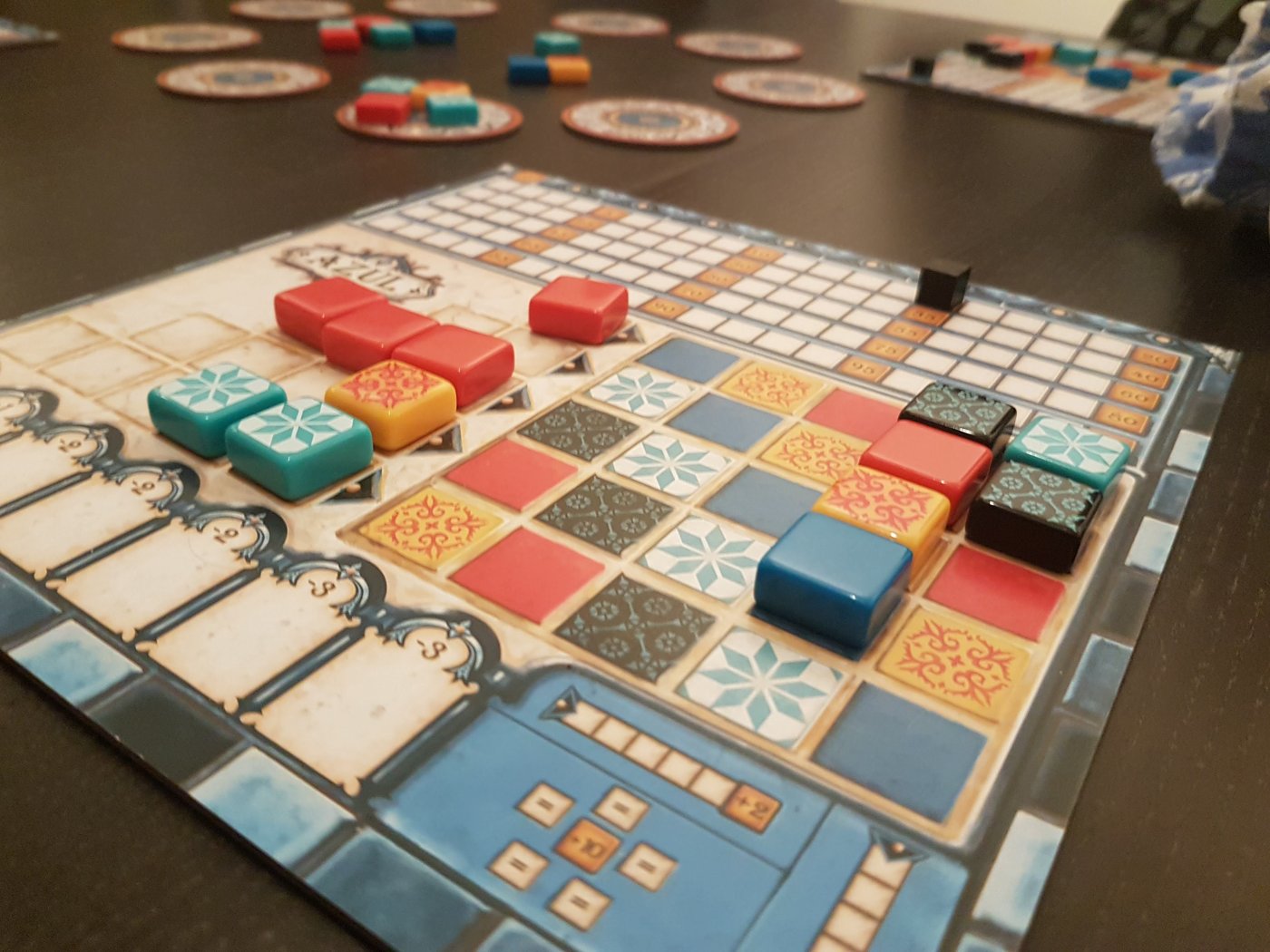
Azul is a tile-drafting game. You take colored tiles from shared displays and arrange them on your own board to build a decorative wall, scoring points for tiles that connect.
| Detail | Info |
|---|---|
| Players | 2–4 |
| Best Player Count | 2 — BGG voters’ top pick, and you can plan around your one opponent |
| Age | 8+ |
| Play time | 30–45 min |
| Complexity | Light to medium |
| Solo Mode | No |
| Designer | Michael Kiesling |
| Publisher | Next Move Games (Plan B Games) |
| Popular Upgrades | Crystal Mosaic expansion (board overlays) |
| Bamboo Plants | 4/5 — simple turns, scoring takes one game |
| Pandas | 4/5 — tense drafting, beautiful tiles |
| Official site | Next Move Games |
How Azul Works
The box holds 100 chunky resin tiles, 20 in each of five colors, plus a board for each player and a set of round “factory displays.” Each round, every factory gets four random tiles from a bag.
On your turn, you take every tile of one color from one factory, and the rest of that factory slides into the center of the table. Or you take every tile of one color from the center. Then you put those tiles on one of the five pattern lines on your board. Line 1 holds one tile, and line 5 holds five.
One factory has three red tiles and a black one. You need exactly three red for your third line. Take them, and the black tile slides into the center, where your opponent has been collecting black. Or take the black tile to deny them, and put it on your floor for a 1-point penalty. Most Azul turns come down to this kind of trade-off.
When all the tiles are gone, each completed line moves one tile onto your wall, where it scores for every tile it connects to. Tiles you couldn’t place fall onto your floor line and cost points. The game ends after someone completes a horizontal row on their wall, and then everyone scores bonuses for complete rows, columns and colors.
If you’d like to see it played first, Shut Up & Sit Down’s Azul review shows the drafting well.
What We Liked
Every turn is a real decision with almost no rules to learn. There’s only one action, taking tiles, but each choice changes what’s left for everyone else.
The components are wonderful. The resin tiles have a satisfying weight and click, and a finished wall looks like real tile work. It’s a game people want to touch.
It’s short. The rules list 30 to 45 minutes, and the game ends on its own once someone completes a row.
It works for mixed ages. The box says 8+, and there’s no reading or math beyond counting connected tiles.
What We Disliked
There’s little direct interaction. You affect other players only by what you take and leave. Groups who love negotiation or table talk may find it too quiet.
It can stall on a slow thinker. Every pick changes what’s left for everyone, so a player who wants to calculate every option can slow the game down.
At four players, you have less control. With nine factories and three opponents, the tiles you were planning on are often gone before your turn.
Who It’s For
Azul is for couples, families with kids 8 and up, and friend groups who enjoy a quiet puzzle with a little competition. It’s a strong pick for people who like abstract games such as dominoes or Qwirkle and want something with more strategy.
It also makes a beautiful gift. The box and tiles look good enough to leave out on a table, and the rules are short enough that the recipient can learn them on Christmas Day.
Who should skip this game:
– Groups that want laughing, trading or bluffing. Try Bohnanza or Coup instead.
– Players who dislike games where you can block other players.
– Big groups. Azul tops out at four players.
Who Should Buy This?
Buy Azul if you want a game for two to four people that looks beautiful, teaches in a few minutes and plays in under an hour. Next Move Games lists it at $39.99, and it often sells for less.
It’s a core collection game for couples and small families. If you play mostly at two, it’s one of the best choices you can make, and it sits well alongside 7 Wonders Duel on a two-player shelf. Start with the original Azul before any of the newer versions.
Best Player Count
Azul is best at 2. The box says 2 to 4, and BGG voters pick 2 as the best count. Our ranking is 2, then 3, then 4.
With two players there are five factories, so you can track what your opponent needs and plan the tiles that will come back to you. Three players adds more competition for tiles with seven factories. Four players uses all nine factories, and with three opponents picking before your next turn, planning ahead gets much harder. We haven’t played every count, so this ranking comes from how the setup changes at each count and from BGG’s community poll.
Replayability
Azul replays well because the bag draws a different mix of tiles every round, and your opponents’ choices change what’s left for you. The board stays the same, but the gray side of the player board offers an official variant where you choose where each tile goes on your wall.
For more variety, the Crystal Mosaic expansion adds new double-sided player boards and overlays that hold tiles in place. The other Azul games (Summer Pavilion, Stained Glass of Sintra, Queen’s Garden and Azul Duel) are standalone games with their own twists, so you don’t need the original to play them.
Awards
Azul won the 2018 Spiel des Jahres, Germany’s top board game award. According to Azul’s BGG page, it also won the 2017 Golden Geek for Best Family Board Game and the 2018 Origins Award for Best Family Game.
Similar Games
If you like Sagrada, try Azul. Both are colorful puzzles about building a pattern on your own board. In Azul you draft tiles from shared displays, while in Sagrada you draft dice from a shared roll, so luck plays a bigger part.
If you like 7 Wonders Duel, Azul is the lighter two-player pick. Both are excellent at two, but 7 Wonders Duel has more paths to victory and a longer arc. Azul plays faster and is easier to teach.
If you like Carcassonne, Azul is the tile game with more control. Carcassonne is about drawing a random tile and finding the best spot. In Azul you choose which tiles to take, and the challenge is fitting them on your board.
Tips & Tricks
Aim for columns and colors. At the end of the game, a complete column scores 7, a complete set of one color scores 10, and a complete row scores only 2. Our Azul strategy guide explains how to build for them.
What new players often do: take the biggest pile of tiles because it looks like the most progress.
What actually works: take piles that fit an open pattern line exactly. Extra tiles land on your floor line, and three of them cost at least 4 points.
Fill the middle of your wall early. A tile scores for every tile it connects to in its row and column, and middle spaces can connect in more directions than corners.
Keep a couple of pattern lines open late in the round. Near the end, you may be forced to take whatever’s left, and an open line gives those tiles somewhere to go.
Worth knowing: the first-player marker takes the next free space on your floor line, so it costs at least 1 point. In exchange, you pick first next round when every factory is full.
Frequently Asked Questions
Is Azul worth buying?
Yes, for couples, families with kids 8 and up, and small groups who like a short strategy game. We rate it 4/5 Bamboo and 4/5 Pandas, and it won the 2018 Spiel des Jahres.
Is Azul good for 2 players?
Yes. It’s arguably at its best with two, which is also BGG voters’ top pick. With five factories, you can track what your opponent needs and plan your picks.
How long does Azul take to play?
About 30 to 45 minutes, according to the publisher.
Is Azul hard to learn?
No. A turn is one action: take every tile of one color and place them on one line. The scoring and floor-line penalties take one game to understand.
What age is Azul for?
The box says 8 and up. There’s no reading, and the only math is counting connected tiles, so it works well for families.
Which Azul should I buy first?
The original Azul. It’s the simplest version, it won the 2018 Spiel des Jahres, and the later games build on it. Azul Mini is the same game in a smaller box for travel.
Is Azul like Sagrada?
Both are colorful pattern-building games. Azul uses tiles drafted from shared displays, while Sagrada uses dice drafted from a shared roll, so Sagrada has more luck.
Want to go deeper?
- Azul strategy — why columns beat rows, with the scoring math. Read it here
- Azul rules — setup for 2 to 4 players, scoring and the floor line. Read it here
Verdict
Buy it if you want a beautiful, short strategy game for two to four people, especially couples. Skip it if your group wants trading, bluffing or big-group chaos. Start with the original before trying the other Azul games.
Azul official site: Next Move Games