

This article contains affiliate links — if you buy through them, we may earn a small commission at no extra cost to you. Full disclosure.
Ticket to Ride Europe Review: The One Most People Should Buy
Ticket to Ride Europe earns 5/5 Pandas and 4/5 Bamboo Plants from us, and it’s the version we hand to people who ask which Ticket to Ride to buy. Not the original. This one.
Some links below are Amazon affiliate links — as an Amazon Associate, King Panda Games earns from qualifying purchases at no extra cost to you. Full disclosure.
That’s a slightly heretical thing to say about a game whose North America edition is the more famous box, so here’s the short reasoning: Europe takes the same brilliant 20-minute-to-learn engine and adds three small systems that fix the exact two things that go wrong with the original — flat two-player games and blocking that leaves a beginner with nowhere to go. It costs about five extra minutes of teaching. It’s worth every one of them. It lands at #11 on our best board games of 2026 list.
| Detail | Info |
|---|---|
| Players | 2–5 (best at 4, excellent at 2) |
| Age | 8+ |
| Play time | 30–60 min |
| Designer | Alan R. Moon |
| Publisher | Days of Wonder (2005) |
| Bamboo Plants | 4/5 — five more minutes of rules than the original |
| Pandas | 5/5 — the version that works at every player count |
| Official site | daysofwonder.com |
Ticket to Ride Europe is a complete standalone game. It is not an expansion, and you never need the North America base game to play it.
The Bottom Line
Buy Europe if you’re buying one Ticket to Ride. It seats the same 2–5 players, teaches almost as fast, and produces better games at every count — dramatically better at two.
Skip it if you want the absolute simplest possible introduction to the hobby for someone who’s never played a modern board game, or if the North American map has personal pull for you. Those are real reasons. They’re just not the common ones.
How It Works
The turn structure is identical to the original, and if you’ve played that, you already know 90% of this game. On your turn you do exactly one thing: draw two train car cards, claim a route, or draw new destination tickets. Each player has 45 trains, and the game ends when someone drops to two or fewer.
What’s different is what sits on top.
Round six. You need the tunnel from Zürich to Venezia — three orange spaces through the Alps. You have exactly three orange cards. You lay them down, and the table goes quiet while you flip the top three cards of the draw pile: orange, blue, orange. Two matches. You owe two more orange cards or you take everything back and lose your turn. You have none. The cards come back and you’ve spent a turn on nothing, and everyone saw it happen.
That’s tunnels, and there are a lot of them. Claiming a tunnel means playing your cards, flipping three from the draw pile, and paying one extra matching card for every flip that matches your color. You can bail out and take your cards back, but the turn is gone. It converts routine claims into decisions with real variance, and it’s the single best thing Europe adds.
Ferries are routes that require Locomotive wildcards — you can’t claim them with ordinary colors at all. Since there are only 14 Locomotives in the 110-card deck, the ferries create standing competition over the scarcest resource on the table. When someone takes the face-up Locomotive you were saving for the Stockholm ferry, you feel it.
Train Stations are the mercy rule. Each player starts with three. Place one in a city and you may use one route out of that city that somebody else has already claimed — placing them costs one card for your first, two for your second, three for your third. Any Station you finish the game without using is worth 4 points.
Setup is also different in a way that matters: you’re dealt one long-route ticket and three regular ones, and must keep at least two. Starting with a guaranteed big cross-continental goal gives every game a spine.
What We Liked
Stations solve the game’s worst feeling. In the original, a new player who gets their key route claimed has no recourse — they discover mid-game that their tickets are dead and spend twenty minutes playing out a loss they can already see. Europe hands that player a Station and a 4-point cost. It’s a small rule that quietly removes the single most common reason people bounce off Ticket to Ride.
Tunnels give the game a pulse. The original’s tension is entirely about timing — claim now or draw more. Europe adds a second axis of genuine uncertainty, and the moment the table leans in to watch three cards flip is the most reliably fun thing in the box.
It’s the rare game that’s actively good at two. Most 2–5 player games tolerate two. Europe is legitimately great there, because all three added systems create friction that doesn’t depend on a crowded board. We’ve covered this at length in our two-player breakdown, and it’s the main reason Europe beats the original outright.
The map is better drawn. Central Europe is a genuine bottleneck; the edges — Iberia, Scandinavia, the far east of the map — are spacious. That gradient means the board has a hot zone at every player count instead of just filling in evenly.
What We Didn’t
Tunnel variance can genuinely decide a close game. Losing a turn to two bad flips at the wrong moment is a real swing, and if you’re the kind of player who resents luck in a strategy game, this will occasionally annoy you. It annoys us maybe once every four games, which we think is the right amount.
Stations are slightly under-costed. Four points is a modest penalty for escaping a block, and experienced players sometimes plan to spend one from the start rather than treating it as insurance. It’s a small balance wobble, not a flaw.
The rulebook buries the ferry rule. Every group we’ve taught has had at least one player try to claim a ferry with plain colored cards. Point it out during setup and save yourself the argument.
Best Player Count
Four, same as the original — but the gap between counts is much narrower here, and that’s the point.
Europe at two players is a real game rather than a compromise, which is not true of North America. Three is excellent. Five gets loud and blocky, and Stations keep it from getting mean. If you want the full breakdown of what changes at each count across the whole line, we mapped it out in our Ticket to Ride player count guide.
Who Should Buy This
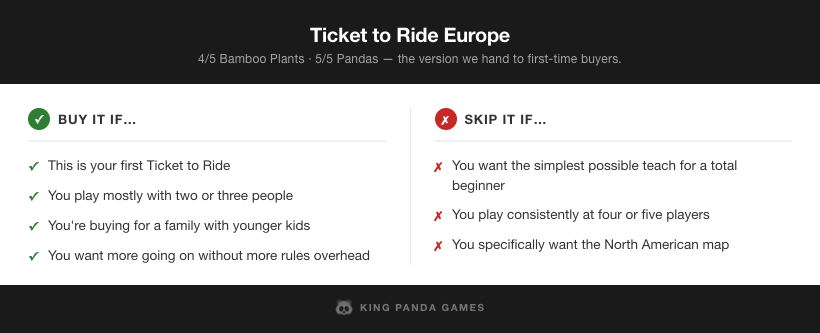
Buy Europe if: this is your first Ticket to Ride, you play mostly with two or three people, you’re buying for a family with kids who’ll get frustrated by being blocked, or you want the version with the most going on without more rules overhead.
Buy the original instead if: you want the simplest possible teach for someone brand new to board games, you play consistently at four or five, or you want the map that everyone recognizes.
At typical retail, Europe and the original cost the same. There is no price argument between them — it’s purely which game you want, which is why we come down on Europe so hard. We break the two down side by side in Europe vs. Original.
Replayability
High, and higher than the original for one specific structural reason: the long-route ticket you’re dealt at setup changes the shape of your whole game. Two sessions that both start with Cádiz–Stockholm and Kyiv–Petrograd feel like different games, because those spines run through different halves of the map.
The destination ticket deck holds enough variety that we’ve never had the “we’ve seen this game before” feeling that eventually arrives with smaller maps. Expect dozens of plays before it goes stale.
Worth knowing: Europe is compatible with the Europa 1912 expansion, which adds warehouses, depots and a much larger ticket deck — the natural next purchase once you’ve played the base map into the ground. We ranked it against the rest of the line in our expansions guide.
Accessories & Upgrades
The plastic trains are fine and nobody needs to replace them. The one upgrade worth considering is a set of card sleeves — the destination tickets get handled constantly and the corners soften after a year of regular play. Skip the 3D-printed station upgrades on Etsy; the base components already read clearly at a glance, which is more than you can say for a lot of games in this price range.
Check Ticket to Ride sleeves price on Amazon →
The Verdict
Buy it. Ticket to Ride Europe is the best version of one of the best gateway games ever designed, and it’s the copy that should be on your shelf if you’re only having one. 5/5 Pandas, 4/5 Bamboo Plants, and the one we reach for when someone new is at the table.
If you’re still working out which of the ten-plus boxes with “Ticket to Ride” on the front you actually want, we ranked every version here. And once you own it, our strategy guide covers the route-scoring math that wins games.
Frequently Asked Questions
How many players can play Ticket to Ride Europe?
Two to five players, ages 8 and up, in 30 to 60 minutes. That is the same range as the original North America map, but Europe holds up far better at the low end of it.
Is Ticket to Ride Europe good for 2 players?
Yes — it is the best two-player Ticket to Ride you can buy that also seats five. Tunnels make every claim uncertain, ferries force competition over a limited pool of 14 Locomotive cards, and Stations mean a blocked player always has an escape hatch. The original map at two players has none of that friction.
Do you need the original Ticket to Ride to play Europe?
No. Ticket to Ride Europe is a complete standalone game with its own board, trains, cards and tickets. It is not an expansion, and you never need the North America base game to play it.
What is the difference between Ticket to Ride and Ticket to Ride Europe?
Europe adds three systems the original does not have: tunnels that may cost extra cards, ferry routes that require Locomotive wildcards, and three Train Stations per player that let you borrow one route another player has claimed. The core turn structure is identical.
Which should you buy first, Ticket to Ride or Europe?
Europe, for almost everyone. It plays better at two and three players, its Station rule prevents the dead-end blocking that frustrates new players, and the extra rules add about five minutes to teaching time. Buy the original only if you specifically want the simplest possible version or the North American geography.
What are Train Stations in Ticket to Ride Europe?
Each player starts with three Stations. Placing one in a city lets you use a single route out of that city that another player has already claimed, and costs you one train card matching the number of stations you have already placed. Every Station you do not use is worth four points at the end of the game.
How do tunnels work in Ticket to Ride Europe?
When you claim a tunnel route, you play your cards and then flip the top three cards of the draw pile. For every flipped card matching the color you played, you must add one more card of that color or forfeit the attempt and take your cards back. It turns a routine claim into a genuine gamble.
Is Ticket to Ride Europe harder than the original?
Slightly, and only at the teaching stage. The three added systems take about five extra minutes to explain, after which the game plays at the same speed and complexity as the original. Nobody who can learn the base game will struggle with Europe.