

Bottom Line
Sequence is best for families and friend groups playing in teams of 4 or 6 — it’s one of the fastest games to teach in the hobby (under 5 minutes) and team play creates genuine tension that most light games can’t match. Skip it if you play primarily at 2 players, where luck dominates and the team dimension that defines the game disappears. The biggest strength is immediate accessibility for any age; the biggest weakness is that outcomes at lower player counts can feel decided by the cards you drew rather than the decisions you made.
Sequence earns a 5/5 Bamboo Plants and 4/5 Pandas from us. The 5/5 Bamboo is hard to argue with — this game teaches faster than almost anything in the hobby and the rules click completely within one round of play. The 4/5 Pandas reflects the game at its best (4–6 players in teams) rather than at 2 players, where the experience is significantly thinner.
Some links below are Amazon affiliate links — as an Amazon Associate, King Panda Games earns from qualifying purchases at no extra cost to you. Full disclosure.
| Detail | Info |
|---|---|
| Players | 2–12 |
| Best Player Count | 4 (2 teams of 2) — team dynamic adds tension the solo format lacks |
| Age | 7+ |
| Play time | 20–30 min |
| Complexity | Light |
| Solo Mode | No |
| Designer | Doug Reuter |
| Publisher | Jax Ltd / Goliath Games |
| Popular Upgrades | No |
| Bamboo Plants | 5/5 — teaches in one explanation |
| Pandas | 4/5 — genuinely fun, especially in teams |
| Official site | https://www.goliathgames.us/product/sequence/ |
How It Works
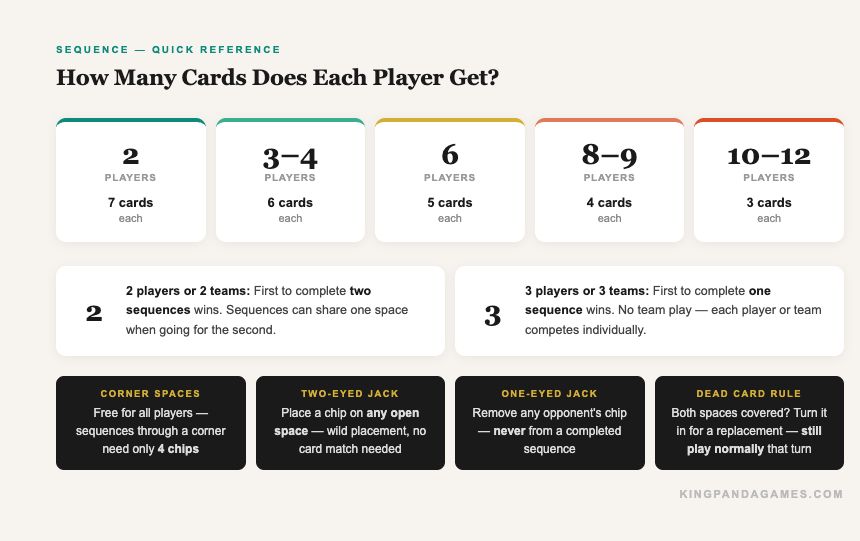
The board is a 10×10 grid displaying every card in a standard deck twice over — every two through ace, in both suits, laid out across 100 spaces. Jacks don’t appear on the board at all. You’re dealt a hand of cards (seven at 2 players, six at 3 or 4, fewer as the table grows), and on your turn you do three things in order: play a card from your hand face-up to your discard pile, place a chip of your color on one of the two matching board spaces, then draw a replacement card. First team to build a connected row of five same-colored chips — horizontal, vertical, or diagonal — completes a sequence. Two sequences wins a two-player game; one sequence wins a three-player game.
It’s round four. Your teammate placed a chip on the nine of spades two turns ago. You’re holding a nine of diamonds — the other nine-space on the board sits two spots away from connecting their chip into a three-chip run. You can’t say a word. You play the card, drop your chip, draw your replacement. Across the table, your opponent is watching both of you, trying to map the pattern before it closes. That silent three-way chess — coordinate without speaking, infer without asking, block without revealing — is what Sequence is actually about.
The four corner spaces are free for all players — every team can use them as if their chip is already placed there. A sequence running through a corner only requires four chips instead of five. Multiple teams can build through the same corner simultaneously, which makes them contested but not exclusively ownable.
Jacks work differently from every other card. The two-deck set contains eight jacks — four two-eyed jacks (wild: place a chip anywhere on any open space) and four one-eyed jacks (tactical: remove any opponent’s chip from any non-completed sequence space). Once a sequence locks in, it’s permanent — no one-eyed jack can break it.
The dead card rule catches first-time players off guard. If both board spaces for a card in your hand are already covered, you’re holding a dead card. On your turn, announce it, turn it in, draw a replacement — then still play a normal turn with your remaining cards. One dead card exchange per turn, and you must announce it to the table.
Pros
- The communication ban creates natural theater. When your teammate places a chip in an unexpected spot, you spend the next 30 seconds reverse-engineering their intent — and your opponent is doing the same. We’ve had rounds where figuring out a partner’s logic was more entertaining than any move either of us made.
- One-eyed jacks are the most satisfying card in the game. Playing one to dismantle a four-chip run your opponent was counting on — in team play especially, when the groan travels around the table — is exactly the kind of moment that makes people want to play again immediately.
- The corner space rule rewards players who learn the board. Knowing you only need four chips to complete a sequence through a corner is a real edge over players who don’t know it. Corners become subtly contested in a way that only surfaces when you’re paying attention.
- Plays fast at any player count. A four-player game typically finishes in 20–25 minutes. Turns are quick — play, place, draw — and there’s no calculation time. You can comfortably fit three rounds in an evening.
- Works with virtually any group. Age 7+ is accurate. We’ve seen this played with eight-year-olds and seventy-year-olds at the same table under the same rules, and both generations stayed engaged for the full game. That’s rarer than it sounds.
Cons
- At 2 players, luck dominates. Playing 1v1 without team dynamics exposes the card draw element. A run of mismatched cards at the wrong moment can feel unwinnable rather than a consequence of decisions — you’re contesting spaces your opponent holds cards for, and the hand you’re dealt determines more than the choices you make.
- The fixed board becomes familiar fast. Unlike games with randomized setups, Sequence uses the same board configuration every game. Experienced players gravitate to the same high-value zones — the center cluster, the corner adjacencies, the spaces that threaten multiple sequence directions at once — and novelty compresses. For casual groups who play monthly, this is fine. For a weekly game night crew, you’ll notice the ceiling.
- High player counts get chaotic. At 9–12 players, individual hands drop to just 3–4 cards and the board fills quickly with multiple team colors. The game becomes more reactive than strategic — you’re responding to what just happened rather than executing a plan. It works, but it’s a shallower experience than 4–6 players.
Who It’s For
Sequence is the game to pull out when your table includes people who haven’t touched a board game in years. The rules take under five minutes to explain, the first round serves as a live tutorial, and there’s no scoring complexity to track. Anyone who can read playing card values can compete meaningfully within their first game.
Team play is where Sequence earns its reputation. The communication ban — no hints, no pointing, no knowing glances — creates a shared puzzle between partners that stays fresh across multiple sessions. For couples, it functions almost like a personality test: you’ll learn whether your partner thinks spatially, aggressively, or defensively from how they place chips. For larger family gatherings, it gives everyone a shared stake without requiring game literacy.
Who should skip this game
Mid-to-heavy strategy gamers will find Sequence thin after a handful of plays. The core loop is light area control with a meaningful luck component, and there’s no decision layer that deepens over time beyond jack card timing and placement priority. If your regular nights include Catan, Wingspan, or anything with engine building, Sequence will likely sit on the shelf. Also skip it if two players is your primary setup — the game’s defining feature is absent at that count and the experience suffers for it.
Who Should Buy This?
At $20–25, Sequence is priced right for what it delivers. It’s not trying to be a gateway into heavier strategy gaming — it’s a reliable tool for mixed-age groups who need something everyone can play immediately.
Buy it if you host regular gatherings with people at different experience levels, or if you need a game for family holidays where ages range from 8 to 80. It’s especially strong for couples who play in groups — team play at double-date game nights, where the communication ban becomes its own running joke, is where this game is genuinely memorable.
Don’t buy it as your only game if strategic depth matters. But alongside a heavier title in your collection, it earns its shelf space.
Check Sequence price on Amazon →
Best Player Count
Four players in two teams of two is where Sequence plays its best game. The team dynamic transforms what would otherwise be a light card-placement game into something genuinely tense — you’re coordinating placements with a partner who can’t explain their intent, while opponents are doing the same thing and trying to read both of you. The silent inference layer is what Sequence is actually about, and it only emerges fully with teams.
Six players in three teams of two is the runner-up. More players means more jacks in circulation, more contested spaces, faster board development — and the same team dynamic stays intact. Turns stay quick enough that nobody waits long, and the chaos of multiple teams building simultaneously adds a layer of pressure that solo-mode play never achieves.
The box says 2–12, and the game technically works at every number. But the experience degrades at the edges: 2 players is luck-heavy without team dynamics; 3 players puts everyone in solo mode; 8–12 players reduces hands to 3–4 cards and tilts the game toward pure reaction. The honest recommendation is four people, split into teams of two, and that’s your game.
Replayability
Sequence has solid replay value for casual groups and a lower ceiling for regular gamers. The first several sessions stay fresh — the team dynamic creates different experiences based on who your partner is, and the jack card distribution shifts meaningfully from game to game. Playing once or twice a month can sustain enjoyment for a long time without feeling repetitive.
The fixed board is the long-term ceiling. Every game starts from the same configuration, and the variation comes entirely from card draws and who you’re playing against. Over time, regular players will map the high-value zones and the game’s strategic surface area shrinks. This isn’t a game where you discover a new approach after 50 plays — you optimize, then plateau.
There are no meaningful expansions to the standard game. Sequence for Kids simplifies the format for ages 3–6 with a smaller, image-based board. Sequence Dice swaps card play for dice rolls — a variant, not a deeper version. Neither extends the long-term ceiling of the core game.
Awards
Sequence won the Canadian Toy Testing Council Game of the Year. It has been in continuous production since the mid-1980s — more than 40 years on store shelves is the industry’s clearest verdict on whether a game delivers.
Similar Games
If you like Sequence, try Blokus — both games are about claiming territory on a fixed board, but Blokus removes the luck element entirely. Every turn is a placement puzzle, and outcomes are more directly tied to spatial thinking than card draws. Better for players who want decisions to feel more decisive.
If you like Sequence, try Ticket to Ride — Ticket to Ride is the natural next step for groups who’ve enjoyed Sequence and want more strategic depth without a steep learning curve. It adds route-building, a light resource element, and plays in 60–90 minutes while still working with casual players. See our full Ticket to Ride review for a complete breakdown.
If you like Codenames, try Sequence — Codenames players who want a team game that doesn’t require one person to carry the group will find Sequence a satisfying alternative. Silent chip coordination replaces the verbal puzzle, and both games work equally well with casual players who’ve never played cooperatively before. See our Codenames review.
Tips & Tricks
Prioritize the center in the early game. A chip placed in or near the center of the board can contribute to sequences in four directions — horizontal, vertical, both diagonals. An edge chip commits you to one or two directions at best. Early center presence doesn’t guarantee a win, but it multiplies your options for the entire game.
What most players do: Hold one-eyed jacks for emergencies — waiting until an opponent is one chip away from a completed sequence before playing one.
What actually works: Play them proactively. The chip worth removing isn’t the fourth chip in a line — it’s the chip that’s simultaneously anchoring two separate sequence paths. Remove it before the threat is obvious, not after it’s already forcing you to react.
Never ignore the corners. Each corner space is free — every team can use it without playing a card. A sequence running through a corner only needs four chips, not five, and multiple teams can build through the same corner at the same time. Routing through corners whenever your cards allow it reduces your chip requirement by one — that’s a full turn of advantage.
Worth knowing: Completed sequences are locked permanently. Once an opponent finishes a sequence in a direction you were building toward, that blocker cannot be removed. Build secondary sequence routes before your primary gets contested — waiting until one path closes means starting over from scratch.
In team play, extend your teammate’s work. A chip that builds on your partner’s existing run is almost always better than starting a new lone placement. Your teammate reads your chip placement to infer your intent — the closer it is to something they’ve already started, the clearer the message.
Build toward two sequence paths simultaneously. Teams that win most often aren’t pursuing one sequence at a time — they’re placing chips that threaten two potential completions at once. That forces opponents to choose between two blocks with limited jacks, and gives you a path forward if one direction gets shut down.
Save two-eyed jacks for genuine gaps, not finishes. Players tend to hold their two-eyed jacks for the final winning chip. They’re often more valuable mid-game, filling a board space your current cards can’t reach. Holding them too long gives opponents time to observe the gap and contest it first.
What the critics said about Sequence
We play these games ourselves, but it’s worth knowing where the rest of the hobby lands.
-
“I give this one a five. You know what? I’m feeling a soft spot. I think I’m giving it a six. For what it is, I think it works pretty well.”
— Tom Vasel, The Dice Tower. Vasel covered Sequence in a segment literally titled “A Pile of Mid Games” — which is roughly where we land too. It is fine, and fine is the point.
-
The Rules Girl, The Dice Tower — A two-minute rules explainer, if you want the whole game explained faster than you can read this section.
Going straight to the source: See the official Sequence page, plus the background and history.
📕 Grabbing the rules? Grab this too.
The KPG Budget Board Games Guide — 9 games under $30, each with player counts, play time, and who it’s actually for. Free PDF, no email gymnastics.
Frequently Asked Questions
Is Sequence worth buying?
Yes, for groups of four or more who want a fast, easy-to-teach game that works across mixed ages. At under $25, it’s priced right for family game nights and casual gatherings. If you play primarily at two players or need strategic depth, there are better options for your setup.
How long does a game of Sequence take?
Most four-player games finish in 20–30 minutes. Larger groups run slightly longer as the board fills with chips from multiple teams. Sequence is one of the rare games that genuinely plays close to the time printed on the box.
What’s the difference between one-eyed and two-eyed jacks in Sequence?
Two-eyed jacks are wild — play one and place a chip on any open board space, bypassing the card-matching requirement. One-eyed jacks let you remove any opponent’s chip from the board, but only from spaces that aren’t part of a completed sequence. There are four of each type in the two-deck set.
Can you remove a chip from a completed sequence?
No. Once a sequence is completed, those chips are locked permanently — no one-eyed jack can remove them. This makes completing sequences quickly the strongest defensive move in the game, since finished sequences can never be dismantled by opponents.
Is Sequence a good game for kids?
Yes — the recommended age is 7+, and kids in that range typically pick it up within one round. There’s no reading complexity beyond recognizing playing card suits and values. Sequence for Kids offers a simplified variant for ages 3–6 using images instead of card values.
How many players is best for Sequence?
Four players in two teams of two. Team play with the communication ban is the game’s defining mechanic — silent coordination with a partner, while opponents try to infer your intent from chip placement. Six players in three teams of two is an excellent alternative. Two players works but misses the feature that makes Sequence memorable.
What happens if you forget to draw a card in Sequence?
If another player notices before you draw, you play the rest of the game shorthanded — you don’t recover that draw. This is a meaningful disadvantage in the late game when every card in hand matters. Always draw immediately after placing your chip, before the next player takes their turn.
Is Sequence good for 2 players?
It’s playable but not where the game shines. Without team dynamics, the luck-of-the-draw element is more exposed, and the game’s best feature — silent team coordination — disappears entirely. For dedicated two-player gaming, 7 Wonders Duel or Codenames Duet are more satisfying in that format. See our 7 Wonders Duel review for a detailed comparison.
How many players can play Sequence?
Sequence officially supports 2 to 12 players. It plays as individuals at 2 or 3 players, and switches to team play from 4 players upward — two teams of two, three teams of two, or larger team splits at higher counts. The game is best at 4 (two teams of two), where the team dynamic is strongest and turns still move quickly.
Want to go deeper?
- How to Win at Sequence: Strategy Guide — jack card timing, board control, and how to coordinate with your team without saying a word. Read it here
- Sequence Jack Cards Explained: One-Eyed vs Two-Eyed — the single most misunderstood part of Sequence, covered in full. Read it here
- Is Sequence Good for 2 Players? — honest answer to the most common pre-purchase question. Read it here
Buy it if you want a game that any group can pick up immediately and that genuinely shines in team play. Skip it if you play primarily at two players or need strategic depth to stay engaged long-term. Try before you buy if you’re not sure whether your group will lean into the communication ban — it’s the game’s best feature and something most first-time players don’t expect.
Sequence official site: https://www.goliathgames.us/product/sequence/