

This article contains affiliate links — if you buy through them, we may earn a small commission at no extra cost to you. Full disclosure.
Which Ticket to Ride Should You Buy? Every Version, Ranked
Buy Ticket to Ride: Europe. If you want the answer and not the reasoning, that’s it — it’s the best version for the largest number of people, and it’s what we hand to anyone buying their first copy.
Some links below are Amazon affiliate links — as an Amazon Associate, King Panda Games earns from qualifying purchases at no extra cost to you. Full disclosure.
The reasoning matters, though, because there are more than a dozen boxes with “Ticket to Ride” on the front and they are not interchangeable. Some are complete games. Some are maps that need a game you don’t own. One caps at three players. One takes two hours. Buying the wrong one is the single most common Ticket to Ride mistake, and it usually happens at a store shelf in about forty seconds.
First: Standalone vs. Map Collection
This is the distinction that costs people money.
A standalone version comes with its own board, trains and cards, and can be your only copy. A Map Collection comes with a map and tickets only, and requires you to already own Ticket to Ride or Ticket to Ride Europe.
Everything ranked below is standalone — a game you can bring home and play tonight. If you already own a copy and you’re shopping for more maps, you want our expansions guide instead, which covers the Map Collections and add-ons.
The Quick Answer, by Group
| If your group is… | Buy this |
|---|---|
| Anyone, no strong preference | Ticket to Ride: Europe |
| Always two or three people | Nordic Countries |
| Four or five, mostly new to board games | Ticket to Ride (original) |
| A family with kids aged 6–7 | First Journey |
| A dedicated group wanting a campaign | Legacy: Legends of the West |
| Experienced, wanting the biggest version | Rails & Sails |
| Looking for a 15-minute filler or travel game | Any city edition |
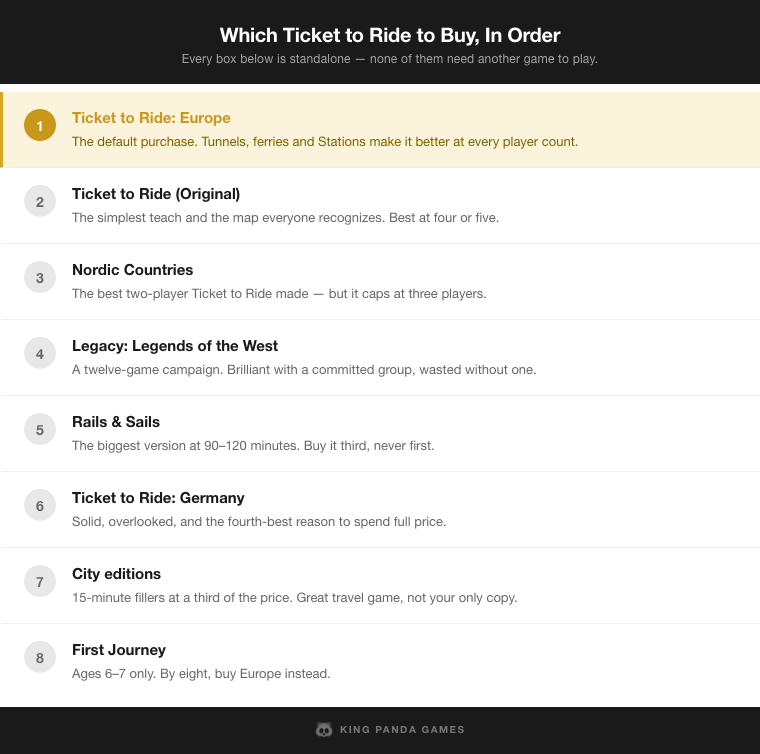
1. Ticket to Ride: Europe — Buy This One
Europe is the best version of Ticket to Ride and the correct default purchase. Same 2–5 players, same 8+, same 30–60 minutes as the original — and three additions that make it a better game at every count.
Tunnels turn routine route claims into card-flipping gambles. Ferries require Locomotive wildcards, creating standing competition for the 14 in the deck. Train Stations let a blocked player borrow someone else’s route for a 4-point cost, which quietly eliminates the beginner experience of realizing your tickets are dead and playing out twenty minutes of a loss you can already see.
It costs about five extra minutes to teach. That’s the entire downside. Our full Europe review has the detail.
2. Ticket to Ride (Original) — The Simplest Teach
The North America map is still an excellent game and the right pick in exactly one scenario: you’re teaching someone who has never played a modern board game and you want the absolute cleanest possible rules explanation.
It’s also the best-looking version of the line, and there’s real value in the map everyone recognizes. Its weakness is well documented — two players on this board is flat, because the map is too big to generate competition at low counts. At four or five it’s terrific.
2–5 players, 8+, 30–60 minutes. Full review here.
3. Nordic Countries — The Two-Player Specialist
Nordic Countries is the best two-player Ticket to Ride ever made, and the only mainline box that caps at three players.
That cap is the whole story. The Scandinavian map was drawn for 2–3 and nothing else, so the bottlenecks land where they need to, the ferry routes through the Norwegian coast create real Locomotive competition, and games stay tense from the first claim. If you’re a couple, or a pair of roommates, this is a better purchase than Europe.
If you might ever need to seat four, it isn’t. That’s the trade. Our two-player guide walks through the choice in more depth.
2–3 players, 8+, 30–60 minutes.
4. Legacy: Legends of the West — For a Committed Group
Legends of the West is a twelve-game campaign in which your map permanently changes — you write on it, add stickers, and unlock new rules between sessions. Designed with Matt Leacock (Pandemic), it plays 2–5 at ages 10+, with individual games running 20–90 minutes.
It’s genuinely good and genuinely demanding: you need the same group to show up a dozen times, and it costs roughly three times a standard box. Nail those conditions and it’s the most memorable thing in the line. Miss them and you’ve got a partially-drawn-on board in a closet.
Worth knowing: Legacy is not a good first Ticket to Ride. The campaign assumes you already understand route-building, and burning your first play on a permanent, unrepeatable game is a rough way to learn a system.
5. Rails & Sails — The Big One
Rails & Sails is the maximalist version: a double-sided board with world and Great Lakes maps, ship routes alongside train routes, harbors, and a 90–120 minute runtime at ages 10+.
It’s the best large Ticket to Ride, and it is the worst possible introduction to the series. Everything that makes the base game elegant — one action per turn, 30 minutes, teach it in five — gets traded for scope. Buy it third, not first.
2–5 players, 10+, 90–120 minutes.
6. Ticket to Ride: Germany — Good, Quietly Overlooked
Germany plays 2–5 at 8+ in the standard 30–60 minutes and adds passenger meeples that tour your completed network collecting goods, which gives you a second scoring track alongside routes.
It’s a genuinely solid design that suffers mainly from being the fourth-best reason to buy a full-price box. Get it when you’ve worn out Europe and want a different puzzle, not before.
7. The City Editions — Great Fillers, Not Your Only Copy
London, New York, Amsterdam, San Francisco, Berlin and Paris are the small boxes: 2–4 players, ages 8+, 10–15 minutes, at roughly a third of the price of a full game.
They’re excellent at what they do. A 15-minute Ticket to Ride that fits in a coat pocket is a genuinely useful object, and these are the ones we travel with. They are not, however, enough game to be a group’s only copy — the maps are too small to develop, and you’ll have seen everything they do inside five plays.
What most people do: buy a city edition as their first Ticket to Ride because it’s cheap, then conclude the whole series is slight.
What actually works: buy a full box first, then add a city edition later specifically as the version you take to a restaurant or on a plane. In that order, both purchases feel great.
Check New York price on Amazon →
8. First Journey — Only for Ages 6 to 7
First Journey is the children’s version: 2–4 players, ages 6+, no scoring at all. Kids race to complete six routes, and the tickets use pictures instead of city names so reading isn’t required.
It does its job well and has a narrow window. By around age 8, kids are ready for real Ticket to Ride — and Europe’s Station rule handles the frustration that made you consider a junior version in the first place. If your child is 8 or older, skip this and buy Europe. We go deeper on the age question in Ticket to Ride for kids.
What to Skip
Don’t buy a Map Collection as your first purchase. India, Switzerland, France & Old West, Team Asia and the rest are maps only — they need a base game you may not own. Every year people unwrap a “Ticket to Ride” they can’t play.
Don’t buy two copies to play with more people. Two boxes give you two boards and two decks. Six players requires the Team Asia collection’s team mode, which is the only official route past five. Our player count guide covers the ceiling in detail.
Don’t buy the 15th Anniversary or collector editions expecting a different game. They’re the original with upgraded components at a large premium. Lovely; not new.
The Verdict
For nearly everyone, in order: Europe first, the original if you want the simplest teach, Nordic Countries if you’re a two-player household. Everything else on this list is a second or third purchase, and the city editions are a great fourth.
The one thing not to do is buy on shelf presence. The differences between these boxes are real, and the version that suits your group is worth more than the one with the nicest cover.
More rankings from us: Wingspan expansions · best Dominion expansions · Spirit Island expansions · Everdell expansions
Frequently Asked Questions
Which Ticket to Ride version is the best?
Ticket to Ride Europe. It plays the same 2 to 5 players as the original but adds tunnels, ferries and Train Stations, which make it markedly better at two and three players and far less punishing for beginners. It is the version we recommend to anyone buying their first copy.
Which Ticket to Ride should I buy first?
Europe for most people, the original North America map if you want the simplest possible teach, and Nordic Countries if you will almost always play with two or three people. All three are complete standalone games that need nothing else to play.
What is the difference between a Ticket to Ride version and an expansion?
Standalone versions like Europe, Nordic Countries and Rails & Sails include their own board, trains and cards, and can be your only copy. Map Collections such as India, France or Team Asia ship as maps and tickets only and require a copy of Ticket to Ride or Ticket to Ride Europe to play.
Are the small Ticket to Ride city games worth buying?
Yes, as fillers rather than as your main copy. London, New York, Amsterdam, San Francisco, Berlin and Paris each play 2 to 4 players in 10 to 15 minutes for around a third of the price of a full box. They are excellent lunch-break and travel games and too slight to be a group’s only Ticket to Ride.
Which Ticket to Ride is best for 2 players?
Nordic Countries if two players is nearly always your count, since it was purpose-built for 2 to 3 and caps there. Europe if you want a great two-player game that can still seat five when friends visit. The original North America map is the weakest of the three at two players.
Which Ticket to Ride is best for kids?
Ticket to Ride: First Journey for ages 6 to 8, which drops scoring entirely and has children race to complete six routes using picture-based tickets that require no reading. From about age 8, go straight to Europe rather than buying a junior version they will outgrow in a year.
Is Ticket to Ride Rails & Sails worth it?
Only as a second or third purchase. It plays 2 to 5 at ages 10 and up but runs 90 to 120 minutes, roughly double a standard game, and adds ship routes and a double-sided world map. It is the best big Ticket to Ride and the worst introduction to the series.
How many Ticket to Ride versions are there?
There are roughly a dozen standalone boxes plus around ten Map Collection expansions, and the line keeps growing. Only about eight of the standalone versions are widely available new, which is the practical list most buyers are choosing from.