


Last checked: November 28, 2026. Every sales figure on this page links to its source, and the search data is our own Google Trends pull. This is a history piece built from museum records, period newspapers and magazines, publisher figures and award lists, not from our own play.
The breakout game of each decade, in one line: Pit, Rook, mahjong, Monopoly, gin rummy, Scrabble, Twister, Mastermind, Trivial Pursuit, Catan, Ticket to Ride, Codenames and, so far, Hitster. For each decade we picked the game that broke out in it, judged on sales from the time, period press and awards. “Most popular” here means that breakout hit, not lifetime sales, and five of the 13 picks are card or tile games, while Twister is played on the floor. Monopoly sits in the background of almost all of them, and we show you where.
Some links below are Amazon affiliate links — as an Amazon Associate, King Panda Games earns from qualifying purchases at no extra cost to you. Full disclosure.
| Decade | The breakout game | Why it won | Key number | Play it today |
|---|---|---|---|---|
| 1900s | Pit (card) | Parker Brothers’ trading-floor card game, a fast seller from 1904 | “Sold briskly” from 1904 (The Strong); no reliable unit count | Card games we rate |
| 1910s | Rook (card) | The only game a museum calls America’s best seller in the decade | Best-selling US game by 1913 (The Strong) | Classic game reviews |
| 1920s | Mahjong (tile) | A national craze that peaked in 1923–24 | About $850,000 of sets in nine months of 1923 | Best mahjong sets |
| 1930s | Monopoly (board) | Parker Brothers could barely keep up with demand | 1.8 million copies in 1936 | Games like Monopoly |
| 1940s | Gin rummy (card) | “The principal fad game” of 1941–46 | Rummy known in 49% of US families (1941) | Best playing cards |
| 1950s | Scrabble (board) | Sales nearly quadrupled in one year | 3.8 million sets in 1954 | Best word games |
| 1960s | Twister (party) | One TV broadcast turned it into a smash | 3 million+ copies in 1967 | Best party games |
| 1970s | Mastermind (board) | Won Britain’s first Game of the Year award | UK Game of the Year, 1973 | Uno (runner-up) on Amazon → |
| 1980s | Trivial Pursuit (board) | Its 1984 boom is confirmed by museums in two countries | 20 million copies in 1984 | Board game statistics |
| 1990s | Catan (board) | Won the 1995 Spiel des Jahres and kept selling for 30 years | 45 million+ sold by early 2025 | Buy on Amazon → |
| 2000s | Ticket to Ride (board) | First American game to win the Spiel des Jahres since 1981 | 18 million+ sold (Days of Wonder) | Buy on Amazon → |
| 2010s | Codenames (party word game) | Spiel des Jahres winner with the biggest single-title sales figure of any 2010s launch we found | 16 million+ copies by June 2025 | Buy on Amazon → |
| 2020s so far | Hitster (music card game) | The only new release of the decade with a multi-million sales claim | 8 million+ units for the brand (Dec 2025) | Party games we rate |
The evidence is strong for the 1930s and 1980s, fairly strong for the 1960s, and thin for the 1900s, 1910s, 1940s, 1970s and 2020s. We say which is which in every section below.
How We Picked the Game of Each Decade
Each pick is the game that broke out in that decade. It was released then, or it first became a mass hit then, judged on sales from the time, period press coverage and awards. Lifetime sales only break ties. Card and tile games count, and we label them. Where the pick isn’t a board game, we name a board-only alternate.
The Monopoly problem. On raw sales, Monopoly would win almost every decade since 1936. In December 1963, TIME called Monopoly “the most popular patented game of all time,” at about 1.3 million sets the year before. A “most copies sold” rule would very likely hand Monopoly most decades from the 1930s on, even though its sales figures for many of them were never published, and tell you nothing new. So from the 1930s on, each section ends with a one-line Monopoly check that puts the pick next to the evergreen.
Two definitions get mixed up all the time. “Released in the decade” and “most bought during the decade” give different answers, especially for imports like mahjong and slow burners like Uno. We use the breakout rule above and flag every case where the other reading would change the answer.
1900s, Pit Corners the Market
Pit is the 1900s pick, with thin evidence. Parker Brothers’ noisy card game has players shout out trades to corner the market in wheat, barley and other commodities. The Strong National Museum of Play’s record for Pit says it “sold briskly after its introduction in 1904.”
That is the whole case, and we want to be plain about it. The big volume figures that circulate for Pit trace back to Parker Brothers’ own company history. We couldn’t check them against a primary source, so we don’t print them. We found no audited sales figures for any game before the mid-1930s.
| Key evidence | Museum statement of brisk sales from 1904 (The Strong) |
|---|---|
| Awards and honors | None |
| Runner-up | Flinch, a card game from Kalamazoo, Michigan (the Strong holds a box dated around 1900) |
| Board-only alternate | None well evidenced |
| Evidence strength | Thin |
The decade’s most famous board game today wasn’t a hit at the time. Lizzie Magie’s Landlord’s Game, the ancestor of Monopoly, was patented on January 5, 1904. It mattered for what it led to, not for what it sold. If you like Pit’s shouting-and-trading chaos, our best card games list has modern games in the same spirit.
1910s, Rook Takes the Top Spot
Rook is the 1910s pick. It is the only game with a dated museum statement that it was America’s best seller in the decade. The Strong’s Rook record reads: “First published in 1906, Rook was the USA’s best-selling game by 1913.”
Rook is a trick-taking card game with its own deck, designed by George Parker himself. The museum line gives no number, and we found no unit sales for any 1910s game. One sentence from one museum is thin evidence, but it is the cleanest claim in the decade.
| Key evidence | “The USA’s best-selling game by 1913” (The Strong) |
|---|---|
| Awards and honors | None |
| Runner-up | Uncle Wiggily (Milton Bradley, 1916), which “remains in publication until the present day,” per the Strong’s board and card game timeline; no sales data found |
| Board-only alternate | Uncle Wiggily |
| Evidence strength | Thin (one museum sentence) |
Rook and Pit both still sell, which says something about how well Parker Brothers built card games. Our classic game reviews cover the older games that are still worth a table.
1920s, Mahjong Takes Over America
Mahjong is the 1920s pick, and the decade’s evidence is the best before Monopoly. The Chinese tile game became a full-blown American craze. Historian Annelise Heinz, interviewed by OPB in 2026, dates the peak to 1923 and 1924. It was even played in the White House by President and First Lady Harding, before the President died in August 1923.
The numbers come from the time. A 1923 newspaper report, retold by the Los Angeles Daily Mirror, said “almost $850,000 worth of sets had been sold in just the first nine months of 1923.” JSTOR Daily, summarizing Heinz’s research, says white Americans “bought hundreds of thousands of game sets.” The Strong notes that Parker Brothers was “the first of many game publishers to capitalize on the craze.”
| Key number | About $850,000 of sets sold in nine months of 1923 (1923 press) |
|---|---|
| Period press | Newspaper sales reports, 1923; White House play (Heinz) |
| Awards and honors | National Toy Hall of Fame finalist in 2026, not inducted |
| Runner-up | Ouija, a talking board that “reached the height of its popularity in 1920,” per The Strong |
| Board-only alternate | None well evidenced |
| Evidence strength | Medium |
Mahjong wasn’t a 1920s release. It counts because the 1920s is when it first became a mass hit in the US. The fad faded fast: National Geographic says it “evaporated by the end of the ‘roaring twenties'” among white Americans. A century later it is back, which we cover in the 2020s. To play it now, start with our guide to the best mahjong sets.
1930s, Monopoly Becomes America’s Game
Monopoly is the 1930s pick, and with the 1980s it is one of the two best-evidenced decades on the page. Parker Brothers began marketing Monopoly on November 5, 1935, according to TIME. By the next year, Salem, Massachusetts was working flat out to keep up.
The 1936 number is unusually solid. Parker Brothers historian Philip Orbanes, quoted by WGBH, says the company produced 1.8 million copies that year, and a University of Alabama game archive cites the same figure from his book. WGBH puts it this way: “Within a year, they were producing 20,000 copies a week in Salem — and Monopoly was the best selling game in America.”
| Key number | 1.8 million copies in 1936 (Orbanes, via WGBH) |
|---|---|
| Period evidence | “By 1936 the company could barely meet demand” (The Strong) |
| Awards and honors | Hall of Fame, 1998, in the first class |
| Runner-up | Contract bridge (card), which started booming in 1931, per the ACBL |
| Board runner-up | Chinese checkers; one Topeka maker shipped about 15,000 sets a month in spring 1938 (Kansas Historical Society) |
| Evidence strength | Strong |
Monopoly’s origin story has a second author. Lizzie Magie filed for her Landlord’s Game patent in 1903, and Parker Brothers paid her $500 for the rights in 1935, according to The Strong’s history of Monopoly. Charles Darrow, long credited as the inventor, sold his own sets before Parker took over.
Monopoly check: Monopoly is the pick. Want something with the same trading and less waiting? See our list of games like Monopoly and our Monopoly Deal review.
1940s, Gin Rummy Is the Wartime Craze
Gin rummy is the 1940s pick, and this is the thinnest decade on the page. No 1940s sales figure exists for any game that we could find. What we have is a contemporary reference book and a 1941 survey.
The 1952 book Culbertson’s Card Games Complete, quoted on David Parlett’s card game history site, calls gin rummy “the principal fad game, in the years 1941-46, of the United States.” A 1941 industry survey reported by TIME found that 83% of US families played cards, and rummy was the most widely known card game, in 49% of families.
| Key number | Rummy known in 49% of US families; 83% of families played cards (TIME, June 1941) |
|---|---|
| Period evidence | “The principal fad game, in the years 1941-46” (Morehead and Mott-Smith, 1952) |
| Awards and honors | Playing cards entered the Hall of Fame in 2010 |
| Runner-up | Contract bridge, the game played most often in the same 1941 survey |
| Board-only alternate | Monopoly, by continuity alone |
| Evidence strength | Thinnest |
The 1940s gave us Candy Land, Clue and Scrabble, but none of them was a 1940s hit. Clue and Candy Land came out in 1949, and Scrabble was trademarked in December 1948. All three took off in the 1950s, so that’s where we count them. Our Clue review covers the one that aged best.
Monopoly check: We found no 1940s Monopoly sales figure. It was almost certainly still the top board game, but that is an inference, not a number.
A standard deck still plays gin rummy, and our best playing cards guide picks one that lasts. For another card classic from the same era, try our how to play cribbage guide.
1950s, Scrabble Spells Out a Boom
Scrabble is the 1950s pick. It is the one 1950s breakout with a documented, year-by-year sales explosion. The Lemelson-MIT program says “more than a million sets of Scrabble were sold” in 1953 “and 3.8 million sold the following year.”
Scrabble had been around in other forms since the 1930s, when architect Alfred Butts tried it as Lexiko and then Criss Cross Words. James Brunot renamed it and took the trademark in 1948. Then it caught fire: EBSCO’s history of the game says it was “featured in Life, Look, Time, and Reader’s Digest,” and that waiting lists for the three-dollar sets were long.
| Key number | 3.8 million sets in 1954 (Lemelson-MIT) |
|---|---|
| Period press | Life, Look, Time and Reader’s Digest coverage (EBSCO) |
| Awards and honors | Hall of Fame, 2004 |
| Runner-up | Canasta (card), which had “rapidly gained popularity in the U.S.” by May 1949, per TIME; no sales figure found |
| Board runner-up | Candy Land (1949), which PBS says has averaged one million units a year; Hall of Fame 2005 |
| Evidence strength | Medium |
You’ll see “4 million in 1954” on other sites. The sources split: Lemelson-MIT says 3.8 million in 1954, while The Strong’s Scrabble page says sales “topped 4.5 million” by 1954, which reads as a running total. We use 3.8 million. Yahtzee also arrived this decade, in 1956; our Yahtzee review covers how it holds up.
Monopoly check: For scale, TIME put Monopoly at about 1.3 million sets in 1962. Scrabble’s 1954 total was nearly three times that pace.
There’s no Scrabble page on our site yet, so for word games in the same vein see our best word games.
1960s, Twister Ties America in Knots
Twister is the 1960s pick. It has the strongest single-year number of the decade. The Strong says “Twister sold more than three million copies in 1967,” the year after Milton Bradley brought it to market.
The turning point was one night of television. On May 3, 1966, Johnny Carson played Twister with Eva Gabor on the Tonight Show, as History.com tells it. History.com credits that one broadcast with saving the game.
| Key number | More than 3 million copies in 1967 (The Strong) |
|---|---|
| Period moment | The Tonight Show, May 3, 1966 |
| Awards and honors | Hall of Fame, 2015 |
| Runner-up | Mouse Trap (Ideal, 1963), which “reportedly accumulated around 1.2 million sales in the first year,” per the V&A |
| Board-only alternate | Mouse Trap (Twister is played on the floor, not a table) |
| Evidence strength | Medium-strong |
The Game of Life (1960) is the decade’s long-distance runner. The Strong calls it “one of the best-selling games of all time,” but we found no verified 1960s number for it. Risk reached the US in 1959 and made the Hall of Fame in 2021; our games like Risk list picks its best modern heirs.
Monopoly check: TIME’s December 1963 article is where the “most popular patented game of all time” line comes from, at about 1.3 million sets a year. Twister more than doubled that in 1967.
For a party game with Twister’s energy that stays on the table, see our best party games.
1970s, Mastermind Cracks the Code
Mastermind is the 1970s pick, but this decade is thin and genuinely contested. The code-breaking game won Britain’s first Game of the Year award, the strongest contemporary evidence we found for any 1970s launch. The V&A says the British firm Invicta Plastics “released it in 1971-72,” and it “went on to win the first ever Game of the Year Award in 1973.”
The big sales number is shaky. A 2020 Vice article says Mastermind “would sell 30 million copies before that decade was up,” but it names no source. We report it as Vice’s claim, not a fact.
| Key evidence | UK Game of the Year, 1973 (V&A) |
|---|---|
| Sales claim | 30 million by 1979, worldwide (Vice, 2020; unsourced) |
| Awards and honors | UK Game of the Year, 1973; not in the Hall of Fame |
| Runner-up | Uno (card, 1971), which “saw unequalled sales throughout the 1980s,” per The Strong; Hall of Fame 2018 |
| Also in the running | Othello, called “the No. 1 seller in the game department” at F.A.O. Schwarz by TIME in 1976; Dungeons & Dragons (1974), the most influential, though it’s a role-playing game |
| Evidence strength | Thin, contested |
You could fairly give this decade to Uno, which had the bigger American life. Barber Merle Robbins invented Uno in 1971, and his family paid to print the first 5,000 copies. But The Strong ties its peak to the 1980s, and we couldn’t verify any 1970s Uno sales figure.
Monopoly check: In 1972, American Heritage reported that Clue and Careers “sell about one fifth as many sets” as Monopoly. The evergreen was still far ahead.
Uno is the 1970s game you can still find in almost any toy aisle; our Uno review explains why, and our Uno house rules settle the arguments.
1980s, Trivial Pursuit Breaks Every Record
Trivial Pursuit is the 1980s pick, and its sales boom is the best documented on this page. The Strong says publisher Selchow & Righter “sold 1.3 million copies of the game in 1983 and 20 million in 1984.” The V&A gives the same 20 million for the US in 1984.
Canadian journalists Chris Haney and Scott Abbott invented it on December 15, 1979, according to The Canadian Encyclopedia. It went on sale in Canada in 1981 after a first run of 1,100 copies, and Selchow & Righter licensed it for the US in 1982. The encyclopedia quotes TIME calling it “the biggest phenomenon in game history.”
| Key number | 20 million copies in 1984 (The Strong, V&A) |
|---|---|
| Period press | “The biggest phenomenon in game history” (TIME, via The Canadian Encyclopedia) |
| Awards and honors | Hall of Fame, 2025 |
| Runner-up | Pictionary (1985), which has “sold over 38 million copies in 60 countries,” per CNBC in 2020 |
| Evidence strength | Strong |
The 1984 figure gets described three ways: US only, North America, or a running total. The Strong says 20 million were sold in 1984, and we go with that. Jenga is the other big 1980s arrival and joined the Hall in 2020, but its museum page gives no sales figure, and we found no 1980s number for it. Phase 10 reached Kmart shelves in 1982, per The Strong, and was inducted into the Hall in 2024; our Phase 10 review covers it.
Monopoly check: This is almost certainly the clearest year a newcomer beat the evergreen. To match 20 million, Monopoly would have needed about 15 times its early-1960s pace.
Trivial Pursuit’s 1984 is the biggest single year in our board game statistics too.
1990s, Catan Starts the Modern Hobby
Catan is the 1990s pick, with one honest caveat. The German trading game came out from Kosmos in 1995 and won every major German award that year, including the Spiel des Jahres, per The Opinionated Gamers. The same review says it “sold 400,000 copies in its first year.”
The long-run number is the publisher’s. Catan’s own site says that “since 1995 until now (Q1 2025) over 45 million games were sold worldwide,” in more than 40 languages. Our Catan statistics page tracks how that total has climbed since.
| Key number | 45 million+ sold worldwide by Q1 2025 (catan.com) |
|---|---|
| Awards | Spiel des Jahres 1995 |
| Hall of Fame | Not inducted |
| Runner-up | Magic: The Gathering (collectible card game, released August 5, 1993); Hall of Fame 2019 |
| Evidence strength | Medium, contested |
Here’s the caveat. Catan was a niche import in 1990s America; the US English edition arrived in 1996. On strict in-decade US sales, Magic almost certainly beat it, and Magic later passed $1 billion in yearly revenue for the first time in fiscal 2022, per Hasbro. Card games can win under our rule, so this is a judgment call on evidence. We found no published 1990s unit count for Magic, while Catan has a first-year sales figure, the decade’s top board game award and a publisher total. Pokémon cards, which joined the Hall this year, have the same gap as Magic: no published 1990s count, and most of their growth came later.
Monopoly check: We found no 1990s Monopoly sales figure. It stayed on shelves as the evergreen while Catan changed what new games looked like.
Our Catan review covers whether it still holds up, and games like Catan picks what to play next.
2000s, Ticket to Ride Connects the Hobby
Ticket to Ride is the 2000s pick. Days of Wonder launched it in March 2004, and by that November it had sold 250,000 copies, ICv2 reported. It won the 2004 Spiel des Jahres, “the first time an American game has won this award since 1981,” per ICv2’s award report.
The growth since then is the publisher’s figure. A 2025 Days of Wonder press kit says Ticket to Ride “has sold over 18 million copies worldwide” in 33 languages. You may see 20 million elsewhere; we couldn’t confirm it with a primary source.
| Key number | 18 million+ sold worldwide (Days of Wonder, 2025) |
|---|---|
| Early sales | 250,000 by November 2004 (ICv2) |
| Awards | Spiel des Jahres 2004 |
| Hall of Fame | Not inducted |
| Runner-up | Carcassonne, which won the 2001 Spiel des Jahres and “sells over 700,000 copies in its first year – in Germany alone,” per publisher Hans im Glück |
| Evidence strength | Medium |
The decade also produced two 2008 games that hobby players still teach first, the co-op Pandemic and the card game Dominion. Our Carcassonne review and Pandemic review cover the decade’s runner-up and its co-op landmark.
Monopoly check: No public Monopoly unit sales exist for the 2000s that we could find, and Google search data can’t help: McDonald’s Monopoly promotions swamp the board game searches every fall.
Our Ticket to Ride review covers the base game, and every Ticket to Ride version ranked helps you pick a map.
Check Ticket to Ride price on Amazon →
2010s, Codenames Wins the Party
Codenames is the 2010s pick. Czech Games Edition released it in 2015, and it won the Spiel des Jahres in 2016. Prague’s Expats.cz reported in June 2025 that Codenames “has sold over 16 million copies worldwide over the past 10 years.”
No other game launched in the 2010s has a single-title sales figure that big that we could find. Wingspan, the decade’s hobby darling, is closer to 2.6 million (below).
| Key number | 16 million+ copies worldwide (Expats.cz, June 2025) |
|---|---|
| Awards | Spiel des Jahres 2016 |
| Hall of Fame | Not inducted |
| Runner-up | Exploding Kittens (card, 2015), whose Kickstarter drew 219,382 backers and $8,782,571, then the most-backed project ever (GeekWire) |
| Search-interest leader | Cards Against Humanity (see the Google Trends section) |
| Evidence strength | Medium-strong |
Cards Against Humanity is the strongest rival. It led our Google Trends comparison in the mid-2010s, and Kotaku reported in 2013 that it had “made over $12 million in revenue.” But it has never published unit sales, so we can’t put it head to head. On the hobby side, Wingspan (2019) has sold 2,639,429 lifetime units including Wingspan Asia, per BoardGameWire’s March 2026 report.
Monopoly check: Monopoly kept selling all decade, but no public unit figure exists, and its search data is tangled up with the McDonald’s promotion and, later, mobile apps.
Our Codenames review covers the pick. For the rivals, see the Exploding Kittens review, our take on Cards Against Humanity and the Wingspan review.
Check Codenames price on Amazon →
2020s So Far, Hitster Plays the Hits
Hitster is the provisional 2020s pick, with about three years of the decade still to go. Jumbo’s music card game has players place songs on a timeline by the year they came out. Toys n Playthings reported in December 2025 that the Hitster brand had sold “over 8 million units” worldwide, counting its Original, Summer Party and Bingo editions, since “the launch of Hitster Original in 2023.”
That 8 million covers several boxes, not one, and it is the only seven-figure sales claim we found in our research for any game released this decade. No Spiel des Jahres winner from 2022 to 2026 has published a sales figure. So treat this pick as provisional until the decade is over.
| Key number | 8 million+ units for the Hitster brand (December 2025) |
|---|---|
| Awards and honors | None found |
| Runner-up and board-only alternate | Cascadia, the 2022 Spiel des Jahres winner; no sales figure found |
| Evidence strength | Provisional |
Three bigger stories frame the decade. Lockdown sent families back to the table: NPD reported that US toy sales reached $25.1 billion in 2020, up 16%. Co-op games keep winning the top German prize, which BoardGameWire noted in 2025 had gone to a co-operative design “in five out of the past seven years.” And mahjong is back: WUSF reported that Yelp searches for mahjong clubs rose more than 4,400% from September 2024 to August 2025.
By sheer volume, trading cards dwarf every new release. The Pokémon Company says it has produced over 85 billion cards as of March 2026, and the Pokémon TCG was inducted into the Hall of Fame this year.
Monopoly check: Monopoly’s search data is now mixed with the Monopoly GO mobile game, so even Google can’t tell us how the board game is doing.
For the best of this decade so far, see our best indie board games of 2026 and best party games.
The All-Time Best Sellers Sit Above Every Decade
Monopoly, Uno and plain playing cards are the usual answers for the all-time best seller, and they are why this page names breakout hits instead. All three have sold year after year since they launched, and none of them has a reliable lifetime unit count that we could verify.
What we can show is scale. According to Mattel, as CNN reported, almost one Uno set was sold in the US every second in 2023. The Canadian Encyclopedia puts Trivial Pursuit at more than 100 million copies worldwide. Monopoly has no public lifetime figure from its owner that we found, only TIME’s “most popular patented game of all time” from 1963.
Myths We Fact-Checked
“Charles Darrow invented Monopoly.” Lizzie Magie filed her Landlord’s Game patent on March 23, 1903, and it was granted on January 5, 1904 (US 748,626). She published the game in 1906, and Parker Brothers paid her $500 in 1935 (The Strong).
“Scrabble was a 1930s or 1940s hit.” Butts’s early versions went nowhere, and the Scrabble name dates from 1948. The boom came in 1953 and 1954, when sales went from about one million to 3.8 million sets (Lemelson-MIT).
“Trivial Pursuit came out in 1979.” That’s when Chris Haney and Scott Abbott invented it. It went on sale in Canada in 1981 and in the US in 1982, and its big year was 1984. Abbott is often left out of the credits.
“Catan came out in 1996.” Kosmos published it in Germany in 1995. 1996 is when the US English edition arrived.
“Cards Against Humanity is a 2000s game.” Its Kickstarter wrapped in 2011, raising $15,570 on a $4,000 goal, per NBC Chicago. It’s a 2010s game.
“Exploding Kittens has sold 60 million copies.” The company’s 2025 announcement says the company “has sold over 60 million games,” across its whole catalog, not one title.
No Modern Hobby Board Game Is in the Toy Hall of Fame
No modern hobby board game has ever been inducted into the National Toy Hall of Fame. Not Catan, not Ticket to Ride, not Codenames. Two hobby staples are in, Dungeons & Dragons and Magic: The Gathering, but neither is a board game. We checked the museum’s full list of inductees on November 28, 2026: 94 toys since 1998, 19 of them tabletop games.
| Year inducted | Tabletop games |
|---|---|
| 1998 | Monopoly |
| 2003 | Checkers |
| 2004 | Scrabble |
| 2005 | Candy Land |
| 2010 | Playing cards, The Game of Life |
| 2012 | Dominoes |
| 2013 | Chess |
| 2016 | Dungeons & Dragons |
| 2017 | Clue |
| 2018 | Uno |
| 2019 | Magic: The Gathering |
| 2020 | Jenga |
| 2021 | Risk |
| 2024 | Phase 10 |
| 2025 | Battleship, Trivial Pursuit |
| 2026 | Bingo, Pokémon Trading Card Game |
The Hall favors games nearly every American family has owned, which is why mass-market classics fill it. Mahjong, Sorry!, Yahtzee and Mouse Trap were all 2026 finalists and missed out. Twister is in too (2015), though it’s a floor game rather than a tabletop one. Four of our 13 decade picks are in the Hall: Monopoly, Scrabble, Twister and Trivial Pursuit.
Find the Games From the Year You Were Born
Pick any year from 1900 to 2026 and see the notable games released that year. The list comes from public game databases plus our own corrections, and early years with few documented games say so honestly instead of padding the list.
What came out the year you were born?
Games listed by first release year, ranked by how widely each is documented across Wikipedia’s language editions. Data: Wikidata (CC0) and Wikipedia. We spot-checked 45 well-known titles and fixed the errors we found, so treat lesser-known entries as database records. Coverage is strongest from 1960 on.
What Google Searches Show Since 2004
Google search data since 2004 tracks the hobby boom: Cards Against Humanity spikes and fades, Codenames and Ticket to Ride hit their peak months in the 2020 lockdown year, and Catan’s own search interest in 2025 and 2026 is back at its 2020 high. We pulled US Google Trends data for each game’s topic from January 2004 to November 2026 on November 28, 2026, using Catan as the anchor so every game sits on one scale.
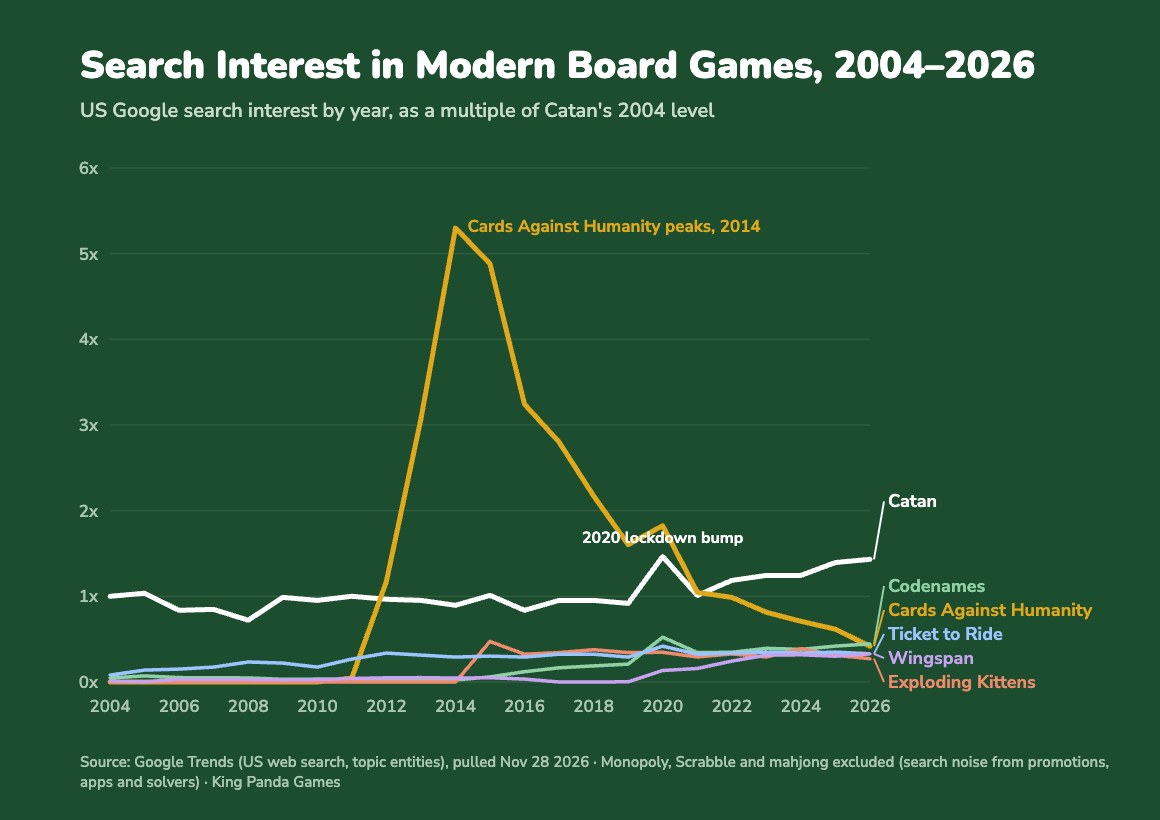
| Game | Peak month | vs Catan, 2014 | vs Catan, 2016 | vs Catan, 2020 | vs Catan, 2026 |
|---|---|---|---|---|---|
| Catan (anchor) | April 2020; 2025–26 run at about the same level | 1.00 | 1.00 | 1.00 | 1.00 |
| Cards Against Humanity | December 2014 | 5.92 | 3.88 | 1.25 | 0.29 |
| Exploding Kittens | July 2024 (Netflix series) | 0.00 (not yet released) | 0.39 | 0.24 | 0.19 |
| Ticket to Ride | December 2020 | 0.32 | 0.35 | 0.29 | 0.23 |
| Codenames | April 2020 | 0.03 (before release; background noise) | 0.14 | 0.36 | 0.31 |
| Apples to Apples | December 2004 | 0.39 | 0.24 | 0.13 | 0.10 |
| Carcassonne | December 2016 | 0.05 | 0.06 | 0.09 | 0.10 |
Read the ratios as “how many Catan searches.” In 2014, Cards Against Humanity drew almost six times Catan’s search interest, and by 2026 it was down to less than a third. Codenames more than doubled its share between 2016 and 2020 and has held most of it.
We left Monopoly, Scrabble and mahjong off on purpose. Their search data measures other things: McDonald’s Monopoly and the Monopoly GO app, Scrabble word finders, and online mahjong solitaire. We used the same method for our state-by-state board game map.
For Journalists and Teachers
You’re welcome to use the picks and numbers on this page with a credit and a link. Every figure links to its original source above, so you can check our work and cite the primary source directly.
Cite this page: King Panda Games, “The Most Popular Board Game of Every Decade, From Pit to Codenames,” updated November 28, 2026 (kingpandagames.com/popular-board-games-by-decade/).
The 13 picks are also available as a CSV file, with each game’s decade, type, year, key number and source link.
Download the 13 picks as a CSV file
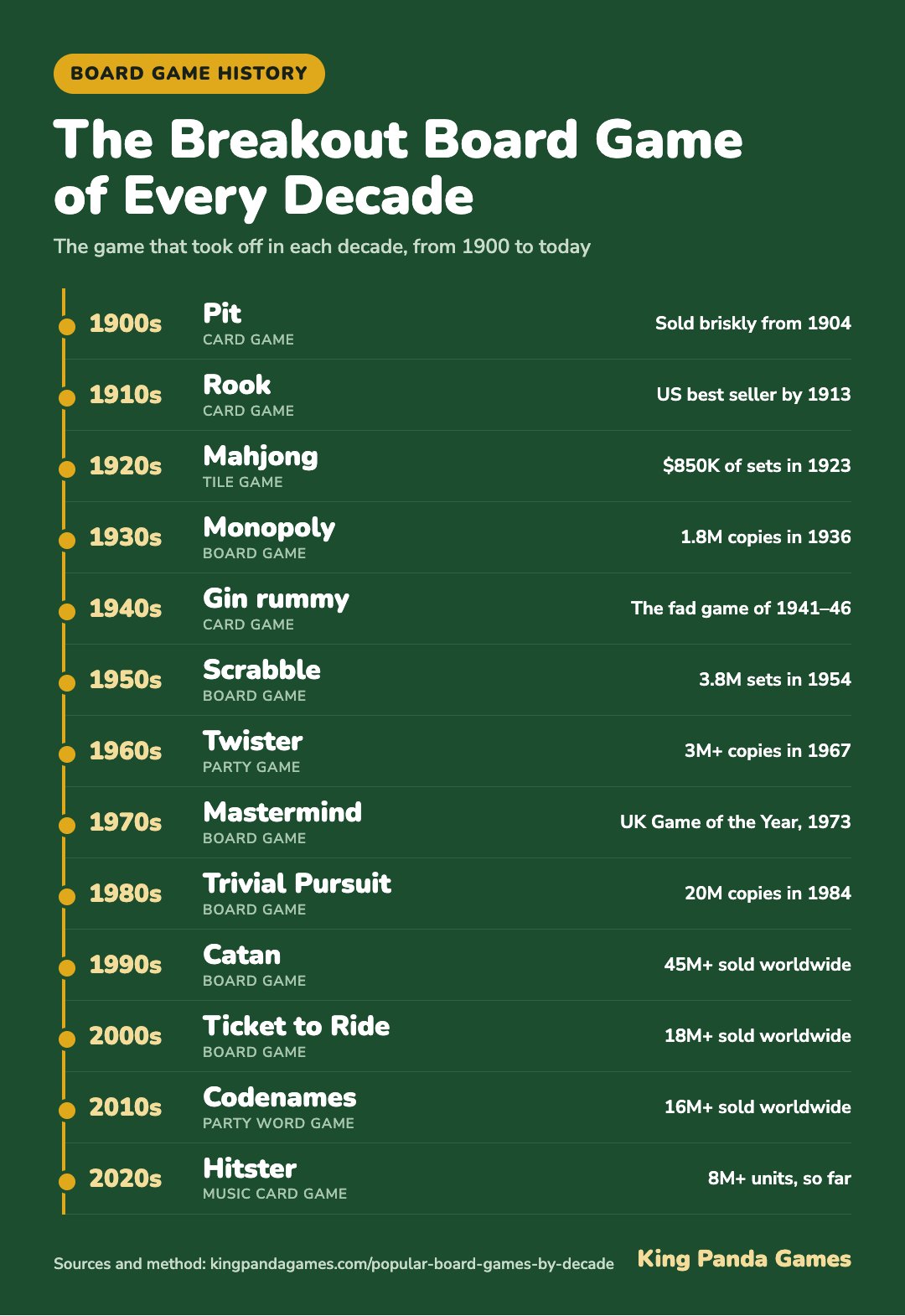
To put the timeline on your own site, copy this code:
<a href="https://www.kingpandagames.com/popular-board-games-by-decade/"><img src="https://www.kingpandagames.com/wp-content/uploads/2026/11/board-games-by-decade-timeline.jpg" alt="The breakout board game of every decade" width="1080"></a><br>Timeline by <a href="https://www.kingpandagames.com/popular-board-games-by-decade/">King Panda Games</a>
If you use the timeline graphic, please credit “King Panda Games” with a link to this page.
Questions About Board Games Through the Decades
What was the most popular board game in the 1980s?
Trivial Pursuit. Selchow and Righter sold 20 million copies in 1984 alone, according to The Strong National Museum of Play, up from 1.3 million in 1983.
What is the best-selling board game of all time?
Monopoly is the usual answer. TIME called it the most popular patented game of all time in 1963, when it sold about 1.3 million sets a year, but its owner has never published a lifetime total we could verify.
When was Monopoly invented?
Monopoly grew out of Lizzie Magie’s Landlord’s Game, patented on January 5, 1904. Parker Brothers began selling Monopoly in 1935 and produced 1.8 million copies in 1936.
What board game was popular in the 1950s?
Scrabble. Sales jumped from more than a million sets in 1953 to 3.8 million in 1954, according to the Lemelson-MIT program. Candy Land (1949) and Yahtzee (1956) arrived around the same time.
Has any modern hobby board game been inducted into the Toy Hall of Fame?
No. As of the 2026 class, none of Catan, Ticket to Ride or Codenames has been inducted. The 19 tabletop inductees are mostly mass-market classics such as Monopoly, Scrabble, Uno and Trivial Pursuit, plus the hobby staples Dungeons and Dragons and Magic: The Gathering.
Sources
Every source below was accessed on November 28, 2026. Sales figures are as stated by each source on its own date.
- The Strong National Museum of Play: Hall of Fame inductee pages and collection records (Pit, Rook, Flinch, Monopoly, Scrabble, Twister, Uno, Trivial Pursuit, The Game of Life, mahjong, Ouija).
- Google Patents, US 748,626, Lizzie J. Magie, filed March 23, 1903, granted January 5, 1904.
- TIME: “Games: Brain Busting” (December 13, 1963); “Sport: Four-Fifths of a Nation” (June 23, 1941); canasta (May 16, 1949); Othello (November 22, 1976); Monopoly’s 1935 launch.
- WGBH (2015) and the University of Alabama game archive, citing Philip Orbanes, The Game Makers (2004).
- OPB (2026), JSTOR Daily and National Geographic on mahjong; Los Angeles Daily Mirror on 1923 mahjong sales.
- David Parlett, quoting Morehead and Mott-Smith, Culbertson’s Card Games Complete (1952).
- Lemelson-MIT program and EBSCO Research Starters on Scrabble.
- History.com on Twister; the V&A on Mouse Trap, Mastermind and Trivial Pursuit; Vice (2020) on Mastermind.
- American Heritage (1972); The Canadian Encyclopedia; CNBC (2020).
- catan.com (Q1 2025); The Opinionated Gamers (2015); Guinness World Records; Hasbro’s FY2022 results (SEC filing).
- ICv2 (2004); Days of Wonder press kit (2025); Hans im Glück.
- t-online (2016); Expats.cz (June 2025); GeekWire (2015); Kotaku (2013); BoardGameWire (2025, 2026); Exploding Kittens via Business Wire (2025).
- Toys n Playthings (December 2025); GamesRadar (2022); NPD via PRWeb (2021); WUSF (2026); The Pokémon Company (March 2026); KSL/CNN (2024); ABC7 (2026).
- Google Trends, US web search, January 2004 to November 2026, pulled November 28, 2026.
Header photo by LilasJardin, Wikimedia Commons, CC BY-SA 2.0, cropped.