

Carcassonne Review: Is It Worth It?
Carcassonne earns a 5/5 Bamboo Plants and a 4/5 Pandas — and if you’re buying your first board game or your first game for two players, this might be the easiest recommendation we’ve ever made.
Some links below are Amazon affiliate links — as an Amazon Associate, King Panda Games earns from qualifying purchases at no extra cost to you. Full disclosure.
The Bamboo Plants rating is a perfect five because Carcassonne is the most learnable game in its class. You can explain the rules in five minutes and someone will be making real decisions by their second turn. No other gateway game at this complexity level matches that. The 4/5 Pandas is honest: it’s consistently enjoyable, occasionally brilliant, but it doesn’t generate the wild table energy of something like Catan. It’s a calmer, more contemplative kind of fun — and for a lot of groups, that’s exactly what they want. It lands at #12 on our best board games of 2026 list.
Buy it if you want a game that works at two players, teaches in minutes, and rewards repeated play. Skip it if your group wants lots of direct conflict and negotiation. Try before you buy if you’re unsure whether quiet strategic games are your group’s style — it’s a different vibe than most gateway games.
| Detail | Info |
|---|---|
| Players | 2–5 |
| Age | 7+ |
| Play time | 30–45 min |
| Bamboo Plants | 5/5 — fully playable after one turn |
| Pandas | 4/5 — satisfying every time, brilliant at its best |
| Official site | zmangames.com |
How Carcassonne Works
On your turn, you do two things: draw a tile from the shuffled face-down stack, then place it somewhere it legally connects to the existing landscape. Roads must connect to roads. City walls must meet city walls. Fields flow into fields. The growing map of medieval southern France takes shape one tile at a time, and no two games look the same.
After placing the tile, you may — but don’t have to — place one of your meeples on a feature of that tile. A meeple on a road segment claims that road. A meeple on a city tile claims that city. A meeple inside a monastery claims it. A meeple lying flat on a field claims the farmland. Once placed, that meeple stays until the feature it’s on scores.
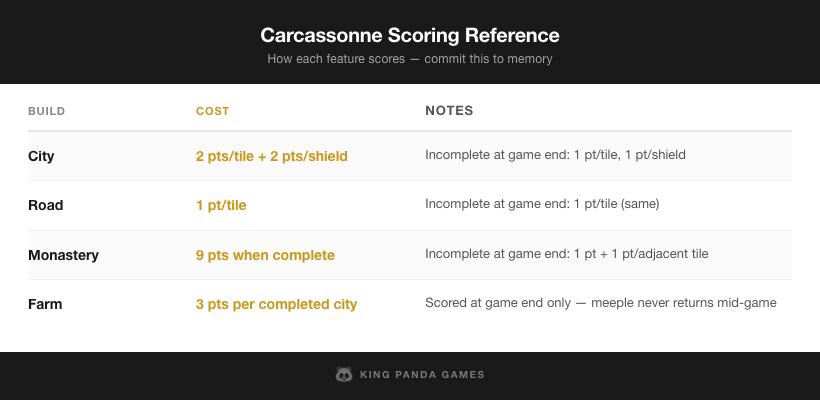
Features score when they complete. A city scores when its walls are fully closed in — 2 points per tile, 2 points per pennant banner. A road scores when it runs from one endpoint (a town, a crossroads, a dead end) to another. A monastery scores when all eight surrounding tiles have been placed. The meeple returns to your hand when its feature scores, ready to be placed again.
The catch is that you only have seven meeples. You can run out — and when you do, you can’t claim new features until existing ones complete and your pieces come home. Managing your meeple supply is the central tension of every Carcassonne game.
The sneakiest mechanic is the farm. A meeple placed flat on a field doesn’t score mid-game at all — farms only score at the very end, when the game is over. Each completed city your farm touches earns you 3 points. A single farmer who quietly tends a large field touching three or four finished cities can swing the entire game in the final tally. It’s the mechanic that rewards experienced players and consistently surprises beginners who don’t see it coming.
A typical game runs 30 to 45 minutes. With two players it often moves faster.
What We Liked
It teaches itself. The first turn of Carcassonne explains the game better than any rulebook. You draw a tile, you look at the existing landscape, you find where it fits — the rules emerge naturally from the act of playing. We’ve taught it to complete beginners, kids as young as eight, and people who actively dislike board games. In every case, they were making independent decisions by the third turn. That kind of onboarding is rare.
It’s genuinely great at two players. Most board games tolerate two players. Carcassonne thrives at two. With just two people, every tile placement is a direct negotiation — do you extend your own city or block your opponent’s road? Do you join their monastery scoring area or build away from it? The entire map becomes a conversation between two minds. We’d comfortably call Carcassonne one of the five best two-player board games ever made.
The farming reveal at the end. Nothing in Carcassonne is better than the end-game tally when a player flips their farmer and suddenly adds 15 points nobody saw coming. It happens in almost every game with experienced players. The moment the farmer reveals itself, the player who didn’t track the fields spends about ten seconds doing silent math and then makes a face. That moment — the realization that you missed the farm — is Carcassonne’s version of the Catan robber. It stings, it’s earned, and it makes you a better player next time.
The tile-placement puzzle is endlessly satisfying. Even when the strategic situation is simple, there’s a tactile pleasure to finding where a tile fits and snapping it into the growing landscape. The map looks increasingly beautiful as the game progresses. Some games produce gorgeous, winding cityscapes. Others sprawl into chaotic networks of intersecting roads. Each game is a unique piece of collaborative/competitive cartography.
The box is small, the setup is fast. Carcassonne sets up in under two minutes. Shuffle the tiles, deal one starting tile face-up, hand out meeples. You’re playing. For a game that delivers 40 minutes of genuine strategic engagement, the setup-to-play ratio is exceptional.
What We Disliked
Field scoring confuses beginners — every time. The farming mechanic is brilliant in practice and baffling in theory. New players consistently misunderstand it during the rules explanation, forget it during the first half of the game, and then either miss a massive farm opportunity or fail to defend against one. The rules explicitly say farmers never return to your hand during the game, which feels strange before you understand why. Most groups need at least two sessions before farming strategy starts to feel natural.
Five players is noticeably crowded. At two, three, or four players, Carcassonne flows beautifully — the tile draw feels meaningful, the map grows at a good pace, there are enough decisions to make. With five players, the game bogs down slightly. Turns take longer, the map fills up faster, and the strategic picture becomes harder to track. The game is designed for five and works fine at five, but if you have the choice, four is the ceiling for the best experience.
Experienced players have a significant advantage over beginners. More so than in Catan, where luck distributes resources and beginners can stumble into a win. In Carcassonne, a player who understands field scoring and efficient meeple usage will consistently outperform someone who doesn’t — sometimes by a wide margin. In a group with mixed experience levels, the beginner may feel outmatched in a way that doesn’t encourage them to play again. If you’re introducing it to new players, explain the farm explicitly before the game starts, even if they don’t fully absorb it.
Who Carcassonne Is For
Couples and pairs. If you’re buying a game primarily to play with one other person, Carcassonne belongs on your short list. It’s competitive without being hostile, fast without feeling rushed, and strategically deep enough to spark genuine post-game conversation. We’d recommend it over most other two-player options in its price range. It lands at #2 on our best board games for couples list, one spot behind 7 Wonders Duel.
Families with younger children. The 7+ age rating is accurate. Kids pick up tile placement intuitively, the game moves fast enough to hold attention, and the visual landscape makes the game tangible in a way abstract games can’t match. The farming mechanic goes over young kids’ heads, but that’s fine — they can learn it in later sessions as they grow into the game.
People who want something calm. Carcassonne is not Catan. There’s no shouting, no negotiation, no robber stealing your resources at the worst moment. If someone at your table has ever said “I don’t like confrontational games,” Carcassonne is the answer. The competition is real but it’s quiet — you’re racing to complete features and managing territory, not taking things directly from other players.
Anyone who wants a game that plays in 45 minutes. For game nights where you don’t have two hours, or as an opener before a longer game, Carcassonne delivers a complete, satisfying game experience in well under an hour.
It’s not ideal for groups that love loud social games, players who need constant interaction to stay engaged, or anyone who gets frustrated when a more experienced player consistently wins. Those groups should look at Catan for social chaos or Ticket to Ride for something competitive but gentler.
Check Carcassonne price on Amazon →
Awards
Carcassonne won the Spiel des Jahres — the most prestigious award in board gaming — in 2001, the year after Catan won it. Designed by Klaus-Jürgen Wrede and originally published by Hans im Glück, it’s been translated into dozens of languages and sold tens of millions of copies worldwide. It’s one of a handful of games that defined what modern gateway board games could be.
How Carcassonne Compares
Catan is the closest peer in terms of audience reach and cultural footprint, but the games feel completely different at the table. Catan is loud, social, and luck-dependent. Carcassonne is quiet, focused, and more skill-driven once you understand the farming mechanic. If your group loves negotiation and direct competition, Catan is your game. If you want something more contemplative that plays beautifully at two, Carcassonne wins. Read our full Catan review for a head-to-head breakdown.
Ticket to Ride occupies a similar niche — accessible, gentle, plays in under 90 minutes. The main difference: Ticket to Ride has a fixed setup (the map doesn’t change), while Carcassonne generates a new landscape every game. Ticket to Ride is slightly easier to learn; Carcassonne has higher replay variance. For pure first-game accessibility, it’s a coin flip. [link: once published, link to /ticket-to-ride-review/]
Azul is where many Carcassonne fans end up when they want the same kind of elegant, puzzle-like satisfaction with more direct competition. Azul is sharper and more cutthroat — you can force bad tiles on opponents in ways Carcassonne doesn’t allow. If you’ve played Carcassonne a dozen times and want the next step up in strategic tension, Azul is a natural recommendation. [link: once published, link to /azul-review/]
Tips & Tricks
Explain farming before you start. New players who don’t understand that farmers score at end-game will almost never place a farmer during the game — it feels wasteful to tie up a meeple with no mid-game return. Thirty seconds of pre-game explanation saves the confusion of a first end-game tally and makes the game more competitive from the start.
Track which cities your farms touch. A field is worth 3 points per completed city it borders at game end. Before placing a farmer, look at every city that field connects to and estimate how many will complete. A field touching two half-built cities might be worth 0 points; the same field next to three completed cities is worth 9. The map tells you what the farm is worth if you read it correctly.
Don’t place a meeple on every tile. New players feel compelled to use a meeple every turn. Experienced players hold back, wait for high-value placements, and return to full meeple supply before opponents. A turn where you place a tile that blocks an opponent and place no meeple is often a better turn than one where you tie up your last meeple on a small road.
Join your opponent’s features carefully. When you place a tile that connects your city section to an opponent’s city section, you join the scoring. Whoever has more meeples in a shared feature splits the points if tied, or wins them all if dominant. Joining is often worth it — but only if you can compete for the majority or force a tie.
Prioritize large city completions in the mid-game. The biggest point swings in Carcassonne come from completing large cities — a 10-tile city with two pennants scores 24 points. If you’re building a city that’s growing large, commit to completing it rather than spreading your meeples thin. Half-finished large cities at game end score half points and represent a massive opportunity cost.
Want to Go Deeper?
- How to Win at Carcassonne: Strategy Guide for Beginners — The principles that separate players who keep losing from players who win consistently. Read it here
- Carcassonne Meeple Placement: When to Commit and When to Hold Back — Your seven meeples are your most limited resource. Here’s how to manage them. Read it here
- Carcassonne for Two Players: Is It Worth It? — The honest answer: yes, and it might be the best two-player game in its category. Here’s why. Read it here
- Carcassonne Expansions Ranked: Which One Should You Buy First? — There are over a dozen expansions. Here’s which ones actually improve the game. Read it here
Verdict
Buy it. Carcassonne is the most learnable game that still has real strategic depth, and it’s the best two-player game in its price range. If you’ve never played a modern board game before, this is one of three we’d hand you first.
Skip it if your group specifically wants loud, social, negotiation-driven gameplay. Carcassonne is calm and contemplative — that’s a feature for the right group and a flaw for the wrong one.
Try before you buy only if you’re genuinely unsure whether your group wants something strategic and quiet versus something chaotic and social. If you already know you want a calm game, just buy it.
Carcassonne official site: zmangames.com
🎋 Budget Board Games
Best Board Games Under $30
Carcassonne frequently goes on sale for under $30 — it’s one of our top picks in our roundup of the best board games at this price.
Frequently Asked Questions
Is Carcassonne a good game for new board game players?
Absolutely, Carcassonne is our top recommendation for anyone buying their first board game. Its rules are incredibly easy to grasp in about five minutes, allowing new players to make meaningful decisions almost immediately. It truly is the most learnable game in its class.
How long does it take to learn Carcassonne?
You can explain the core rules of Carcassonne in a mere five minutes, which is why it earns a perfect 5/5 Bamboo Plants rating. Players will be fully engaged and making strategic choices by their second turn, a feat unmatched by other gateway games at this complexity.
Is Carcassonne fun for just two players?
Carcassonne shines as a two-player game, making it an easy recommendation if you're looking for a game for just two. It offers a consistently enjoyable, contemplative experience that rewards repeated play, perfect for a quiet evening.
Does Carcassonne have a lot of direct player conflict or negotiation?
No, if your group thrives on wild table energy, direct conflict, or heavy negotiation, Carcassonne isn't the game for you. It's a calmer, more strategic experience, offering satisfying fun without the cutthroat back-and-forth of games like Catan.
What's the most important strategy in Carcassonne?
The central tension of Carcassonne definitely revolves around managing your limited supply of seven meeples. Deciding when and where to place them, and when to hold back, is key to maximizing your scoring opportunities throughout the game.
How do farms work in Carcassonne, and are they important?
Farms are the sneakiest and most impactful mechanic, scoring only at the very end of the game. A single farmer can swing the entire game by claiming a large field that touches multiple completed cities, earning 3 points per city. Mastering farm placement is crucial for experienced players.
Is Carcassonne worth buying for my game collection?
Yes, Carcassonne is absolutely worth it if you want a game that teaches in minutes, works brilliantly at two players, and rewards repeated play with satisfying strategic depth. It's a consistently enjoyable experience that we rate 4/5 Pandas.