The best Clue strategy is to get more information out of every suggestion than anyone else does. That means naming cards you already hold, writing down every card that changes hands, even when you can’t see it, and only accusing when nothing else is left.
Some links below are Amazon affiliate links — as an Amazon Associate, King Panda Games earns from qualifying purchases at no extra cost to you. Full disclosure.
The advice below comes from the rules in Hasbro’s current Clue rulebook and from the card counts. If you’re new to the game, start with our Clue review.
Know How Many Cards Everyone Holds
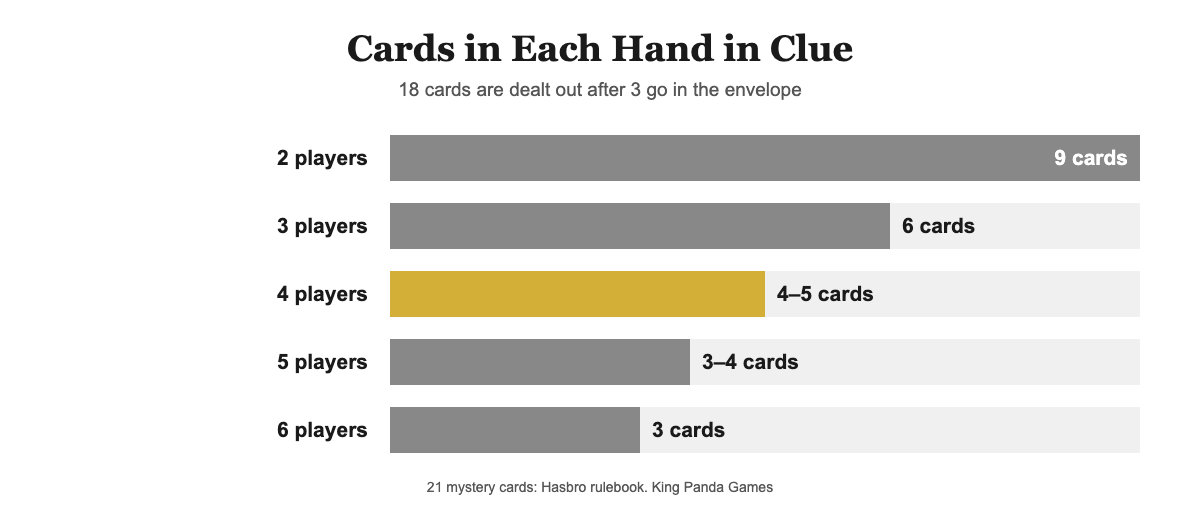
There are 21 suspect, weapon and room cards. Three go in the envelope, so 18 are dealt out, and how many each player holds changes how a game feels.
| Players | Cards in each hand | What it means |
|---|---|---|
| 2 | 9 | Most suggestions get answered by your one opponent |
| 3 | 6 | Slow: each answer rules out less |
| 4 | 4–5 | The sweet spot |
| 5 | 3–4 | Fast answers, fewer cards to track |
| 6 | 3 | Quick deduction, long waits for your turn |
The envelope has 324 possible answers: 6 suspects × 6 weapons × 9 rooms. Every card you cross off cuts that number down. A suspect or weapon card removes 54 of the 324; a room card removes only 36, because there are nine rooms to get through. That’s why the room is usually the last thing you solve.
Name Cards You Hold
This is the single best habit in Clue. When you name a card that’s in your own hand, nobody can show it to you, so the answer has to be one of the other two.
You hold the Rope. You still don’t know the room or the suspect. You walk into the Library and suggest “Plum, in the Library, with the Rope.” If the next player shows you a card, it has to be Plum or the Library. If nobody can show you anything, Plum and the Library are both in the envelope.
It also keeps other players guessing. They see you suggest the Rope and may think it’s still open.
The rule: name one card you hold in most suggestions, so every answer tells you about the other two.
Track the Cards You Don’t See
Most players only write down the card they’re shown. The better players also note every card shown to someone else.
What most players do: ignore suggestions that aren’t theirs, because they can’t see the card.
What actually works: write it down anyway. If Ben shows Ana a card when she suggests “Mustard, Kitchen, Wrench”, Ben holds at least one of those three. When you later learn Ben doesn’t hold Mustard or the Kitchen, you know he holds the Wrench.
It’s also worth noting who couldn’t answer. A player who passes on a suggestion holds none of those three cards, which is often more useful than one card shown.
Use the Board, Not Just the Dice
The dice are luck, but the board has shortcuts. Each corner room has a secret passage to the opposite corner. If you start your turn there, you can take the passage instead of rolling.
- Head for a corner room early. From there, two rooms are always one turn away.
- Stay in a room when you can. The rules let you make a suggestion in the room you’re already in on your next turn, rather than walking out and back.
- When you name a suspect, their token is pulled into your room. If that suspect is another player’s character, you’ve just moved them, which can drag them away from a room they were heading for.
If the magnifying glass comes up on the die, you draw a Clue card and do what it says. Those events can help or hurt, so don’t plan a whole turn around avoiding them.
Accuse Only When You’re Sure
“When should you make an accusation in Clue?” Only when you’ve crossed off everything else. One wrong accusation and you can’t win, though you still have to show cards for the rest of the game.
The one exception is a race. If another player is clearly about to solve it, and you’re down to two possible rooms, a 50% guess beats a certain loss.
For two players, the rulebook has a variant that puts four extra cards face down in rooms, which you look at when you enter. It speeds up the deduction considerably.
If you’re choosing a box, see which Clue to buy. For the Harry Potter edition’s extra rules, see how to play Harry Potter Clue. If you don’t own the game yet, the current Clue is the one we’d buy.
Frequently Asked Questions
What is the best strategy in Clue?
Name a card you already hold in your suggestions, write down every card shown to anyone, and accuse only when everything else is crossed off.
Should you suggest cards you have in Clue?
Yes. Nobody can show you a card you hold, so any answer has to be one of the other two cards you named. It’s the fastest way to narrow down a single card.
How many possible answers are there in Clue?
324. There are 6 suspects, 6 weapons and 9 rooms, and the envelope holds one of each.
How do secret passages work in Clue?
Each corner room has a passage to the opposite corner. If you start your turn in one, you can move through the passage instead of rolling the dice.
What happens if you guess wrong in Clue?
You can’t win and you take no more turns, but you still show cards when others make suggestions. Only accuse when you’re certain.
Is Clue luck or skill?
Both. The dice and the deal are luck. Choosing which cards to name and keeping careful notes on every suggestion are skills that win games over time.