


What Do You Meme Review: A Party Game With an Expiration Date
Bottom Line
What Do You Meme is Cards Against Humanity with photos — same judge-picks-the-funniest engine, same first-night laughs, same total replay collapse, plus a problem all its own: memes age like milk, so the deck gets less funny every year it sits on your shelf. It works once, at the right party, with the right crowd. As a purchase, it’s paying $30 for a joke supply with a printed expiration date.
What Do You Meme gets a 5/5 Bamboo Plants and a 2/5 Pandas from us. The Instagram-famous box (it was built by the FuckJerry meme account, and it shows — the marketing is the best thing about it) contains the most derivative design in the party aisle: deal caption cards, flip a photo card, a rotating judge picks the funniest pairing. If you’ve played Cards Against Humanity, you have played this, with pictures.
The Bamboo 5 is earned — matching captions to photos needs no explanation at all. The Pandas 2 is the same score for the same reason as CAH: the deck tells the jokes, and a deck only tells them fresh once. Here the decay is faster, because the punchlines reference specific memes from specific years.
Some links below are Amazon affiliate links — as an Amazon Associate, King Panda Games earns from qualifying purchases at no extra cost to you. Full disclosure.
| Detail | Info |
|---|---|
| Players | 3–20 |
| Best Player Count | 6–8 — variety without judging fatigue |
| Age | 17+ (the base deck is raunchier than the box implies) |
| Play time | 30–60 min |
| Complexity | Light |
| Solo Mode | No |
| Designer | Fuckjerry / Elliot Tebele |
| Publisher | What Do You Meme LLC |
| Bamboo Plants | 5/5 — instant to teach |
| Pandas | 2/5 — one good night, then a decaying deck |
| Official site | whatdoyoumeme.com |
How What Do You Meme Works
Each round, a rotating judge flips a photo card — a famous meme image — onto the easel. Everyone else plays a caption card from their hand of seven; the judge reads the pairings and awards the photo card to the funniest. First to a set number of photo cards wins, or more realistically, the game ends when the group’s attention does.
If that sounds exactly like Cards Against Humanity’s Card Czar loop, that’s because it is, with the prompt swapped from text to image. The easel is the only original component in the box.
What We Liked
Photo prompts genuinely are funnier than text prompts — briefly. A caption physically pointed at Kermit sipping tea lands harder than a fill-in-the-blank sentence, and the first session produces real, loud laughs. The visual format is this game’s one legitimate improvement on its source material.
It also skews slightly less mean-spirited than CAH’s deck — the humor is more absurdist than shock-value, which makes it survivable at a broader range of parties (though the 17+ on the box is still earned).
What We Disliked
What the box sells: the hilarious internet, in card form, forever.
What the box contains: the internet of roughly 2016 — and jokes about it that your table has already made. Salt Bae and Arthur’s fist were a long time ago, and every year the deck reads more like a yearbook.
- The replay collapse is CAH’s, inherited whole. The fun is stored in the cards; the cards deplete. By session three the strongest captions get nods, not laughs, and the expansions exist to sell you refills.
- Meme decay is a second clock CAH doesn’t have. Text jokes age slowly; meme references age in internet years. Younger players increasingly don’t recognize the images, older players never did — the deck’s audience window narrows from both ends.
- Nobody at the table is being funny. Same core hollowness as its parent: players deal pre-written punchlines and take credit. The game generates the feeling of wit without asking for any.
- Judge fatigue sets in fast. Reading eight caption pairings aloud per round, round after round, makes the judge seat a chore by mid-game — and the game is nothing but that loop.
Who It’s For
What Do You Meme is for one specific gathering: extremely-online twenty-and-thirty-somethings, drinks in hand, most of whom haven’t played it, ideally within a few years of the deck’s printing. At that party it delivers a genuinely fun 45 minutes and some phone-worthy card pairings.
It also works as a white-elephant gift, where “recognizable and funny for one night” is literally the job description.
Who should skip this game
Skip it if your group already owns Cards Against Humanity — you’d be buying the same game with a shorter shelf life. Skip it for any recurring game group, for mixed-age family gatherings (the base deck will make Thanksgiving weird), and for anyone whose meme literacy peaked before 2015 or after 2020 — the deck will read like someone else’s group chat.
Who Should Buy This?
Almost no one, at full price. If the exact party described above is on your calendar, it does that job — but so does the copy your friend already owns. The $30 buys permanently better nights elsewhere: Codenames for the same crowd with laughs that regenerate, or Coup plus Love Letter together for the same money.
Check What Do You Meme price on Amazon →
Best Player Count
Six to eight. Enough caption variety per photo to produce a real winner, few enough that the judge’s read-aloud stays snappy. The “3–20” on the box is aspirational — at three the judging structure barely functions, and past ten each round is a stand-up set nobody booked.
Replayability
The lowest on our shelf, edging out even its parent — CAH’s text jokes at least age at ordinary speed. What Do You Meme depletes two ways at once: your group exhausts the deck in a few sessions, and the culture exhausts the references on its own schedule whether you play or not. The publisher’s constant expansion packs and licensed spin-offs are the business model built on exactly this decay.
A game whose fun comes from the players — their clues, bluffs, and reads — never expires. That’s the standard this whole genre fails, and it’s why the same three alternatives keep appearing at the bottom of these reviews.
Play This Instead
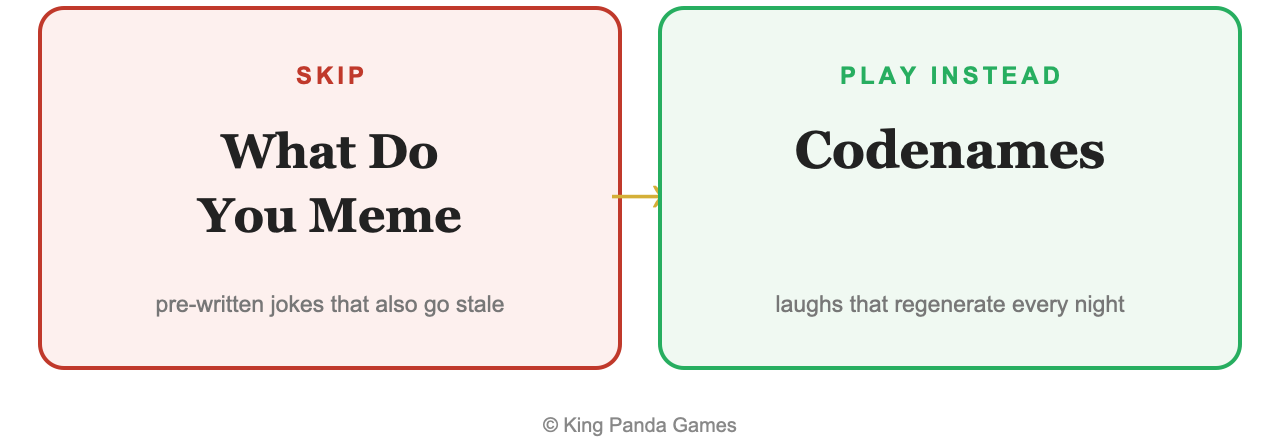
For the same party, permanently funny: Codenames — your friends’ one-word clues and the catastrophes they cause are the joke, so it renews with every crowd forever.
For actual player-made meme humor: Quiplash (Jackbox) — everyone writes the punchlines on their phones. It’s the game What Do You Meme is pretending to be.
For the same money, two lasting games: Coup + Love Letter — $30 total, both endlessly replayable, both pocket-sized. The value comparison isn’t close.
Frequently Asked Questions
Is What Do You Meme worth buying?
Rarely — it delivers one or two genuinely funny sessions and then decays fast, both from repeat plays and from its meme references aging out. As a one-night party icebreaker it works; as a $30 shelf purchase, better options exist at every price.
Is What Do You Meme just Cards Against Humanity?
Mechanically, yes — the same judge-picks-the-funniest loop with photo prompts instead of text prompts. The photos land slightly better on a first play; the replay collapse is identical.
Is What Do You Meme appropriate for families?
The base game is not — it’s raunchier than the Instagram branding suggests, and the 17+ label is accurate. A Family Edition exists and is genuinely tamer, though the meme-recognition gap between parents and kids works against it.
How many people do you need for What Do You Meme?
Officially 3+, realistically 6–8 for the sweet spot — enough captions per photo for variety while the judge’s read-aloud stays quick. Below five it sputters; above ten it drags.
Do the What Do You Meme expansions help?
They refresh the joke supply and update the meme references, which is treating the symptom — the game’s fun is stored in the cards, so keeping it funny is a repeat purchase. Games whose fun comes from the players never send you back to the store.
What’s a better game than What Do You Meme?
Codenames for the same party with regenerating laughs, Quiplash for player-written meme humor, and the Coup + Love Letter pair if you want maximum lasting value for the same $30.
Verdict
Play it at the party where someone else brought it — that’s its natural habitat and its best self. Buy it only as a deliberate one-night purchase or white-elephant gift, eyes open. Skip it for any shelf you’re building on purpose: it’s the most perishable product in the party aisle, and the alternatives above never spoil.
What Do You Meme official site: https://whatdoyoumeme.com/