

Bottom Line
The Crew: Mission Deep Sea is for tables who already play trick-taking games and want a cooperative puzzle that fights back. Skip it if somebody at the table still asks what following suit means, or if you want a game with a story rather than a system. Its strength is the communication rule: you can say just enough to be useful and never enough to solve the hand. Its weakness is that a bad deal can decide a mission before anyone plays a card.
Some links below are Amazon affiliate links — as an Amazon Associate, King Panda Games earns from qualifying purchases at no extra cost to you. Full disclosure.
This earns 4/5 Bamboo Plants and 5/5 Pandas from us, and the two scores pull in different directions for the same reason. The rules are short — 40 cards, four colours, one trump suit, one token each — and the task cards state their objective in plain words, so a table that knows trick-taking is playing inside ten minutes. That is the 4. The box runs about $15 on Amazon, which makes the value question mostly answer itself.
The 5 Pandas is for what happens after those ten minutes. This is the best cooperative card game we’ve played, and the reason isn’t the cards at all. It’s the information puzzle sitting on top of them.
| Detail | Info |
|---|---|
| Players | 3–5, plus a 2-player variant |
| Best Player Count | 4 — ten-card hands give everyone enough control to matter |
| Age | 10+ |
| Play time | ~20 min per mission |
| Complexity | Medium |
| Solo Mode | No |
| Designer | Thomas Sing |
| Publisher | KOSMOS / Thames & Kosmos |
| Popular Upgrades | No |
| Bamboo Plants | 4/5 — short teach, if trick-taking is already familiar |
| Pandas | 5/5 — the information puzzle is superb |
| Official site | Thames & Kosmos |
How It Works
Every mission is a hand of trick-taking with homework attached. The deck is 40 cards: 36 in four colours numbered 1 to 9, plus four submarine cards numbered 1 to 4 that act as trumps. You deal the whole deck out, so at four players everyone holds ten cards and nothing is hidden in a draw pile — every card is in somebody’s hand.
Before you play, you draw task cards. Each one names something a specific crew member has to achieve: win the pink 7, win more yellow cards than blue, win a trick containing only odd numbers, never open a trick with green. Each task carries a difficulty number that changes with player count, and you keep drawing until those numbers add up to exactly the mission’s difficulty. The player holding the submarine 4 becomes captain, picks a task first, and the rest choose in turn.
Then you play tricks, and here is the part that makes the game. You may not say what is in your hand. Not a hint, not a grimace, not “I might be able to help with that.” Once per mission you may use your sonar token: you display one colour card face up and put the token at the top, middle, or bottom of it to say this is my highest, my only, or my lowest card of that colour. Submarines can never be shown this way, and once the token is placed you cannot move it — even when the message stops being true later in the hand.
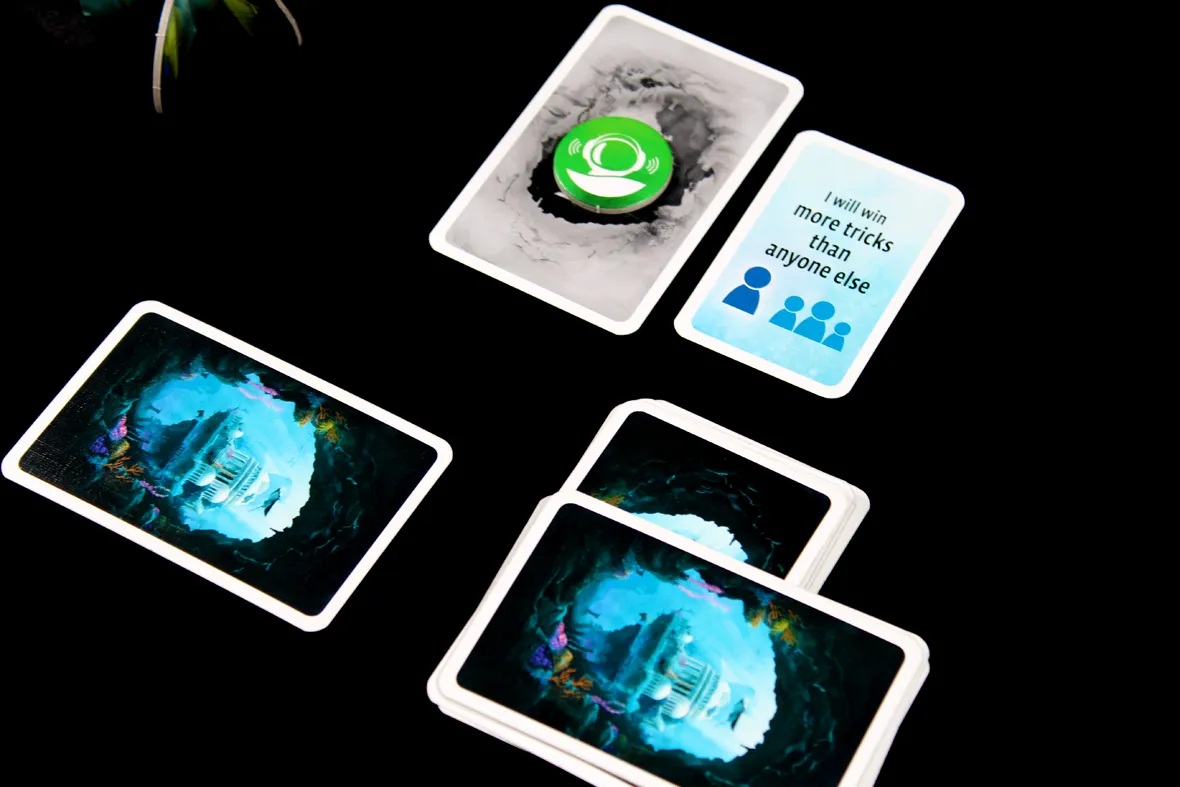
Jake shows the green 7 with the token at the bottom: his lowest green. Now I know something small and specific. He has green, and everything else green in his hand beats a 7. So if I lead a low green, he cannot duck under it — he has to take that trick, whether we want him to or not.
That is the whole game in one exchange. You are never told enough to solve the hand, only enough to reason about it. Complete every task before the cards run out and the mission is logged; miss one and the mission fails immediately, you reshuffle, and you try again.
What We Liked
- The communication rule is the design. Being able to give some information but never enough to finish the thought is the entire engine. A single sonar token changes how everyone reads the hand, and choosing which card to show is a harder decision than any card you play.
- It produces real “oh no” moments. You work out the plan, play a card, and realise in mid-air that you have just ruined someone’s objective. That noise a table makes is the reason to own this game.
- Missions genuinely differ. The task cards change what you’re solving rather than repeating the same trick-taking puzzle 32 times, and because tasks are drawn to hit an exact difficulty total, the same numbered mission isn’t identical between attempts.
- Nobody can quarterback it. This is the rare co-op where the strongest player physically cannot run everyone else’s turn. You can talk about general strategy, but the communication limits mean the loudest voice at the table doesn’t get to play the whole game.
- Failure is cheap. Losing costs you a shuffle and a redeal, not twenty minutes of setup, so a table that fails the same mission three times still feels like it is making progress.
- The difficulty curve is well judged. Early missions teach the system almost invisibly, and the later ones demand coordination that would have been impossible on night one.
What We Disliked
- A bad deal can decide the outcome. Sometimes you look at your hand and the mission is already gone. Some of that is the point — you’re meant to play it out — but it can feel like the deal made the decision and you were just there to confirm it.
- Everyone needs to know trick-taking. Following suit, trumps, being void in a colour: if one player is learning those concepts here, they will have a rough night while four people wait.
- The no-talking rule is hardest on new players. Sitting on the answer and being forbidden to say it is fun once everybody understands the game, and genuinely frustrating while you’re teaching it.
- The theme is a coat of paint. You’re underwater explorers hunting the sunken land of Mu, but mechanically you’re doing clever maths with 40 cards. If you want an adventure, this isn’t one.
- Twenty minutes can feel longer than an hour. You’re tracking what was revealed, what’s been played, which tasks are still open, and what each person could still be holding. That is a lot of mental load for a small box, and a long session gets tiring in a way heavier games somehow don’t.
Who It’s For
This is for groups who like being handed a constraint and told to work inside it. If your table enjoys Hanabi-style deduction, or plays cards at all — euchre, spades, pinochle, whist — the mechanics will feel immediately familiar and the restriction will feel fresh.
It’s also an unusually good fit for people who normally dislike co-ops because one confident player ends up running the table. The communication rules make that impossible by construction, which is a structural fix, not a house rule.
Who should skip this game: anyone whose group includes a player still learning what trumps are, tables that want theme and narrative, and anyone looking for a relaxed filler. Mission Deep Sea is small and short, but it asks for real attention for its whole twenty minutes. If you want a card game that survives a loud backyard, our best card games for a BBQ list is a better place to start.
Who Should Buy This?
At about $15 for 96 task cards and 32 missions, the value case doesn’t need much help. The real question is whether your table clears the trick-taking bar — if it does, buy it now, because the first session is where the campaign hooks people. If it doesn’t, buy it anyway but plan to spend a night on a simpler trick-taker first.
Buy it if you want one small box that gives a regular group months of escalating puzzles, and if “we barely pulled that off” is your favourite sentence at a table. This is a core collection game for card players, not a situational one.
Best Player Count
Four. The reasoning is structural rather than sentimental: at four players everyone holds ten cards, which is enough control to steer a trick and enough length for a sonar signal to still matter in the back half of the hand.
Three has a quirk worth knowing. Forty cards don’t split three ways, so the rulebook deals one player fourteen and the other two thirteen. The hand ends after thirteen tricks, which means that fourteenth card is dealt but never played — a small permanent hole in everyone’s deduction. It’s playable and often easier, but you lose some of the certainty that makes the puzzle satisfying.
Five splits the deck into eight-card hands, which means less individual control and more mission attempts decided by the deal. It’s the most chaotic count and the one where a bad shuffle stings most. If you’re choosing a count for teaching, pick four; if you’re choosing one for a hard evening, five will give you the most spectacular failures.
Replayability
The 96 task cards are the replay engine, not the 32 missions. Because you draw tasks until their difficulty numbers hit the mission’s total exactly, two attempts at the same mission rarely present the same problem, and the rulebook explicitly suggests not reshuffling used tasks straight back in so you keep meeting new ones.
The logbook then layers a campaign on top: you record attempts, and a mission solved with the distress signal costs an extra attempt on the page. That tiny bookkeeping does a lot of work, because it turns “we won” into “we won, but it took four tries and a lifeline.”
For a group playing a couple of missions a week, this is comfortably a season’s worth of game, and the back half of the logbook still produces hands nobody can immediately parse.
Awards
The original Crew won the Kennerspiel des Jahres 2020, and the Mission Deep Sea rulebook leads with that on its first page. The original also took the American Tabletop Awards’ Casual Games prize for 2021. Mission Deep Sea did not repeat that — it landed on the Recommended list in the same category the following year, behind Cubitos. Worth knowing if you see the sequel described as an award winner: the trophy belongs to the first box.
Similar Games
If you like Spirit Island, try The Crew: Mission Deep Sea — both are co-ops that punish sloppy coordination, but Spirit Island gives you complete information and a long think, while Mission Deep Sea hides almost everything and gives you twenty minutes.
If you like Codenames, try The Crew: Mission Deep Sea — both games are about squeezing meaning out of a signal that is far too small. Codenames gives the clue-giver all the freedom; here everyone gets exactly one token and the rest is inference.
If you liked The Crew: The Quest for Planet Nine, this is the upgrade — same trick-taking spine, but the written task cards replace the original’s symbol lookups, which is why we’d point a new table here first. We compare them properly in our Deep Sea versus Planet Nine breakdown.
Tips and Tricks
- Say nothing on purpose. Not communicating is itself information — the rulebook says so outright. If nobody signals in the opening tricks, the table can usually assume everyone thinks their tasks are already reachable.
- With 8 and 9 of a colour, show the 8 as your lowest. Showing the 9 as your highest tells the table almost nothing; the 8 as lowest tells them everything above a 7 in that colour is yours.
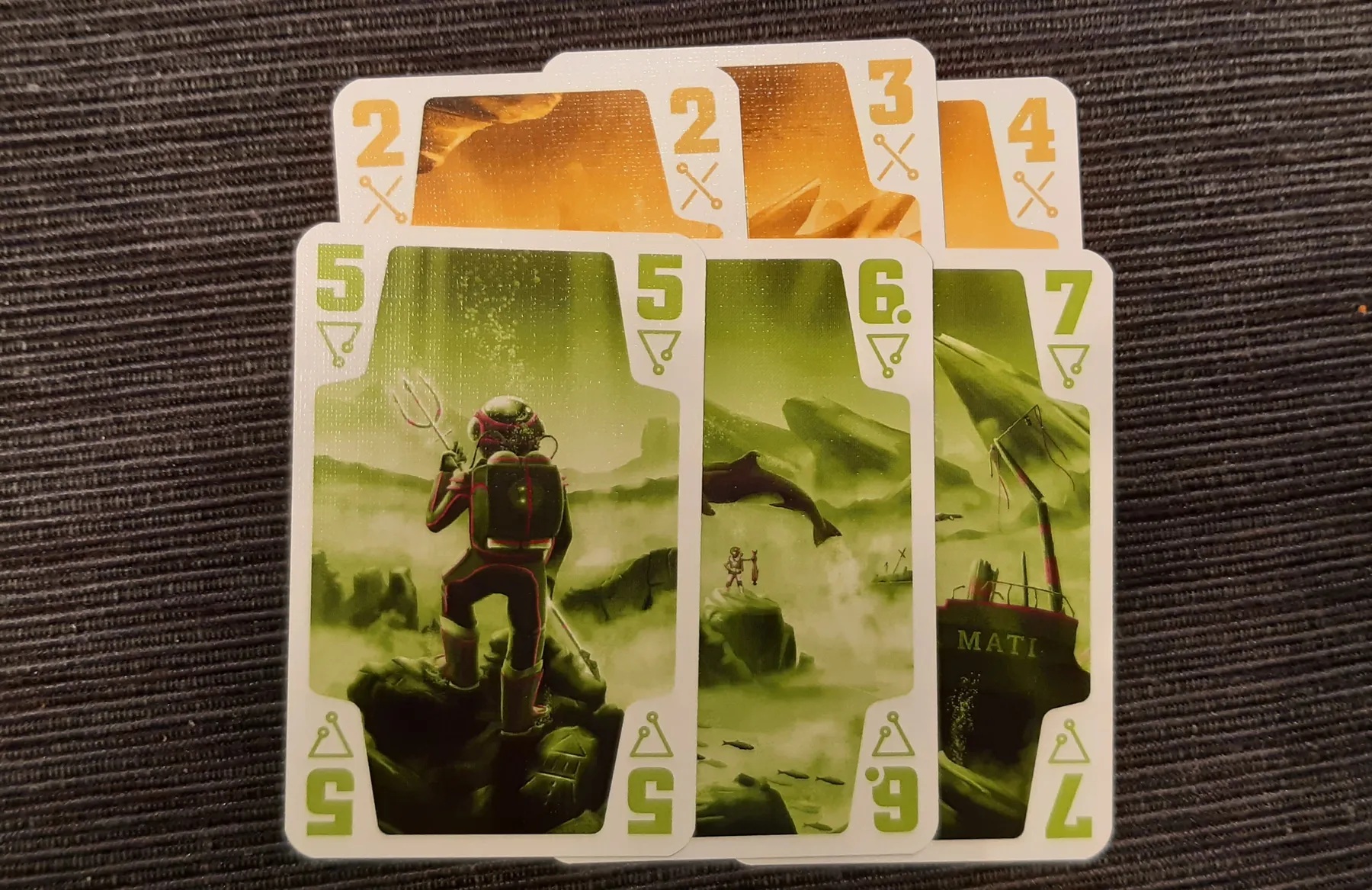
- Take tasks that can resolve in the same trick. One trick can complete several tasks at once, and the task-selection step is where you should be hunting for those overlaps.
- It is easier to win a card you don’t hold. Especially low ones — if you need the blue 3 and you’re void in blue, a submarine takes it comfortably.
- Spend the distress signal early, not heroically. Passing one card costs a single extra attempt in the logbook, and it can turn an impossible task allocation into a solvable one before anyone has communicated.
Frequently Asked Questions
Is The Crew Mission Deep Sea worth buying?
Yes, if everyone at your table already knows how to follow suit. For about $15 you get 96 task cards and 32 missions that stay interesting for months. If trick-taking is new to half your group, buy it anyway but expect the first night to be a teach rather than a campaign.
Do you need to play the original Crew first?
No. Mission Deep Sea is a stand-alone game with its own 32-mission logbook, and the rulebook even tells returning players to skip ahead to page 8. Starting here is the better choice for most tables because the task cards explain themselves.
How long does a game of The Crew Mission Deep Sea take?
About 20 minutes per mission, and most sessions run two or three missions. Failed attempts are fast, because you reshuffle and redeal rather than replaying a long setup.
Can you play The Crew Mission Deep Sea with 2 players?
Yes. The rulebook includes a two-player variant where a third crew member called Tonoja is represented by 14 cards in a double row, and the captain plays her face-up cards. Both players hold 13 cards and the three-player task rules apply.
What happens if a mission is impossible to complete?
The rulebook tells you to play it out anyway, because tables misjudge their hands more often than they think. If a task combination really is impossible, such as two players each needing to win the first trick, you shuffle the last task card back and draw a replacement of the same difficulty.
Can you talk during The Crew Mission Deep Sea?
You can discuss tasks before they are assigned, but once the mission starts you cannot say or hint at what is in your hand. Your only signal is one sonar token per mission, placed on a card you display to show it is your highest, only, or lowest card of that colour.
Is The Crew Mission Deep Sea good for families?
It works well for families who already play trick-taking games, and the box says 10 and up. Younger players can struggle with the no-talking rule more than with the card play itself, because knowing the answer and not being allowed to say it is genuinely hard.
What is the distress signal token for?
It is the game’s help mechanic. Before anyone communicates, the crew can activate it and everyone passes one card, never a submarine, to the same neighbour. Using it costs you one extra attempt in the logbook, which is the only price you pay.
Want to Go Deeper?
- The Crew Mission Deep Sea With 2 Players — how Tonoja actually works, and whether the two-player game is worth playing. Read it here
- Mission Deep Sea or Planet Nine — which Crew to buy first, and what actually changed between them. Read it here
- The Crew Mission Deep Sea Strategy and Sonar Tips — how to choose what to signal, and the task-selection habits that win missions. Read it here
Verdict
Buy it if your table plays cards and wants the best cooperative puzzle in a small box. Skip it if someone is still learning what a trump is, or if you want theme rather than system. Try before you buy only if your group has historically bounced off games that forbid talking — that restriction is the whole experience, and it isn’t for everyone.
You can read the full rules yourself before buying: the official rulebook PDF is free, and Shut Up & Sit Down’s review is the best second opinion if you want to see it played before deciding. Its BoardGameGeek page has the full mission-by-mission community discussion.
The Crew: Mission Deep Sea official site: thamesandkosmos.com