

Bottom Line
Codenames is the best party game ever made for groups who want to actually think. It rewards vocabulary, lateral thinking, and the ability to read your teammates — none of which require board game experience. The only players who bounce off it are those who freeze under social pressure, because both the Spymaster and operative roles demand you commit to something in front of everyone. If your group can handle that, buy it immediately.
Codenames earns 5/5 Pandas and 4/5 Bamboo Plants. The five Pandas come from the fact that this game has been ending game nights with “one more round” since 2015 — it’s the rare party game that rewards real intelligence while still working at a table with people who’ve never played a board game in their life. The four Bamboo Plants (not five) is honest: the rules teach in five minutes, but being a good Spymaster is a skill you develop over many sessions. New players underestimate this gap every time.
Some links below are Amazon affiliate links — as an Amazon Associate, King Panda Games earns from qualifying purchases at no extra cost to you. Full disclosure.
| Detail | Info |
|---|---|
| Players | 2–8+ |
| Best Player Count | 6 — two teams of three, everyone engaged |
| Age | 14+ |
| Play time | 15–30 min |
| Complexity | Light |
| Solo Mode | No |
| Designer | Vlaada Chvátil |
| Publisher | Czech Games Edition |
| Popular Upgrades | No |
| Bamboo Plants | 4/5 — rules in 5 min, Spymaster skill takes longer |
| Pandas | 5/5 — ends every game night with “one more round” |
| Official site | czechgames.com/games/codenames |
How It Works
 It lands at #3 on our best board games of 2026 list.
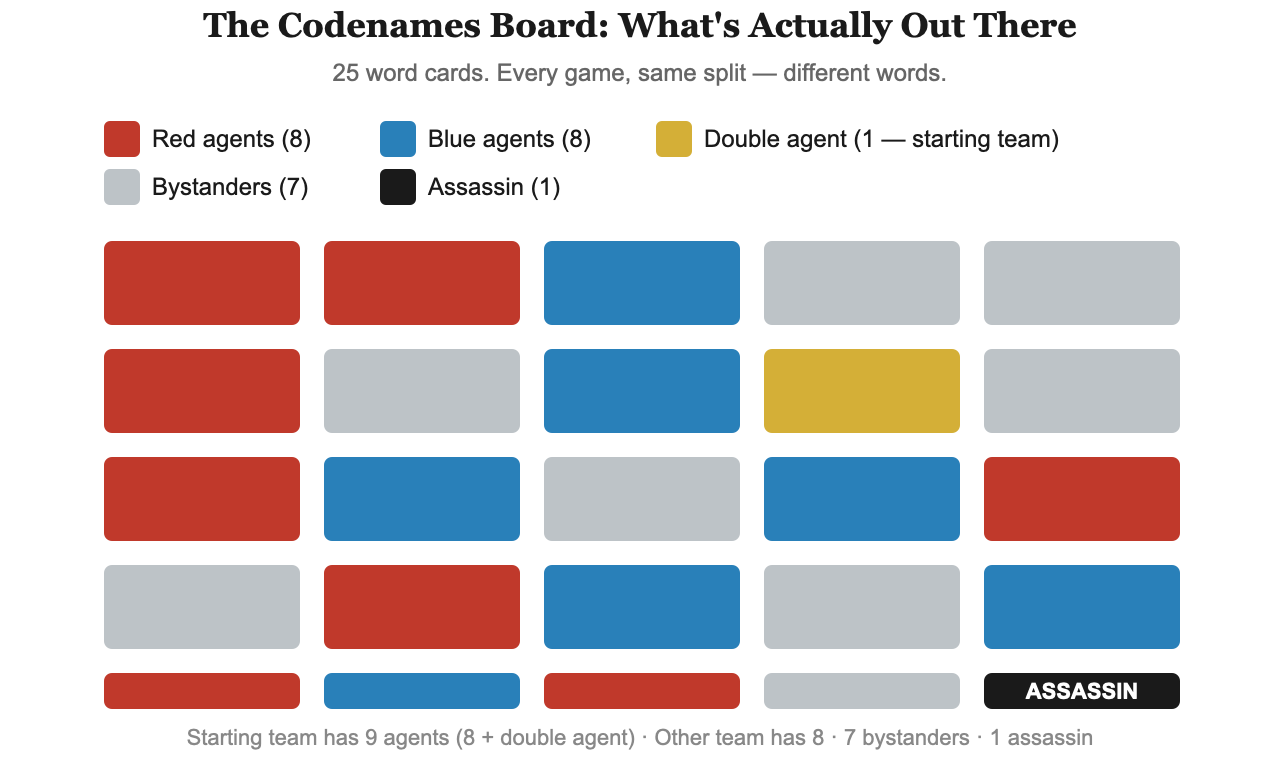
25 word cards. A 5×5 grid of seemingly unrelated codenames — LONDON. APPLE. NEEDLE. TRUNK. NURSE — laid out on the table. Two teams: red and blue. Each team has a Spymaster who holds a secret key card showing exactly which words belong to which team, which are innocent bystanders, and which one is the assassin.
You’re the Red Spymaster. Your key card shows your team owns BARK, FOREST, and TRUNK. There’s a bystander — PAPER — that could plausibly connect, and your opponent owns ROOTS. You say “TREE, 3.” Your operatives immediately lock in FOREST and TRUNK, then spend 90 seconds debating whether BARK means tree bark or dog bark. They pick BARK. Correct. Then someone makes a convincing argument that paper comes from trees, and you watch, completely stone-faced, as they touch PAPER. Bystander. Turn over.
That’s Codenames in one turn. The Spymaster knows everything. The operatives know nothing except the 25 words in front of them. The game lives in the gap between those two states.
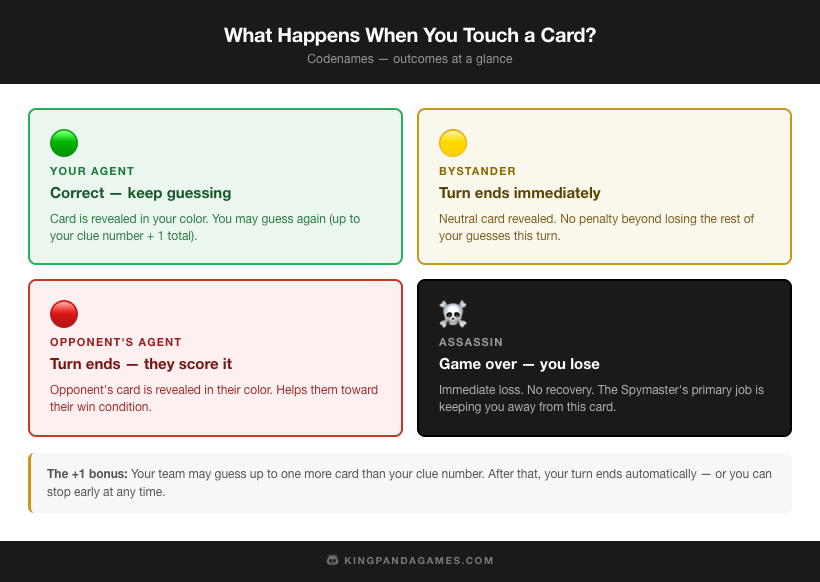
Turn mechanics: your team gets to guess up to the clue number plus one bonus guess. Touch your own agent card — correct, you may keep going. Touch a bystander — turn ends immediately. Touch the opponent’s card — they claim it and your turn ends. Touch the assassin — your team loses on the spot. First team to uncover all their agents wins. The starting team has 9 agents on the board; the second team has 8. That extra card is the built-in cost of going first.
A full game usually runs four to seven rounds total across both teams. Early turns have the most options — the board is full, clues can connect five or six candidates, and Spymasters have room to be ambitious. By the final three or four turns, the board is sparse, the remaining cards are the ones nobody wanted to guess earlier, and a single bad clue ends the game. The tension arc is built into the design: Codenames almost always ends with one high-stakes round that neither team saw coming.
What We Liked
The assassin is what separates Codenames from every other word-association game on the shelf. Without it, you’d have a pleasant-enough cooperative exercise. With it, every single guess carries real stakes. There’s always a version of events where “COLD, 2” accidentally routes your team to the assassin card STONE because someone made a compelling case about cold stone floors. That tension doesn’t go away — it’s there in round one and it’s there in round fifty.
The Spymaster role is unlike anything else in party gaming. You’re sitting on all the information, holding the key card below the card stand so no one can see it, trying to give a clue that connects three of your words without touching any of the six opponent cards or the bystanders or — worst of all — the assassin. When your team cracks a four-word clue on the first try and everyone at the table is staring at you in disbelief, that’s the feeling this game was built for.
It also bridges groups that most games can’t. A 16-year-old and a 60-year-old can sit on the same team without either being bored or lost. Vocabulary and lateral thinking do the equalizing — there’s no reaction-speed disadvantage, no pop culture gap that shuts someone out. For genuinely mixed-age groups, this matters more than most reviews acknowledge. That is why Codenames is #3 on our best board games for teens list, and the one we hand a table with a teenager and a grandparent on it.
Worth knowing: The 200 double-sided word cards give you 400 unique codenames. With 40 double-sided key cards (80 configurations), the grid combination space is enormous — you won’t see meaningful repeats for a very long time.
What We Disliked
Quiet players go invisible. If you’re on a four-person team and one player won’t argue for their guess, the other three make every call. This isn’t strictly a Codenames design flaw — it’s a social dynamics problem — but it surfaces faster here than in most party games because every guess requires real team consensus. With the wrong group dynamic, Codenames highlights the imbalance rather than smoothing it over.
The Spymaster role is also genuinely uncomfortable when you’re new to it. You give a clue, your team heads in the wrong direction, and you cannot say or signal anything — no nodding, no raised eyebrows, no visible discomfort near the assassin card. First-time Spymasters almost always slip. And when they do, experienced players at the table will catch it, which poisons the round.
The base word set also has a ceiling. After 30+ sessions with the same core group, you start predicting each other’s clue strategies. You know how each person thinks as a Spymaster. The game stops surprising you, even when the word grid changes. The expansions address this, but they require a separate purchase.
Who It’s For
Codenames fits best with friend groups in their 20s and 30s who want something they can explain in five minutes but still argue about for an hour afterward. It’s competitive enough to stay interesting, simple enough that no one needs a rulebook in hand after the first game, and short enough (15–30 minutes) to run multiple rounds in a single night.
It also works well for mixed-age family gatherings — specifically when you need a game that doesn’t favor one generation over another. LONDON means the same thing to a 15-year-old and a 55-year-old. That’s harder to find than it sounds.
Who should skip this game: Anyone who freezes when put on the spot. The Spymaster role requires holding your reaction while your team makes painful, avoidable mistakes — if that sounds miserable, it will be. And if your group has players who won’t commit to guesses out loud, the operative side collapses into one person deciding for everyone. Codenames rewards people who want to be in it, and punishes groups with passengers.
Who Should Buy This?
Buy it. At $20–25, Codenames delivers more hours of actual fun per dollar than most games at twice the price. The 15–30 minute play time means it fits before dinner, between other games, or as the last game of the night when energy is low. It runs cleanly at 4–10 players without any rules adjustments.
The one pause: if you exclusively play with 2 people, you’re buying the wrong version. Codenames Duet was built specifically for two-player cooperative play and is the better choice in that situation. For everyone else — any group of four or more — the base game is the buy.
Check Codenames price on Amazon →
Best Player Count
Six players — three per team — is where Codenames is best. Both teams have enough operatives that real deliberation happens before each guess, and both Spymasters are working under genuine pressure from across the table.
At four (2v2), the game still functions but loses the thing that makes it special. With only one operative per team, there’s no debate — one person guesses, and guessing alone removes the social layer entirely. You’re playing a different game.
At eight or more, the teams get large enough that the loudest voice makes every call. Quieter players fade out. Turn time creeps up as bigger groups spend more time reaching consensus. The box says 2–8+ and none of those are technically wrong — but six is the answer, and four is where it’s still good enough to bother with.
Replayability
High — with one honest limit. The 400 unique codenames and 80 key card configurations mean the word grid randomizes across hundreds of sessions before overlap becomes noticeable. On pure variety, Codenames holds up for dozens of plays without feeling repetitive.
The limit: clue strategies get predictable before the words do. By game 20 or 25 with the same group, you start anticipating how each person thinks as a Spymaster. The surprise erodes slowly. The game doesn’t get boring — it gets familiar, which is a different problem.
The expansions genuinely extend the game’s life. Codenames: Pictures replaces words with illustrated cards and resets the puzzle completely — visual pattern recognition is a different skill than linguistic association, and it often clicks better with groups who struggle with word-based clues. Codenames: Duet is a full cooperative redesign for two players. Both are legitimate purchases, not cash-grab add-ons.
Awards
Codenames won the Spiel des Jahres in 2016 — the most prestigious award in board game design. The Spiel is the Nobel Prize of tabletop gaming; winning it is the difference between a niche cult following and a game that ends up in every Target in America.
Similar Games
If you like Taboo, Codenames replaces it. Taboo rewards speed and energy. Codenames rewards precision and restraint. Most groups past college age find Codenames ages better because the fun doesn’t depend on everyone being in the right mood — the game provides enough structure that quieter nights still work.
If you like Wavelength, try Codenames next. Both reward reading your teammates’ minds and work well with the same crowds. Wavelength plays faster per round and is better for groups where some players struggle with word-based thinking. If Codenames ever stalls your group, Wavelength is the first alternative to try.
If you like Just One, Codenames is the sharper version. Both are word-based party games that reward reading your teammates, but Just One is fully cooperative and plays in about 20 minutes. Codenames adds competition, the assassin’s permanent threat, and an asymmetric role structure that Just One doesn’t have. Just One is gentler and friendlier to groups who don’t want conflict. Codenames is better when your group wants something with actual stakes.
If you liked Carcassonne and want to add something more social to your shelf, Codenames is the cleaner choice — it pulls in non-gamers faster and doesn’t require any spatial reasoning. Check out our full Carcassonne review if you’re choosing between them for a family shelf.
If you want a team game with no words or reading required, try Sequence. It uses playing cards and a grid board — teams race to complete rows of chips without any verbal strategy involved. It’s faster (20 minutes), works with up to 12 players, and has zero learning curve. Our Sequence review covers exactly who it’s for.
Codenames also appears regularly in our best games for groups and best card games for adults roundups — worth reading if you’re building out a broader game night collection.
Tips & Tricks
Build your clue around what it excludes, not just what it includes. New Spymasters think about their three target words and work outward. Experienced Spymasters think about the assassin and opponent cards first, then find a clue their words share that those dangerous cards can’t plausibly claim. The fence has to keep things out, not just gather things in.
What most Spymasters do: Connect as many of their own words as possible in one clue — a 4-word clue feels efficient. The problem is each added word is another chance your team picks the assassin or the opponent’s card by mistake.
What actually works: Give 2-word clues for your safest pairs first. Bank small wins. The +1 bonus guess adds up across turns faster than a single blowout clue that ends in disaster.
Track the assassin every single turn before you build any clue. Look at the assassin card. Ask yourself: what clue word could my team plausibly link here? Work around it deliberately. If the assassin is CROWN and you’re considering “QUEEN,” reconsider. The assassin is the real puzzle you’re solving — your agent cards are secondary.
Operatives: process of elimination works. When a clue lands and you’re not sure which cards it connects, flip the question. What would the Spymaster never have meant? Which cards are too risky, too obvious, or too disconnected from the theme? Narrowing down the wrong answers often gets you to the right guess faster than pure association.
The +1 bonus guess is underused by most teams. After correctly guessing all your clue words, you get one free extra guess — this is the right moment to act on a strong read from a previous unfinished clue. A lot of games are won in this window.
Spymasters: save your hardest card for last, not first. Most Spymasters try to bundle a difficult word into an early clue because it feels like the right time to be ambitious. The problem — the board is fullest early, which means the most possible wrong connections exist. By the final two turns, the board is sparse, the dangerous cards are already gone, and a clue that would have been impossible in round one is suddenly clean. Save your toughest connection for when the board has fewer traps.
Frequently Asked Questions
Is Codenames worth buying?
Yes. At $20–25, it’s one of the best value-per-hour purchases in party gaming. It plays in 15–30 minutes, works with 4–10 people, and requires zero board game experience to enjoy. Most groups that try it end up playing three or four rounds back to back without being asked.
How long does a game of Codenames take?
A single game runs 15–30 minutes. With experienced players and decisive teams, it’s closer to 15. With a new group still learning the Spymaster role, expect 30. Budget 45–90 minutes for a proper session — most groups play multiple rounds.
Is Codenames good for families?
Yes, with one condition: you need at least one confident reader per team willing to take the Spymaster role. The box says 14+, which is accurate — younger kids can play operatives but struggle to give clues without accidentally telegraphing information. For mixed-age groups where everyone is 14+, it’s one of the best options available because vocabulary beats reaction speed and pop culture knowledge.
What is the assassin in Codenames?
The assassin is one of the 25 word cards on the board. If a team’s operatives touch it on their turn, that team loses immediately — game over. The Spymaster knows which card it is and must give clues that steer their team away from it. It’s the single mechanic that gives Codenames real tension.
Can you play Codenames with 2 players?
Technically yes, but the experience is missing the social layer that makes Codenames work. With two players, there’s no team deliberation — the whole dynamic disappears. For two-player games specifically, Codenames Duet is the right buy: it’s a cooperative redesign built from the ground up for two, not a modified version of the base game.
What makes a clue illegal in Codenames?
A clue is illegal if it uses any word currently visible on the board, if it’s more than one word, or if it uses a word that’s part of a compound word shown on the board. The official penalty for an illegal clue: the opposing team gets to cover one of your agent cards. House rules vary, but that’s the Czech Games Edition ruling.
Is Codenames better than Codenames Pictures?
They’re different puzzles, not the same game in two formats. Codenames rewards linguistic and lateral word thinking. Pictures rewards visual pattern recognition and abstract connection. Groups with non-native English speakers or players who struggle with word-based clues often click faster with Pictures. Most groups that love one end up owning both.
Does the team that goes first have an advantage?
The starting team has 9 agents vs. the second team’s 8 — one more card to find, not one less. The extra agent is the built-in cost of going first. In practice, experienced players don’t consider this a meaningful imbalance; the advantages of going first (fuller board, more connection options) roughly offset the extra work.
Want to go deeper?
- Codenames Spymaster Tips: How to Give Clues That Actually Win — everything you need to move from guessing-game chaos to real Spymaster strategy. Read it here
- Codenames vs Codenames Duet: Which Version Should You Buy? — a direct comparison so you buy the right one for your group the first time. Read it here
- How Many Players Do You Need for Codenames? — the honest answer to player count, including what actually works vs. what the box claims. Read it here
Buy it if you want a party game that rewards real thinking and works for any group of four or more. Skip it if your group has players who shut down under social pressure, or if you’re buying it specifically for two people. Try it once before committing if you’re not sure word-association games are your thing — one round will tell you everything.
Codenames official site: czechgames.com/games/codenames