

Task selection is where you still have the most control. By the time you’re playing cards the shape of the hand is largely set — what you chose to take, and what you told your crew before the first card hit the table, is the part you decided.
These are the habits that move a table from “we got unlucky” to “we had that,” several of them straight from the rulebook’s own tips page.
Show the Card That Says the Most
Your sonar token is one message per mission. The instinct is to show your biggest card. That is almost always the weaker choice.
Consider a hand with the green 8 and green 9 and nothing else in green. Showing the 9 as your highest tells the table you hold the highest green — which they could have guessed from the 9 never appearing. Showing the 8 as your lowest tells them something far sharper: everything green you hold is above a 7, and you have at least two of them.
The rule: a token on a low card usually carries more information than a token on a high one, because it draws a boundary rather than naming a single card.
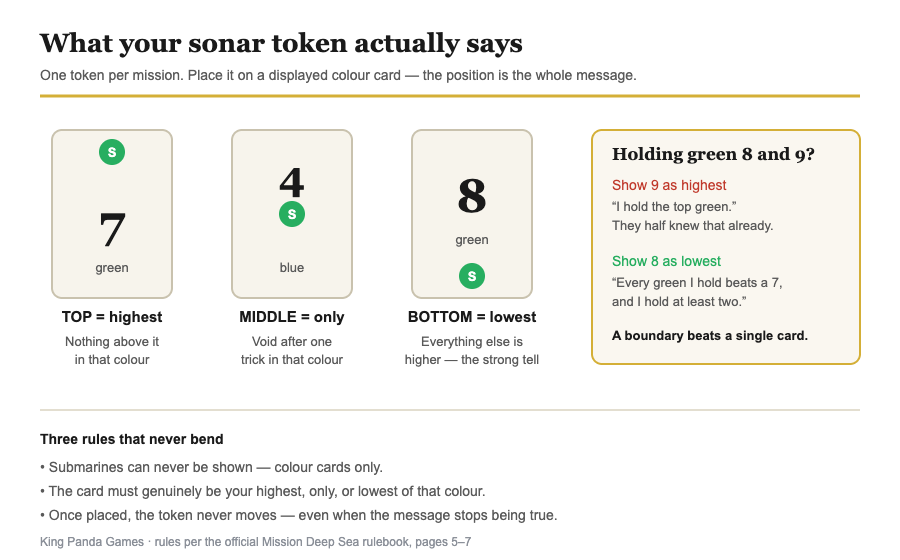
The “only” position carries the most information of the three when it is true. This is my only blue tells the crew exactly how many blue cards sit elsewhere, and it tells them you will be void in blue after one trick.
Say Nothing, Loudly
Silence is a signal and the rulebook treats it as one. If nobody has placed a token by the second trick, the reasonable inference is that everyone believes their own tasks are already on track.
That cuts both ways. If you’re sitting on a task you cannot see a path to, an early token is more useful than a late one, because your crew can still change their plans around it. A token saved for a better moment is often a token that never gets placed at all.
Remember that a placed token freezes. If you show the pink 4 as your lowest and later play your pink 2 — well, you can’t, because the 2 would have been your lowest. But your highest can stop being your highest in effect, and the token stays where it is. Plan the message to still be true in five tricks.
Pick Tasks That Collapse Into Each Other
Here is where most missions are actually decided.
When the task cards are face up in the middle of the table, you are not looking for the task you can most easily complete. You’re looking for two or three that can be completed by the same trick.
Mission five, four players. The table shows “I will win the blue 4”, “I will win a trick containing only even-numbered cards”, and “I will win at least three cards of any one colour”. One player taking all three can chase a single fat blue trick — the blue 4, even numbers, three blues — and clear all of them in one go. Split those three tasks across three players and you now need three separate tricks to fall exactly right.
The rulebook’s own tip section says this plainly: being able to complete several tasks in one trick is worth a lot. It’s easy to forget during selection because taking two tasks feels greedier and riskier than taking one.
Learn Which Cards Are Easy to Win
Two structural facts about trick-taking decide most task outcomes:
- It is easier to win a card you don’t hold. If you need the yellow 3, holding the yellow 3 is useless. You need someone else to play it into a trick you take.
- Being void is a weapon. If you have no cards in a colour, a submarine takes any trick in that colour. Tasks asking for low cards in a specific colour are much easier when you’re void in it.
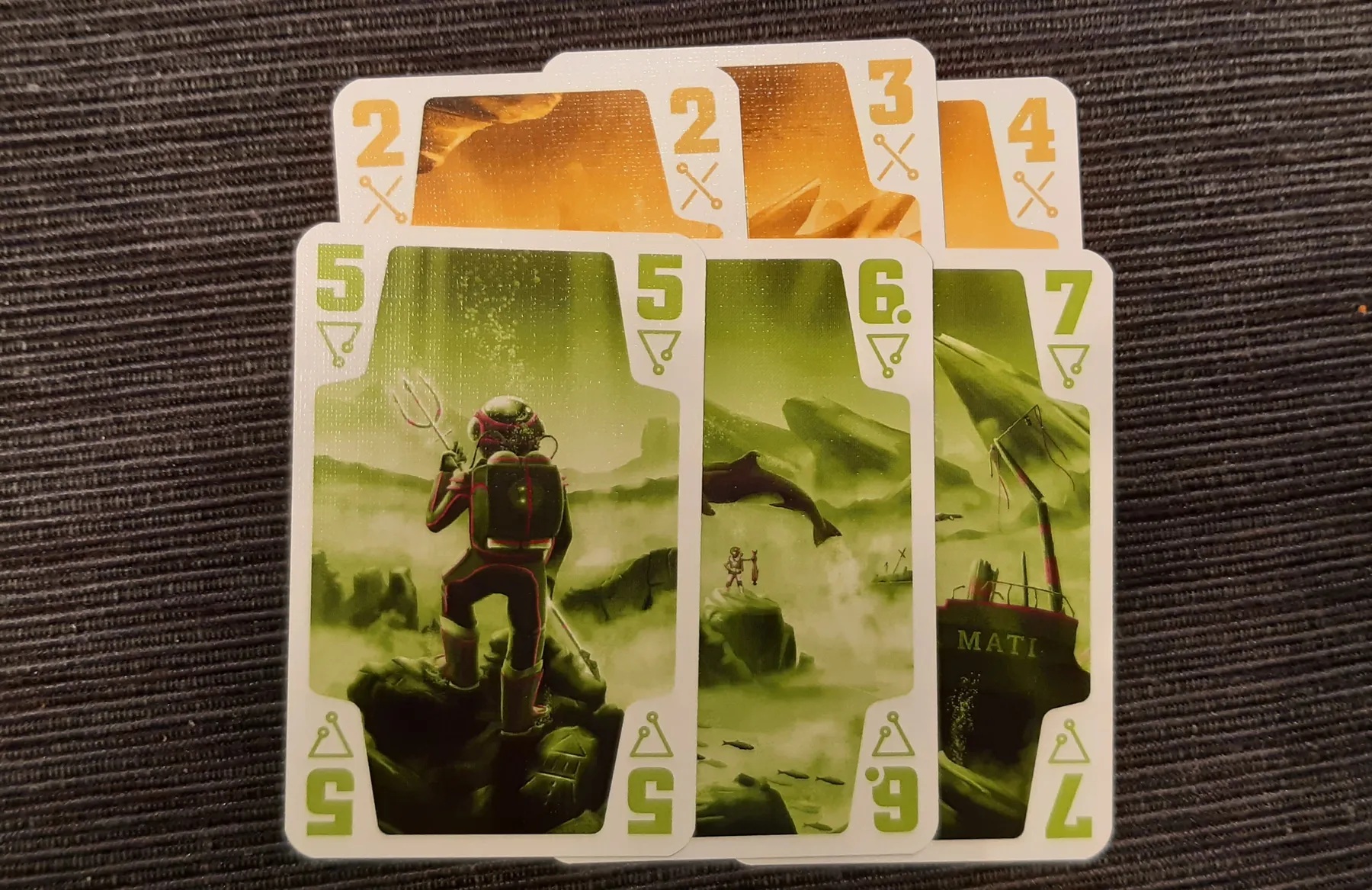
So when you read I will win the green 2, check whether you hold green at all before deciding it’s hard. Sometimes the best position is having none of a colour, because a submarine will collect whatever is led.
Spend the Lifeline on Bad Allocations, Not Bad Hands
The distress signal passes one card from every player to the same neighbour, before any communication, at a cost of one extra attempt in the logbook.
Use it when the tasks are wrong, not when your hand is ugly. A hand with no face cards still plays fine if your task is to avoid opening with green. A task allocation where two people need the same trick is a structural problem, and passing a card is the only tool that can fix it before play starts.
And when you do think a mission is dead, play it out anyway. The rulebook is emphatic about this, and it’s right — tables misjudge their hands constantly, and a mission you were sure was lost takes ninety seconds to finish proving it either way.
The Information Most Tables Forget to Track
Track what has been ruled out, not only what has been shown.
When a player fails to follow a colour, that is permanent information: they are void for the rest of the hand, and every future trick in that colour is one they can trump or discard into. A sonar token is easy to remember because it sits face up on the table; a void leaves no marker at all, which is exactly why it is the easier information to lose. Those voids accumulate, and by the sixth trick the shape of a hand is often clearer from what never appeared than from anything anyone signalled.
For the rules themselves, the official rulebook is free to download, and the BoardGameGeek forums are where tables argue about specific mission solutions when they get stuck.
Frequently Asked Questions
What is the best card to communicate in The Crew Mission Deep Sea?
Usually a low card shown as your lowest, because it tells the table the most. If you hold the 8 and 9 of a colour, show the 8 as your lowest: that says everything above a 7 in that colour belongs to you, while showing the 9 as your highest says almost nothing.
When should you use the sonar token?
As early as the information stays true, and always before the trick where it matters. A token placed before the first trick shapes every decision after it, and you cannot move it later even when the message stops being accurate.
How do you choose tasks in Mission Deep Sea?
Look for tasks that can resolve in the same trick, and take them yourself rather than spreading them around. One trick can complete several tasks at once, which is the cheapest way to clear a difficult mission.
Should you always use the distress signal?
Use it when the task allocation looks impossible rather than when a hand looks weak. It costs one extra attempt in the logbook, and passing a single card can convert an unreachable task into a reachable one before anyone has communicated.
Is saying nothing a strategy in The Crew?
Yes, and the rulebook says so directly. Not communicating is itself information: if nobody signals in the opening tricks, the table can usually assume everyone believes their tasks are already reachable.
How do you win a specific low card in The Crew?
Get someone else to lead the colour while you hold a higher card in it, or be void in that colour and take the trick with a submarine. It is easier to win a card you do not hold than one sitting in your own hand.
Do this first: next mission, before you look at anything else, read every task on the table and ask which two could be won by the same trick. Then take both.
More on the game itself in our full Mission Deep Sea review, how the dummy hand changes things in the two-player guide, and which box to start with in Deep Sea versus Planet Nine.