


Bottom Line
Mysterium is best for groups of four or more who like talking through clues together and want a cooperative game with real atmosphere. Skip it if nobody in your group will commit to playing the ghost, because the whole game runs through that one player. Its biggest strength is the debate over every vision card, where the table argues about what a painting of a staircase really means. Its biggest weakness is that a flat or rushed ghost makes for a flat game.
Mysterium gets 4/5 Bamboo Plants and 4/5 Pandas from us. It’s pretty easy to play once you get started, and Mysterium is worth buying for any group that already enjoys games like Dixit or Codenames.
The Bamboo is a 4 because the first few minutes are the hard part: the ghost’s screen, the three rows of cards and the clock all need explaining. Once the first visions are on the table, it clicks. The Pandas are a 4 because the game is great with an engaging ghost, and you need to have one for it to be a fun experience.
Some links below are Amazon affiliate links — as an Amazon Associate, King Panda Games earns from qualifying purchases at no extra cost to you. Full disclosure.
Check Mysterium price on Amazon →
We’ve played Mysterium; the scores and the player-count call are ours. Rules, card counts and edition details come from Libellud’s rulebooks and BoardGameGeek. We haven’t played the expansions, Mysterium Park or Mysterium Kids, so where we mention them, it’s from the rules and listings.
Mysterium is a cooperative mystery game where one silent player, the ghost, sends picture cards to everyone else, the psychics, so they can work out who killed them, where, and with what.
| Detail | Info |
|---|---|
| Players | 2–7 (original edition); 3–7 (2025 edition) |
| Best Player Count | 4 — enough psychics to argue over every vision, short waits for the ghost |
| Age | 10+ |
| Play time | 42 min on the box |
| Complexity | Light to medium |
| Solo Mode | No |
| Designers | Oleksandr Nevskiy and Oleg Sidorenko |
| Publisher | Libellud |
| Popular Upgrades | No |
| Bamboo Plants | 4/5 — easy once you get started |
| Pandas | 4/5 — great with an engaging ghost |
| Official site | Libellud’s Mysterium page |
How Mysterium Works
Mysterium is a cooperative deduction game. Everybody wins or loses together, and the only person who knows the answer can’t say a word.
One player is the ghost. They sit behind a screen with a hand of seven vision cards: dreamy, surreal paintings with no words on them. Every other player is a psychic, and each psychic has a secret target: one suspect, one location and one object from the cards laid out on the table.
Each turn, the ghost gives every psychic a vision of one or more cards that hints at their current target. The psychics then talk it over with each other, out loud, while a two-minute hourglass runs. The ghost listens and can’t react.
Libellud’s rulebook walks through one: a psychic has to find the Attic, which shows a wedding dress. The ghost sends a card with a woman in a white dress, one with a strange bluish light, and one full of cobwebs. The rest of the table says Attic. The psychic is convinced it’s the Bedroom and goes with their gut. That argument is the whole game.
Right guesses move a psychic on to their location, then their object. Wrong guesses keep their vision cards and get more next turn. The séance lasts seven turns on the clock board, and every psychic has to find all three cards by then.
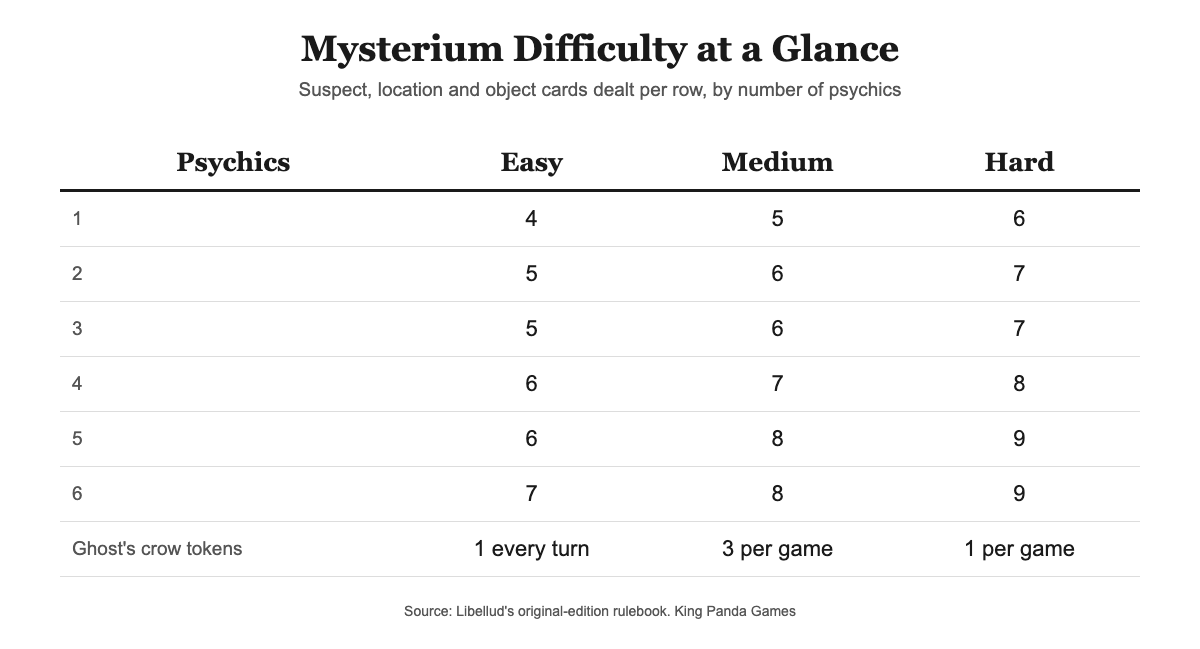
If they do, the ghost sends one last three-card vision, and the psychics vote in silence on which psychic’s three cards are the real murder. Difficulty sets how many cards are on the table: with three psychics, that’s five of each type on easy, six on medium and seven on hard. It also sets the ghost’s crows, which redraw a bad hand: one every turn on easy, three per game on medium, one per game on hard. The full sequence is in our Mysterium rules guide, and Libellud’s rulebook is free to download.
What We Liked
The table talk is the best part. The psychics are allowed to discuss everything, and they will. Two people looking at the same painting see completely different things, and you have about two minutes to settle it. Shut Up & Sit Down’s Mysterium review “categorically recommends” it for the same reason.
It’s easy once you get started. The opening explanation is the only hurdle. After one round of visions, nobody needs the rulebook again.
The art carries the mood. The vision cards are strange and beautiful, and they’re what make a cooperative guessing game feel like a ghost story. BoardGameGeek members gave it their 2015 Golden Geek award for artwork and presentation.
Being the ghost is its own game. The ghost has to point someone to one card using only paintings that were never drawn to match it, then sit silently while the table talks itself toward, or away from, the right answer.
What We Disliked
Everything depends on the ghost. You need to have an engaging ghost for this to be a fun experience. A ghost who rushes, gives up on hard cards, or can’t sit still and silent turns a great game into a slow one. Libellud’s rulebook itself recommends that a player who already knows the game takes the ghost for a first game.
The ghost works harder than everyone else. Six psychics share the fun of arguing, while one person does all the thinking alone behind a screen. Some players will love that job; others won’t want it twice.
- Setup is fiddly. Dealing three rows of cards and matching each one behind the screen takes a few minutes before every game.
- Luck of the draw. Seven vision cards don’t always have anything that fits, which is what the crow tokens are for.
Who It’s For
Mysterium is for groups who love talking a puzzle through: fans of Dixit, Codenames and cooperative games, and families with kids of 10 and up. It’s also a natural Halloween game, since the story takes place on Samhain night.
It works best when one player in your group is a natural storyteller who will happily be the ghost every time.
Who should skip this game:
– Groups where nobody wants to be the ghost.
– Players who want a quiet, competitive strategy game. This one is loud and shared.
– Two-player households. The original edition has 2-player rules, but the game needs a table to argue.
Who Should Buy This?
Buy Mysterium if you have a regular group of four or more and at least one person who will enjoy playing the ghost. It’s a core collection game for party-leaning groups and a situational one for strategy players.
Try it first if your group is quiet. The game is only as lively as the conversation.
There are two editions in stores: the original and a 2025 refresh with more cards and a few rule changes. Both are good buys, and our Mysterium versions guide explains which to get. For most people, the Mysterium base game is the one to start with.
Check Mysterium price on Amazon →
Best Player Count
Mysterium is best with 4 players: one ghost and three psychics. The box says 2 to 7.
With three psychics there are enough voices to argue over every vision, and the clairvoyancy tokens come into play, letting psychics bet on each other’s guesses. The ghost only has three visions to build each turn, so the psychics never wait long.
BoardGameGeek’s community poll leans bigger, with 5 to 6 voted best. That’s a fair pick if your ghost is quick; with six psychics, the ghost has six visions to build every turn.
At two, one player plays two psychics against the ghost. It works, but it loses the argument that makes the game.
Replayability
Mysterium holds up well because every game deals a different set of suspects, locations and objects, and every ghost reads the art differently.
The original edition has 84 vision cards and 18 of each target type, so the same cards do come back around after several games. The two expansions, Hidden Signs and Secrets & Lies, add more of both. Our Mysterium expansions guide ranks them.
Rotating the ghost role is the other big source of variety. The same cards play very differently with a new person behind the screen.
Awards
Mysterium won the 2016 As d’Or for game of the year at the Cannes games festival, according to Wikipedia’s As d’Or list. It also won the 2015 Golden Geek for best artwork and presentation.
Similar Games
If you like Dixit, try Mysterium — both are about reading surreal art, but Mysterium is cooperative, with one silent ghost and a murder to solve. Our Dixit vs Mysterium comparison picks between them, and our Dixit review covers the original.
If you like Codenames, try Mysterium — both have one clue-giver and a team arguing over what they meant, but in Mysterium the clue-giver can’t use words at all. See our Codenames review.
If you like Wavelength, try Mysterium — both run on guessing how one person thinks. Wavelength is faster and wordier; Mysterium is slower and spookier. Our Wavelength review has it at 5/5.
For more like these, see our best cooperative board games.
Tips & Tricks
Ghost: give more than one card. A vision can be several cards. When one card points two ways, add a second that only fits one of them.
Psychics: write down what the ghost is avoiding. If you keep getting cards full of blue, the ghost probably isn’t thinking of the red room.
The tempting play: follow the table’s majority every time.
The better play: trust your own read when you’re sure. The rulebook says placing your pawn is your call, and the ghost built that vision for you, not for the group.
Use the clairvoyancy tokens early. You get them all back at the start of the fourth turn, so there’s no reason to hoard them in the first three.
Ghost: spend crows on hopeless hands. If nothing in your seven cards fits anyone, a crow lets you redraw. Saving it while the psychics guess wrong costs more time than it saves.
Frequently Asked Questions
Is Mysterium worth buying?
Yes, for groups of four or more with at least one person who’ll enjoy being the ghost. We rate it 4/5 Bamboo and 4/5 Pandas. It’s a great cooperative game when the ghost is engaged and a slow one when they aren’t.
How long does Mysterium take?
The box says 42 minutes. The game always lasts at most seven turns plus a final vote, and each turn’s discussion is limited by a two-minute hourglass.
Is Mysterium hard to learn?
No. The setup and the ghost’s screen take a few minutes to explain, but after the first round of visions everyone knows what to do. Libellud recommends that an experienced player takes the ghost for a first game.
What is the best player count for Mysterium?
We think four, with one ghost and three psychics. BoardGameGeek’s community poll favors five to six. The box says 2 to 7 for the original edition.
Is Mysterium good for kids?
The box says ages 10 and up. Younger kids can join in the discussion as psychics, and Libellud also makes Mysterium Kids for ages 6 and up.
Is Mysterium like Dixit?
The art style is similar, but the games work differently. Dixit is competitive and scores clever clues; Mysterium is cooperative, with one silent ghost guiding everyone to a hidden murder.
What if nobody wants to be the ghost?
Then Mysterium isn’t the right game for your group. The ghost does all the creative work and can’t talk, and the game is only fun when that player enjoys the role.
Want to go deeper?
- How to Play Mysterium — setup, a full turn, crows, clairvoyancy and the final vote. Read it here
- Mysterium Expansions Ranked — Hidden Signs and Secrets & Lies, and which to buy first. Read it here
- Which Mysterium Should You Buy? — the original, the 2025 edition, Mysterium Park and Mysterium Kids. Read it here
- Dixit vs Mysterium — the two big picture-card games compared. Read it here
Verdict
Buy it if you have a talkative group of four or more and someone who’ll love being the ghost. Skip it if nobody wants the ghost’s chair. Try it first if your group tends to go quiet, because Mysterium is only as good as the conversation around it.
Mysterium official site: Libellud’s Mysterium page