

Some links below are Amazon affiliate links — as an Amazon Associate, King Panda Games earns from qualifying purchases at no extra cost to you. Full disclosure.
Buy Mission Deep Sea. That’s the short answer for almost everyone, and the reason is not that the original is dated — it’s that the sequel’s task cards do the teaching for you.
Both games are cooperative trick-taking, both are by Thomas Sing, both are a small box with 40 cards and a campaign logbook. What separates them is how they tell you what to accomplish.
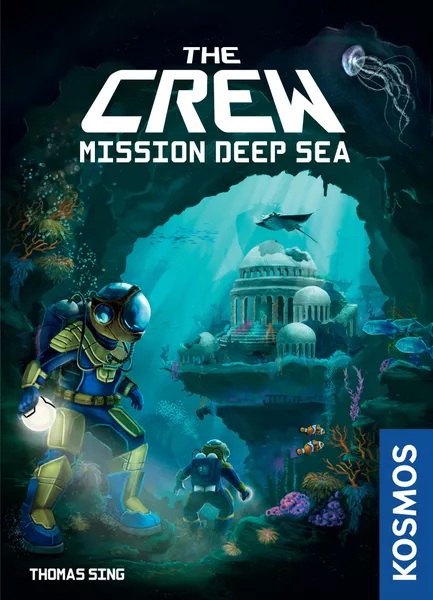
One note on where this comparison comes from: our hands-on time is with Mission Deep Sea, which we’ve played across a dozen-odd sessions and reviewed. What follows about Planet Nine is drawn from its rules and components rather than a campaign of our own, so treat the comparison as a structural one.
The One Difference That Matters
Planet Nine hands out tasks as cards you must win, arranged with ordering tokens when a mission demands a sequence. It works, but the objective reaches you as iconography: a card and a token, which a player has to translate before they know what they’re chasing.
Mission Deep Sea replaces all of that with 96 task cards that say what they want in plain words: I will win more yellow than blue cards. I will win a trick that contains only odd numbers. I will not open a trick with green. A player reads their card and knows their job.
That single change ripples outward. Because each task carries a difficulty value, missions are built by drawing tasks until the values sum to exactly the mission’s difficulty — so the same mission number can hand you a different problem on the next attempt. The original’s missions are more fixed, which makes them more repeatable but less surprising.
What Deep Sea Adds
The distress signal is the other real addition. Once per mission, before anyone communicates, the crew can flip the token and everyone passes a single card — never a submarine — to the same neighbour. It costs one extra attempt in your logbook and it can rescue a task allocation that was never going to work.
It’s a small rule that solves the original’s most common complaint: a deal that kills the mission before the first trick. You still lose sometimes to the shuffle, but now you have one lever.
What the Original Still Does Better
Planet Nine’s campaign has more shape. Its 50 missions are written as a story with escalating complications, and if your group likes the feeling of a narrative arc with a destination, that structure lands better than Deep Sea’s drawn-task variety.
It’s also the cheaper of the two to find used, and it’s the one that won the Kennerspiel des Jahres 2020 — the award Deep Sea’s rulebook cites on its own first page.
Worth knowing: if your table already owns Planet Nine and liked it, Deep Sea is not a re-buy of the same experience. The trick-taking is near identical, but the variety in the task deck is where your money goes.
Which One for Your Table
Buy Mission Deep Sea if you’re starting fresh, if you teach the game often, or if you want missions that stay unpredictable after a dozen sessions. For most groups this is the better first Crew, and it’s the one we reviewed at Bamboo 4 and Pandas 5.
Buy The Quest for Planet Nine if you want the story-driven campaign, you’ve already worn out Deep Sea’s logbook, or you find it cheaply and want the cooperative trick-taking system at its lowest price of entry.
Buy both if you play with the same crew every week. They share a spine, so the second one is easy to teach, and 82 missions between them is most of a year.
The Honest Version
If someone handed you either box you’d have a good night. The gap between them is smaller than the internet suggests — this is a sequel that fixed an onboarding problem, not a redesign.
What tips it is the onboarding. A task card that reads I will win more yellow than blue cards needs no interpretation, while a symbol-based task has to be decoded before a new player can act on it. That’s a difference in how much of a first session goes on teaching rather than playing — which, for most tables choosing one box, counts for more than a mission count does.
Both rulebooks are free to read before you choose: Mission Deep Sea’s task cards start on page 16, and Wikipedia’s entry covers both games’ release history if you want the short version.
If neither has landed on your shelf yet, start with our full Mission Deep Sea review for what the game feels like in practice, and see the two-player variant guide if your usual count is two. The original Crew also appears on our best card games for a BBQ list, where it earns its place as the quiet game for the end of the night.
Frequently Asked Questions
Which Crew game should I buy first?
Mission Deep Sea, for most tables. Its 96 task cards state each objective in words, so the teach is shorter and the objectives are more varied than the original’s fixed symbol tasks.
Is Mission Deep Sea a sequel or an expansion?
A stand-alone sequel. It contains its own 40 playing cards, its own 32-mission logbook and its own rulebook, and it needs nothing from The Crew: The Quest for Planet Nine.
What actually changed between the two Crew games?
The task system. Planet Nine assigns numbered card tasks with ordering tokens, while Mission Deep Sea draws from 96 written task cards with difficulty values that must add up exactly to the mission’s difficulty. Deep Sea also adds the distress signal help mechanic.
Can you combine The Crew Mission Deep Sea and Planet Nine?
Not as a single deck, because each game has its own 40 cards and its own logbook. Many groups do own both and alternate campaigns, since the trick-taking rules are close to identical.
Is Mission Deep Sea harder than Planet Nine?
It is more variable rather than strictly harder. Because tasks are drawn to hit an exact difficulty total, the same numbered mission can present very different problems between attempts, while Planet Nine’s missions are more fixed.
Which Crew game is better for new players?
Mission Deep Sea, because a new player can read their task rather than decode a symbol. Both games still assume everyone knows how to follow suit and what a trump is.
One box, one evening, one crew that can’t tell each other anything. Start with Deep Sea. You can always add the other one later, and by then you’ll know whether your table wants more missions or a different story.