

Bottom Line
Here to Slay is best for families with kids around 10 and up, and for groups who already like Unstable Unicorns and want a little more to do on each turn. Skip it if your group gets frustrated by dice, because a failed roll costs you the action and does nothing. Its biggest strength is the turn structure: three action points and a clear list of things to spend them on. Its biggest weakness is how often a plan comes down to one roll of two dice.
Here to Slay gets 4/5 Bamboo Plants and 3/5 Pandas from us. We’ve played it a few times. It’s a fine game with great art, and Here to Slay is worth buying for the right table, but it isn’t one we’d tell everyone to get.
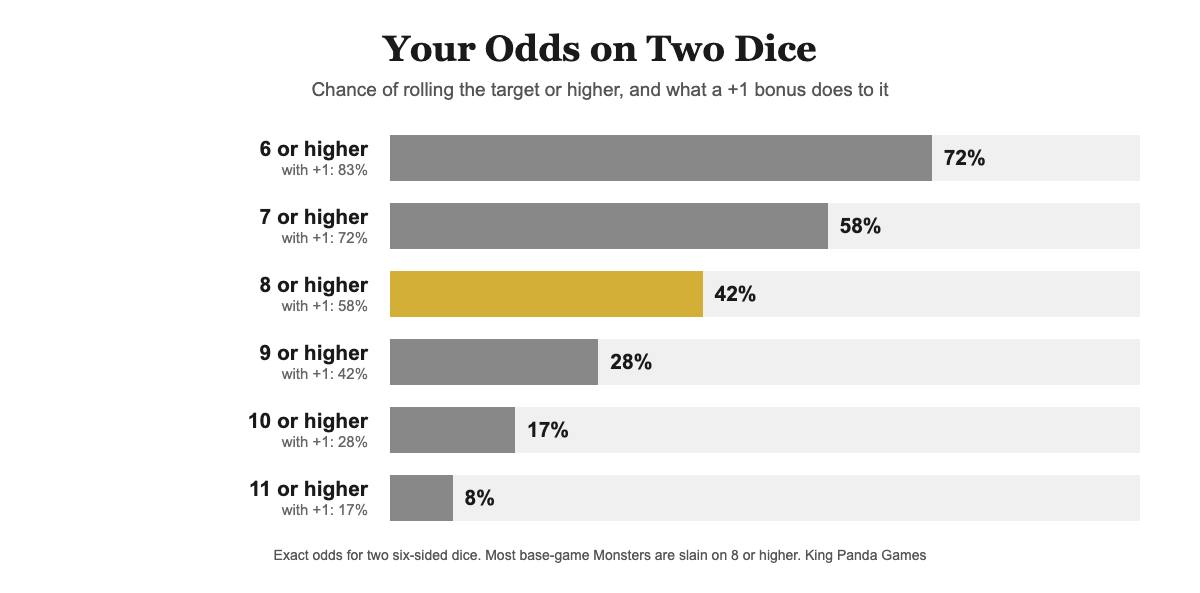
The Bamboo is a 4 because the turn is easy to explain: you get three action points, and a reference card lists what each action costs. It isn’t a 5 because challenges, modifiers and monster requirements take a few rounds to sink in. The Pandas are a 3 because the dice have too much say. Most of the Monsters need a roll of 8 or higher, which fails 58% of the time.
Some links below are Amazon affiliate links — as an Amazon Associate, King Panda Games earns from qualifying purchases at no extra cost to you. Full disclosure.
Check Here to Slay price on Amazon →
Here to Slay is a card game where each player builds a party of animal heroes and uses them to fight monsters. It’s from Unstable Games, the publisher of Unstable Unicorns, and it has the same designer and artist, Ramy Badie.
| Detail | Info |
|---|---|
| Players | 2–6 |
| Best Player Count | 4 — enough opponents to challenge, short waits between turns |
| Age | 10+ |
| Play time | 30–60 min |
| Complexity | Light to medium |
| Solo Mode | No |
| Designer and artist | Ramy Badie |
| Publisher | Unstable Games (TeeTurtle) |
| Popular Upgrades | Yes — four expansions, play mats and sleeves |
| Bamboo Plants | 4/5 — three action points, a reference card |
| Pandas | 3/5 — charming, but the dice decide a lot |
| Official site | TeeTurtle’s Here to Slay page |
How Here to Slay Works
On your turn you spend three action points. The box holds a 115-card main deck, 6 oversized Party Leader cards, 15 oversized Monster cards and two dice, according to the official product page.
| Action | Cost |
|---|---|
| Draw a card | 1 point |
| Play a Hero, Item or Magic card | 1 point |
| Roll to use a Hero’s effect | 1 point |
| Attack a Monster | 2 points |
| Discard your hand and draw 5 | 3 points |
Each player starts with a Party Leader, which has a class and a permanent skill. You add Heroes from six classes to your party. Each Hero has an effect, and to use it you roll two dice and try to meet the number on the card.
Three Monsters sit face up in the middle. Each one lists what your party needs before you can attack it, the roll that slays it, and a low roll that costs you something.
You have two Heroes and want a Monster that needs two Heroes and a roll of 8 or more, with a penalty on 5 or less. Attacking costs two of your three points. You roll a 5. That’s low enough to trigger the penalty, so you sacrifice a Hero. Now you have one Hero, one action point left, and you can’t attack it again until you rebuild.
There are two ways to win. Slay three Monsters, or end your turn with six different classes in your party, counting your Party Leader.
Other players can interfere. A Challenge card lets someone try to cancel a Hero, Item or Magic card as you play it: you both roll, and the challenger wins ties. Modifier cards add to or subtract from anyone’s roll.
If you’d rather watch than read, this independent how to play Here to Slay video covers it in seven minutes. Our Here to Slay rules guide has every action and both win conditions.
What We Liked
The action points make turns feel like choices. Draw three cards, or play a Hero and roll for it, or go straight at a Monster. That’s more to think about than a draw-one, play-one card game.
The art is the best thing in the box. Every Hero is a small animal in fantasy gear with a pun for a name, and the oversized Monster cards look great on the table.
Two win conditions keep everyone guessing. You can’t just watch the Monster count. A player with five classes in their party is one card from winning.
Party Leaders give each player a small identity from the first turn. A Ranger leader adds 1 to every Monster attack, which nudges that player toward fighting.
What We Disliked
The dice decide too much. A roll that fails still costs the action point. The six Monsters that need a specific class are all slain on 8 or higher, and that’s a 42% chance. Fail on a 4 or less and you also discard two cards.
You can only roll for each Hero once per turn. A missed roll means that Hero does nothing until your next turn, and you’ve spent a third of your turn finding that out.
It can be mean. Heroes get stolen and destroyed, and a Challenge can cancel the card you spent a point on. Younger or more sensitive players may not enjoy that.
Who It’s For
Here to Slay is for families with older kids and for casual groups who like cute art and a bit of take-that. It’s a natural next step for anyone who has played a lot of Unstable Unicorns.
It also suits groups who like rolling dice and cheering or groaning at the result. If the swing is the fun for your table, this delivers it.
Who should skip this game:
– Players who want their plans to work when they’ve set them up properly.
– Groups that dislike having their cards stolen or destroyed.
– Anyone looking for a deep strategy game. This is a light one.
– Kids much under 10, who may struggle with the amount of card text.
Who Should Buy This?
Buy Here to Slay if the art makes your kids want to play and you’d like something a step up from Uno-style games. The publisher lists it at $20, and that’s fair for what’s in the box.
Try it first if you’re buying for adults. One game will tell you whether your group enjoys the dice or resents them.
It’s a situational game for most collections. If it lands with your table, the expansions add classes and Monsters, and our Here to Slay expansions ranked guide covers which to get first. The base Here to Slay box is all you need to start.
Check Here to Slay price on Amazon →
Best Player Count
Here to Slay is best with 4. The box says 2 to 6, and it works across that range, but four is the balance point.
BoardGameGeek’s community poll rates it best with 3 or 4 and recommended from 2 to 5. Six isn’t in the recommended range.
That fits the rules. With more players, there are more Challenge and Modifier cards pointed at each of your plays, and a longer wait between turns. At two, there’s only one opponent to challenge you, and one Party Leader, The Shadow Claw, isn’t allowed at all.
Replayability
Here to Slay has moderate replay value. The Monsters that come up, your Party Leader and the Heroes you draw all change from game to game.
The limit is that most games follow the same shape: build a few Heroes, roll, attack.
The expansions are where the variety comes from. Warriors & Druids and Berserkers & Necromancers each add two classes, and Banner Quest adds a third way to win.
Accessories & Upgrades
The publisher sells its own upgrades, and they’re cosmetic. TeeTurtle’s store lists play mats, card sleeves, dice and standees alongside the game. None of them change how it plays. Sleeves make sense if the deck is going to be shuffled by kids.
Awards
We couldn’t find any major awards for Here to Slay. Its Kickstarter campaign raised just over $3 million from 38,922 backers in early 2020.
Similar Games
If you like Unstable Unicorns, try Here to Slay — same publisher and art style, with dice and action points added. Our Here to Slay vs Unstable Unicorns comparison covers which to buy.
If you like Here to Slay, try Munchkin — it’s also about fighting monsters and sabotaging friends, and we rate it higher at 4/5 Pandas. See Here to Slay vs Munchkin or our Munchkin review.
If the dice are what you like, try King of Tokyo — it’s built around rolling and re-rolling, so luck feels like the point. Our King of Tokyo review has the details.
Tips & Tricks
Know the odds before you attack. On two dice, 7 or higher comes up 58% of the time, 8 or higher 42%, 9 or higher 28% and 10 or higher 17%. A Monster that needs a 10 is a long shot without Modifier cards in hand.
Watch for the full-party win. Your Party Leader counts as one of the six classes, so you only need Heroes from the other five. Count your opponents’ classes every turn.
The tempting play: attack a Monster the moment you meet its requirement.
The better play: check the penalty first. Several Monsters make you sacrifice a Hero on a low roll, which can drop you below the requirement you just reached.
Save Modifier cards for the rolls that matter. They cost no action points and can be played on anyone’s roll, including your own Monster attacks.
Pick a Party Leader that helps the roll you’ll make most. Our best party leader guide ranks all six.
Frequently Asked Questions
Is Here to Slay worth buying?
For families with kids 10 and up, and for fans of Unstable Unicorns, yes. We rate it 4/5 Bamboo and 3/5 Pandas. Skip it if your group dislikes games where dice decide whether a plan works.
How long does Here to Slay take to play?
The publisher says 30 to 60 minutes. Games end when someone slays three Monsters or ends a turn with six classes in their party.
Is Here to Slay good for kids?
For kids around 10 and up, yes. That’s the age on the box. There’s a fair amount of card text to read, and other players can steal or destroy your Heroes.
Is Here to Slay better than Unstable Unicorns?
It has more to do on each turn: three action points, dice and Monsters to fight. Unstable Unicorns is simpler, seats up to eight and is rated for ages 8 and up. BoardGameGeek users rate Here to Slay higher.
Can you play Here to Slay with 2 players?
Yes. The box says 2 to 6. The one rule change is that The Shadow Claw can’t be used as a Party Leader in two-player games.
How do you win Here to Slay?
Slay three Monsters, or end your turn with six different classes in your party, including your Party Leader. With any expansion added, the full party needs seven classes.
Is Here to Slay mostly luck?
Luck plays a big part. Hero effects, Monster attacks and Challenges are all decided by rolling two dice. Choosing when to attack and when to spend Modifier cards is where the skill comes in.
Do you need the expansions?
No. The base game is complete. The expansions add classes, Monsters and, with Banner Quest, another way to win.
Want to go deeper?
- Here to Slay Rules — the actions, challenges, Monsters and both win conditions. Read it here
- Best Party Leader in Here to Slay — all six base leaders ranked, with the dice maths. Read it here
- Here to Slay Expansions Ranked — the four you can buy, and which to get first. Read it here
- Here to Slay vs Unstable Unicorns — the publisher’s two big card games compared. Read it here
- Here to Slay vs Munchkin — which monster-fighting card game to buy. Read it here
Verdict
Buy it if your kids love the art or your group already enjoys Unstable Unicorns. Skip it if dice-driven luck frustrates your table. Try before you buy if you’re shopping for adults who usually play strategy games.
Here to Slay official site: TeeTurtle’s Here to Slay page