Last checked: November 15, 2026. Every number links to its source or shows our math.
Catan has sold more than 50 million copies in over 100 countries, and the United States is its largest market. That figure comes from an unusual source: Germany’s foreign minister, Johann Wadephul, cited Catan in a November 2026 speech on trade. Most sites still quote 45 million, the number on Catan’s own site in January 2025.
Below: how Catan got there, where Americans search for it most, what board gamers think of it today, the dice odds that decide every game, and what we learned from simulating 10,000 games to see which starting spots win. For whether it’s still worth buying, see our honest Catan review.
Catan by the Numbers
| Stat | Number |
|---|---|
| Copies sold | 50 million+ (Nov 2026) |
| Markets | 100+ countries; the U.S. is the largest |
| First published | 1995, Germany (designer Klaus Teuber) |
| First print run | 5,000 copies |
| Copies sold in year one | 400,000 |
| Spiel des Jahres | Won, 1995 |
| Current edition | 6th, released 2025 for the 30th anniversary |
| BoardGameGeek users who own it | 246,948 |
| BoardGameGeek average rating | 7.09 / 10 (145,416 ratings) |
| U.S. search rank among 29 board and card games | #4, behind Scrabble, Monopoly and Uno |
| Most likely roll | 7 (16.7%), which moves the robber |
Catan Sales Over Time
| Year | Copies sold (cumulative) | Source |
|---|---|---|
| 1995 | 5,000 first print run, sold out fast | The Opinionated Gamers |
| 1995–96 | 400,000 in the first year | |
| 2005 | 8 million+ in Germany alone | |
| 2015 | 22 million+ | The Opinionated Gamers (estimate for Catan products) |
| 2020 | 32 million (reported) | Game Developer |
| 2025 | 45 million+ | catan.com |
| 2026 | 50 million+ | German Federal Foreign Office |
The pace is the striking part. Catan took about 20 years to pass 22 million copies, then added roughly another 28 million in the 11 years after that. A game from 1995 is selling faster now than it did in its first 20 years. The 2015 and 2020 figures are estimates from the press, not company statements, so treat them as approximate.

Where Americans Search for Catan Most
We compared Google searches for 29 board and card games in every state for our state-by-state board game map. Catan came fourth nationally, with 4.6% of searches across those 29 games, behind three mass-market classics: Scrabble, Monopoly and Uno.
Relative to that national share, Catan is searched most in:
| Rank | State | Catan’s share of searches | vs. national |
|---|---|---|---|
| 1 | Utah | 6.8% | 1.47x |
| 2 | District of Columbia | 6.7% | 1.45x |
| 3 | Montana | 6.0% | 1.30x |
| 4 | Washington | 5.9% | 1.29x |
| 5 | Texas | 5.9% | 1.28x |
| 6 | Alaska | 5.8% | 1.27x |
| 7 | California | 5.8% | 1.26x |
| 8 | Hawaii | 5.8% | 1.26x |
| 9 | Colorado | 5.5% | 1.20x |
| 10 | Idaho | 5.2% | 1.13x |
The least Catan-curious states are Nebraska (2.4%), Mississippi (2.8%), and Kentucky, West Virginia, Louisiana and Alabama (about 3.0% each). The West leans Catan; much of the South leans Phase 10 instead (see the map).
Search interest over time
Google Trends shows U.S. interest in Catan peaked in April 2020, the first full month of pandemic lockdowns. What’s surprising is what happened next. Interest dipped in 2021, then climbed every year after, and 2025 and 2026 are the highest years since 2020. Worldwide, 2026 is running ahead of 2020.

| Year | U.S. search interest (yearly average, 0–100) |
|---|---|
| 2019 | 39.5 |
| 2020 | 61.0 (peak month: April) |
| 2021 | 43.9 |
| 2022 | 50.1 |
| 2023 | 52.1 |
| 2024 | 53.2 |
| 2025 | 57.9 |
| 2026 (Jan–Nov) | 58.5 |
What Board Gamers Think of Catan Today
On BoardGameGeek, Catan has 145,416 ratings and an average of 7.09 out of 10. It ranks #624 overall, which says more about how many great games came after it than about Catan itself.
- 40% of ratings are 8 or higher.
- 12% are 5 or lower.
- The most common rating is a 7 (44,662 people).
- 246,948 users list it in their collection, 1.7 owners for every rating.
- Players have logged 454,071 plays.
- Complexity: 2.28 out of 5, light for a strategy game. Users vote it best at 4 players and fine from age 8.
That’s the profile of a game almost everyone has played and few people hate. If you’ve outgrown it, here are games like Catan that build on what it does.
The Dice Math Behind Every Game
Catan’s 18 number discs (one 2, one 12, and two each of 3–6 and 8–11) decide which hexes pay out. This is our math for two six-sided dice:
| Number | Chance per roll | Chance it hits in one round (4 rolls) | Chance it hits in two rounds (8 rolls) |
|---|---|---|---|
| 2 or 12 | 2.8% | 10.7% | 20.2% |
| 3 or 11 | 5.6% | 20.4% | 36.7% |
| 4 or 10 | 8.3% | 29.4% | 50.1% |
| 5 or 9 | 11.1% | 37.6% | 61.0% |
| 6 or 8 | 13.9% | 45.0% | 69.8% |
| 7 (robber) | 16.7% | 51.8% | 76.7% |
Two numbers worth remembering:
- A 7 comes up about once every 6 rolls, so in a four-player game the robber moves roughly every round and a half. With more than 7 cards in hand you discard half, which is why the robber matters as much as it does. Our Catan robber guide covers where to put it.
- The whole board is worth 58 “pips” (the dots under each number, one per way to roll it). That works out to about 1.6 hexes producing something on an average roll. Our starting placement guide shows how to use pips to pick your first settlements.
How lucky are the dice in a single game?
Over 100,000 simulated rolls, every number landed within 0.15 percentage points of the odds above. The 6, for example, came up 13.88% of the time against 13.89% expected. One game is a different story. We simulated 100,000 games of 70 rolls each, roughly a four-player game:
| In one 70-roll game… | How often |
|---|---|
| A 4 is rolled more often than a 6 | 1 game in 8 (12.9%) |
| The 6 and the 8 differ by 5 or more rolls | 31% of games |
| Nobody rolls a 12 all game | 13.7% of games |
| 7 is the outright most-rolled number | Only 40% of games |
So when it feels like the dice hate your 6, sometimes they do, for one game. Game length changes this: a 4 out-rolls a 6 in 16% of 50-roll games and 10.5% of 90-roll games.
We Simulated 10,000 Games of Catan
Which starting spots actually win? We had bots play 10,000 four-player games on random boards and tracked every player’s two opening settlements, 40,000 openings in all. “Pips” are the dots under each number, one per way to roll it, so a settlement touching a 6, 8 and 5 has 5 + 5 + 4 = 14 pips. With four players, a fair share of wins is 25%.
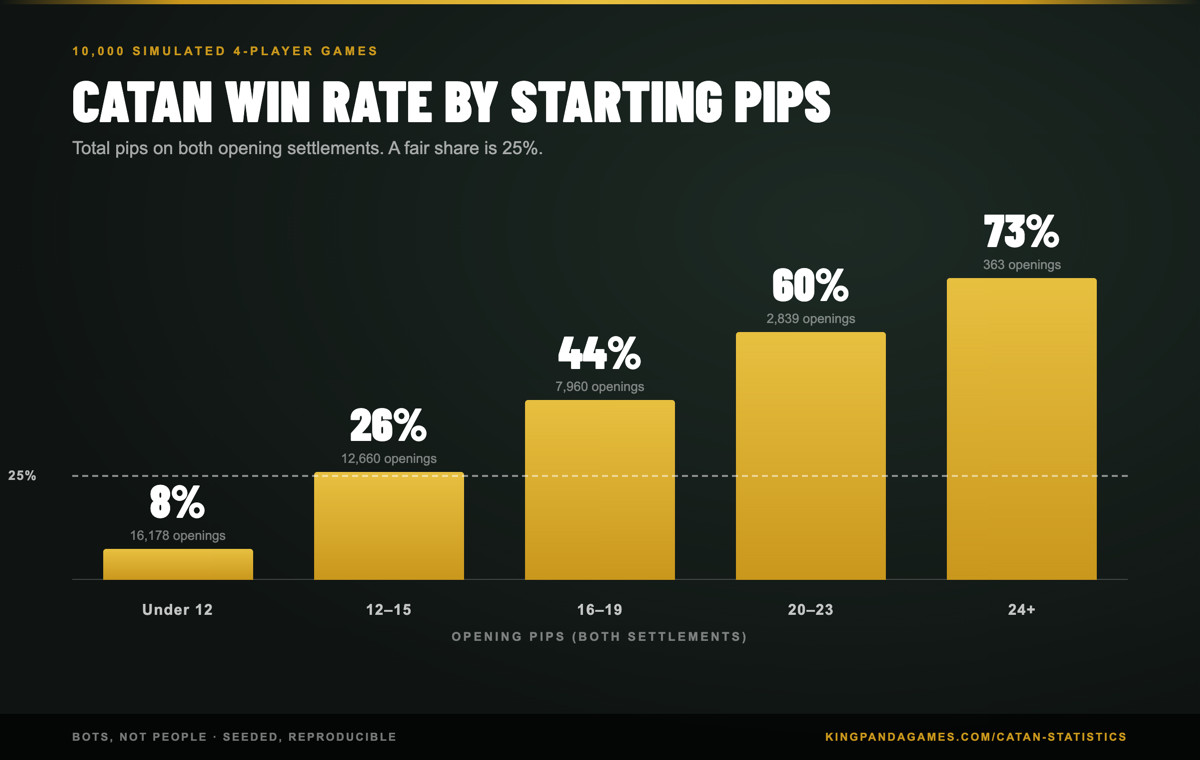
| Opening pips (both settlements) | Openings | Win rate |
|---|---|---|
| Under 12 | 16,178 | 7.6% |
| 12–15 | 12,660 | 26.2% |
| 16–19 | 7,960 | 43.6% |
| 20–23 | 2,839 | 60.2% |
| 24+ | 363 | 73.3% |
What decides a starting spot
1. Pips matter most. An opening worth 20–23 pips wins about eight times as often as one under 12. Nothing else we measured comes close.
2. Variety is next. Comparing openings with the same pips (16–19), the more resource types you touch, the more you win:
| Resource types at your opening (16–19 pips) | Win rate |
|---|---|
| 3 | 35.6% |
| 4 | 51.5% |
| All 5 | 69.3% |
3. Sheep is the weakest resource to start on. At the same pips, openings with no sheep won 57.0% of the time, and openings with 9 or more sheep pips won 34.0%.
4. Ore and grain or brick and wood? It depends on how you play. We ran a second set of 2,000 games with a different bot, one that heavily favors cities. Both pairs helped both bots, but by very different amounts:
| Opening includes (16–23 pips) | Expansion-minded bot | City-focused bot |
|---|---|---|
| Ore + grain | 55.3% (vs 41.7% without) | 63.2% (vs 34.8% without) |
| Brick + wood | 63.4% (vs 34.9% without) | 54.3% (vs 41.8% without) |
If you plan to build roads and settlements fast, brick and wood are worth more. If you plan to rush cities, ore and grain are. Pips and variety mattered for both bots.
5. A 3:1 port is a modest plus. At the same pips, a 3:1 port lifted the expansion-minded bot’s win rate by about 10 points (51.0% vs 41.2%), but only about 3 points for the city bot, which is within the noise. Without that same-pips comparison, ports look harmful, but only because coastal spots touch fewer hexes.
6. Going first doesn’t matter. All four seats won between 24.6% and 25.4% of games.
For how to find these spots on your own board, see our starting placement guide.
Is Longest Road or Largest Army worth chasing?
The winner held Longest Road in 65.8% of games and Largest Army in 16.1%. Only 19.1% of winners held neither. Whoever ended the game holding Longest Road won 72.5% of the time.
Two cautions. Holding a card at the end partly reflects being ahead already, so this shows the cards go with winning, not that chasing them causes it. And our bots buy few development cards, so Largest Army was awarded in only about a quarter of games, which understates it compared with real tables.
Can you come back from behind?
Rarely. A turn here is one player’s turn, so turn 40 is about ten rounds into a four-player game.
| Game state | At turn 40 | At turn 80 |
|---|---|---|
| The sole leader goes on to win | 64.3% | 74.9% |
| A leader by 2+ points goes on to win | 77.8% | 84.2% |
| The player in last place wins | 3.7% | 1.4% |
Catan snowballs: production buys more production, so an early lead tends to grow. (Our bots can’t trade with each other, so real tables, where players gang up on the leader, may allow a few more comebacks.)
Do Catan Event Cards take the luck out?
Catan sells Event Cards that replace the dice with a deck of 36 cards matching every dice combination. Under the official rules (in the Traders & Barbarians booklet), a “New Year” card sits five cards from the bottom and triggers a reshuffle, which keeps a little uncertainty. We played the same 3,000 boards three ways: real dice, Event Cards as published, and the full 36-card deck with no New Year card. The cards’ event text wasn’t simulated, only the production numbers.
| Real dice | Event Cards | Full deck | |
|---|---|---|---|
| Share of a game’s rolls “off” from perfect odds | 10.9% | 4.8% | 2.6% |
| Games where a 4 is rolled more often than a 6 | 8.6% | 0.1% | 0% |
| Player with the best opening wins | 56.4% | 57.1% | 55.9% |
Event Cards do what they promise for the numbers: they cut how far a game’s rolls stray from the odds by more than half, and a 4 basically never beats a 6. What surprised us is the last row. The player with the best opening didn’t win any more often. On the same board with the same openings, swapping dice for cards changed the winner in about 40% of games. Smoother numbers don’t remove every swing: the robber, development card draws and the board itself still vary. Buy Event Cards if bad streaks ruin your table’s fun, not because they’ll make the best player win.
Is the beginner board fair?
The 6th edition’s fixed setup for first games (rulebook pages 4–5) is carefully balanced on paper: every color’s two starting settlements total exactly 20 pips. We played 4,000 games on it with a random seat order:
| Color | Win rate | Same board, city-focused bot |
|---|---|---|
| Orange | 35.6% | 30.2% |
| Red | 29.4% | 37.8% |
| White | 18.8% | 18.4% |
| Blue | 16.1% | 13.6% |
Seat order didn’t matter (24.1%–26.2%), but color did. With both bots, red and orange won about twice as often as blue and white. We can’t say for sure why. Equal pips clearly don’t make equal positions, and room to expand and nearby ports are the likely differences. If you’re teaching someone Catan on the starter board, give them red or orange. In our runs, roads were placed by the bot rather than exactly as printed.
Does the robber on your best hex hurt?
Less than it feels. We played 3,000 boards twice: once with the robber starting on the desert, and once with it starting on one player’s best hex. That player won 24.2% of the time either way. A 7 comes up about once every six rolls, so the robber moves on quickly. What hurts is a robber that stays parked, which is why players move it onto the leader.
How the simulation works, and its limits
We used Catanatron, an open-source Catan engine. Opening settlements were picked at random from the legal spots, so the results measure the spots themselves and not a placement habit. After setup, every seat played the same bot, which tries each legal move and keeps the one that best improves its victory points, production and building options, with no built-in preference for any resource. For the resource-mix and beginner-board questions we checked the result with a second, city-focused bot. Every game is seeded, so any result can be replayed exactly.
Know the limits. These are bots, not people. The engine has no player-to-player trading, so games ran longer than real ones (a median of 119 turns). Random openings include spots no human would pick. Treat the numbers as a guide to what matters, not as exact odds for your table.
What’s in the Box (6th Edition)
From the official 2025 rulebook: 19 terrain hexes (4 forests, 4 pastures, 4 fields, 3 hills, 3 mountains, 1 desert), 18 number discs, 95 resource cards (19 of each), 25 development cards (including 14 Knights and 5 Victory Points), and for each player 5 settlements, 4 cities and 15 roads. The first player to 10 victory points on their turn wins. Largest Army takes 3 Knights. The 6th edition renamed Longest Road to Longest Route; it still takes 5 continuous roads.
Choosing a box? We rank every Catan version and every Catan expansion. For the wider industry picture, see our board game statistics.
How We Built This Page
Sales figures come from Catan, the German government and the press, linked where cited. BoardGameGeek numbers were read from Catan’s BGG stats page on November 15, 2026, and they change daily. The state and national search shares come from our Google Trends comparison of 29 games over the 12 months to October 2026. The yearly search interest averages come from Google Trends’ “all time” series for the Catan topic, pulled November 15, 2026. The dice odds are our own math, and the simulations are our own runs (details above). We don’t publish yearly unit sales because we couldn’t find a primary source for any.
Cite this page: King Panda Games, “Catan Statistics 2026,” updated November 15, 2026 (kingpandagames.com/catan-statistics/).
Frequently Asked Questions
How many copies of Catan have been sold?
More than 50 million as of November 2026, according to Germany’s Federal Foreign Office. Catan’s own site said 45 million in early 2025.
Where is Catan most popular in the U.S.?
Utah, by share of board game searches, followed by D.C., Montana, Washington and Texas.
What is the most common roll in Catan?
Seven, at 16.7% of rolls. Of the numbers that produce resources, 6 and 8 are the most likely, at 13.9% each.
Is Catan still popular?
Yes. U.S. search interest in 2025 and 2026 is the highest since the 2020 lockdown spike.
What is the best starting spot in Catan?
In our 10,000 simulated games, the openings with the most pips won most often, and touching four or five different resources beat touching three at the same pips.
Are Catan Event Cards worth it?
They make the numbers far more even, but in our simulation the best opening didn’t win any more often. Get them if dice streaks spoil your fun, not to make the game more skill-based.
Which color is best on the Catan beginner board?
Red and orange. In 4,000 simulated games on the 6th edition’s fixed setup, they won about twice as often as blue and white.