


The best word board games we’ve played are Bananagrams, our top pick, then Catch Phrase and Wavelength, and all three get 5/5 Bamboo and 5/5 Pandas from us. Bananagrams leads because spelling is the whole game.
This list is for tabletop play: board games, tile games and word card games where spelling, unscrambling, clue-giving or describing a word is the main thing you do. If you came for a word game app, this page doesn’t cover those.
Played & scored means we’ve played it and scored it (Bamboo is how easy it is to learn, Pandas is how much fun it is, both out of 5), and Researched means we haven’t played it and the facts come from publishers, rulebooks and retailer listings. That’s 12 played and 27 researched, 39 games in all, plus two we’d skip.
Some links below are Amazon affiliate links — as an Amazon Associate, King Panda Games earns from qualifying purchases at no extra cost to you. Full disclosure.
Jump to:
- Our ranking of the word games we’ve played
- Word games by type
- Researched word games worth knowing
- Games like Scrabble
- Word games we’d skip
- The word game finder (every game)
- How we built this list
Last verified: November 2026.

Our Ranking of the Word Games We’ve Played
These 12 are ranked by Pandas, then Bamboo. Codenames and Wavelength have full KPG reviews, and the quotes in their entries come from those reviews. Eric has also played Bananagrams, Catch Phrase, Boggle, Scrabble, Password and Mad Gab, and his summary of those six was short: “They’re five out of five for easy and varying scores of fun between 3 to 5.” He has no notes beyond the scores, so those entries describe how each game works and what the box says. When two games tie on both scores, the one where words are more of the game goes first.
1. Bananagrams
Played & scored 1–8 players · 15–30 min · ages 7+ · Pandas 5 · Bamboo 5.
How it plays. Everyone takes letter tiles from a shared pile of 144 and builds their own crossword at the same time, with no board and no turns. When you’ve used all your tiles you call “Peel!” and every player draws one more. Once the pile is smaller than the number of players, the first person to use every tile calls “Bananas!” and wins if all their words are real.
Why it’s our top pick. It’s one of three games here with full marks for both ease and fun, and it’s the one where the whole game is spelling, so it leads the ranking. There’s no scoring to add up, and the explanation above is most of the rulebook.
Watch for. A strong speller can finish while a newer player is on their third word, and nothing in the rules helps whoever is behind. The tiles are small and easy to lose. Moose Toys bought the brand in July 2025 and lists it at $15.99 on its Bananagrams page. The player count, age and time here are from Asmodee Canada’s distributor listing.
Check Bananagrams price on Amazon →
2. Catch Phrase
Played & scored 4+ players (two teams) · time not stated · ages 12+ · Pandas 5 · Bamboo 5.
The game. Two teams sit in alternating seats and pass an electronic unit that shows a word or phrase. You describe it until a teammate says it, then hand the unit to the next player. When the hidden timer goes off, the other team scores if you’re the one holding it, and Hasbro’s copy says the first team to 7 points wins.
Where it ranks. It ties Bananagrams and Wavelength on both scores, and it sits second because describing words is all you do, where Wavelength’s clues are about opinions. The unit keeps time, so nobody has to run the round.
Watch for. It takes three AAA batteries, and they aren’t in the box. Hasbro rates it 12+ and doesn’t print a play time, and the number of words on the unit varies by edition. Taboo uses the same describe-it idea with cards and a list of banned words.
Check Catch Phrase price on Amazon →
3. Wavelength
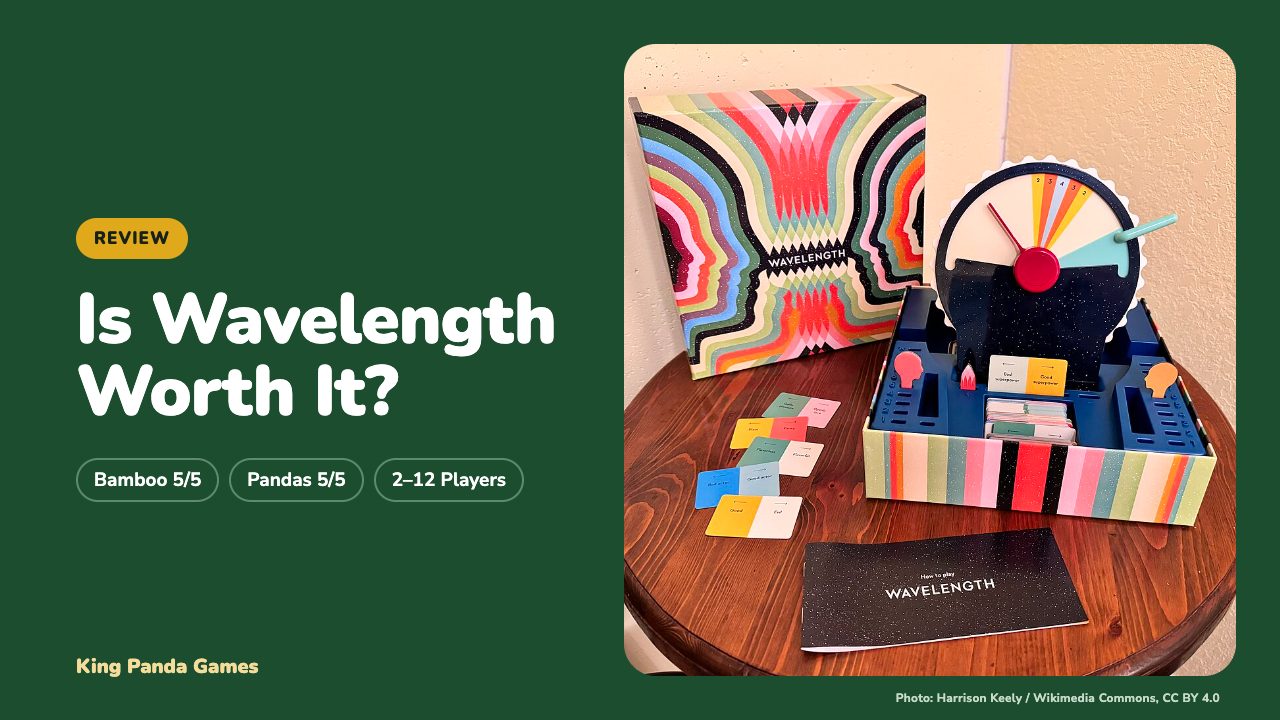
Played & scored 2–12 players · 30–45 min · ages 14+ · Pandas 5 · Bamboo 5.
How a turn works. One player sees where a hidden target sits on a dial between two opposites, such as overrated and underrated, and gives one clue. Their team turns the dial to where they think the clue points, and the closer they land, the more they score.
Our verdict. It gets 5/5 Bamboo and 5/5 Pandas in our Wavelength review, which explains the fun score this way: “The Pandas are a five because every round ends with half the table defending a position the other half thinks is insane.” It won the Golden Geek award for Best Party Board Game in 2019, as Wikipedia’s Golden Geek tables show. It’s third of the three double-5 games here because the clue is a judgement call more than a word puzzle.
Watch for. The review’s main warning: “Its biggest weakness is that it needs a confident clue-giver, and a shy one can stall a round.” How to play Wavelength covers the 2-player and co-op modes, our Wavelength strategy guide covers reading clues, and our spectrum ideas let you play without the cards.
Check Wavelength price on Amazon →
4. Codenames
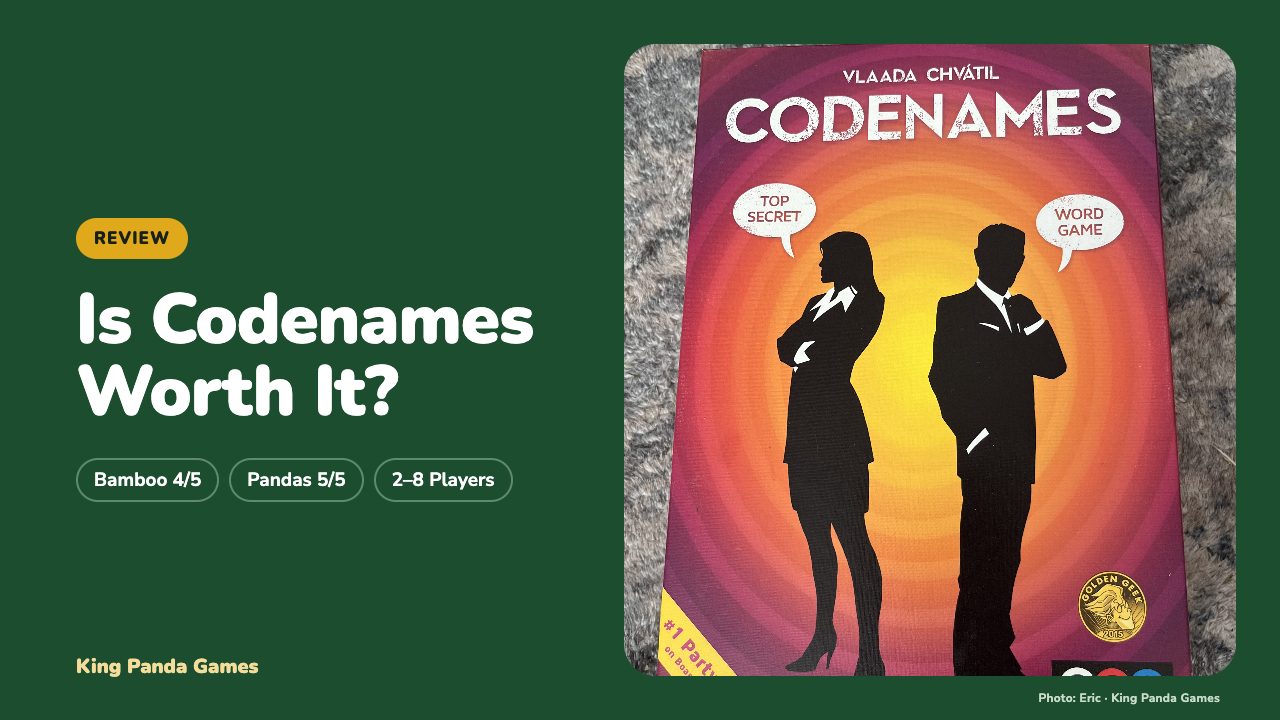
Played & scored 4–8+ players · 15 min · ages 10+ · Pandas 5 · Bamboo 4.
What you do. Two teams face a grid of 25 word cards. Each team’s spymaster gives a one-word clue and a number, trying to link several of their team’s words, and teammates guess one card at a time. Touch the assassin card and your team loses on the spot.
Our verdict. Our Codenames review gives it 5/5 Pandas and 4/5 Bamboo, and calls it “the rare party game that rewards real intelligence while still working at a table with people who’ve never played a board game in their life.” The missing Bamboo is explained too: “the rules teach in five minutes, but being a good Spymaster is a skill you develop over many sessions.” It won the 2016 Spiel des Jahres, listed on Wikipedia’s page of winners.
Watch for. Czech Games Edition’s page for the current edition lists 4–8+ players and ages 10+. For two players the review points to Codenames Duet, which is in the two-player table and in our Codenames vs Codenames Duet comparison. Our Spymaster tips cover clue-giving, the Codenames player count guide covers small groups, and Codenames versions ranked compares every edition.
Check Codenames price on Amazon →
5. Boggle
Played & scored 1+ players · 90-second rounds · ages 8+ · Pandas 4 · Bamboo 5.
How it works. Shake 16 letter cubes into a 4×4 grid, and everyone writes down the words they can trace through touching letters before the timer runs out. Players then read their lists, and under the classic rules any word that two players both found is crossed off, so the rare finds are the ones that score.
Score. It’s level with Bananagrams on ease, at 5/5, and one Panda behind on fun.
Watch for. Hasbro’s current edition uses a 90-second timer, half the classic three minutes. Checking everyone’s words after each round takes a while, and strong spellers win most rounds, so younger players may need a head start. Boggle Jr. for preschoolers is in the kids’ table.
Check Boggle price on Amazon →
6. Scrabble
Played & scored 2–4 players · 50–60 min · ages 8+ · Pandas 3 · Bamboo 5.
The basics. Each player keeps a rack of seven letter tiles and takes turns placing a word on a shared 15×15 board, crossing the words already there. Letters carry points and premium squares multiply them, so where you play counts as much as what you spell. It began in 1931 as Criss-Crosswords, was published as Scrabble in 1948 and joined the National Toy Hall of Fame in 2004, according to Wikipedia’s Scrabble entry.
Score. A 5 for ease and a 3 for fun put it below Bananagrams, which uses similar tiles with no turns, and our games like Scrabble section has other options.
Watch for. Wikipedia gives 50 to 60 minutes as tournament pace, and a four-player game has long waits between turns. A big vocabulary gap makes it lopsided, and it helps to agree on a dictionary before the first word. Hasbro sells it in the US and Canada, and Mattel everywhere else.
Check Scrabble price on Amazon →
7. Password
Played & scored 4+ players · time not stated · ages 14+ · Pandas 3 · Bamboo 5.
How it plays. Partners take turns giving one-word clues to get each other to a secret word, and the fewer clues it takes, the more points you score. It’s the home version of the TV game show, and Milton Bradley first sold it in 1962.
Score. It gets the full 5 Bamboo, since anyone who has seen the show already knows the rules, and 3 Pandas.
Watch for. Editions differ. The 2025 Spin Master version is for four or more players aged 14+, with 50 cards, a decoder sleeve and a Lightning Round, while Endless Games’ classic version has different parts. We couldn’t confirm a play time for either.
Check Password price on Amazon →
8. Mad Gab
Played & scored 2–12 players · time not stated · ages 10+ · Pandas 3 · Bamboo 5.
The game. Each card shows a run of unrelated words that sounds like a familiar phrase when you say it out loud. Your team reads it over and over until someone hears the phrase. Mattel’s rules give a team three puzzles per timed turn, let the other team steal a miss, and end the game at 30 points.
Score. The same as Password, a 5 for ease and a 3 for fun. The skill is listening more than vocabulary, so a weak speller isn’t at a disadvantage.
Watch for. Once your group has solved a card it’s used up, so the deck has a shelf life. It’s rated 10+ and plays best in two teams. Incohearent, in the party table, uses the same say-it-aloud idea for adults.
Check Mad Gab price on Amazon →
9. The Classics (Just One, Taboo, Scattergories, Heads Up!)
Played & scored Pandas 3 · Bamboo 5, one score for all four.
Eric has played these four, and they share the classics score on our party games page. His verdict there covers them together:
“I have played all of those classics and they’re fine as party games, probably a three out of five. All of those are great if you don’t want a big setup and take-down. They’re inclusive of pretty much everyone and they’re super easy to learn and do.”
So each gets a 5 for teaching and a 3 for fun. Just One won the 2019 Spiel des Jahres, as Wikipedia’s list shows, and the other three are word games most people already know. The facts below come from the publishers and Wikipedia.
| Game | Players | Time | Age | How it works | Buy |
|---|---|---|---|---|---|
| Just One | 3–7 | 20 min | 8+ | Co-op one-word clues, where matching clues cancel | See Just One on Amazon → |
| Taboo | 4+ | 20–60 min | 13+ | Describe the word without saying the banned words on the card | See Taboo on Amazon → |
| Scattergories | 2–6 | About 3 min per round | 12+ | Fill a list of categories with one starting letter; matching answers cancel | See Scattergories on Amazon → |
| Heads Up! | 2–6 | Not stated | 8+ | The phone game in a box: guess the word on your headband | See Heads Up! on Amazon → |
Word Games by Type
Pick the kind of word game first, then the game. Each table mixes played and researched games, with our Pandas and Bamboo scores where we have them, and a few games appear in two tables. Buy links for every game are in the finder.
Word-Building and Spelling Games
These are the Scrabble-likes, where you build words from letters on a board or from a hand of cards. Scrabble is the one here we’ve played. Quiddler, Paperback and Letter Tycoon are word card games, and our best card games list covers card games of every kind. Small letter tiles go missing easily, and our board game accessories guide covers trays and organizers that keep them together.
| Game | Players | Time | Age | Pandas · Bamboo | Why it’s here |
|---|---|---|---|---|---|
| Scrabble | 2–4 | 50–60 min | 8+ | 3 · 5 | The crossword-on-a-board classic, where placement matters as much as words |
| Paperback | 2–5 | 45 min | 8+ (some editions 10+) | Researched | Spelling plus deck-building: your word is your buying power |
| Quiddler | 1–8 | 30–35 min | 8+ | Researched | Rummy with letters, from three-card hands up to ten |
| Upwords | 2–4 | 30+ min | 8+ (by edition) | Researched | Scrabble you can stack: change a word by building on top of it |
| Letter Tycoon | 2–5 | 30–45 min | 10+ | Researched | Spell for money, then patent letters and collect royalties |
| Word on the Street | 2–8 | Not stated | 10+ | Researched | Spell a category word to drag its letters to your side of the street |
| Typewriter | 2–5 | 30–45 min | 10+ | Researched | Paperback’s lighter sibling, with letter tiles that flip each time you use them |
| Word Heist | 2–10 | 20 min | 10+ | Researched | Pick a secret word from shared letters; match someone else’s and you both score nothing |
Speed and Anagram Games
Speed games drop the turns, so everyone plays at once and nobody sits waiting. Bananagrams, our top pick, and Boggle are the two we’ve played.
| Game | Players | Time | Age | Pandas · Bamboo | Why it’s here |
|---|---|---|---|---|---|
| Bananagrams | 1–8 | 15–30 min | 7+ | 5 · 5 | Everyone builds their own crossword at once, so nobody waits |
| Boggle | 1+ | 90-second rounds | 8+ | 4 · 5 | Everyone hunts the same 16-letter grid against a timer |
| Anomia | 3–6 | 20–30 min | 10+ | Researched | Matching symbols set off a race to name an example of a category |
| Wordsy | 1–6 | 15 min | 8+ | Researched | Use any letters, score only on the ones showing, with a bonus for finishing first |
| Scrabble Slam! | 2–4 | About 15 min | 8+ | Researched | No turns: race to change one letter of a shared four-letter word |
| Tapple | 2–8 | 10–20 min | 8+ | Researched | Name a word in the category and tap its first letter before 10 seconds run out |
Clue-Giving and Guessing Games
One player gives clues and the others guess the word, so these play in teams or as a whole table. Wavelength and Codenames have full KPG reviews, and Password and Just One are played and scored too. Decrypto, So Clover! and Letter Jam have researched profiles below.
| Game | Players | Time | Age | Pandas · Bamboo | Why it’s here |
|---|---|---|---|---|---|
| Wavelength | 2–12 | 30–45 min | 14+ | 5 · 5 | One clue, a hidden target on a dial, and a team argument |
| Codenames | 4–8+ | 15 min | 10+ | 5 · 4 | One-word clues that link several words, with an assassin to avoid |
| Password | 4+ | Not stated | 14+ | 3 · 5 | Get your partner to the word one single-word clue at a time |
| Just One | 3–7 | 20 min | 8+ | 3 · 5 (classics) | Co-op one-word clues, where matching clues cancel |
| Letter Jam | 2–6 | 45 min | 10+ | Researched | Co-op: everyone sees your letter but you |
| Decrypto | 3–8 | 15–45 min | 12+ | Researched | Teams give coded clues while the rivals listen in |
| So Clover! | 3–6 | 30 min | 10+ | Researched | Write clues that link word pairs, then the table rebuilds your clover |
| Dito! | Not confirmed | Not confirmed | Not confirmed | Researched | The 2026 Spiel des Jahres winner, about guessing how the table answers |
| Cross Clues | 2–6 | 10 min | 7+ | Researched | Co-op one-word clues for where two words cross on a grid |
| Trapwords | 4–8+ | 30 min | 8+ | Researched | Taboo reversed: the other team secretly picks the words you can’t say |
| Werewords | 4–10 | 10 min | 8+ | Researched | Yes-or-no questions toward a word, with a secret werewolf steering you wrong |
Party Word Games
Team games for a crowd, mostly about describing words or saying them out loud. Catch Phrase leads the played ones with 5/5 for both scores. Monikers and Incohearent are rated 17+, so check the box before a family night. Our party games ranking covers party games of every kind.
| Game | Players | Time | Age | Pandas · Bamboo | Why it’s here |
|---|---|---|---|---|---|
| Catch Phrase | 4+ (two teams) | Not stated | 12+ | 5 · 5 | Describe the word, pass the timer, don’t get caught holding it |
| Mad Gab | 2–12 | Not stated | 10+ | 3 · 5 | Read a string of random words aloud until it turns into a phrase |
| Taboo | 4+ | 20–60 min | 13+ | 3 · 5 (classics) | Describe the word without saying the banned words on the card |
| Scattergories | 2–6 | About 3 min per round | 12+ | 3 · 5 (classics) | Fill a list of categories with one starting letter; matching answers cancel |
| Heads Up! | 2–6 | Not stated | 8+ | 3 · 5 (classics) | The phone game in a box: guess the word on your headband |
| Word on the Street | 2–8 | Not stated | 10+ | Researched | Spell a category word to drag its letters to your side of the street |
| Monikers | 4–16 | 30–60 min | 17+ | Researched | Three rounds with the same name cards: describe, one word, then charades |
| Poetry for Neanderthals | 2+ | 15 min | 7+ | Researched | Clues in one-syllable words only, or you get bopped with a foam club |
| Incohearent | 3–8 | 20–40 min | 17+ | Researched | The Mad Gab idea for adults: shout the real phrase hidden in the gibberish |
Word Games for Kids and Families
Junior editions are the way in for children who are still learning to read. We haven’t played the three junior games, and their ages come from the publishers’ listings. Bananagrams is the played game with the youngest age on its box, 7+. Our board games for kids list sorts more picks by age, and our travel games for kids list covers games that pack small for a trip.
| Game | Players | Time | Age | Pandas · Bamboo | Why it’s here |
|---|---|---|---|---|---|
| Bananagrams | 1–8 | 15–30 min | 7+ | 5 · 5 | Everyone builds their own crossword at once, so nobody waits |
| Tapple | 2–8 | 10–20 min | 8+ | Researched | Name a word in the category and tap its first letter before 10 seconds run out |
| Poetry for Neanderthals | 2+ | 15 min | 7+ | Researched | Clues in one-syllable words only, or you get bopped with a foam club |
| Scrabble Junior | 2–4 | Not stated | 5+ | Researched | One side matches tiles to printed words; flip the board to build your own |
| My First Bananagrams | 1–4 | 15–30 min | 4+ | Researched | 80 letter tiles plus 13 builder tiles that help early readers make short words |
| Boggle Jr. | 1–2 | Not stated | 3+ | Researched | Match letter cubes to picture-and-word cards; stock is patchy |
Two-Player Word Games
Most word games play at two, and a few are built for it. Of the played games, Bananagrams and Scrabble both work at two by the box. Codenames Duet is the version our Codenames review sends couples to, and A Little Wordy is two-player only. Our best 2-player games list has more games for two.
| Game | Players | Time | Age | Pandas · Bamboo | Why it’s here |
|---|---|---|---|---|---|
| Bananagrams | 1–8 | 15–30 min | 7+ | 5 · 5 | Everyone builds their own crossword at once, so nobody waits |
| Scrabble | 2–4 | 50–60 min | 8+ | 3 · 5 | The crossword-on-a-board classic, where placement matters as much as words |
| Paperback | 2–5 | 45 min | 8+ (some editions 10+) | Researched | Spelling plus deck-building: your word is your buying power |
| Quiddler | 1–8 | 30–35 min | 8+ | Researched | Rummy with letters, from three-card hands up to ten |
| Upwords | 2–4 | 30+ min | 8+ (by edition) | Researched | Scrabble you can stack: change a word by building on top of it |
| Letter Tycoon | 2–5 | 30–45 min | 10+ | Researched | Spell for money, then patent letters and collect royalties |
| Codenames Duet | 2+ (built for 2) | 15 min | 11+ | Researched | Cooperative Codenames for two; Golden Geek Best 2-Player Board Game 2017 |
| A Little Wordy | 2 | 15 min | 10+ | Researched | Unscramble your own word, then trade clues to find your partner’s; $14.99 from Exploding Kittens |
| Paperback Adventures | 1–2 | 50–150 min | 14+ | Researched | Solo-first word deck-builder against pulp villains; needs the Core Box plus a Character Box |
Researched Word Games Worth Knowing
We haven’t played these 10, and each has a sourced reason to be here, either an award we could link or a design that does something the played games don’t. The facts come from publisher pages, rulebooks, retailer listings and Wikipedia.
Paperback
Researched 2–5 players · 45 min · ages 8+ (some editions 10+).
How a turn works. Each turn you spell a word from the letter cards in your hand, and its letters’ values are your money for buying new letters. Better letters come with abilities that fire when you use them, so over the game you build a deck that spells stronger words. Wild cards double as victory points, which first-timers often trip on.
Why we list it. Tim Fowers designed it in 2014, and it puts a full strategy game around the spelling, which suits Scrabble players who want more decisions. Fowers Games sells the 10th Anniversary edition for $38.82 on its Paperback page. Players new to deck-builders should expect a learning curve, and age guidance runs from 8+ to 10+ depending on the edition. Its sister game Hardback is sold out at Fowers, which says a reprint is planned.
Check Paperback price on Amazon →
Letter Jam
Researched 2–6 players · 45 min · ages 10+.
What you do. You hold your letter card facing out, so everyone can see it except you. Other players spell clue words from the letters they can see, and each clue helps you work out your own letter, until you can unscramble a secret word. It’s fully cooperative, so the table wins or loses together.
Why it’s here. Ondra Skoupý designed it for Czech Games Edition in 2019, and CGE’s Letter Jam page lists 2–6 players, ages 10+ and 45 minutes. A strong speller can help a weaker one instead of beating them. Clue rounds can drag with players who think for a long time, and there’s no head-to-head mode.
Check Letter Jam price on Amazon →
Quiddler
Researched 1–8 players · 30–35 min · ages 8+.
How it works. It’s rummy with letter cards. The first hand deals three cards and each hand after deals one more, up to ten in the eighth, so the puzzle grows from short scraps to long word chains. Some cards carry two-letter pairs such as QU and TH.
What it does well. Marsha J. Falco designed it in 1998, and it was a Mensa Select winner in 1999, according to Wikipedia’s list of Mensa Select recipients. PlayMonster lists it at $13.99 on its Quiddler page, and it’s a small card box, which makes it the easy one to pack. The draw decides close games, and big vocabularies have an edge, so mixed ages may want house rules.
Check Quiddler price on Amazon →
Decrypto
Researched 3–8 players · 15–45 min · ages 12+.
The basics. Each team has four secret keywords, numbered one to four. Every round one player draws a three-digit code and gives a clue for each number, and their team has to decode it while the rival team listens and tries to crack the pattern over several rounds.
Why it made the list. It’s for groups who like Codenames and want a longer puzzle with more banter. Thomas Dagenais-Lespérance designed it for Le Scorpion Masque in 2018. It takes longer to teach than most clue games, it’s at its best with two even teams of four or more, and the three-player mode is a variant.
Check Decrypto price on Amazon →
So Clover!
Researched 3–6 players · 30 min · ages 10+.
How it plays. Each player secretly writes four clues, one for each pair of words on their own clover board. Then the group gets your clues plus the word cards with one decoy added, and works together to rebuild your clover. Every player gets a turn in the spotlight.
The appeal. François Romain’s design for Repos Production won the Golden Geek award for Best Party Game in 2021, in Wikipedia’s Golden Geek tables. It’s quieter and slower than most party games, and it seats six at most.
Check So Clover! price on Amazon →
Upwords
Researched 2–4 players · 30+ min · ages 8+ (by edition).
The game. You spell words on a grid like Scrabble, but you can also stack a tile on top of a letter already played, turning one word into another. The board keeps changing, and stacked words score differently from flat ones.
Why we list it. Elliot Rudell designed it in 1982, and Spin Master publishes the current US editions. It feels familiar to Scrabble players and needs a different kind of thinking. Check which edition you’re buying, since the 8×8 classic, a 10×10 board and a 2023 rotating board all exist, with ages from 7+ to 10+. Tall stacks can be hard to read across the table.
Check Upwords price on Amazon →
Letter Tycoon
Researched 2–5 players · 30–45 min · ages 10+.
How a turn works. You spell a word from a seven-card hand plus three shared cards, and each word earns money and stock. Money buys patents on letters, and you collect a royalty whenever another player uses one of your letters. Rare letters have powers that reward unusual words.
Why it’s here. Brad Brooks designed it for Breaking Games, and it was a Mensa Select winner in 2015, per Wikipedia’s list of recipients. Breaking Games sells it for $25 on its own store. An early lead in patents can snowball, and the shared cards mean someone can take the word you were planning. Age ratings vary between 8+ and 10+.
Check Letter Tycoon price on Amazon →
Word on the Street
Researched 2–8 players · time not stated · ages 10+.
What you do. Two teams read a category card, agree on a word before a 30-second timer runs out, and spell it, pulling each of its letters one space toward their side of the street. Common letters slide back and forth all game, which makes it a team tug-of-war more than a quiet vocabulary test.
What it does well. Jack Degnan designed it, Out of the Box published it in 2009, and it was a Mensa Select winner in 2010 (Wikipedia’s list). Educational Insights publishes it now. It needs teams and is thin with two, and arguments over whether a word fits can frustrate younger kids. Older copies on resale sites are the Out of the Box edition.
Check Word on the Street price on Amazon →
Anomia
Researched 3–6 players · 20–30 min · ages 10+.
How it works. Players flip cards onto their own piles, and when two top cards show the same symbol, those two players race to name an example of the other’s category. Winning a face-off can uncover a new match, so one flip can set off a chain.
Why it made the list. Andrew Innes designed it in 2009, and it was a Mensa Select winner in 2010, per Wikipedia’s list. Simple answers go missing under pressure, and that’s the joke. The pressure can frustrate slower thinkers, and it caps at six, with a separate Party Edition for bigger groups.
Check Anomia price on Amazon →
Dito!
Researched Players not confirmed · time not confirmed · age not confirmed.
The basics. Published descriptions call it a word-association game where you try to predict how the other players will answer a shared prompt, so knowing your group matters more than knowing words.
The appeal. Martin Ang’s Dito! (also listed as JinxO) won the 2026 Spiel des Jahres, Germany’s game of the year award, according to Wikipedia’s Spiel des Jahres page. The edition that won is from Game Factory and Tabletoys. We couldn’t confirm its player count, age, play time or an English edition sold in the US, so it has no buy link yet.
Games Like Scrabble
If you like Scrabble, each of these keeps one part of it and changes another.
- Bananagrams keeps the letter tiles and drops the board and the turns. It’s the one we’ve played, and it scores two Pandas higher than Scrabble with us.
- Upwords keeps the grid and lets you stack letters on top of words already played.
- Quiddler turns spelling into rummy with letter cards, in a box small enough for a bag.
- Paperback adds deck-building, so the words you spell buy you better letters.
- Letter Tycoon adds money, with royalties whenever someone uses a letter you’ve patented.
- Scrabble Slam! carries the Scrabble name as a card game, a race to change one letter of a shared four-letter word in about 15 minutes.
Bananagrams is the only one of the six we’ve played, and the rest are researched.
Word Games We’d Skip
Apples to Apples is a word card game in which a judge picks the noun that best fits an adjective card. Our review gives it the full 5 Bamboo and a single Panda, the first one-Panda score we’d given, and the review’s reason for skipping it is that “everything it does now exists somewhere better”. The Bamboo is real, since anyone can play it, and Codenames and Wavelength above both score four Pandas higher.
Cards Against Humanity is the adult fill-in-the-blank version of the same judge format. It scores 5 for ease and 2 for fun with us, and our review’s warning is that “the deck cannot survive a regular group”, because the jokes are printed on the cards.
The Word Game Finder
Every game on the page in one table: the 12 we’ve played in ranking order, then the 27 researched games, then the two we’d skip. The name jumps to its entry or table.
| Game | Type | Players | Time | Age | Badge | Buy |
|---|---|---|---|---|---|---|
| Bananagrams | Speed | 1–8 | 15–30 min | 7+ | Played | Buy → |
| Catch Phrase | Party | 4+ | Not stated | 12+ | Played | Check price → |
| Wavelength | Clue | 2–12 | 30–45 min | 14+ | Played | See price → |
| Codenames | Clue | 4–8+ | 15 min | 10+ | Played | Buy on Amazon → |
| Boggle | Speed | 1+ | 90-second rounds | 8+ | Played | Amazon price → |
| Scrabble | Word-building | 2–4 | 50–60 min | 8+ | Played | Price check → |
| Password | Clue | 4+ | Not stated | 14+ | Played | Shop on Amazon → |
| Mad Gab | Party | 2–12 | Not stated | 10+ | Played | Shop → |
| Just One | Clue | 3–7 | 20 min | 8+ | Played (classic) | Buy → |
| Taboo | Party | 4+ | 20–60 min | 13+ | Played (classic) | Check price → |
| Scattergories | Party | 2–6 | About 3 min per round | 12+ | Played (classic) | See price → |
| Heads Up! | Party | 2–6 | Not stated | 8+ | Played (classic) | Buy on Amazon → |
| Paperback | Word-building | 2–5 | 45 min | 8+ | Researched | Amazon price → |
| Letter Jam | Clue | 2–6 | 45 min | 10+ | Researched | Price check → |
| Quiddler | Word-building | 1–8 | 30–35 min | 8+ | Researched | Shop on Amazon → |
| Decrypto | Clue | 3–8 | 15–45 min | 12+ | Researched | Shop → |
| So Clover! | Clue | 3–6 | 30 min | 10+ | Researched | Buy → |
| Upwords | Word-building | 2–4 | 30+ min | 8+ | Researched | Check price → |
| Letter Tycoon | Word-building | 2–5 | 30–45 min | 10+ | Researched | See price → |
| Word on the Street | Word-building | 2–8 | Not stated | 10+ | Researched | Buy on Amazon → |
| Anomia | Speed | 3–6 | 20–30 min | 10+ | Researched | Amazon price → |
| Dito! | Clue | Not confirmed | Not confirmed | Not confirmed | Researched | None |
| Codenames Duet | Two-player | 2+ | 15 min | 11+ | Researched | Price check → |
| A Little Wordy | Two-player | 2 | 15 min | 10+ | Researched | Shop on Amazon → |
| Paperback Adventures | Two-player | 1–2 | 50–150 min | 14+ | Researched | Shop → |
| Typewriter | Word-building | 2–5 | 30–45 min | 10+ | Researched | Buy → |
| Wordsy | Speed | 1–6 | 15 min | 8+ | Researched | Check price → |
| Scrabble Slam! | Speed | 2–4 | About 15 min | 8+ | Researched | See price → |
| Word Heist | Word-building | 2–10 | 20 min | 10+ | Researched | Buy on Amazon → |
| Tapple | Speed | 2–8 | 10–20 min | 8+ | Researched | Amazon price → |
| Cross Clues | Clue | 2–6 | 10 min | 7+ | Researched | Price check → |
| Trapwords | Clue | 4–8+ | 30 min | 8+ | Researched | Shop on Amazon → |
| Werewords | Clue | 4–10 | 10 min | 8+ | Researched | Shop → |
| Monikers | Party | 4–16 | 30–60 min | 17+ | Researched | Buy → |
| Poetry for Neanderthals | Party | 2+ | 15 min | 7+ | Researched | Check price → |
| Incohearent | Party | 3–8 | 20–40 min | 17+ | Researched | See price → |
| Scrabble Junior | Kids | 2–4 | Not stated | 5+ | Researched | Buy on Amazon → |
| My First Bananagrams | Kids | 1–4 | 15–30 min | 4+ | Researched | Amazon price → |
| Boggle Jr. | Kids | 1–2 | Not stated | 3+ | Researched | Price check → |
| Apples to Apples | Party | 4–10 | 30–45 min | 12+ | Played, skip | None |
| Cards Against Humanity | Party | 4–20+ | 30–90 min | 17+ | Played, skip | None |
How We Built This List
Each game is labelled by what we know first-hand. Codenames and Wavelength have full KPG reviews, and every line quoted from them is copied from the review. Eric has played Scrabble, Bananagrams, Boggle, Catch Phrase, Password and Mad Gab, and those scores are his, but he has no play notes beyond the scores, so their entries stick to the rules and the box. Just One, Taboo, Scattergories and Heads Up! share one classics score from our party games page, and Apples to Apples and Cards Against Humanity are scored in their own reviews.
The 27 researched games come from publisher pages, rulebooks, retailer listings and Wikipedia, checked on November 26, 2026. We kept an award only where we could link a source for it, and where sources disagree on an age or a player count, the entry says so. Prices appear only where the maker lists one. We counted a game as a word game when the words are the game, so drawing games such as Pictionary and Telestrations are left out, and so is Hues and Cues, which we’ve reviewed but which is played with colours. Our review methodology explains the scoring, and About the reviewer covers who does the playing.
Frequently Asked Questions
What is the best word game for adults?
From the games we’ve played, Codenames and Wavelength, which both get 5/5 Pandas in their KPG reviews. Wavelength is rated 14+ and suits a group that likes to argue, and Codenames suits a group that likes to puzzle over a clue. Catch Phrase, rated 12+ and scored 5/5 for both ease and fun, is the played pick for a louder night. For adult-only tables, Monikers and Incohearent are researched options rated 17+. Cards Against Humanity is the adult word card game we’d skip, at 2/5 Pandas.
What is the best word game for families or kids?
Bananagrams, our top pick, is rated 7+, plays up to eight and gets 5/5 for both ease and fun from us. For younger children the researched junior editions start earlier: Scrabble Junior at 5+, My First Bananagrams at 4+ and Boggle Jr. at 3+. Quiddler (8+) and Word on the Street (10+) are researched options for a family with older kids. Our board games for kids list sorts more picks by age.
What is the best two-player word game?
Of the games we’ve played, Bananagrams and Scrabble both work at two by the box, and Bananagrams scores higher with us, 5/5 Pandas against 3/5. Our Codenames review says two players should buy Codenames Duet, the cooperative version, which won the 2017 Golden Geek award for Best 2-Player Board Game. A Little Wordy is built only for two. We haven’t played Duet or A Little Wordy, and our best 2-player games list has more.
What are some games like Scrabble but faster?
Bananagrams is the played one. It uses the same kind of letter tiles with no board and no turns, and takes 15 to 30 minutes by the distributor’s count, against Wikipedia’s 50 to 60 minutes for a tournament game of Scrabble. Boggle rounds last 90 seconds in Hasbro’s current edition. Among the researched games, Scrabble Slam! and Wordsy both list about 15 minutes, and Quiddler about half an hour.
What is the best word game for a big group?
Wavelength takes up to 12 by the box and gets 5/5 for both scores in our review, and Mad Gab plays 2 to 12 in teams. Catch Phrase and Taboo have no upper player count on the box, since both are played in two teams. Of the researched games, Monikers seats up to 16 adults and Word Heist lists up to 10.
Is Bananagrams better than Scrabble?
By our scores Bananagrams is more fun. Both get 5/5 Bamboo, and Bananagrams gets 5/5 Pandas to Scrabble’s 3/5. The rules explain the gap. In Bananagrams everyone builds at once, so there’s no waiting, and a game takes 15 to 30 minutes. Scrabble is turn-based on a shared board with letter points and premium squares, so it rewards planning, and a game runs closer to an hour. If you want to take turns and keep score, Scrabble is the one to buy.