

Is Root Worth It? Our Honest Review
Bottom Line
Root is for a regular group of four who will play it more than twice. It earns Bamboo 2/5, Pandas 5/5 — the low Bamboo is not a criticism of the teach, it is a statement of fact about learning four rulebooks at once. Buy Root if your table wants a war game that argues with itself; skip it if you need a game that works with whoever turns up.
Most asymmetric games give every player the same rules and different powers. Root gives them different rules. The Marquise builds an economy, the Eyrie obey a programmed list of orders they wrote themselves, the Alliance spread sympathy they cannot defend, and the Vagabond walks between all three carrying a backpack. Four players, four scoring tracks, one map.
That is the best thing about it and the reason it fails so often. A table where three people understand their faction and one does not is not a close game — it is a coronation.
Some links below are Amazon affiliate links — as an Amazon Associate, King Panda Games earns from qualifying purchases at no extra cost to you. Full disclosure.
| Detail | Info |
|---|---|
| Players | 2–4 |
| Best Player Count | 4 — the only count where the leader reliably gets punished |
| Age | 14+ |
| Play time | 60–90 min once learned |
| Complexity | Heavy — four faction rulebooks, not one |
| Solo Mode | Not in the base box (the Clockwork Expansion adds bots) |
| Designer | Cole Wehrle |
| Publisher | Leder Games |
| Art | Kyle Ferrin |
| Official site | ledergames.com |
How It Works
Everyone is fighting over the same twelve clearings, and no two players are playing the same game while they do it.
The map is a woodland of clearings linked by paths, each clearing marked fox, rabbit or mouse. You rule a clearing when you have more warriors and buildings there than each other player — tokens and pawns do not count, and a tie means nobody rules it. Ruling is what lets you act there, and almost every faction ability keys off it.
Turns run Birdsong, Daylight, Evening, and what those three phases mean depends entirely on who you are. The Marquise de Cat makes wood in Birdsong and spends it building in Daylight. The Eyrie must add one or two cards to a Decree every Birdsong and then obey every card on it in Daylight. The Woodland Alliance bank cards as face-down supporters and spend them to spread sympathy. The Vagabond exhausts items from a personal satchel and refreshes them each turn.
Battle is fast and mean. Both dice are rolled at once: the attacker deals hits equal to the higher roll and the defender the lower, and each side’s rolled hits are capped by the warriors they actually have in that clearing. A defender with no warriors present hands the attacker one extra hit. That cap is the hinge the whole design swings on.
First to 30 victory points wins. Four dominance cards in the deck offer a way out for a losing position — at 10 or more points you can activate one, come off the score track entirely, and win by controlling specific clearings instead.
The Box Hands Out Four Very Different Armies
Root’s asymmetry is not flavour text. It is printed on the component list, and you can count it.
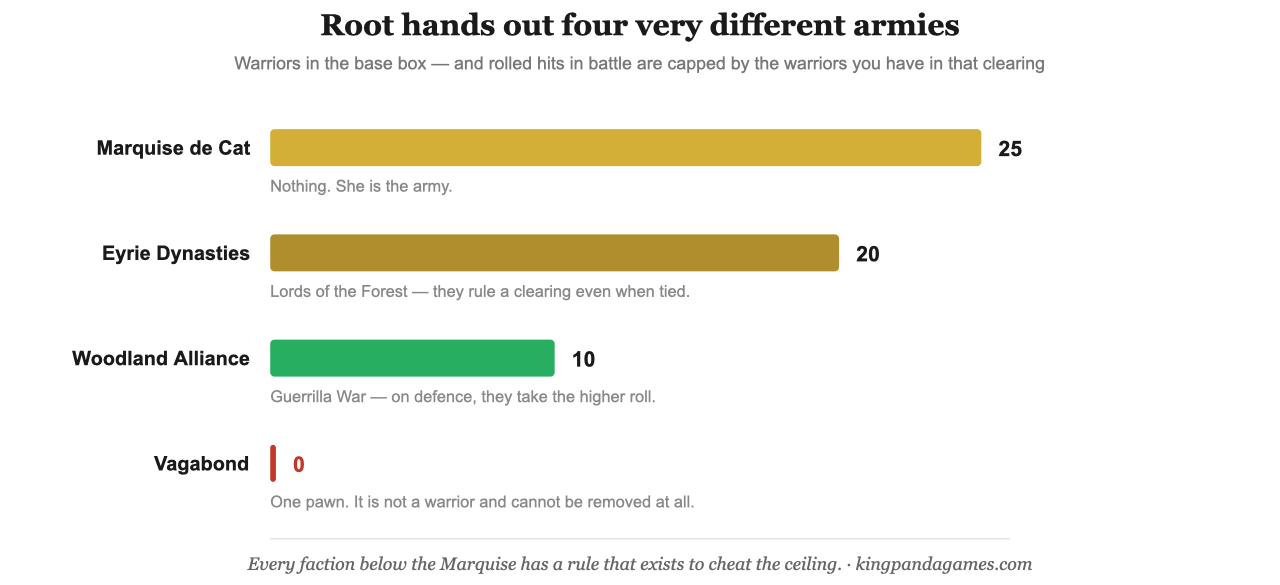
| Faction | Warriors in the box | Share of the Marquise’s army | What the game gives them instead |
|---|---|---|---|
| Marquise de Cat | 25 | 100% | Nothing. She is the army |
| Eyrie Dynasties | 20 | 80% | Lords of the Forest — they rule a clearing even when tied |
| Woodland Alliance | 10 | 40% | Guerrilla War — on defence they take the higher roll |
| Vagabond | 0 (one pawn) | 0% | The pawn is not a warrior and cannot be removed at all |
Read that next to the rolled-hit cap and the design snaps into focus. Your army size is a hard ceiling on how much damage you can do in any single fight, and Root deals out 25, 20, 10 and zero. Every faction below the Marquise has a rule that exists to cheat that ceiling — the Eyrie win ties, the Alliance invert the dice, and the Vagabond simply cannot be killed.
Guerrilla War is the most misread rule in the game. Attacking ten Alliance warriors is not a discount; it is a coin flip you are on the wrong side of.
What We Liked
The table argues. Root produces the specific kind of conversation where four people are each explaining, sincerely, why somebody else is the real threat — and because everybody scores differently, all four arguments are usually true.
Turmoil is a brilliant piece of design and it deserves its reputation. The Eyrie write their own orders and can never delete them, so a good Eyrie player is building a machine they will eventually be unable to feed. When it breaks they Humiliate (lose a point for every bird card on the Decree), Purge the Decree, and Depose their leader. Losing four points to your own past decisions is a better story than most games produce all night.
Kyle Ferrin’s art does real work. The cheerful woodland creatures are why non-wargamers sit down at a game about insurgency and supply lines, and it is why Root sits in our best board game artwork ranking.
What We Disliked
The first game is not the game. Four new players will spend most of three hours reading their own faction board, and the result will not resemble Root. Everyone needs one throwaway play before the design shows up, and plenty of groups never schedule the second.
It punishes unequal knowledge harder than almost anything else we rate. In most games a new player loses. In Root a new player decides who wins, because the faction they fail to threaten runs away with it.
Two players is a real weakness, not a niche. The whole design assumes a leader gets ganged up on, and at two there is nobody to form the gang.
Who It’s For
Root is for groups who already like conflict games and want a shorter one. It is a war game at heart — area control, attrition, a map that everybody wants — compressed into ninety minutes and dressed as a children’s book.
It is also the best game we know for a table that has one very competitive person in it, because Root gives the other three a shared reason and a shared mechanism to deal with them.
Who should skip this game: anyone shopping for a family game, anyone whose group changes every week, and anyone who wants to sit down and be good at something immediately. The 14+ rating is about patience, not content.
Who Should Buy This?
Buy it if you have a group of four that meets regularly and has already worn out something like Catan. Sixty dollars for four asymmetric factions and two maps is a lot of game per pound, provided the group commits to the second play.
Do not buy it to try it. Root is the clearest example on this site of a game that needs a plan — borrow a copy, or agree with your group in advance that the first evening is a write-off. If you cannot get that agreement, spend the money on something your table will open twice.
Best Player Count
Four, and it is not close. Root’s balance rests on the assumption that the player in front becomes everybody’s problem, and that assumption only holds when there are three other players to notice.
Three is playable and noticeably looser. Drop a faction and one of the pressure points on the map disappears — whoever is left has more room than the designer intended, and the Vagabond in particular becomes hard to police with one fewer army in the world.
Two is the count to avoid. The leader is never punished by a coalition because there is no coalition, so the game becomes a straight race, and Root was not built as a race. We go through what actually happens at two, and the one setup that improves it, in is Root good at 2 players.
Replayability
Very high, and unusually front-loaded. There are four factions in the base box and each one plays like a different game, so the first four times you play Root you are effectively buying four games — a table that rotates factions properly has a year of material before anything repeats.
The board helps more than people expect. The box holds a double-sided map: Autumn with no special rules, and Winter, where the Raging River divides forests the way printed paths do. That single change reshapes how armies move.
The ceiling arrives when a group settles into fixed faction assignments and the same person always plays the Marquise. That is the moment expansions start earning their money, and which one to buy first is a real decision — we rank them in all 4 Root expansions ranked.
Awards
Root swept the 2018 Golden Geek Awards, taking Board Game of the Year, Most Innovative, Best Thematic and Best Artwork & Presentation. That combination is telling: it won for being clever and for being beautiful, which is exactly the tension that makes people buy it expecting something lighter than it is.
How It Compares
If you like Scythe, Root is the faster and meaner version. Both are asymmetric games about armies on a shared map, but Scythe’s factions differ in powers while Root’s differ in rules, and Scythe rewards an engine where Root rewards a coalition. Our Scythe review covers the other side, and we put them head to head in Root vs Scythe.
If you like Catan, Root is what happens when the trading stops. Both are area-control games where position on a shared map is everything; Catan resolves conflict through negotiation and the robber, Root resolves it with dice and warriors.
If you like Spirit Island, you already tolerate the reading. Both hand you a wall of asymmetric rules and expect you to enjoy the homework — the difference is that Spirit Island is cooperative, so a confused player costs the team rather than handing someone the win.
Tips
Play the Marquise first, and play her badly on purpose. She has the most warriors and the most legible scoring, and losing with her teaches you the map faster than winning with anyone else.
Count the Alliance’s warriors before you attack them. Guerrilla War means the defender takes the higher roll, so a ten-warrior faction sitting in a sympathetic clearing is a worse target than an eyrie twice its size.
As the Eyrie, add the card you can always resolve. Turmoil is not bad luck — it is arithmetic you agreed to two turns ago. Every card you tuck is a promise, and the Decree never forgets.
Whoever is closest to 30 is the target, not whoever has the biggest army. Root’s score track is public for a reason, and the table that reads it wins more often than the table that reads the map.
Worth knowing: a dominance card is the losing player’s best friend. At 10 points with no path to 30, taking yourself off the score track and playing for clearings changes what everyone else has to defend.
Want to go deeper?
- All 4 Root expansions ranked — which box to buy first, and the one most groups should skip. Read it here
- Which Root faction should you play first — all four base factions ranked by how forgiving they are. Read it here
- Is Root good at 2 players — the honest answer, and the one setup that helps. Read it here
- Root vs Scythe — two asymmetric war games, one clear recommendation. Read it here
Verdict
Buy it if you have four regulars who will commit to a second play. Skip it if your group is a rotating cast or you wanted the family game the cover is advertising. Borrow it first if you have never played an area-control war game — Root is excellent and it is not gentle, and those two facts arrive together.
Root’s official site: Leder Games, and the full rules are in the Law of Root. Last verified September 2026.
Frequently Asked Questions
Is Root worth buying?
Yes, if you have three other people willing to learn four different rulebooks and play it more than twice. Root is a genuinely great design that is close to worthless as a one-off — every faction scores differently, and a table where nobody knows what the other factions are trying to do produces a runaway winner and a bad evening. Buy it for a regular group, not for a shelf.
Is Root hard to learn?
Harder than its art suggests, which is the single most common complaint about it. The box is 14+ and the Law of Root runs 32 pages, because you are not learning one game — you are learning a shared map, plus four faction rulebooks that share almost no vocabulary. Expect to lose your first game while you work out what your own faction was supposed to be doing.
How do you win Root?
Reach 30 victory points, or win outright with a dominance card. Each faction scores in a completely different way — the Marquise scores by building, the Eyrie by holding roosts, the Alliance by spreading sympathy, the Vagabond by making and breaking friendships. There are four dominance cards in the deck, and activating one at 10 or more points takes you off the score track entirely in exchange for a location-based win condition.
Is Root good at 2 players?
It is the weakest thing the box does. Root is built on the assumption that a leader gets attacked by everybody else, and with two players there is no everybody else — whoever is ahead simply stays ahead. Leder supports it and the map works, but if two-player is your main use case there are better ways to spend sixty dollars.
Which Root faction should a beginner play?
The Marquise de Cat. She has the most warriors in the box at 25, her scoring is the most legible — build things, score points — and her mistakes are recoverable. The Eyrie punish a bad turn with Turmoil, which costs you a victory point for every bird card on your Decree, and the Woodland Alliance are the hardest faction in the base box to play badly and survive.
Do you need the Root expansions?
No, and buying one too early is the common mistake. The base box already holds four asymmetric factions and two maps, which is more game than most groups exhaust in a year. Expansions earn their money once a specific faction has gone stale or your player count has outgrown four.
How long does a game of Root take?
Leder lists 60 to 90 minutes and that is honest for a table that knows the game. A first play with four new players runs closer to three hours, most of it spent reading faction boards, and that gap is where most of the game’s bad reputation comes from.