

Catan Robber Strategy: Where to Place It and When to Move It
Just need the rules? Our Catan robber rules page answers every question — do you have to move it, the 7-card discard, stealing, the desert — in one place. This guide is about strategy: where to put the robber and when.
Some links below are Amazon affiliate links — as an Amazon Associate, King Panda Games earns from qualifying purchases at no extra cost to you. Full disclosure.
Most Catan players use the robber wrong.
Catan won the Spiel des Jahres, the hobby’s most consequential award, in 1995. See the jury’s entry.
They move it onto whoever’s winning. They steal blindly. They use it as punishment rather than strategy. And then they wonder why rolling a 7 feels like a wasted turn.
The robber isn’t just a way to hurt the leader. It’s a diplomatic tool, a blocking mechanism, a resource generator, and — when used correctly — one of the most powerful levers in the entire game. Here’s how to actually use it.
Catan Robber Rules, Quickly
Yes, you must move the robber every time a 7 is rolled or a Knight card is played — you can’t skip it or leave it in place. Here’s the full rules sequence:
- Discard first. Before the robber moves, every player holding more than 7 resource cards discards half (rounded down). This happens on any 7 roll, even if you rolled it yourself.
- Move the robber. The active player moves it to any hex on the board — including a hex it just left, or back onto the desert. There’s no restriction.
- Block production. That hex produces nothing for anyone — including the active player — until the robber moves again.
- Steal one card. If any opponent has a settlement or city touching the new hex, the active player takes one random resource card from their hand. No adjacent opponent, no steal — you still block production, though.
- Knights work the same way. Playing a Knight card triggers the exact same move-and-steal sequence, without needing to roll a 7 — which is what makes Knights a proactive defense tool, not just an offensive one.
For the full Catan overview, check out our complete Catan review.
What the Robber Actually Does
When a 7 is rolled, or when a Knight development card is played, the active player moves the robber to any resource hex. That hex produces no resources until the robber is moved again. The player also steals one random resource card from any opponent with a settlement or city adjacent to the new hex.
Two effects: production blocking (the hex goes offline) and resource theft (one card taken). New players treat both effects as bonuses. Experienced players optimize for one or the other depending on the game state.
The Four Robber Situations
1. Block the Runaway Leader
This is the one everyone knows. If someone is at 8 or 9 points and closing in on a win, move the robber onto their most productive hex. This reduces their production and — if you steal from them — directly slows their ability to finish.
The mistake most players make here is moving the robber onto the leader’s best resource rather than their most needed resource. If someone needs one ore to win, blocking their wheat hex doesn’t help. Block the ore.
Rule: when blocking the leader, block the resource they need to clinch, not the one they produce most of.
2. Break Up a Production Engine
Experienced Catan players often build an engine around one or two high-probability hexes — a settlement or city on the 6 and 8 of the same resource, for example. Moving the robber onto one of those hexes doesn’t just hurt them once; it removes a consistent production node for as long as the robber stays there.
When deciding where to move the robber, look at the whole board and identify who has the most concentrated production dependency. A player with two cities on ore hexes numbered 6 and 8 is more hurt by losing one of those than a player who has ore spread across three different hexes.
Rule: target concentrated production, not distributed production.
3. Use It as Diplomatic Leverage
This is the move most beginners never think of, and it’s where experienced players get outsized value from the robber.
Before you move the robber, announce what you’re considering. “I’m thinking about moving it onto your wheat hex — unless someone wants to make this worth my while.” This is not unsportsmanlike; it’s core Catan diplomacy. Players who need you to put the robber elsewhere will offer trades. Players who benefit from you blocking your other opponent will offer alliance.
The robber is leverage. The threat of the robber is sometimes more valuable than the placement itself.
Rule: before you place the robber, see if someone will trade or deal to influence where it lands.
4. Protect Yourself
A Knight card lets you move the robber proactively — you don’t need to roll a 7. If the robber is sitting on your best hex and you have a knight, play it. Move the robber somewhere useful, claim your production back, and steal a resource in the process. Worth knowing if you ever upgrade the box: Cities & Knights removes the development deck and the Knight card along with it, replacing them with knight figures you activate on the board to chase the robber off a hex — one of the bigger differences in Cities and Knights vs Seafarers.
This is why the Largest Army card (earned by playing three knights first) is so powerful. You get three productive robber placements and 2 victory points — all in one strategic package.
Rule: don’t sit on knight cards waiting for the perfect moment. If the robber is on your land, play the knight.
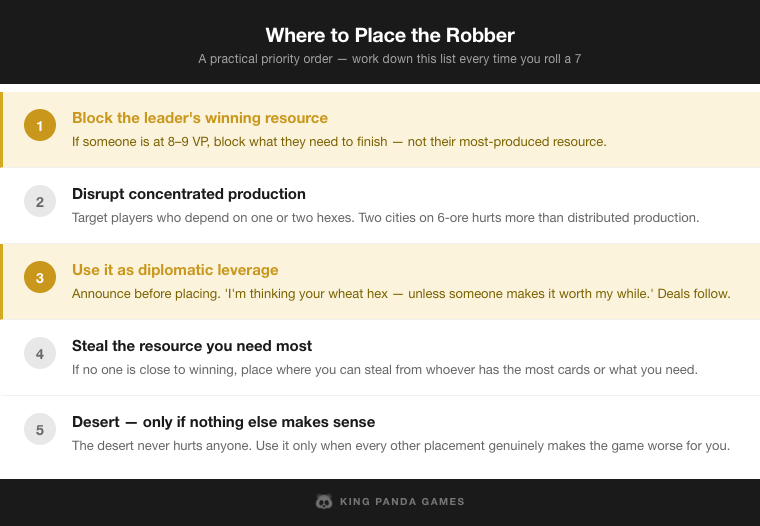
Where to Place the Robber: A Practical Priority Order
When you roll a 7, here’s how to think through your placement in about 10 seconds:
- Is someone about to win? If yes, block their most needed resource.
- Does someone have a resource monopoly that’s letting them pull away? Block their production engine.
- Can you use this as leverage for a trade you need? Negotiate before placing.
- Is there a high-value theft target? Place where you can steal from whoever has the most cards or the resource you need most.
- None of the above? Move it to the highest-probability hex owned by whoever is currently ahead on points.
The desert is always available and never blocks anyone — use it only if every other option genuinely makes the game worse for you (rare).
The Robber Etiquette Question
Catan groups often develop informal rules about robber placement. Some groups play that you can’t move the robber onto the same person twice in a row. Some groups let anything go.
Our take: the game was designed with full robber freedom. Restricting it softens the strategic layer. If your group is new to the game and the robber is creating bad feelings, ease into it — but don’t nerf it permanently. Learning to use and respond to the robber is part of learning Catan.
The first time someone moves the robber onto you right before you can win and steals your last resource card — that moment is Catan. It’s supposed to hurt a little.
What the critics said about Catan
We play these games ourselves, but it’s worth knowing where the rest of the hobby lands.
-
“My rating of Catan is pretty low, actually.”
— Tom Vasel, The Dice Tower. Vasel has played it for decades and still lands cooler on it than its reputation suggests — worth knowing before you treat Catan as an automatic buy.
Going straight to the source: Read the official Catan rules, plus the publisher’s game page and background and history.
📕 Grabbing the rules? Grab this too.
The KPG Budget Board Games Guide — 9 games under $30, each with player counts, play time, and who it’s actually for. Free PDF, no email gymnastics.
Don’t own Catan yet? This guide assumes the base game.
Frequently Asked Questions
Do you have to move the robber in Catan?
Yes. Whenever a 7 is rolled, or whenever you play a Knight development card, you must move the robber to a different hex — you cannot leave it where it is or decline to move it. The only exception is the desert, where the robber starts the game; once it leaves the desert, it can be moved onto any hex, including back to the desert.
How does the robber work in Catan?
When a 7 is rolled, the player who rolled it moves the robber to any hex on the board. That hex stops producing resources for everyone until the robber moves again. The active player then steals one random resource card from any single opponent who has a settlement or city touching that hex.
Do you steal a card every time you move the robber?
Only if at least one opponent has a settlement or city adjacent to the hex you place the robber on. If no opponent borders that hex, you block production but steal nothing. You always get to choose which adjacent player to steal from if more than one qualifies, but the card taken is random from their hand.
What happens when you roll a 7 in Catan?
First, any player holding more than 7 resource cards must discard half of them (rounded down), before the robber moves. Then the player who rolled the 7 moves the robber to any hex and steals one card from an adjacent opponent. No one produces resources from that roll — the 7 has no resource number attached to it.
Can you move the robber to the same hex twice in a row?
By the official rules, yes — there’s no restriction on returning the robber to a hex it just left, including back onto the desert. Some house rules ban immediately re-blocking the same player or hex; that’s a group preference, not an official rule.
What is the best Catan robber strategy?
Block the resource an opponent needs to win, not just the one they produce most, and prioritize concentrated production (a city sitting on two high-probability hexes of the same resource) over a scattered board presence. Use the threat of the robber to negotiate trades before you place it, and never let a Knight card sit unplayed if the robber is parked on your own land.