

This article contains affiliate links — if you buy through them, we may earn a small commission at no extra cost to you. Full disclosure.
Heat: Pedal to the Metal Review: Is It Worth It?
Bottom Line
Heat is best for groups who want a genuinely tense, fast-playing game that teaches in fifteen minutes and still rewards a dozen plays. Skip it if your table hates any luck at all — the Stress cards will occasionally hand you a bad corner at the worst moment. Its biggest strength is that the whole game runs on one brilliant idea: your speed and your hand are the same resource. Its biggest weakness is that the base box’s four tracks start feeling familiar faster than the game itself gets old.
Some links below are Amazon affiliate links — as an Amazon Associate, King Panda Games earns from qualifying purchases at no extra cost to you. Full disclosure.
Heat gets 5/5 Pandas and 4/5 Bamboo Plants from us, and the short version is that this is the best racing board game ever made. The Pandas are because the last lap of a close Heat race is the most tense forty-five minutes in our collection — cars nose to tail, everyone out of Heat, everyone praying they don’t have to shift down. The 4 Bamboo is a genuine compliment: the rules teach in about fifteen minutes because there’s really only one system to learn. It lands at #7 on our best board games of 2026 list.
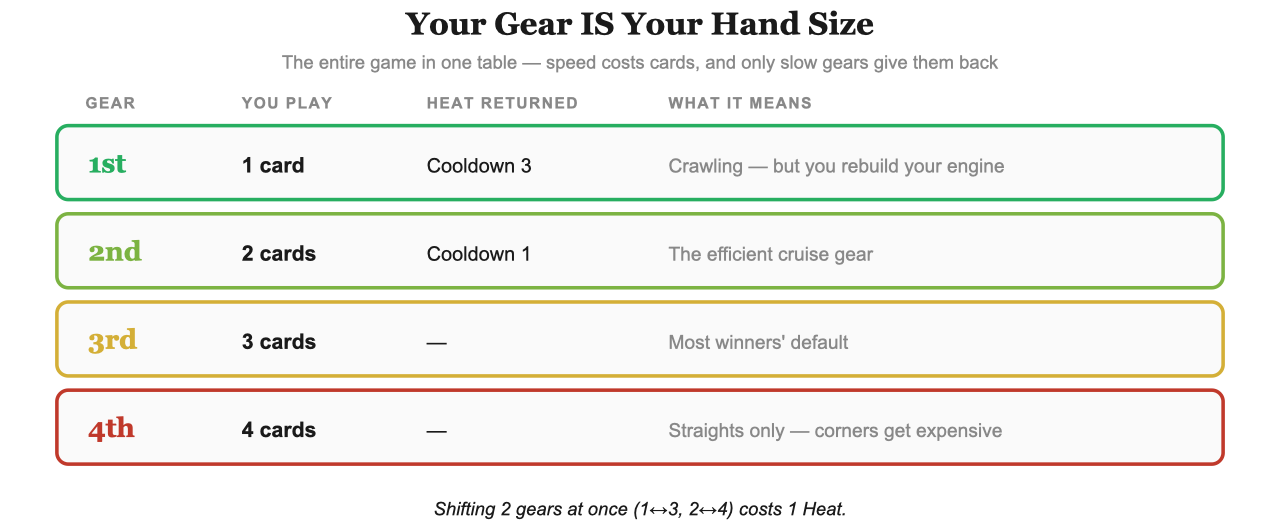
Here’s the thing that makes it work: your gear is your hand size. Fourth gear plays four cards, first gear plays one. Go fast and you burn through your deck; go slow and you sit there watching everyone pull away. Every racing game before this one simulated speed. Heat makes you feel the cost of it.
| Detail | Info |
|---|---|
| Players | 1–6 |
| Best Player Count | 4 — the pack stays tight enough that slipstreaming matters every lap |
| Age | 10+ |
| Play time | 45–60 min (genuinely — this is not a 60-minute game that takes 90) |
| Complexity | Light-Medium |
| Solo Mode | Yes — the Legends bot module in the advanced rulebook |
| Designer | Asger Harding Granerud & Daniel Skjold Pedersen |
| Publisher | Days of Wonder |
| Popular Upgrades | Yes — inserts, sleeves, and a big aftermarket for the fan-made track community |
| Bamboo Plants | 4/5 — one core system, taught in a quarter hour |
| Pandas | 5/5 — the tightest finishes in board gaming |
| Official site | daysofwonder.com/heat |
How Heat Works
Every round, everyone simultaneously picks a gear — 1 through 4 — and that number is exactly how many Speed cards you play from your hand. Reveal, add them up, move that many spaces. That’s the entire core loop, and you’ll have it in five minutes.
The tension comes from what you’re spending. Your deck holds Speed cards and Heat cards, and Heat is dead weight — it clogs your hand and does nothing. You take Heat for boosting, for shifting two gears at once, and for going through corners too fast. The only way to get Heat back out of your hand is to cool down, which mostly means dropping into 1st gear (3 cooldown) or 2nd (1 cooldown) — the slow gears.
You’re two spaces from a corner with a Speed Limit of 3, sitting in 4th gear. Your four cards total 9. That’s 6 over the limit — six Heat, and you only have four left. Which means you shift down to 2nd and crawl through at 4, giving up two places… or you go for it, pay everything you have, spin out, and get placed back before the corner anyway. Heat is a game about paying for yesterday’s decisions.
Two more systems shape every race. Slipstream gives you a free 2 spaces if you end your move beside or behind another car — and critically, it doesn’t count toward your corner speed. It’s the only free speed in the game. And Adrenaline hands the last-place car a catch-up bonus every round, so nobody gets dropped from the race by lap two.
The round itself runs in a fixed order that’s worth knowing before your first game: shift gears, play cards face down, reveal and move, Adrenaline, react, slipstream, check the corner, discard, refill to seven. Steps one and two happen simultaneously for everyone — which is why a six-player game doesn’t take six times as long as a two-player one.
Cards you play are gone until you cycle your deck, and your hand refills to seven at the end of every round. So a 4th-gear lap doesn’t just cost you Heat at the corner — it eats four cards of deck, and what comes back may be the Heat you took two corners ago. The deck is the engine, and running it hot is exactly as costly as it sounds.
What We Liked
The gear-as-hand-size idea is genuinely brilliant. Most racing games make speed a number on a track. Heat makes speed a resource you physically feel running out, because going fast means playing more cards, and playing more cards means drawing the Heat you took at the last corner. One mechanic does the work of an entire simulation.
Races end in a photo finish more often than they have any right to. The Adrenaline rule and slipstreaming combine to keep the pack bunched, so the leader is never comfortable. In our closest game, four of five cars crossed the line in the same round — that basically never happens in a race game without feeling scripted.
The last lap is a different game entirely. Everyone’s out of Heat, everyone’s been managing the same engine for forty minutes, and the corner math turns brutal because nobody has any margin left. It’s the rare game where the tension curve genuinely rises to the finish instead of settling once a leader emerges.
Setup and teardown are fast, and it plays 1–6. Twelve Speed cards and a player mat per person, and a two-sided board with four tracks. It’s a five-minute setup for a game that can seat six — a combination almost nothing else in this weight class manages.
And the production is gorgeous. Vincent Dutrait’s art gives the whole thing a 1960s Grand Prix look that makes people at the next table lean over.
What We Disliked
Four tracks is fewer than it sounds. USA, France, Great Britain, and Italy differ in corner placement and lap count, but they’re all learnable, and once your group knows where the hard corners are, some of the discovery goes out of it. This is exactly what the Heavy Rain and Tunnel Vision expansions exist to fix, but it’s a real limitation of the base box after a dozen plays.
The Stress cards will occasionally rob you. You start with three shuffled into your deck, and each resolves as a random 1–4 speed. That’s the game’s intentional variance, and it mostly works — but a Stress card flipping high right as you’re threading a tight corner can spin you out through no fault of your own. Players who need total control will grind their teeth.
Simultaneous selection means the table waits on the slowest thinker. Everyone chooses gear at once, which is great, but resolving movement happens one car at a time from the front, and a table with two analysis-paralysis players adds real minutes to a game that otherwise flies.
Who It’s For
Heat is for the group that wants something with teeth but doesn’t want to spend a night on it. It’s the game we pull out when we have an hour, six people, and mixed experience levels — because a first-timer can genuinely win, and a veteran still has plenty to think about.
It’s also the best “my friend says they hate board games” game we own. Racing is instantly legible in a way that trading sheep or building bird engines isn’t. Everyone understands going too fast into a corner.
Fans of lighter engine-management games will click with it immediately — if you liked how Ticket to Ride taught a whole table in ten minutes, Heat is that lesson with a pulse.
Who should skip this game: anyone who wants a pure-skill contest with no randomness — Stress cards and card draw mean the best driver doesn’t always win. Also skip it if your group only meets for three-hour epics; Heat is a 45-minute game and doesn’t pretend otherwise.
Who Should Buy This?
Buy Heat at full price — around $55 — if you host game nights with four or more people. Very few games at this price play six, teach in fifteen minutes, and still get requested by the same group forty plays later. On a cost-per-hour-of-fun basis it’s among the best purchases in our collection.
Try before you buy only if your group has historically bounced off games with luck in them. That’s the one dealbreaker here, and one play will tell you.
If you’re deciding between Heat and a heavier strategy centerpiece like Scythe, buy Heat first. It’ll hit the table five times more often.
Best Player Count
Heat is best at 4. The box says 1–6, and the honest ranking is 4, then 5, then 3, then 6, then solo, then 2.
At four, the pack stays tight without the board getting crowded. Slipstream opportunities appear every lap because there’s almost always a car within reach, and the Adrenaline bonus meaningfully rotates rather than living with one poor soul all race.
At six the board gets genuinely congested — fun in a demolition-derby way, but you’ll spend turns blocked behind traffic you can’t pass. At two, the game still works but loses its heart: with one opponent, slipstreaming becomes rare and the race turns into parallel time trials. Our full player-count breakdown covers each option including the solo Legends bots.
Replayability
Heat’s replay value comes from the tracks and the deck, not from asymmetry — every driver starts identical. What changes is the corner geometry: a track with two tight corners back to back demands a completely different Heat budget than one long sweeping circuit.
The base box’s four tracks carry a group comfortably through a dozen races. After that, the advanced rulebook is where the game reopens — it adds upgrade card drafting, weather and road conditions, the Legends bot module, and a full championship system where results carry across multiple races. That championship layer is the single biggest replayability addition, and it’s already in the box.
Beyond that, the expansions add tracks and modules, and there’s an unusually active fan community making printable circuits — a sign of exactly how much life this design has.
Accessories & Upgrades
Heat has a modest but genuinely useful aftermarket:
- A fitted insert (Folded Space or Laserox, ~$25–$35) — the stock box has six player colors of cards and mats to sort, and setup drops from five minutes to two with a real organizer.
- Card sleeves (~$15) — your Speed cards get shuffled every single round, more than almost any game. If you sleeve anything, sleeve these.
- Fan-made track PDFs (free) — the community prints extra circuits, which is the cheapest possible fix for the four-track limitation.
None of it changes the game. The insert is the one we’d actually buy.
Check a Heat insert price on Amazon →
Awards
Heat swept the 2022 Golden Geek Awards, winning Medium Game of the Year and Best Thematic Board Game, plus a nomination for Most Innovative — unusual recognition for a racing game, a genre that had been creatively stuck for years.
Similar Games
If you like Formula D, try Heat — Formula D simulates racing with custom dice per gear, so your speed is a roll; Heat makes speed a hand of cards you manage across the whole race. Formula D is louder and swingier, Heat is tighter and more strategic. We cover the full comparison here.
If you like Ticket to Ride, Heat is your next step up. Same fifteen-minute teach, same “everyone can play” accessibility, but with real tension and decisions that compound across a race instead of accumulating quietly.
If you want Heat’s tension in a heavier package, play Blood Rage instead — both are games where pushing too hard is punished, but Blood Rage is a 90-minute drafting-and-combat game where dying gloriously is a strategy.
Tips & Tricks
Cool down before you need to, not after. The instinct is to run hot until your hand clogs, then drop gears in a panic — but a planned lap in 2nd gear on a straight costs you almost nothing, while an emergency downshift into a corner costs you position.
What most new players do: stay in 4th gear as long as possible, because it’s a racing game and 4th is fast.
What actually works: treat 4th gear as a burst tool for straights, not a default. The winner of most Heat races spends more rounds in 2nd and 3rd than anyone expects — they’re the ones with Heat left for the final lap.
Slipstream is free speed, and free speed doesn’t count at corners. This is the single most underused rule at new tables: ending your move next to or behind a car gives you 2 extra spaces that don’t add to your corner-check total. Deliberately parking behind a rival before a tight corner is often better than passing them.
Count the spaces to the next corner before you pick your gear, every single round. Heat punishes autopilot more than bad math — the number is printed right there on the board, and the players who read it win.
Shifting two gears at once costs 1 Heat, and it’s usually worth it coming out of a corner, almost never going in. Dropping 4→2 to survive a corner means paying Heat on top of the Heat you’re already paying for the corner itself — the double penalty that ends most first-time races. Coming out of a slow section, though, 1 Heat to jump straight back to 4th buys you a full lap of tempo.
Take the inside line early on tracks with back-to-back corners. Corner checks happen per corner, not per round, so a lap that clips two tight corners can charge you Heat twice before you ever reach a straight — and the players who plan their cooldown one corner ahead are the ones still racing on the last lap.
Worth knowing: Adrenaline only goes to the last car (last two with 5+ players) and it can’t be saved. If you’re in last place, that bonus is a free resource each round — sometimes the right play is staying last through a corner section, cashing Adrenaline every round, and pouncing on the final straight.
Not sure whether Heat is the right step for your group? It is number 6 of 12 on our strategy board games list, ranked easiest to hardest to learn.
Frequently Asked Questions
Is Heat: Pedal to the Metal worth buying?
Yes — we rate it 5/5 Pandas and it’s the best racing board game available. It teaches in about 15 minutes, plays in under an hour, seats up to six, and produces genuinely close finishes. The only people who should skip it are groups who dislike any luck in their games.
Is Heat hard to learn?
No — it’s one of the easiest medium-weight games to teach, which is why we rate it 4/5 Bamboo Plants. There’s really only one system: your gear equals how many cards you play. Most groups are racing confidently by the second lap of their first game.
How long does a game of Heat take?
Genuinely 45–60 minutes, including setup. Unlike a lot of games in this weight class, Heat hits its stated play time because the round structure is simultaneous and the lap count is fixed.
How many players is Heat best with?
Four. The pack stays tight enough that slipstreaming matters every lap without the traffic jams you get at six. It plays 1–6, and even the solo mode is good, but four is the sweet spot.
Does Heat have too much luck?
It has real luck — the three Stress cards in your starting deck resolve as a random 1 to 4 speed, and card draw matters. Skilled players win far more often than not because Heat management is a genuine skill, but a bad Stress flip at a tight corner can cost you a race.
What happens when you spin out in Heat?
If you go through a corner over the Speed Limit and can’t pay the Heat difference, you pay all the Heat you have and your car is moved back to the first available space before that corner. It’s the game’s harshest punishment and it usually costs you two or three positions.
Is Heat good solo?
Yes — the Legends module in the advanced rulebook runs bot cars with a simple deck-driven system that requires little upkeep. It’s a solid solo experience, though Heat is fundamentally a game about racing actual humans.
Do you need the Heat expansions?
Not right away. The base box has four tracks plus an advanced rulebook containing upgrades, weather, bots, and a full championship system — that’s a lot of game. Consider expansions once your group has raced all four circuits several times.
Want to go deeper?
- Heat Strategy Guide: How to Win — The Heat economy explained, and why the winner usually spends more time in 2nd gear than you’d think. Read it here
- Heat Corner Rules Explained — Speed limits, spin outs, boost, and the slipstream exception, straight from the rulebook. Read it here
- Is Heat Good for Beginners? — What the 15-minute teach actually covers, and the two rules new players always miss. Read it here
- Heat Player Count: Best at 4? — Every count from solo to six, honestly ranked. Read it here
- Heat vs. Formula D — Two racing games, two completely different ideas about what speed should feel like. Read it here
Verdict
Buy it if you want one game that plays six people in an hour, teaches in fifteen minutes, and still produces photo finishes after fifty races — Heat is the rare crowd-pleaser that doesn’t get boring. Skip it if your group demands zero randomness; the Stress cards are baked in and they will occasionally decide a corner. Try before you buy only if racing themes leave you cold — though we’d note that Heat has converted several people at our table who swore they had no interest in cars.
For a genre that spent decades producing roll-and-move disappointments, critics broadly agree this is the one that finally got it right — Shut Up & Sit Down’s review called out the same last-lap tension we did, and its BGG page has held a top-100 overall ranking since release. We’d go further: Heat is the best game Days of Wonder has published since Ticket to Ride, and it’s not particularly close.
Heat: Pedal to the Metal official site: daysofwonder.com/heat — the full rulebook PDF is free to read there too.