

Catan Best Starting Placement: Where to Settle First
The two decisions you make before your first turn — where to place your starting settlements — shape every resource trade, every road, every city upgrade for the rest of the game. Get them right and you’re playing from strength. Get them wrong and you spend 90 minutes fighting uphill.
Most players know the basics: settle near 6s and 8s, try to hit multiple resources. But the actual best placement is more specific than that, and the second settlement is almost always chosen worse than the first. Here’s how to nail both.
For a full breakdown of how Catan works, see our Catan review.
Why Starting Placement Matters More Than Strategy
In Catan, the resource production you lock in at setup is essentially your starting income. Unlike cash in Monopoly, you can’t earn your way to better production mid-game — you can only build from what your hexes give you.
A settlement on a 6 and an 8 of the same resource will produce that resource roughly 10 times every 36 rolls. A settlement on a 4 and a 10 produces the same resource roughly 6 times. That’s a 40% production gap from one bad placement — a gap no amount of trading can fully close against a player who started in a better spot.
The math matters: every pip on the number token represents one way to roll that number out of 36 possible dice outcomes. 6 and 8 each have 5 pips. 5 and 9 have 4. 4 and 10 have 3. 3 and 11 have 2. 2 and 12 have 1. Totaling the pips on each settlement tells you exactly how productive it is.
A settlement with 9 total pips across its adjacent hexes is excellent. 12 or more is rare and dominant. Anything under 6 is a liability.
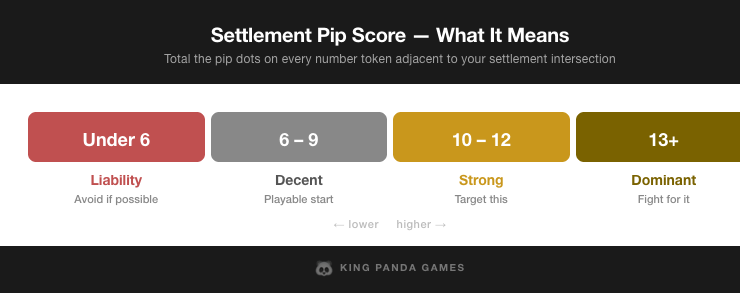
Choosing Your First Settlement
Find the intersection with the highest pip count
Before you place anything, scan the entire board and add up the pips at each intersection. Intersections are where three hexes meet. Add the pips from each of the three adjacent hexes (ignoring desert, which contributes 0).
The highest-pip intersections are almost always on the 6 and 8 hexes. Specifically, look for intersections where two high-probability hexes share a corner — a 6 and an 8 meeting at the same intersection, for example. That single intersection produces 10 pips and is worth more than most second settlements.
Prioritize ore and wheat over wood and brick
In Catan, the endgame is won with ore and wheat. Cities cost 2 wheat + 3 ore. Development cards cost 1 ore + 1 wheat + 1 sheep. These are the resources that get you from 5 points to 10 points.
Wood and brick win the early game — you need them for roads and initial settlements — but their value declines sharply once you’re past your third settlement. If you’re choosing between an intersection that gives you excellent ore/wheat coverage and one that gives you excellent wood/brick coverage, take the ore/wheat. You can trade for wood and brick; you can’t easily trade your way into consistent ore production late in the game.
Exception: if you’re settling on the 6-ore and 8-wheat hexes, you’ll need wood and brick to get anywhere in the early game. Balance matters. But if forced to choose, weight ore/wheat higher.
Port access changes the calculus
A 2:1 ore port next to a good ore hex is extremely powerful — you can trade two ore for any resource, which lets you fill gaps efficiently. A 3:1 port is broadly useful but less dramatic.
If an intersection gives you both decent production and port access (meaning a road to that port from your starting settlement is short), that’s worth adjusting your pip-maximizing instinct for. Ports are recurring advantages that compound over the entire game.
Choosing Your Second Settlement
This is where most players lose their starting placement advantage.
The standard mistake: after placing the first settlement, players look for whatever’s left and pick the best available spot near their preferred resource. This is reactive. It ignores the board-state dynamics that will play out over the next 60 minutes.
Plan your second settlement before you place your first.
Before you put your first token down, identify where you want your second token to go. Then place your first settlement in the location that gives you a clean road path to that second spot before anyone else can claim it.
The best second settlement location typically:
1. Covers resources you don’t have from settlement one. If your first settlement gives you ore, wheat, and wood, your second settlement should prioritize brick and sheep. You need all five resources to play a full game.
2. Still has solid pip counts. Don’t sacrifice production probability just for resource diversity. A 10-pip intersection that covers your missing resources is infinitely better than a 6-pip one.
3. Sits on a different part of the board from your first settlement. Clustering settlements on the same hexes gives you redundant resources and limited expansion options. Spreading out gives you a larger portion of the board to develop into.
The diagonal trick
In the starting placement phase, players alternate placing settlements — one each in order, then reverse. The second round starts with the last player and works backward. This means the first player picks twice in succession on the second pass, while the last player picks first in round two but then waits the longest.
If you’re picking late in round one (third or fourth), you likely won’t get the highest-pip intersections. But you will pick first or second in round two. Identify that second spot before round one ends and position your first settlement to reach it via road before the early-turn players can pivot to block you.
What to Avoid
Avoid settling near 2, 3, 11, and 12 hexes unless forced. These numbers produce so rarely that a settlement covering only them is nearly useless. If you have to settle near one of these, make sure the other two hexes at your intersection have strong numbers.
Avoid putting both settlements on the same high-probability hexes. Two settlements on the 6-ore hex means you produce a lot of ore but struggle for everything else. Diversify production.
Avoid settling purely for port access without strong adjacent hexes. A 2:1 port is worthless if you’re not producing enough of that resource to make trades. The intersection leading into a port still needs good pip counts.
Don’t let an opponent’s placement override your read of the board. New players often abandon their planned second settlement because another player built nearby. If your intended spot is still available and it’s the right call, take it. Reactively chasing away from good positions often ends with settling in worse spots.
A Sample Read
You’re player one. The board comes out with a cluster of 6 (ore), 8 (wheat), and 5 (sheep) hexes sharing intersections in the upper right quadrant. The best intersection there has 14 pips. The rest of the board has scattered 3s, 4s, and 9s.
Round one, pick one: Take the 14-pip intersection. It gives you ore, wheat, and sheep — three of the five resources, with two being endgame-critical.
Scout second settlement: You’re now looking for wood and brick on 6s, 8s, or 5s. Suppose there’s a decent wood/brick/wheat intersection with 11 pips in the lower left. It’s close enough to reach with two roads before the field fills.
Round one road: Build toward the lower left. When your second pick comes in round two, you can place a settlement there immediately and have a complete resource base by turn three.
This is the play. Two settlements, five resources covered, high total pips, full board access. The rest of the game plays out from that foundation.
Quick Reference
| Priority | What to look for |
|---|---|
| 1st | Highest pip-count intersection (aim for 12+) |
| 2nd | Ore and wheat coverage (endgame resources) |
| 3rd | Missing resources at second settlement |
| 4th | Port access if it doesn’t cost pip count |
| Avoid | Settling on 2, 3, 11, 12 without backup |
| Avoid | Clustering both settlements near the same hexes |
Get the starting placement right and you’re not just playing better — you’re playing a different game than the players who winged it.
Everything ranked above is in the base game of Catan. Some links below are Amazon affiliate links — as an Amazon Associate, King Panda Games earns from qualifying purchases at no extra cost to you. Full disclosure.
Frequently Asked Questions
Why is starting placement so crucial in Catan?
Starting placement dictates your resource income, which is your fundamental economic engine for the entire game. Unlike other games, you can't significantly improve your production mid-game, making a strong start irreplaceable for building roads, cities, and trading effectively.
What are the best numbers to settle on in Catan?
You absolutely want to prioritize 6s and 8s, as they are the most frequently rolled numbers, each having 5 pips. Aim for intersections that combine these high-probability numbers with other strong ones like 5s and 9s to maximize your overall pip count.
How do I calculate the 'pip count' for a Catan settlement?
To calculate a settlement's pip count, sum the pips from the three adjacent hexes it touches, ignoring the desert. For example, a 6 has 5 pips, an 8 has 5, a 5 has 4, and so on, with 2 and 12 having 1 pip each. This total pip count is the most accurate measure of a settlement's long-term productivity.
What's a good target pip count for my first Catan settlement?
An excellent first settlement should aim for at least 9 total pips across its three adjacent hexes. If you can find an intersection with 12 or more pips, that's a rare and dominant starting position that will give you a significant advantage. Anything under 6 pips is a serious liability and should be avoided.
Is it better to get many different resources or focus on high production of a few?
While hitting multiple resources seems intuitive, the most critical factor is high production, measured by total pips. A settlement with high pip counts on just two or three resources is far superior to one with low pip counts across all five. Focus on maximizing your pip total, even if it means initially specializing in fewer resource types.
Does my second Catan settlement matter as much as the first?
Yes, your second settlement is almost as critical as your first, and often chosen worse by players. It should complement your first by securing different vital resources and maintaining a high pip count, ideally aiming for another 9+ pip intersection if available. Don't just grab what's left; strategically secure your economic future.
Can good trading overcome a bad starting placement in Catan?
Absolutely not. The article explicitly states a 40% production gap from a bad placement 'no amount of trading can fully close.' While trading is important, it's a supplement to, not a replacement for, strong inherent resource generation. A poor start means you'll always be playing catch-up against players who optimized their initial settlements.
Placement isn’t the only lever in Catan — the robber rules and strategy matter just as much once the game gets going.