Yes — you have to move the robber. That’s the rule most tables argue about, and the official rulebook settles it in one line: “The robber must be moved. You may not choose to leave the robber on the same hex.” Everything else about the robber is nearly as short, and this page covers all of it: the 7, the discards, the stealing, the desert, and the Knight card — straight from the official Catan rulebook, with the exact wording where it matters.
Some links below are Amazon affiliate links — as an Amazon Associate, King Panda Games earns from qualifying purchases at no extra cost to you. Full disclosure.
The first half of this page is the rules, straight from the rulebook. The second half is strategy: where to put the robber, when to move it, and how to use the threat of it to get trades you need.
Do You Have to Move the Robber in Catan?
Yes, always. Whenever the robber activates — a rolled 7 or a played Knight — moving it is mandatory, and it must go to a different hex. You cannot leave it where it sits, even if you’d rather not block or rob anybody.
The move is also unrestricted: “the number token of any other terrain hex, or the desert.” There is no rule against targeting the same player twice, no rule protecting the leader, and no rule against putting it right back where it was two turns ago — as long as it moves somewhere else each time it activates.
Worth knowing: if you genuinely don’t want to hurt anyone — early game, family game, fragile alliance — the desert is your legal “pass.” Moving the robber there blocks no production and, if the desert borders no settlements, steals from no one.
What Happens When You Roll a 7?
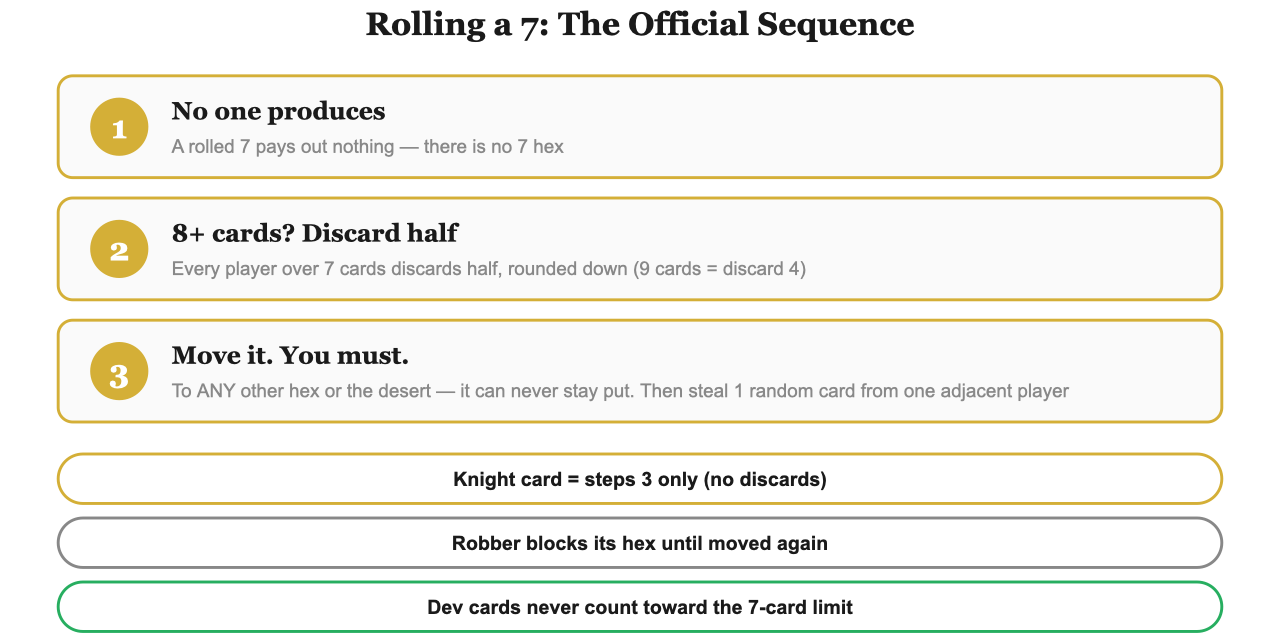
A rolled 7 triggers three things, in this exact order:
- Nobody produces. No hex pays out on a 7 — there is no 7 number token on the board.
- Everyone fat on cards discards. Every player holding more than 7 resource cards chooses half their hand, rounded down, and returns it to the bank. Nine cards? Discard four. Eleven? Discard five. This hits every qualifying player, including the roller.
- The roller moves the robber and steals. Move it to any other hex (or the desert), then take one random resource card from a player with a settlement or city touching the new hex.
The order matters more than people think: discards happen before the steal. Your victim discards down first, and then you rob from what’s left.
Do development cards count toward the 7-card hand limit? No — only resource cards (brick, grain, lumber, ore, wool). Development cards are never counted and never discarded, which is one more reason buying them is a decent 7-proofing move.
How Does the Robber Actually Block Production?
The robber shuts off the hex it sits on, completely and for everyone. While it’s parked there, that hex produces nothing when its number is rolled — every adjacent settlement and city gets skipped, no matter whose they are. The rulebook’s own example: robber on a fields hex with a 4 token means a rolled 4 pays that hex’s owners nothing.
The block lasts until the robber moves again — the next 7, or the next Knight. There is no turn limit and no expiration. We’ve had games where an 8 hex sat robbed for a third of the game because everyone kept aiming 7s at each other’s new targets instead.
The Stealing Rules, Precisely
You steal one random card from one player — not one card from everyone. If the robber’s new hex touches settlements or cities from two or more players, you pick which player to rob, but the card itself is drawn blind from their hand.
What a lot of tables play: the robber steals from everyone on the hex, or steals a card of the robber’s choosing.
The actual rule: one victim, one random card. Hold their hand face-down, pull one. If the hex borders no one’s buildings — or your only victim has zero cards — you simply steal nothing.
One more edge case: cities aren’t special. A city adjacent to the robbed hex makes its owner a legal target exactly like a settlement — it doesn’t lose two cards or change the odds.
How the Knight Card Changes Things
A Knight card is a rolled 7 with two differences. When you play one, you must immediately move the robber and steal exactly as described above — but nobody discards for holding more than 7 cards, and the Knight counts toward Largest Army (three played Knights, 2 victory points, stealable by whoever plays more).
The timing rule most players miss: you may play a development card at any point during your turn — including before you roll the dice. Sitting adjacent to the robber with a big hand? Knight it away first, then roll. That sequencing is legal and it’s the single most useful robber rule that isn’t in most people’s heads.
Where to Put the Robber
Most Catan players use the robber wrong.
Catan won the Spiel des Jahres, the hobby’s most consequential award, in 1995. See the jury’s entry.
They move it onto whoever’s winning. They steal blindly. They use it as punishment rather than strategy. And then they wonder why rolling a 7 feels like a wasted turn.
The robber isn’t just a way to hurt the leader. It’s a diplomatic tool, a blocking mechanism, a resource generator, and — when used correctly — one of the most powerful levers in the entire game. Here’s how to actually use it.
The Four Robber Situations
1. Block the Runaway Leader
This is the one everyone knows. If someone is at 8 or 9 points and closing in on a win, move the robber onto their most productive hex. This reduces their production and — if you steal from them — directly slows their ability to finish.
The mistake most players make here is moving the robber onto the leader’s best resource rather than their most needed resource. If someone needs one ore to win, blocking their wheat hex doesn’t help. Block the ore.
Rule: when blocking the leader, block the resource they need to clinch, not the one they produce most of.
2. Break Up a Production Engine
Experienced Catan players often build an engine around one or two high-probability hexes — a settlement or city on the 6 and 8 of the same resource, for example. Moving the robber onto one of those hexes doesn’t just hurt them once; it removes a consistent production node for as long as the robber stays there.
When deciding where to move the robber, look at the whole board and identify who has the most concentrated production dependency. A player with two cities on ore hexes numbered 6 and 8 is more hurt by losing one of those than a player who has ore spread across three different hexes.
Rule: target concentrated production, not distributed production.
3. Use It as a Bargaining Chip
This is the move most beginners never think of, and it’s where experienced players get outsized value from the robber.
Before you move the robber, announce what you’re considering. “I’m thinking about moving it onto your wheat hex — unless someone wants to make this worth my while.” This is not unsportsmanlike; it’s core Catan diplomacy. Players who need you to put the robber elsewhere will offer trades. Players who benefit from you blocking your other opponent will offer alliance.
The robber is a bargaining chip. The threat of the robber is sometimes more valuable than the placement itself.
Rule: before you place the robber, see if someone will trade or deal to influence where it lands.
4. Protect Yourself
A Knight card lets you move the robber proactively — you don’t need to roll a 7. If the robber is sitting on your best hex and you have a knight, play it. Move the robber somewhere useful, claim your production back, and steal a resource in the process. Worth knowing if you ever upgrade the box: Cities & Knights removes the development deck and the Knight card along with it, replacing them with knight figures you activate on the board to chase the robber off a hex — one of the bigger differences in Cities and Knights vs Seafarers. Deciding which box to add? See which Catan expansion to buy first.
Playing with the expansion? Does Cities and Knights fix the robber? covers how knights chase it away and why it stays off the board until the first barbarian attack.
This is why the Largest Army card (earned by playing three knights first) is so powerful. You get three productive robber placements and 2 victory points — all in one strategic package.
Rule: don’t sit on knight cards waiting for the perfect moment. If the robber is on your land, play the knight.
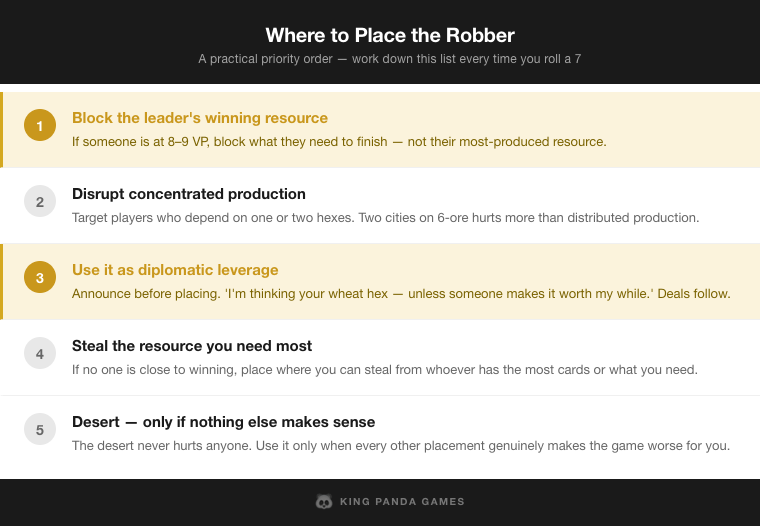
The 10-Second Priority Order for Placing the Robber
When you roll a 7, here’s how to think through your placement in about 10 seconds:
- Is someone about to win? If yes, block their most needed resource.
- Does someone have a resource monopoly that’s letting them pull away? Block their production engine.
- Can you trade the threat of it for a card you need? Negotiate before placing.
- Is there a high-value theft target? Place where you can steal from whoever has the most cards or the resource you need most.
- None of the above? Move it to the highest-probability hex owned by whoever is currently ahead on points.
The desert is always available and never blocks anyone — use it only if every other option genuinely makes the game worse for you (rare).
The Robber Etiquette Question
Catan groups often develop informal rules about robber placement. Some groups play that you can’t move the robber onto the same person twice in a row. Some groups let anything go.
Our take: the game was designed with full robber freedom. Restricting it softens the strategic layer. If your group is new to the game and the robber is creating bad feelings, ease into it — but don’t nerf it permanently. Learning to use and respond to the robber is part of learning Catan.
The first time someone moves the robber onto you right before you can win and steals your last resource card — that moment is Catan. It’s supposed to hurt a little.
What the critics said about Catan
We play these games ourselves, but it’s worth knowing where the rest of the hobby lands.
-
“My rating of Catan is pretty low, actually.”
— Tom Vasel, The Dice Tower. Vasel has played it for decades and still lands cooler on it than its reputation suggests — worth knowing before you treat Catan as an automatic buy.
Going straight to the source: Read the official Catan rules, plus the publisher’s game page and background and history.
📕 Grabbing the rules? Grab this too.
The KPG Budget Board Games Guide — 9 games under $30, each with player counts, play time, and who it’s actually for. Free PDF, no email gymnastics.
Don’t own Catan yet? This guide assumes the base game.
Frequently Asked Questions
Do you have to move the robber in Catan?
Yes. When you roll a 7 or play a Knight card, moving the robber is mandatory — the official rules state you may not choose to leave the robber on the same hex. It must go to a different terrain hex or the desert.
What happens when you roll a 7 in Catan?
Three things, in order: no one collects resources this roll; every player holding more than 7 resource cards discards half of them, rounded down; then the roller must move the robber to a new hex and steal one random card from a player with a settlement or city adjacent to it.
What does the robber do in Catan?
The robber blocks resource production on whatever hex it occupies — when that hex’s number is rolled, adjacent settlements and cities receive nothing. It stays there, blocking, until another 7 or a Knight card moves it.
Can you move the robber back to the desert?
Yes. The rules explicitly allow moving the robber to the number token of any other terrain hex or to the desert hex. Parking it in the desert blocks nobody — it’s the peace-keeping move.
How many cards can you hold before discarding in Catan?
Seven. When a 7 is rolled, every player holding 8 or more resource cards discards half, rounded down — so 8 cards discard 4, 9 cards discard 4, and 11 cards discard 5. Development cards never count toward the limit and are never discarded.
Do you steal a card every time you move the robber?
Only if at least one opponent has a settlement or city adjacent to the hex you place the robber on. If no opponent borders that hex, you block production but steal nothing. You always get to choose which adjacent player to steal from if more than one qualifies, but the card taken is random from their hand.
Can you steal from someone with no cards in Catan?
You can target them, but you steal nothing — there’s nothing to take. The steal is one random card from one adjacent player, so if every adjacent player has an empty hand (or the hex borders no one’s buildings), no steal happens.
Do you steal a card when you play a Knight in Catan?
Yes. A Knight card moves the robber exactly like a rolled 7 — move it to a new hex, then steal one random resource card from a player with a settlement or city adjacent to that hex. The only difference is that nobody discards for holding more than 7 cards.
Can you move the robber to the same hex twice in a row?
Not on the same activation: every time the robber activates, it has to move to a different hex. Nothing stops you sending it back to a hex it left a turn or two earlier, or targeting the same player again. Some groups add a house rule against that, but it isn’t in the official rules.
What is the best Catan robber strategy?
Block the resource an opponent needs to win, not just the one they produce most, and prioritize concentrated production (a city sitting on two high-probability hexes of the same resource) over a scattered board presence. Use the threat of the robber to negotiate trades before you place it, and never let a Knight card sit unplayed if the robber is parked on your own land.