

Ticket to Ride Player Count: How Many People Can Play?
Ticket to Ride plays 2 to 5 players, and it’s best at 4.
Some links below are Amazon affiliate links — as an Amazon Associate, King Panda Games earns from qualifying purchases at no extra cost to you. Full disclosure.
That’s the whole answer if you’re standing in a store deciding whether it fits your game night. If you’re deciding how many people to invite, or you’ve got a specific number in mind and want to know what you’re in for, the count changes this game more than almost any other gateway box on the shelf.
Every Version, and What It Seats
The number on the box isn’t the same across the line, and this trips people up constantly — someone plays the small London box at a friend’s house, buys “Ticket to Ride,” and ends up with a different game that seats a different group.
| Version | Players | Age | Time |
|---|---|---|---|
| Ticket to Ride (North America) | 2–5 | 8+ | 30–60 min |
| Ticket to Ride: Europe | 2–5 | 8+ | 30–60 min |
| Ticket to Ride: Germany | 2–5 | 8+ | 30–60 min |
| Ticket to Ride: Rails & Sails | 2–5 | 10+ | 90–120 min |
| Ticket to Ride Legacy: Legends of the West | 2–5 | 10+ | 20–90 min |
| Ticket to Ride: Nordic Countries | 2–3 | 8+ | 30–60 min |
| City editions (London, New York, Amsterdam, San Francisco, Berlin, Paris) | 2–4 | 8+ | 10–15 min |
| Ticket to Ride: First Journey | 2–4 | 6+ | 15–30 min |
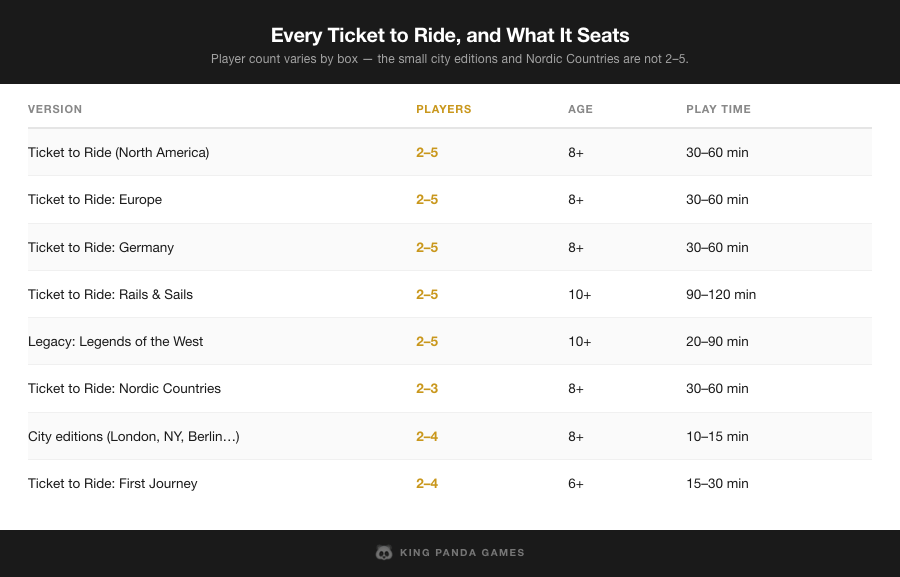
Nordic Countries is the only mainline Ticket to Ride that caps at three players — it’s the one box you can buy that will not seat a group of four.
Four Is the Sweet Spot
Four players is the count the North America map was drawn for. The board reaches the density where routes actually get taken out from under you, the Chicago–Pittsburgh–New York corridor turns into a genuine knife fight, and you still get your turn back fast enough to have a plan when it arrives.
What makes four work is that it’s the last count where blocking is incidental. Somebody takes the route you wanted because they needed it, not because they were hunting you. At five, blocking becomes deliberate and the game gets meaner.
Four players, round nine. You’ve been quietly building a Seattle-to-Chicago spine and you need one more 6-space stretch. Two other players have been fighting over the Southeast all game and haven’t looked at the northern route once. Then the player to your left draws their third destination ticket, glances at the top of the board for the first time all game, and takes it. That moment — genuine competition that arrived by accident — is Ticket to Ride at four players.
The Full Breakdown, Count by Count
Five players is the loudest and the luckiest. Every desirable route is gone by the midgame, the face-up card display gets picked over before it comes back around to you, and plans made two turns ago are frequently dead on arrival. It’s a great time with the right crowd and a frustrating one with people who want to optimize. Turn downtime is the real cost — expect to wait a couple of minutes between decisions.
Four players is the recommendation. See above.
Three players is the underrated count and the one we’d defend hardest. The eastern half of the board gets properly contested while the west stays open enough that a blocked player always has somewhere to go. Games run fast, everyone stays in it, and the route-scoring math gets to matter because you can actually execute a plan. If your regular group is three, you don’t need to buy anything special.
Two players on North America is the weak spot. The map is too big, nobody gets blocked, and the game ends with two tidy networks that never touched. It works — it just doesn’t produce a story. The fix isn’t a house rule, it’s a different map: Europe or Nordic Countries both turn two-player Ticket to Ride into a genuinely tense game.
The Rule Most Groups Get Wrong at Low Counts
What most groups do: play two or three players with all the double routes open, then conclude Ticket to Ride is boring with a small group.
What the rules actually say: in 2- and 3-player games, only one of any double route may be used. When either player claims one half of a parallel pair, the other half is closed permanently — to both of you.
This single rule is the difference between a small-count game that has friction and one that doesn’t. It’s printed in the rulebook and skipped constantly, usually by groups who learned the game at four or five players and never re-read the setup section.
It’s also the rule to stop enforcing if you’ve read our two-player breakdown and decided to house-rule the map more open. Just know which direction you’re going and why.
Playing With 6 or More
You can’t, straight out of a standard box. Every mainline copy of Ticket to Ride contains exactly five sets of 45 trains, so five is a hard physical ceiling.
The one official route to six players is Map Collection Volume 1: Team Asia, which restructures the game into two-player teams that share a card holder alongside their private hands. It requires a copy of Ticket to Ride or Ticket to Ride Europe to play, since it ships as maps and tickets only. It genuinely works — the shared-hand mechanic is clever, and teams keep the downtime tolerable — but it’s a specific purchase for a specific problem.
Buying two base sets and merging them doesn’t solve this. You’d have two boards, two card decks, and no shared map.
Worth knowing: if your group is regularly six or more, the honest answer is that Ticket to Ride is the wrong tool. Run two parallel games of a city edition — they take 15 minutes each — or pick something from our games for big groups list instead of forcing a five-player game to stretch.
How Long It Takes at Each Count
Two players finish in roughly 30–40 minutes. Five players run closer to 60. That’s a much smaller spread than most games, and the reason is structural: every player has the same 45 trains no matter what, and the game ends when any one player drops to two trains or fewer.
More players doesn’t lengthen the arc of the game. It just adds waiting inside it. Heat: Pedal to the Metal is the rare game that seats six straight out of the box and still lands on four as its best count — our Heat player count guide ranks every count, solo included.
Check Ticket to Ride: Team Asia price on Amazon →
Frequently Asked Questions
How many players can play Ticket to Ride?
The original Ticket to Ride and Ticket to Ride Europe both play 2 to 5 players. The small city editions — London, New York, Amsterdam, San Francisco, Berlin and Paris — play 2 to 4, and Nordic Countries plays 2 to 3. No standard box goes above 5 without an expansion.
What is the best player count for Ticket to Ride?
Four players on the North America map. The board fills to roughly the density the map was drawn for, routes get genuinely contested around the Midwest hubs, and turns still come back fast enough that you can plan. Three is the close runner-up and five is the loudest, luckiest version.
What is the minimum number of players for Ticket to Ride?
Two. Every mainline Ticket to Ride box supports two players with no variant rules needed, though the North America map plays noticeably flat at that count. Europe and Nordic Countries are the two-player versions worth owning.
Can you play Ticket to Ride with 6 players?
Not with a standard box. The Map Collection Volume 1: Team Asia expansion adds a six-player team mode where players compete as three pairs sharing a card holder, but it requires a copy of Ticket to Ride or Ticket to Ride Europe to play. Combining two base sets on one map does not work — there are only five sets of trains.
What is the double route rule at 2 and 3 players?
In games with two or three players, only one of any double route may be used. Once either player claims one half of a parallel pair, the second half is closed to everyone for the rest of the game. This rule exists to keep a half-empty board competitive, and skipping it is the most common reason low-count games feel dull.
Does Ticket to Ride take longer with more players?
Yes, but less than you would expect. Two players finish in about 30 to 40 minutes and five players in about 60, because everyone still has only 45 trains to spend and the endgame trigger is one player dropping to two or fewer. More players means more waiting, not a longer game arc.
Is Ticket to Ride good with 3 players?
Very good, and underrated. Three players on North America produces real route competition in the eastern half of the board while leaving enough western space that nobody gets completely locked out. If your regular group is three, you do not need a different map.
How many trains does each player get in Ticket to Ride?
Forty-five colored train cars each, regardless of how many people are playing. The count never scales, which is why the board feels emptier at two players and gridlocked at five — the same 45 trains per person are competing for a fixed number of routes.
If you remember one line: Ticket to Ride is a 2–5 player game that’s happiest at 4, fine at 3, chaotic at 5, and needs a different map at 2. Still deciding whether it belongs on your shelf at all? The full review settles that, and our guide to every version settles which box to actually buy.