

Scythe Review: Is It Worth It?
Bottom Line
Scythe is best for players ready to graduate from Catan and Wingspan into a big, brainy strategy game — and for anyone who’s ever stared at a board game photo and said “I want THAT one.” Skip it if you’re expecting the mech war the box art promises: fights are rare, short, and usually avoided on purpose. Its biggest strength is how smoothly a heavy game flows once you know it — turns take thirty seconds. Its biggest weakness is the learning curve standing between you and that smoothness.
Scythe gets 4/5 Pandas and 2/5 Bamboo Plants from us — and yes, buy it, as long as you know what you’re actually buying. The Pandas are for a game that hums like a machine once your table knows it: turns are fast, every decision matters, and the alternate-history 1920s farmland-with-mechs table presence is the best in our collection. The 2 Bamboo is equally earned. Your first game will take three hours, someone will move a mech across a river illegally, and at least one player will finish the night still not totally sure why they lost.
Some links below are Amazon affiliate links — as an Amazon Associate, King Panda Games earns from qualifying purchases at no extra cost to you. Full disclosure.
Here’s the thing nobody tells you before your first play: Scythe looks like a war game, and it’s actually an economy game. The mechs are mostly scarecrows. Once you make peace with that, it’s one of the most satisfying strategy games you can put on a table.
| Detail | Info |
|---|---|
| Players | 1–5 (up to 7 with the Invaders from Afar expansion) |
| Best Player Count | 4 — enough neighbors to squeeze you, without the downtime of 5 |
| Age | 14+ |
| Play time | 90–115 min (plan on 2.5–3 hours for your first game) |
| Complexity | Medium-Heavy |
| Solo Mode | Yes — the Automa deck is excellent |
| Designer | Jamey Stegmaier |
| Publisher | Stonemaier Games |
| Popular Upgrades | Yes — metal coins, realistic resources, inserts |
| Bamboo Plants | 2/5 — heavy teach, but turns are simple once it clicks |
| Pandas | 4/5 — genuinely tense from turn one to the sudden ending |
| Official site | stonemaiergames.com/games/scythe |
How Scythe Works
Every turn in Scythe is the same small decision: place your action token on one section of your player mat — it must be a different section than last turn — and do what it says. That’s it. That’s the whole turn.
Each section has a top action (move units, gain power, trade for resources, or produce) and a bottom action (upgrade, deploy a mech, build a structure, or enlist a recruit). You can do the top, the bottom, or both. The bottom actions cost resources, and they’re where the game lives — they build your permanent engine, and each one you max out is worth a star.
It’s your fourth turn. You want to Produce, but your token is already sitting on Produce from last turn — so you Trade instead, grab two metal, and suddenly the mech you couldn’t afford until “later” is on the board this turn, guarding the workers your neighbor was eyeing. Scythe is a hundred small forced pivots like this, and they’re where the game gets good.
The game ends the instant someone places their sixth star. There are ten ways to earn one: complete all six upgrades, deploy all four mechs, build all four structures, enlist all four recruits, get all eight workers on the board, complete your secret objective card, win a combat (this one can score twice), hit 18 popularity, or hit 16 power. You need any six — and no one has time for all of them, which is why every Scythe game is really an argument about which four things you’re willing to skip.
Then everyone counts coins, and how much your stars, territories, and resources pay out depends on your popularity. Below 7 popularity, each star is worth $3, each territory $2, each pair of resources $1. At 7–13, that becomes $4/$3/$2. At 14-plus, $5/$4/$3. A disliked warlord earns $3 per star; a beloved one earns $5 for the same star.
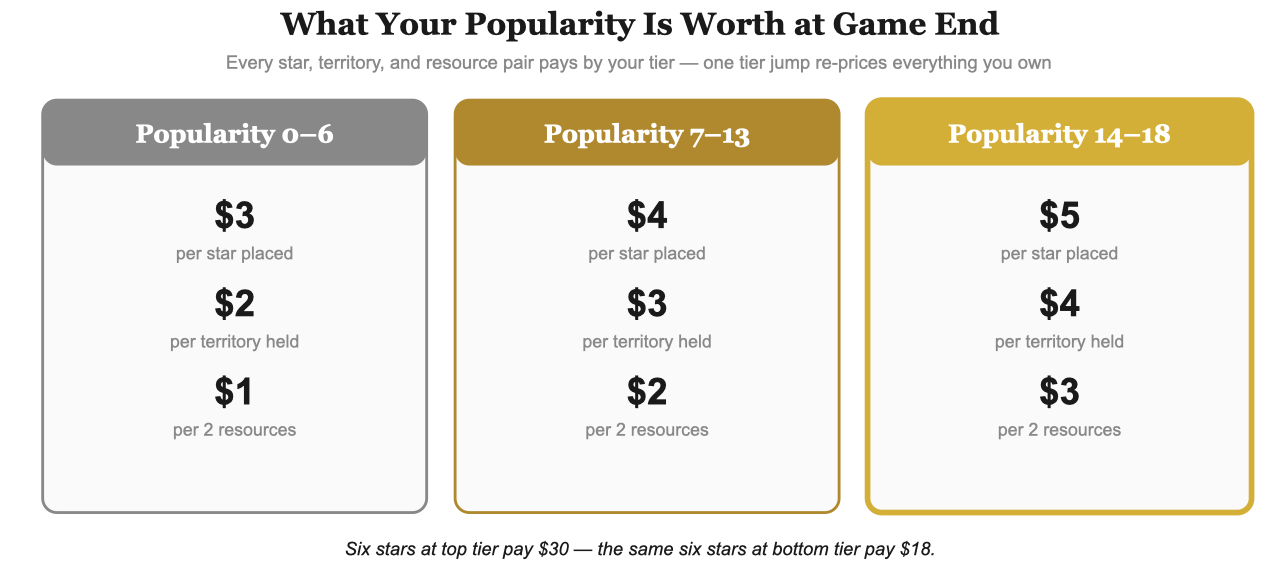
That popularity multiplier is the sneaky heart of Scythe. It’s why the aggressive player who won two fights sometimes loses to the quiet farmer who never fired a shot.
What We Liked
Turns are thirty seconds long in a three-hour-looking game. This is Scythe’s party trick. The box, the art, and the miniatures all scream “weekend commitment,” but the actual turn structure — pick a section, do the actions — moves faster than Catan. Our games have less downtime than Wingspan, and Wingspan is half the weight.
The sudden ending changes everything. Because the sixth star ends the game immediately, mid-game turns carry real tension. In one of our plays, my wife triggered the end while I was two turns from cashing in a huge popularity swing — 14 popularity, one tier from the top payout, worth exactly nothing. I’ve never forgotten a star count since. Losing that way teaches you more about Scythe than winning ever does.
Combat is a mind game, not a dice roll. When fights do happen, both players secretly dial in power and play hidden combat cards, then reveal. No dice anywhere. Winning big is often worse than winning small, because power you spend is gone — the real skill is winning fights by exactly one.
The engine-building itch gets scratched hard. Every upgrade is a physical cube you move from a top action to a bottom one — which means one upgrade makes Produce better and makes your next mech cheaper at the same time. By the endgame you’re doing for one oil what used to cost three, and you can point at the exact cubes that got you there. If tableau games like Everdell are your thing, this is that feeling with territory attached.
The enlist mechanic deserves its own mention, because it’s the sneakiest design in the game. Enlisted recruits pay you a small bonus whenever you — or the players next to you — take a certain bottom-row action. Suddenly your neighbor building a mech puts power in your pocket, and you start rooting for the person you’re supposed to be blocking. It’s the closest Scythe gets to Catan-style table talk, and it’s completely silent.
And the table presence is honestly unmatched at this price. Jakub Różalski’s paintings — hulking mechs idling behind farmers doing chores — give the game a mood no photo does justice. People walk past and stop.
What We Disliked
The rules overhead is real. The teach runs 30–40 minutes, and the first game still generates constant lookups: rivers block movement (until a mech ability says otherwise), lakes are off-limits (until a different ability), tunnels all connect, the Factory counts as three territories. None of it is hard alone; all of it at once buries new players. That’s the 2/5 Bamboo.
It ends right when your engine gets fun. The best engine in Scythe usually spends its last two turns not running, because someone — often you — triggers the end for position instead. Some of us love that discipline. At least one person in every group mourns the turn they never got.
At 5 players the map gets slow before it gets interesting. More on this in Best Player Count, but the short version: we stopped playing base Scythe at 5.
Who It’s For
Scythe is for the player who finished a game of Catan and asked “what’s the next level up?” It’s the best bridge we know between family-weight games and genuinely heavy ones, because its complexity is in the setup and rules — the decisions, one you’re playing, come fast and feel natural.
It’s also quietly one of the best solo board games ever made. The Automa deck plays a convincing opponent in about half the time of a multiplayer game, and it’s how I learned the rules before teaching my group — which I now think is the correct order.
Who should skip this game: anyone buying it for the mechs. If the art has you picturing Blood Rage-style constant battle, you will be bored and confused by turn five, watching everyone farm. Skip it too if your group’s ceiling is a 15-minute teach — Scythe past that ceiling isn’t a stretch, it’s a wall.
Who Should Buy This?
Buy Scythe at full price if heavy euros are already your lane — it’s a permanent-collection game, not a phase. At around $90 retail (routinely $65–75 online), the production quality alone carries the price: the mats, minis, and art hold up after fifty plays.
If you’re on the fence about weight, play it once first — a friend’s copy, a café, or the digital version on Steam. Scythe is an acquired taste that most people acquire on game two, and $90 is a lot to spend finding out you’re the exception.
Check Scythe price on Amazon →
Best Player Count
Scythe is best at 4. The box says 1–5, and the honest ranking is 4, then 3, then solo, then 2, then 5.
At 4, the map is tight enough that territory actually gets contested, which keeps the mech-shaped deterrents doing their job. At 3 you get a faster, more open game — great, slightly politer. At 5, base Scythe slows down: more downtime between turns and a crowded map that punishes whoever starts between two aggressive neighbors.
Two players works but changes the personality — it becomes a quiet, chess-like race where you can mostly ignore each other. Fine, not what the game is best at. We’d point couples at our best 2-player games list before Scythe.
Replayability
Scythe’s replay value comes from the mat shuffle: five factions crossed with five player mats, and the combination changes your whole opening. Rusviet with an Industrial mat plays nothing like Rusviet with an Agricultural one — the faction gives you your powers, but the mat decides what’s cheap.
The first ten games genuinely feel different from each other, because you’re usually piloting a combination you’ve never held. After that, the map itself starts to feel familiar — it never changes — and that’s when the expansions earn their keep. The Rise of Fenris campaign alone added a dozen plays to our copy.
Accessories & Upgrades
Scythe has one of the biggest upgrade aftermarkets in board gaming, most of it sold by Stonemaier directly:
- Metal coins (~$25) — the single best upgrade. The cardboard coins are the one cheap-feeling component in the box, and endgame counting feels completely different with real weight in your hand.
- Realistic resource tokens (~$30) — little metal ingots, oil barrels, wood bundles. Purely cosmetic, undeniably fun.
- A broken-in insert (Folded Space, ~$25) — not optional in our view. Loose, Scythe takes 20 minutes to set up; organized, it takes 8.
None of these change the gameplay. All of them change how it feels to sit down to it.
Paint is the other option. Scythe’s 25 miniatures make it one of the few sets you can realistically finish, which is why it places third in our ranking of board games with miniatures worth painting.
Check Scythe metal coins price on Amazon →
Awards
Scythe swept the 2016 Golden Geek Awards — Board Game of the Year, Best Strategy Game, Best Artwork, and Best Solo Game — after a record-setting Kickstarter that raised $1.8 million.
Similar Games
If you like Spirit Island, try Scythe — both are heavy engine games, but Spirit Island is cooperative chaos where the puzzle fights back; Scythe is competitive and quieter, with the tension coming from neighbors instead of the board.
If you like Wingspan, Scythe is the graduation. Same engine-building satisfaction — build cheap actions into a machine — with territory, positioning, and an actual opponent staring at your workers.
If you want the fight Scythe’s box promises, buy Blood Rage instead. Blood Rage is the game where battling is the point and dying is often correct. Scythe is the game where the best players fight twice, on purpose, on their own terms.
Tips & Tricks
Get your workers out early, even though it feels slow. Producing on a village makes more workers, more workers make production explode, and the players who spend turns one through three “boringly” expanding are the ones swimming in resources on turn ten. All eight workers on the board is also a star — though watch the catch: more workers make each Produce action cost extra, first power, then popularity, then coin. The engine has a fuel bill.
Read your player mat before the game starts, not during it. Your mat tells you which bottom action is discounted and which top action it’s paired under — that pairing is your strategy. If Deploy sits under Produce on your mat, you’re a mech-rush faction this game whether you planned to be or not. Ten quiet minutes with your mat before turn one is worth more than any strategy article, including this one.
What most new players do: hoard power for one huge, satisfying combat win — dial 7, stack cards, crush someone.
What actually works: win fights by one. Power is a currency, and overkill is overspending; the veteran who wins 4–3 fights the next battle too. Remember the loser draws a combat card as a consolation — losing cheap is also a strategy.
Watch the star count like a hawk from star three onward. The game does not wind down — it stops. When any player hits four stars, start asking “if this ended right now, do I win?” and if the answer is no, fix your popularity tier before building anything else.
Speaking of which: popularity tiers are worth more than almost any action. Jumping from 6 to 7 popularity moves every star, territory, and resource pair you own up a payout bracket. We’ve watched a single Trade-for-popularity turn swing a final score by $12.
Worth knowing: the Factory in the center counts as three territories at scoring — holding it at game end is routinely a $6–9 swing, which is why the endgame traffic jam around it is never really about the Factory card.
Not sure whether Scythe is the right step for your group? It is number 10 of 12 on our strategy board games list, ranked easiest to hardest to learn.
Frequently Asked Questions
Is Scythe worth buying?
Yes, if you want a heavy strategy game that plays faster than it looks — we rate it 4/5 Pandas. Skip it only if you’re expecting a combat-heavy war game or your group prefers games that teach in 15 minutes.
Is Scythe a war game?
No, and this is the most common misconception about it. Scythe is an economic engine-building game where combat is possible but rare — most games see only a handful of fights, and threatening a battle is usually more valuable than having one.
How long does a game of Scythe take?
Experienced groups finish in 90–115 minutes. Your first game will realistically take 2.5–3 hours including the rules teach, and it drops fast from there — by game three we were under two hours.
Is Scythe hard to learn?
The teach is the hard part — expect 30–40 minutes of rules plus a first game full of lookups, which is why we rate it 2/5 Bamboo Plants. The turns themselves are simple: pick a mat section, do its actions. Most players are comfortable by their second game.
What’s the best faction for beginners?
Nordic or Polania. Nordic’s Seaworthy ability makes lakes normal territory, which removes the movement rules most likely to trip up a new player. Crimea and Rusviet are the strongest factions, but their power comes from combos a first-timer won’t see yet.
Does Scythe play well at 2 players?
It works, but it becomes a quieter, more solitaire race with little territorial pressure. We’d call it the weakest count above solo — the game is clearly best at 4, and the excellent Automa solo mode is honestly a better two-experience: each of you fights a bot, then swap notes.
Are the Scythe expansions worth it?
Rise of Fenris absolutely — it’s an 8-episode campaign that revitalizes the game after your first dozen plays. Invaders from Afar is only essential if you regularly play with 6–7 people. The Wind Gambit is the skippable one.
Why do rivers matter so much in Scythe?
Rivers block all movement until you unlock a mech ability that crosses them, so your early game is shaped by which rivers cage you in. Lakes are stricter — no unit can enter one without a specific faction ability. Misplaying river movement is the #1 rules mistake at every new Scythe table.
Want to go deeper?
- Is Scythe Too Hard for Beginners? — What the intimidating box actually asks of a new player, and how to shortcut the learning curve. Read it here
- Scythe Factions Ranked — All five base factions from strongest to weakest, and which to hand a first-timer. Read it here
- Scythe Strategy Guide — Why economy wins and combat only finishes, plus the star-timing rules that decide close games. Read it here
- Scythe Expansions Ranked — Rise of Fenris, Wind Gambit, and Invaders from Afar, in the order they’re worth your money. Read it here
- Scythe Player Count: What’s Best? — Every count from solo to 7, honestly ranked. Read it here
Verdict
Buy it if you want a heavy, beautiful strategy centerpiece that rewards every play you give it — Scythe is a permanent-collection game. Skip it if the mechs are the draw; the fights they promise mostly never come, and that disappointment has soured more first plays than any rule. Try before you buy if your group has never gone past gateway games — one borrowed play will tell you whether the weight reads as delicious or exhausting.
For the record, critics were split in a useful way: Shut Up & Sit Down’s review found it colder than the hype suggested, and they’re not wrong that it’s a quieter game than it looks — we just think that quiet tension is the point. BGG’s community pegs it at a 3.4/5 complexity weight, which matches our experience: heavy to learn, medium to play.
Scythe official site: stonemaiergames.com/games/scythe — the free rules PDFs and reference guides live there too.