

The best Secret Hitler strategy starts with the deck. There are 6 Liberal and 11 Fascist policy tiles, everyone at the table knows it, and every claim a President makes can be checked against those numbers. Learn the odds below and you’ll catch more lies than you will by reading faces.
Some links below are Amazon affiliate links — as an Amazon Associate, King Panda Games earns from qualifying purchases at no extra cost to you. Full disclosure.
We’ve played Secret Hitler a few times, so this guide leans on the official rules, the designers’ own strategy notes and maths you can check yourself.
Know the Odds of the First Draw
A President draws three tiles from the 17-tile deck. At the start of the game, these are the only four hands they can get:
| President draws | Chance | What an honest Liberal President does |
|---|---|---|
| 3 Fascist | 24% | Has to pass two Fascist tiles |
| 2 Fascist, 1 Liberal | 49% | Discards a Fascist, passes one of each |
| 1 Fascist, 2 Liberal | 24% | Discards the Fascist, passes two Liberals |
| 3 Liberal | 3% | Passes two Liberals |
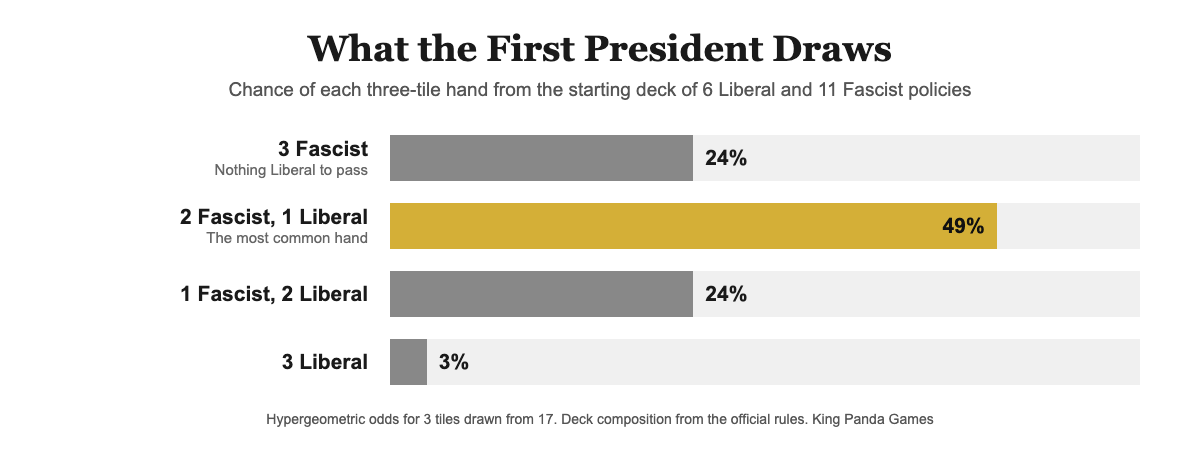
About one opening draw in four is three Fascist tiles. So “I drew three Fascists” is a believable claim the first time you hear it. It isn’t proof of anything.
The useful number is the other one. Three times in four, the President had at least one Liberal tile to pass. When a Fascist policy hits the board, the likeliest story is that someone chose it.
Count the Tiles as the Game Goes On
Policies on the board never return to the deck, and the discards are only reshuffled when fewer than three tiles are left. That means you can track what’s still in there.
- Start at 6 Liberal and 11 Fascist.
- After each government, subtract the policy that was played.
- Subtract what the President and Chancellor say they discarded, and keep a note of who said it.
- When the numbers stop adding up, someone lied. The Liberal tiles are the ones to watch, because there are only six.
Three governments in, two Liberal policies are on the board. All three Presidents said they drew two Fascists and one Liberal. That accounts for three Liberal tiles out of six. The deck has eight tiles left, and if everyone told the truth, three of them are Liberal. The next President says they drew three Fascists. That’s possible, and it’s about 18% likely on those numbers. If the President after that says the same thing, someone is lying, because only two Fascist tiles would be left in the deck.
The designers built the game for this. Their Kickstarter notes say players “can roughly track deck contents based on what the President and Chancellor report, though someone might have lied about what was discarded.”
How to Play as a Liberal
Your team has the numbers and no information. Your job is to create information.
Remember the three culprits. The rulebook’s strategy notes say that when a Fascist policy comes up, “there are only three possible culprits: The President, the Chancellor, or the Policy Deck.” Ask both players what they held, before they’ve had time to agree on a story.
After three Fascist policies, stop taking chances on Chancellors. From that point, electing Hitler as Chancellor ends the game. The same rule helps you: when a Chancellor is elected after the third Fascist policy and the game doesn’t end, that player is confirmed as not Hitler.
The rule: once three Fascist policies are down, only vote Ja for a Chancellor who has already been elected Chancellor in that stretch, or one you’d bet the game on.
Don’t vote Nein on everything, though. Three failed elections in a row plays the top tile of the deck with nobody choosing it. At the start of the game, that tile is Fascist 65% of the time, and it also wipes out the term limits that were protecting you.
How to Play as a Fascist
Your team wins by getting Hitler elected far more often than by passing six policies. The rulebook says so directly: “Fascists most often win by electing Hitler, not by enacting six Policies!”
So your real job is to make Hitler look trustworthy, and to make at least one Liberal look guilty.
The tempting play: pass a Fascist policy every time you’re in government.
The better play: pass a Liberal policy early when you can afford to. A Fascist who has put a Liberal tile on the board gets elected again later, when it matters.
When you do pass a Fascist policy, the deck is your cover. As President holding two Fascists and a Liberal, you can discard the Liberal and claim three Fascists. It’s a claim that’s true a quarter of the time on the first draw, so it can’t be disproved on its own.
At 7 or more players, you know who Hitler is and Hitler doesn’t know you. Don’t defend Hitler too loudly. If you get caught later, everyone you vouched for goes down with you.
How to Play as Hitler
Play as a Liberal. That’s the designers’ advice too, and at 7 or more players it’s almost forced, because you don’t know who your teammates are.
Pass Liberal policies when you’re in government. Vote the way a careful Liberal would. Your goal is to be the Chancellor nobody worries about once the third Fascist policy is down.
“Should Hitler ever lie about a draw?” Rarely. Every lie is a chance to get caught, and a Hitler who is caught can be executed, which hands the Liberals the win. Let your Fascists take the risks.
Use the Powers to Force Answers
Each presidential power produces a claim that someone has to stand behind.
- Investigate Loyalty. The President sees a party card and can lie about it. If they accuse the player they looked at, one of those two is on the Fascist team. Nobody can be investigated twice, so choose someone the table is split on.
- Policy Peek (5 or 6 players only). The President sees the next three tiles. The next government’s claims should match what the President said was coming.
- Special Election. The President picks the next presidential candidate. A Liberal should pick the most trusted player. Notice who a suspect picks.
- Execution. If Hitler is executed, the Liberals win at once. Otherwise the table doesn’t learn the dead player’s role.
Worth knowing: the veto becomes available after the fifth Fascist policy. If the Chancellor asks for a veto and the President agrees, both tiles are thrown away, but the election tracker moves forward one step. Veto too often and you trigger the same random top-deck you were trying to avoid.
For more depth than one article can hold, the fan-written Unofficial Secret Hitler Strategy Guide covers advanced lines, and a Cornell networks course post works through the game theory of testing a Chancellor.
If you’re still learning the game, start with our Secret Hitler rules guide. The roles change with the size of the table, which our player count guide covers, and our Secret Hitler review has the verdict.
Don’t own Secret Hitler yet? This guide assumes the base game.
Check Secret Hitler price on Amazon →
Frequently Asked Questions
What is the best strategy in Secret Hitler?
Track the policy deck. It starts with 6 Liberal and 11 Fascist tiles, and policies on the board never go back in. Checking each President’s claim against what should be left is the most reliable way to catch a lie.
What are the odds of drawing three Fascist policies?
About 24% on the first draw of the game, or roughly one in four. The chance of at least one Liberal tile in the opening draw is about 76%.
How do Fascists usually win Secret Hitler?
By electing Hitler as Chancellor after three Fascist policies are on the board. The official strategy notes say this is more common than passing all six Fascist policies.
How should Hitler play?
Like a Liberal. Pass Liberal policies, vote carefully and avoid lies that could be caught. Hitler wins by being trusted enough to be elected Chancellor late in the game.
Should Liberals vote no on governments they don’t trust?
Sometimes, but not three times running. After three failed elections in a row, the top tile of the deck is enacted automatically, and at the start of the game that tile is Fascist 65% of the time.
Who should you investigate in Secret Hitler?
A player the table is unsure about. Each player can only be investigated once per game, and the President is allowed to lie about the result, so the accusation itself becomes evidence about both players.
Can you lie about your role in Secret Hitler?
Yes. The rules say you can always lie about hidden information. The only exception is Hitler, who must admit it if executed or if elected Chancellor after three Fascist policies.