

Which Root Faction Should You Play First? All 4 Ranked
Play the Marquise de Cat first. This ranking is not about which faction wins most — it is about which one teaches you Root fastest and forgives you while it does it, which is a completely different question and the one new players are actually asking.
Root hands four players four rulebooks, and the box does not distribute difficulty evenly — which is why BGG’s crowd weight for Root sits near the top of the mid-heavy band. If you are still deciding on the game, our full Root review covers whether it suits your table at all.
Some links below are Amazon affiliate links — as an Amazon Associate, King Panda Games earns from qualifying purchases at no extra cost to you. Full disclosure.
1. Marquise de Cat — Start Here
The Marquise is the only faction in the box whose scoring you can explain in one sentence: place a building, score the number revealed under it on your board.
She begins the game owning the map. A warrior sits in every clearing except the one diagonally opposite her keep, and her Birdsong produces wood at every sawmill she controls. Her whole game is a supply chain — wood travels to where you want to build, and your opponents win by cutting the chain rather than by killing you.
Two rules make her forgiving. The keep means nobody else can place pieces in that clearing, so you always have somewhere safe. And Field Hospitals let you spend a matching card to recall removed warriors to the keep instead of losing them, which converts a disastrous battle into an expensive one.
Her weakness is the flip side of starting everywhere: she is the obvious leader on turn one, and Root tables punish leaders. Learning to feel that pressure is exactly the lesson a first game should teach.
2. Eyrie Dynasties — Second, and Only Once You Accept Turmoil
“Why would anyone play a faction that can lose points for existing?”
Because the Eyrie are the most satisfying machine in the box when they work. Every Birdsong you must add one or two cards to your Decree, and in Daylight you must resolve every card on it, column by column. The Decree only grows. You are writing instructions for a future self who will have fewer options than you do.
When that future self cannot obey, Turmoil fires in three steps, in order (the Law of Root spells them out at 7.7):
- Humiliate — lose one victory point for every bird card on the Decree, including both Loyal Viziers.
- Purge — discard everything on the Decree except those two Viziers.
- Depose — flip your leader face down and choose a new one from the remaining leaders.
They also carry two rules worth knowing before you sit down. Lords of the Forest means the Eyrie rule a clearing even when merely tied, provided they have a piece there — a genuinely powerful exception. And Disdain for Trade means crafting an item scores them exactly one point regardless of what the card says, so the crafting route that works for everyone else is closed to them.
The rule: add the card you can resolve on your worst future turn, not the card you want on this one.
3. Woodland Alliance — Powerful, Unforgiving, Not a First Faction
The Alliance are the hardest faction in the base box to play badly and survive, which is different from being the hardest to play well.
They have ten warriors. The Marquise has twenty-five. What they have instead is Guerrilla War: as the defender, the Alliance deal hits equal to the higher roll and the attacker takes the lower. That single inversion is why a ten-warrior faction is not a pushover, and it is the most misread rule in Root — new players attack sympathetic clearings because the stack looks small, and hand the Alliance free points.
Their engine runs on the Supporters stack, face-down cards spent by suit that do not count against hand size. The catch is capacity: with no bases on the map the stack holds five cards and any excess is discarded outright. Get a base down and it becomes unlimited.
It is round four. You have two bases, eleven supporters banked, and the Marquise marches into the clearing holding one of them. You survive the battle but the base comes off. Now discard every supporter matching that clearing, including birds, and remove half your officers. A single lost battle has just deleted a third of your turn economy.
That cliff is why they rank third for a beginner and why experienced players love them. The Alliance are the faction where the punishment for a mistake arrives two turns later and all at once.
4. Vagabond — Fun, Fiddly, and Hardest to Learn From
The Vagabond is last here purely because he teaches you the least about Root.
He has no warriors. He has one pawn, and the glossary is explicit that the pawn is not a warrior and cannot be removed. He cannot be killed, cannot rule a clearing, and cannot be stopped from going anywhere — his limit is his satchel, a set of items that exhaust when used and refresh each turn.
He scores by aiding factions to improve relationships, by removing warriors of factions hostile to him, and by completing quests. All three are about other players rather than about the map, which means a Vagabond player spends the game reading a game they are not really playing.
Leder sell three more of him in the Root line, which tells you how popular the role is. He is a great third or fourth faction and a poor first one. A new Vagabond learns how to manage a backpack; a new Marquise learns how Root works.
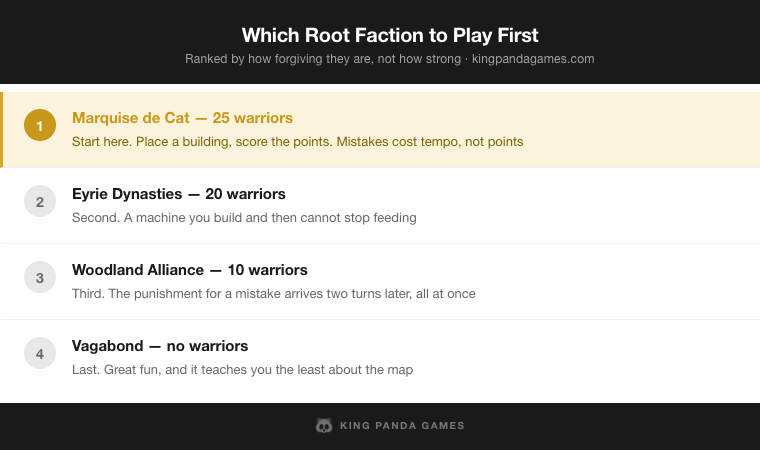
The Honest Summary
| Faction | Warriors | Scores by | Play it |
|---|---|---|---|
| Marquise de Cat | 25 | Building | First — most legible, most forgiving |
| Eyrie Dynasties | 20 | Holding roosts | Second — once Turmoil makes sense |
| Woodland Alliance | 10 | Spreading sympathy | Third — the punishment is delayed |
| Vagabond | 0 (one pawn) | Relationships and quests | Last — teaches the least about the map |
If you like the idea of ranked asymmetric factions generally, Scythe’s factions are the closest comparison on this site, and Spirit Island does the same trick cooperatively.
Rotate every game. Root’s balance assumes everybody at the table knows what everybody else is trying to do, and the only reliable way to learn what a faction threatens is to have played it. When four factions stop being enough, the Riverfolk Expansion is where the line goes next — we rank all four boxes in our Root expansions guide.
Frequently Asked Questions
Which Root faction is best for beginners?
The Marquise de Cat. She has 25 warriors, the most in the box, and her scoring is the most legible in the game — place a building, score the points printed under it. Her turns are also the most forgiving, because a bad Marquise turn costs you tempo rather than victory points.
Which Root faction is the hardest to play?
The Woodland Alliance, for a reason that surprises people: they are hard to play badly and survive. They field 10 warriors against the Marquise’s 25, their Supporters stack is capped at five cards until they get a base on the map, and losing a base forces them to discard every supporter matching that clearing and remove half their officers.
What is Turmoil in Root?
Turmoil is the Eyrie’s failure state. If you cannot fully take an action the Decree demands, you immediately Humiliate — losing one victory point for every bird card on the Decree including your two Loyal Viziers — then Purge the Decree back to just those Viziers, then Depose your leader by flipping it face down and choosing a new one.
Is the Vagabond overpowered in Root?
No, but an unpoliced Vagabond wins. The pawn is not a warrior and cannot be removed from the map at all, so the only way to hurt him is to damage his items, and that requires attacking him deliberately rather than incidentally. Tables that treat him as harmless because he holds no territory lose to him.
How many warriors does each Root faction have?
The base box holds 55 warriors: 25 for the Marquise de Cat, 20 for the Eyrie Dynasties and 10 for the Woodland Alliance. The Vagabond has no warriors at all, only a single pawn. Because rolled hits in battle are capped by the warriors you have in that clearing, those numbers set a hard ceiling on how hard each faction can hit.
Should everyone switch factions between games of Root?
Yes, and it is the single best habit a Root group can build. Root’s balance depends on every player understanding what the others are trying to do, and the fastest way to learn what threatens you is to have been that threat. A table where the same person always plays the Marquise stops reading the board correctly.