

All 4 Root Expansions Ranked (Which to Buy First)
Buy the Riverfolk Expansion first. It is the cheapest box that fixes the problem most Root groups actually have — a faction nobody wants to play any more — and it does it without asking anyone to learn a new map.
Four boxed expansions exist, and they are not competing for the same slot. One adds factions, one adds a board, one adds a mood, and one adds robots. Which is right for you depends entirely on which part of your Root nights has gone wrong. If you have not decided on the game itself yet, start with our full Root review.
Some links below are Amazon affiliate links — as an Amazon Associate, King Panda Games earns from qualifying purchases at no extra cost to you. Full disclosure.
1. The Riverfolk Expansion — Buy This First
The Riverfolk Expansion is the one to own if you own one. It ships 40 warriors across two new factions — 25 Lizard and 15 Riverfolk — plus a second Vagabond pawn, three more Vagabond characters, and four faction boards including the Mechanical Marquise, Root’s first automated opponent. Its BGG page carries the component list if you want to check a used copy against it.
The Riverfolk Company are the reason to buy it. They do not conquer; they sell. Other players pay them for services, which means the Riverfolk’s fortunes are set by people who are not the Riverfolk, and that is a genuinely new kind of turn in this box. The Lizard Cult convert discarded cards into a scoring engine and give the table a faction that wants the game to go long.
The rule: buy Riverfolk when a faction has gone stale, not when you want a bigger game.
Check the Riverfolk Expansion price on Amazon →
2. The Underworld Expansion — The One With a New Board
Underworld is the biggest change to how Root feels, and that is why it is second rather than first.
It brings the Underground Duchy and the Corvid Conspiracy — 35 warriors between them — along with 9 Minister cards, a Burrow, a Tower, 9 Crowns, and its own double-sided board carrying the Lake and Mountain maps (BGG lists the full contents). The Lake map is the headline: clearings that touch the lake become coastal clearings, the lake works as rivers linking every coastal clearing to every other one, and a Ferry piece lets you ignore paths once a turn.
The Duchy play underneath the map and surface where they like. The Corvids place face-down plots that everyone can see the backs of and nobody can see the fronts, which turns the whole board into a bluffing problem.
Why second: a new map resets everyone’s map knowledge at the same time as it adds two rulebooks. That is a lot to ask of a group still learning the Autumn map, and it is the right second purchase rather than the right first one.
Check the Underworld Expansion price on Amazon →
3. The Marauder Expansion — For Tables That Want It Nastier
“Our Root games have gone polite. Everyone builds, nobody fights.”
That is the table Marauder is for. It adds the Lord of the Hundreds and the Keepers in Iron — 56 warriors, the largest warrior count of any Root box — plus 8 Mood cards, 12 Relics, 5 Mobs, and three extra dice including a Mob die and an Uprising die.
The Hundreds are led by a Warlord whose Mood changes what the faction can do, so the same faction plays differently from turn to turn. The Keepers drag relics around the map and score for getting them home. Both factions want conflict, and dropping either one into a settled group changes the temperature of the evening immediately.
It also brings four Hirelings, which is Root’s answer to an empty seat: a faction that everyone shares control of, handed around as the score track moves.
Check the Marauder Expansion price on Amazon →
4. The Clockwork Expansion — Only If You Have a Seat to Fill
Clockwork is last on this list and first for exactly one group: people who want to play Root alone, or with two, or with a missing fourth.
It is not a faction box in the usual sense. The contents are 12 Priority Markers, 12 Difficulty cards, 16 Trait cards, 3 Vagabots and four faction boards, and the rulebook is called the Law of Rootbotics. What you are buying is automated opponents with adjustable difficulty and randomised personalities.
What most players do: rank Clockwork last because it adds no new human factions, and skip it.
What actually works: if your Root problem is scheduling rather than variety, this is the only box in the line that solves it — and it is the one thing that makes Root viable at two, which is otherwise its weakest count.
Check the Clockwork Expansion price on Amazon →
The Small Boxes Are Not Expansions
Several Root products are not faction boxes and get mistaken for them on a used listing.
- Exiles and Partisans and Squires and Disciples are each 54 cards — a replacement shared deck, not an addition. You swap one in; you do not add it.
- The Landmarks Pack is 6 landmark cards and 4 wooden landmarks that sit on the map as permanent features.
- The Vagabond Pack is 7 more Vagabond pawns, 3 characters and 3 items.
- The Hireling Packs add shared, part-time factions rather than a seat at the table.
None of these will play on their own, and none replaces a boxed expansion. Leder has also announced a Homeland Expansion, which ships the Lilypad Diaspora, the Twilight Council and the Knaves of the Deepwood along with Marsh and Gorge maps — it is already written into the current Law of Root even where the box is not yet on shelves.
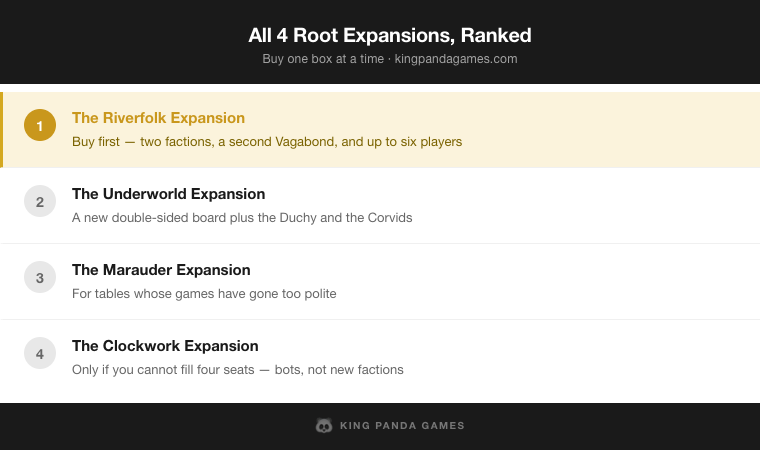
The Quick Buying Order
| Buy | Box | What it fixes |
|---|---|---|
| First | Riverfolk | A stale faction, and player counts up to six |
| Second | Underworld | The map itself has gone familiar |
| Third | Marauder | Your games have turned peaceful |
| Only if | Clockwork | You cannot reliably fill four seats |
| Skip | Small packs | Nothing, until you own a boxed expansion |
If you are still building a first collection rather than deepening one, our best board game expansions list covers the boxes worth owning across every game we rate, and Scythe’s expansions sit in a similar position for that game.
One box at a time is the honest advice. Every Root expansion adds a rulebook, and the thing that kills Root nights is not a lack of content — it is a table where one person is still reading. Which faction each player should be learning first is its own argument, and we settle it in our Root factions ranking.
Frequently Asked Questions
Which Root expansion should I buy first?
The Riverfolk Expansion. It adds the Riverfolk Company and the Lizard Cult, three more Vagabond characters and a second Vagabond pawn, and it raises the player count to six without a new board to learn. It is also the cheapest way to fix the problem most groups actually have, which is that one faction has gone stale.
How many Root expansions are there?
Four boxed expansions — Riverfolk, Underworld, Marauder and Clockwork — plus a Homeland expansion from Leder and several small packs: the Exiles and Partisans deck, the Squires and Disciples deck, the Landmarks Pack, the Vagabond Pack and the Hireling Packs. The boxed four are the ones that add factions.
Do Root expansions need the base game?
Yes, every one of them. None of the Root expansions is standalone — they ship faction boards, warriors and in some cases a new map, but they all assume you own the base box with its shared deck, item supply and battle dice.
Which Root expansion adds a new map?
The Underworld Expansion. It includes a double-sided board with the Lake and Mountain maps, plus the Underground Duchy and the Corvid Conspiracy. The Lake map adds coastal clearings and a Ferry piece; the base box already contains the Autumn and Winter maps on its own double-sided board.
Is the Clockwork Expansion worth it for solo play?
It is the only official way to play Root alone or to fill an empty seat, so if that is your problem it is the only box that solves it. The Clockwork Expansion is the automated-faction box — its rulebook is the Law of Rootbotics, and it ships faction boards, difficulty cards and trait cards rather than new human factions.
Can you combine Root expansions?
Yes. Every faction in the line is written into the same Law of Root, so factions from different boxes mix freely on any map. The practical limit is not compatibility but table size and teaching time — every extra faction is another rulebook somebody has to learn.