

Scythe Factions Ranked: All 5, Strongest to Weakest
Rusviet is the best faction in base Scythe, Saxony is the weakest, and the gap between them is bigger than any five-faction game should really allow. The community has known this for years — the official tournament scene literally banned Rusviet’s strongest mat pairing. Here’s the full ranking, why each faction lands where it does, and the pairing caveat that matters more than the ranking itself.
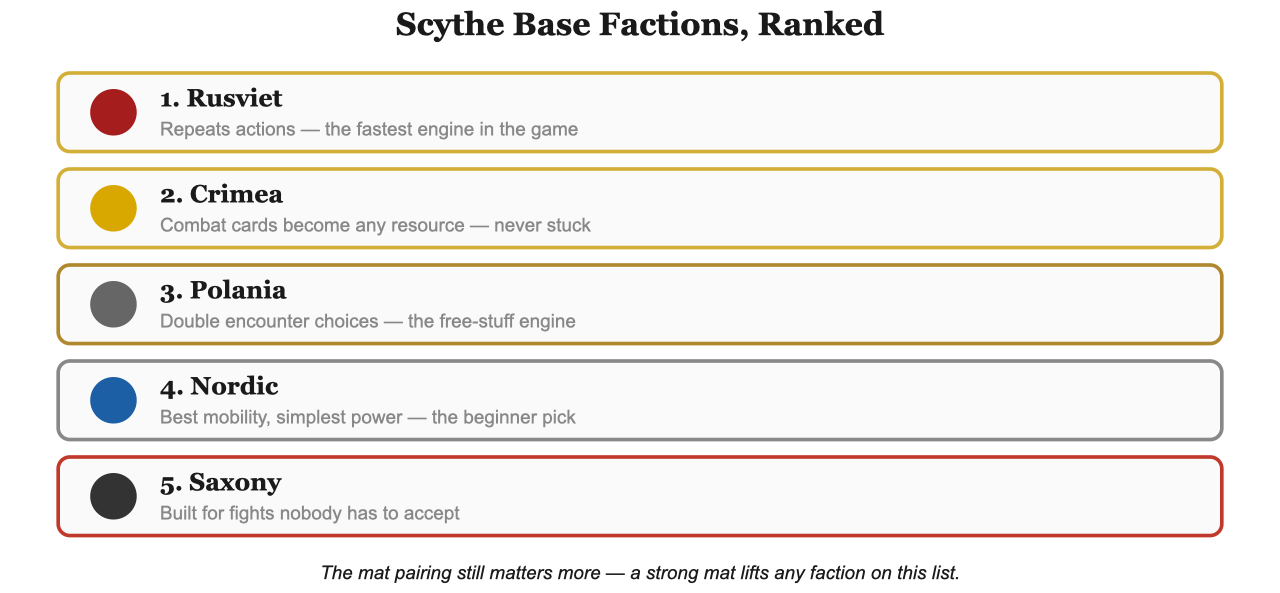
1. Rusviet (Red) — The Engine That Doesn’t Stop
Rusviet breaks Scythe’s most fundamental rule: everyone else must move their action token to a different mat section each turn, and Rusviet’s faction ability lets them stay put. Repeating Produce three turns in a row is exactly as strong as it sounds — it compresses their whole engine timeline while everyone else pivots around the rulebook.
Their Township mech ability adds a teleport network between villages and the Factory, so their late game is as mobile as their early game is rich. The Rusviet + Industrial mat pairing was formally banned from competitive play by Stonemaier — no other faction earned that honor.
2. Crimea (Yellow) — The Flexible Assassin
Crimea’s ability turns combat cards into wildcard resources, one per turn. That sentence reads mild and plays absurd: it means Crimea is never resource-stuck, can hit bottom-row actions a turn earlier than expected all game, and treats its combat card stack as a second bank account.
Wayfare — teleporting to empty home bases and the Factory — enables the game’s dirtiest finishing moves, dropping a fight where nobody was defending. In one of our games, Crimea’s last two stars came from a Wayfare jump that started a combat the defender literally could not have seen two turns earlier. Strong ability, stronger surprise.
3. Polania (White) — The Free-Stuff Engine
Polania gets two choices instead of one on encounter cards, and their Camaraderie ability removes the popularity penalty for shoving workers around. Together they make Polania the best goodwill-and-tempo faction: more free resources, more free workers, fewer scoring apologies.
Worth knowing: Polania’s Submerge ability moves mechs lake-to-lake. The lakes near their corner form a private highway across the map’s midline — most opponents don’t guard against it until they’ve been hit by it once.
Polania’s ceiling is a little lower than the top two because its power depends on encounter tokens, which run out. When the free stuff dries up mid-game, Polania has to win like everyone else.
4. Nordic (Blue) — The Honest All-Rounder
Nordic’s workers can swim rivers, and Seaworthy makes lakes normal territory. That’s real mobility on a board where geography is the main constraint — Nordic just goes where it wants earlier than anyone.
The problem is that mobility is Nordic’s whole personality. The top three factions get economic engines from their abilities; Nordic gets convenience. It’s the faction we recommend to every beginner precisely because its power is simple — but simple tops out.
5. Saxony (Black) — All Dressed Up for a Fight Nobody Comes To
Saxony is the combat faction in a game that isn’t about combat, and that sentence is the whole ranking. Their ability removes the two-star cap on combat victories and lets objectives score extra stars — a fantastic deal if fights were plentiful. They aren’t. Saxony has to spend real actions chasing opponents who are allowed to simply decline to be nearby.
Can Saxony win? Absolutely — a disciplined Saxony player camping the tunnel network with Underpass can force the fights the faction needs, and when it works it’s the most fun win in the game. It just requires outplaying the table, while Rusviet requires showing up.
The Caveat That Outranks the Ranking
The mat pairing matters more than the faction. Scythe deals each faction a random player mat, and the mat decides your action economy — which bottom-row action is discounted and what it’s paired under. Industrial and Innovative are the strong mats; Agricultural is the gentle one.
A strong mat drags a weak faction up: Saxony + Innovative is a real contender, while Nordic + Agricultural is playing on hard mode regardless of the ranking above. So read this list as tiebreaker knowledge, then look at the actual pairings on your table before deciding who to fear. Community consensus on the deeper pairing math lives in BGG’s Scythe strategy forums if you want to fall down that well. Our Scythe strategy guide has the short version — read your mat, find the discounted bottom action, and build your turns around it.
And if you own Invaders from Afar: Albion and Togawa both slot into the middle of this list — strong abilities, but slow starts that punish unfamiliar pilots.
Everything ranked above is in the base game of Scythe. Some links below are Amazon affiliate links — as an Amazon Associate, King Panda Games earns from qualifying purchases at no extra cost to you. Full disclosure.
Check Scythe price on Amazon →
Frequently Asked Questions
What is the best faction in Scythe?
Rusviet. Their ability to repeat the same action section on consecutive turns — which no other faction can do — compresses their engine timeline all game. Their Industrial-mat pairing was strong enough that Stonemaier banned it from tournament play.
What is the weakest faction in Scythe?
Saxony. Their bonuses reward combat in a game where opponents can simply avoid fighting, so their power is situational while everyone else’s is guaranteed. They can still win, but they have to work hardest for it.
What’s the best Scythe faction for beginners?
Nordic. Lake access via Seaworthy removes the movement rules that cause most first-game mistakes, and their straightforward mobility power doesn’t depend on combos a new player won’t spot.
Does the player mat matter more than the faction in Scythe?
Yes. The mat sets your action pairings and discounts, which shape your strategy more than your faction ability does. A strong mat like Industrial or Innovative lifts any faction; a weak pairing hobbles even Rusviet.
Why was Rusviet Industrial banned in Scythe?
The combination won too consistently in competitive play — Rusviet’s repeat-action ability plus the Industrial mat’s efficient layout produced the fastest reliable engine in the game. Stonemaier banned the pairing in tournament settings; casual tables can and do still play it.
Are Albion and Togawa stronger than the base factions?
No — both expansion factions land mid-tier. Their abilities are flavorful and strong in the right hands, but their slow openings make them easier to punish than Rusviet or Crimea.
If you’re still deciding whether the game beneath these factions is worth owning, our full Scythe review makes that call — short version: yes, and hand the new player Nordic.