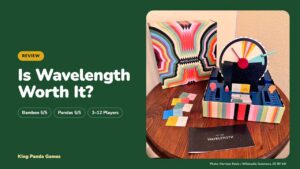
Buy Wavelength if your group is mostly teens and adults, or plays often. Buy Hues and Cues if you have kids under 14 at the table, or want a game for a few family nights a year. We rate both 5/5 Bamboo for ease, but Wavelength gets 5/5 Pandas and Hues and Cues gets 2/5.
Some links below are Amazon affiliate links — as an Amazon Associate, King Panda Games earns from qualifying purchases at no extra cost to you. Full disclosure.
We’ve played each about a dozen times. Both are guessing games where one player gives a short clue and everyone else tries to read their mind. The difference is what you’re guessing, and how long the game stays fresh.
| Hues and Cues | Wavelength | |
|---|---|---|
| Players | 3–10 | 2–12 |
| Age | 8+ | 14+ |
| Play time | 30 min | 30–45 min |
| You guess | A color among 480 squares | A spot on a dial between two opposites |
| Clues | One word, then two | One clue |
| Teams or solo | Everyone for themselves | Two teams (co-op for small groups) |
| Reading needed | None | Spectrum cards |
| Our scores | 5/5 Bamboo, 2/5 Pandas | 5/5 Bamboo, 5/5 Pandas |
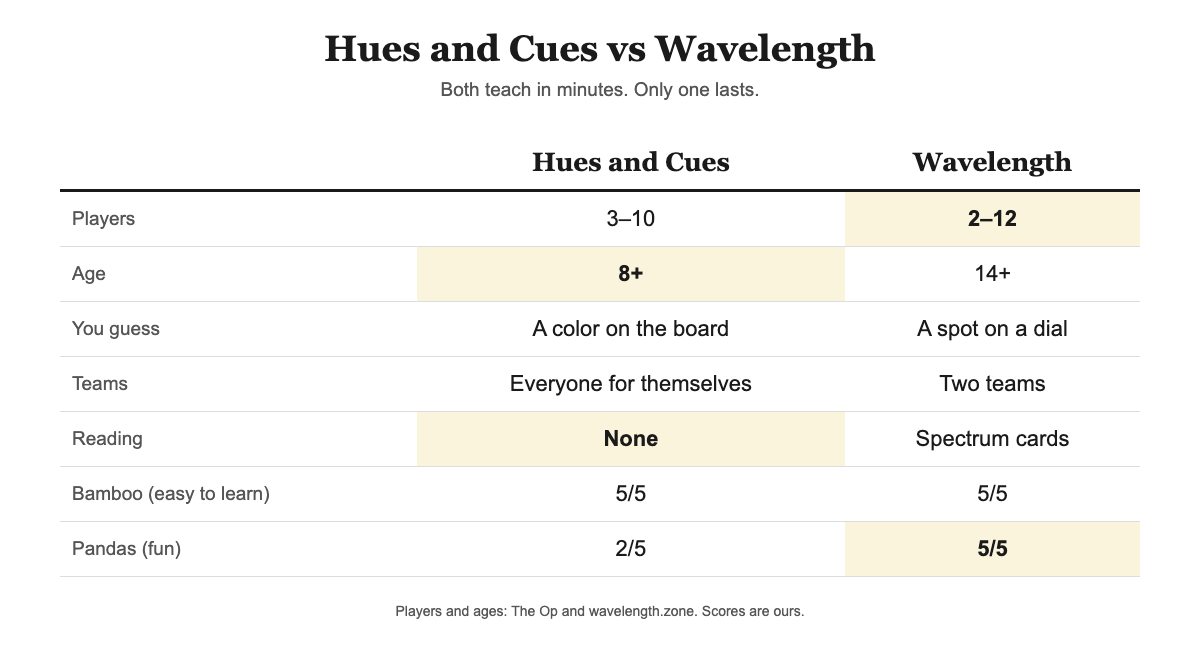
Player counts and ages come from The Op’s Hues and Cues page, The Op’s Hues and Cues rules and the official Wavelength site.
Wavelength Lasts Longer
Wavelength wins on replay value, and it isn’t close. After the second or third game of Hues and Cues, it loses a lot of its pull. Wavelength keeps going because every spectrum card is a new argument.
The reason is in the design. Hues and Cues always uses the same 480-square board, so the cues settle into the same foods and flowers. Wavelength pairs a random target with a random spectrum, like Overrated to Underrated, and the clue depends on who’s giving it.
Hues and Cues: the answer is a fixed color. Once you’ve learned the board, there’s less to discover.
Wavelength: the answer is an opinion. Your friends’ opinions keep surprising you.
Hues and Cues Is Better for Kids
Hues and Cues is rated 8 and up; Wavelength is rated 14 and up. That’s the clearest reason to pick Hues and Cues.
Kids already know colors, and good cues are often things they love: a cartoon character, a candy, a fruit. Wavelength’s spectrums need general knowledge and opinions, which is why its box says 14. There’s no reading in Hues and Cues at all, and its rules include an easier variant for young players who pick any square instead of drawing a card.
Wavelength Is Louder
“Which one is more fun at a party?” For us, Wavelength. Every round of Wavelength ends with the team arguing over where to turn the dial, and that debate is the game.
Hues and Cues is quieter. BoardGameGeek files both under party games, but they play very differently. Each player places a cone on their own, and there’s little to discuss until the frame comes down. It’s pleasant, but it doesn’t produce the same table talk.
Hues and Cues Seats a Big Group Without Teams
Both games handle a crowd. Wavelength stretches to 12 by splitting into two teams. Hues and Cues seats 10, and everyone plays for themselves, which some families prefer: nobody has to be picked for a team.
At the small end, Wavelength has a cooperative mode that works for two or three. Hues and Cues needs at least three, and with three the cue giver can score only 4 points a round.
So Which Should You Buy?
- Teens and adults, playing often: Wavelength. It’s the better game, and it lasts.
- Families with kids aged 8 to 13: Hues and Cues. It needs no reading and teaches in two minutes.
- Two players: Wavelength, with its co-op mode.
- A big mixed-age holiday table: Hues and Cues, for a few games a year.
Check Wavelength price on Amazon →
Check Hues and Cues price on Amazon →
Our full reviews go deeper: the Hues and Cues review and the Wavelength review. For clue-giving tips in each, see the Hues and Cues strategy guide and our Wavelength strategy guide.
Frequently Asked Questions
Is Hues and Cues like Wavelength?
Yes, in spirit. In both, one player gives a short clue and others guess what they mean. Hues and Cues uses a board of colors and everyone plays alone; Wavelength uses a dial between two opposites and is played in teams.
Which is better, Hues and Cues or Wavelength?
Wavelength, for most groups. We rate it 5/5 Pandas against 2/5 for Hues and Cues, mainly because Wavelength stays fresh for far longer.
Which is better for kids, Hues and Cues or Wavelength?
Hues and Cues. It’s rated 8 and up and needs no reading. Wavelength is rated 14 and up because many spectrums need general knowledge.
Can you play Hues and Cues or Wavelength with 2 players?
Wavelength has a cooperative mode that works for two. Hues and Cues needs at least three players under the official rules.
Which seats more players?
Wavelength, at up to 12 in two teams. Hues and Cues seats up to 10, with everyone playing for themselves.