The best Hues and Cues strategy is to give cues everyone pictures the same way, and to know when to stop. Name an object, not a shade, use your first cue to find the region, and skip the second cue when the first one already landed.
Some links below are Amazon affiliate links — as an Amazon Associate, King Panda Games earns from qualifying purchases at no extra cost to you. Full disclosure.
The numbers below come from The Op’s official rules and the shape of the board. Player counts and the design credit match BoardGameGeek’s Hues and Cues page. If you’re new to the game, start with our Hues and Cues review.
Know What Scores
Only 25 of the 480 squares score anything in a round. The 3×3 scoring frame covers 9 squares, and the ring of squares touching it from outside adds 16 more.
| Where your cone lands | Squares | Points |
|---|---|---|
| The exact color | 1 | 3 |
| Elsewhere inside the frame | 8 | 2 |
| Touching the frame from outside | 16 | 1 |
| Anywhere else | 455 | 0 |
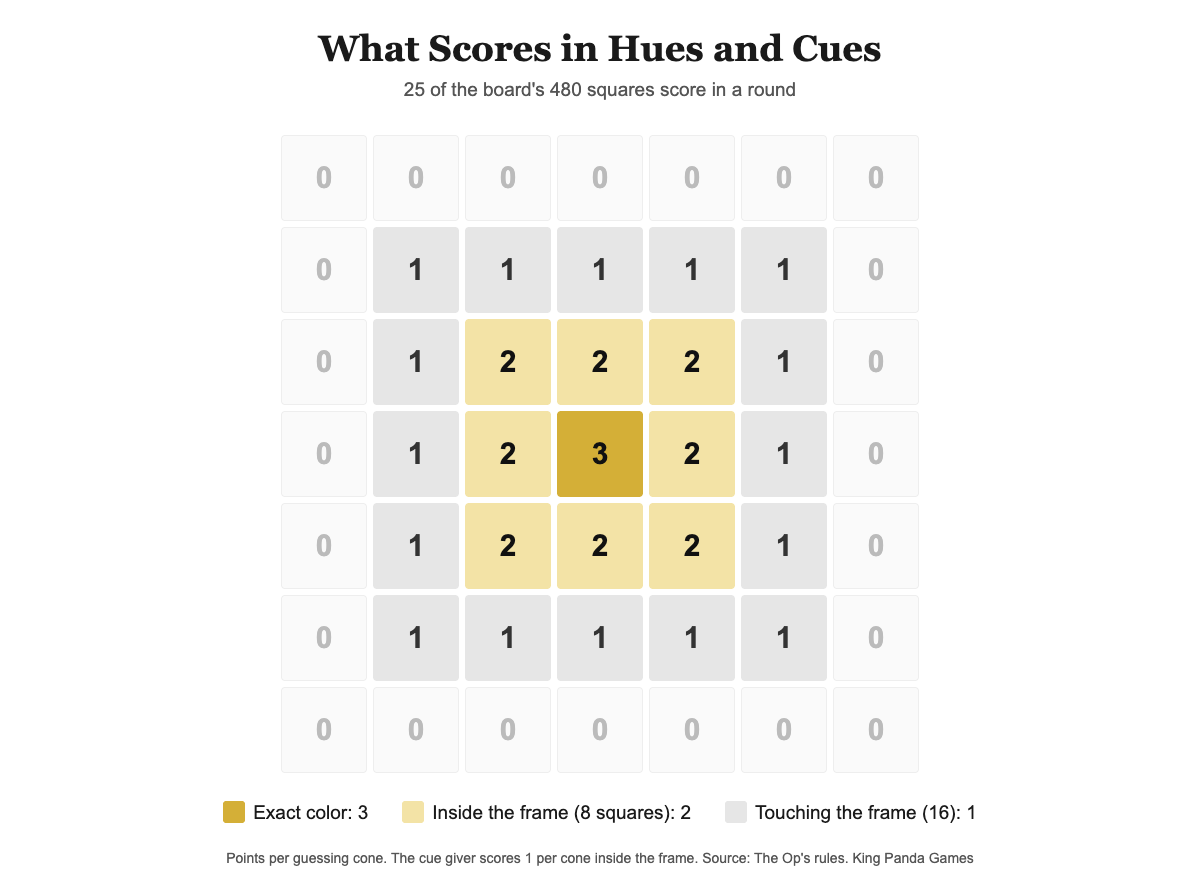
That’s about 5% of the board. A guess that’s off by two squares still scores, but one that’s off by three scores nothing. Close counts, as long as it’s really close.
Name a Thing, Not a Color
“What makes a good Hues and Cues cue?” One that everyone at the table pictures the same way. Objects beat descriptions, because “lime” means one thing to everybody and “zesty” means something different to each person.
Food, flowers, animals and well-known brands all work. “Flamingo,” “avocado,” “denim,” “egg yolk” and “eggplant” each point to a narrow strip of the board.
What most players do: try to describe the shade precisely, with cues like “muted” or “warm.”
What actually works: pick an object of that color and let the table do the rest. Save the adjectives for your two-word cue.
Remember the limits. Common color names like red, blue or orange are banned, as are the board’s letters and numbers and anything in the room. Abstract color names like lavender, chartreuse or golden are allowed.
Use Two Cues Like a Zoom
Your first cue should get the table to the right region; your second should move them a square or two. Think of it as a zoom: wide, then close.
- One word for the family of color: “Banana.”
- Watch where the cones land.
- Two words to correct: “ripe banana” pulls them darker, “banana milkshake” pulls them lighter.
Your color is a deep plum. You say “Eggplant,” and three of four cones land in or around your frame, with one a few squares too blue. You could give a second cue and hope to pull that cone in, or pass and score the three you have. The rules let you pass, and when you do, scoring happens straight away and nobody places a second cone.
The rule: if most of the first cones are already in your frame, pass on the second cue.
Passing protects you from a bad second cue, but it also costs every guesser their second cone. Don’t pass when the first cones are scattered, because a second cue is your only chance to pull them in.
Avoid Colors on the Edge
Every card has four colors, and you choose which one to describe. Pick one away from the edge of the board.
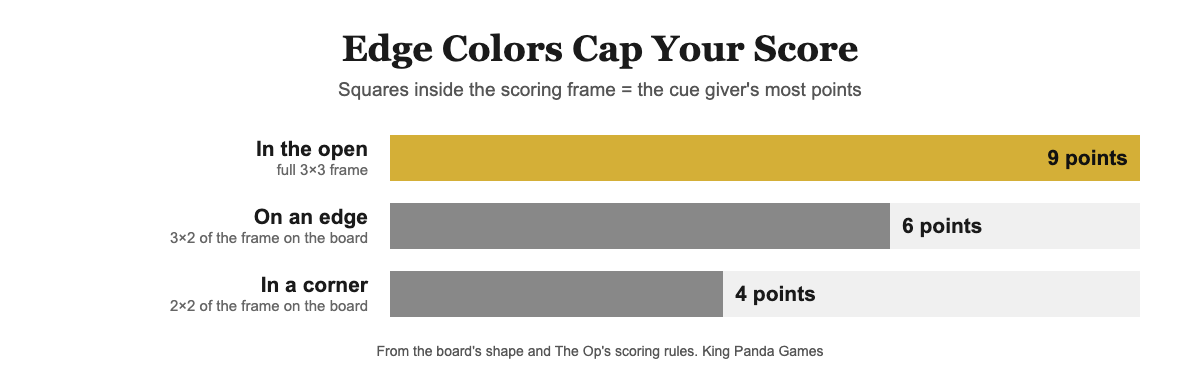
The rules say edge colors score “with fewer possible areas to score.” On the edge, the frame covers only 6 squares; in a corner, only 4. Since each square holds one cone, that caps the cue giver’s points.
| Your color is… | Squares in the frame | Your most points |
|---|---|---|
| In the open | 9 | 9 |
| On an edge | 6 | 6 |
| In a corner | 4 | 4 |
Guess Early, Guess Bold
Each square can only hold one cone, so the best spots go first. In the first round, guessing goes clockwise from the cue giver; in the second, it goes counterclockwise, so the last guesser in round one goes first in round two.
If you’re late in the order and the obvious square is taken, don’t jump far away. Take the next-best square beside it. A cone one step from the target still scores 2.
Your second cone is also a chance to hedge. If your first cone went darker, put your second lighter. One of them is likely to land in the frame.
Worth knowing: the most a guesser can score in one round is 5: 3 for the exact color and 2 for the other cone in the frame. Two cones both in the frame, without an exact hit, still score 4.
Play to Your Table
Hues and Cues rewards knowing your group. Kids will picture “Grinch” and “SpongeBob” before “chartreuse,” and older players might reach for “avocado bathroom.” Give cues your table shares. It’s the problem the game grew from: designer Scott Brady spent years in printing hearing customers say “I wanted it more blue,” as he told Mojo Nation.
If you don’t own it yet, Hues and Cues is inexpensive and seats up to ten. If your group wants a guessing game with more variety, see our Hues and Cues vs Wavelength comparison.
Check Hues and Cues price on Amazon →
Frequently Asked Questions
What is the best strategy in Hues and Cues?
Name an object everyone pictures the same way, use your first cue for the region and your second to fine-tune, and pass on the second cue if the first cones already landed in your frame.
Should you pass on the second cue in Hues and Cues?
Pass when most cones are already in or near the frame, because it locks in your score. Don’t pass when the first guesses are scattered, since the second cue is your chance to pull them in.
How many points can you score in one round of Hues and Cues?
A guesser can score up to 5: 3 for the exact color and 2 for a second cone in the frame. The cue giver can score up to 9, one for each cone inside the frame.
Which colors are hardest to give cues for?
Colors on the edge or in a corner of the board, because the scoring frame is cut off. An edge color caps the cue giver at 6 points and a corner color at 4.
Can you say a color name in Hues and Cues?
Not a common one like red, blue or green. Abstract color names such as lavender, chartreuse or golden are allowed.
Does turn order matter in Hues and Cues?
Yes. Each square holds one cone, so earlier guessers get the best spots. Order runs clockwise in the first round and counterclockwise in the second.