


Is Wavelength Worth It? Our Honest Review
Bottom Line
Wavelength is best for groups of four to ten who like to talk, argue and find out how differently their friends think. Skip it if your group goes quiet in party games, because the whole game is the conversation. Its biggest strength is a teach that takes thirty seconds and a dial that produces a real argument every round. Its biggest weakness is that it needs a confident clue-giver, and a shy one can stall a round.
Wavelength earns a perfect 5/5 Bamboo Plants and 5/5 Pandas from us, and we’ve played it about a dozen times with our board game group. The Bamboo is a five because the whole rule set is one clue and one dial. The Pandas are a five because every round ends with half the table defending a position the other half thinks is insane.
Some links below are Amazon affiliate links — as an Amazon Associate, King Panda Games earns from qualifying purchases at no extra cost to you. Full disclosure.
| Detail | Info |
|---|---|
| Players | 2–12 |
| Best Player Count | 6–8 — two teams big enough to argue, small enough to agree |
| Age | 14+ |
| Play time | 30–45 min |
| Complexity | Light |
| Solo Mode | No (there’s a co-op mode for small groups) |
| Designers | Alex Hague, Justin Vickers, Wolfgang Warsch |
| Publisher | CMYK (originally Palm Court) |
| Popular Upgrades | No |
| Bamboo Plants | 5/5 — one clue, one dial, thirty-second teach |
| Pandas | 5/5 — every round starts an argument worth having |
| Official site | wavelength.zone |
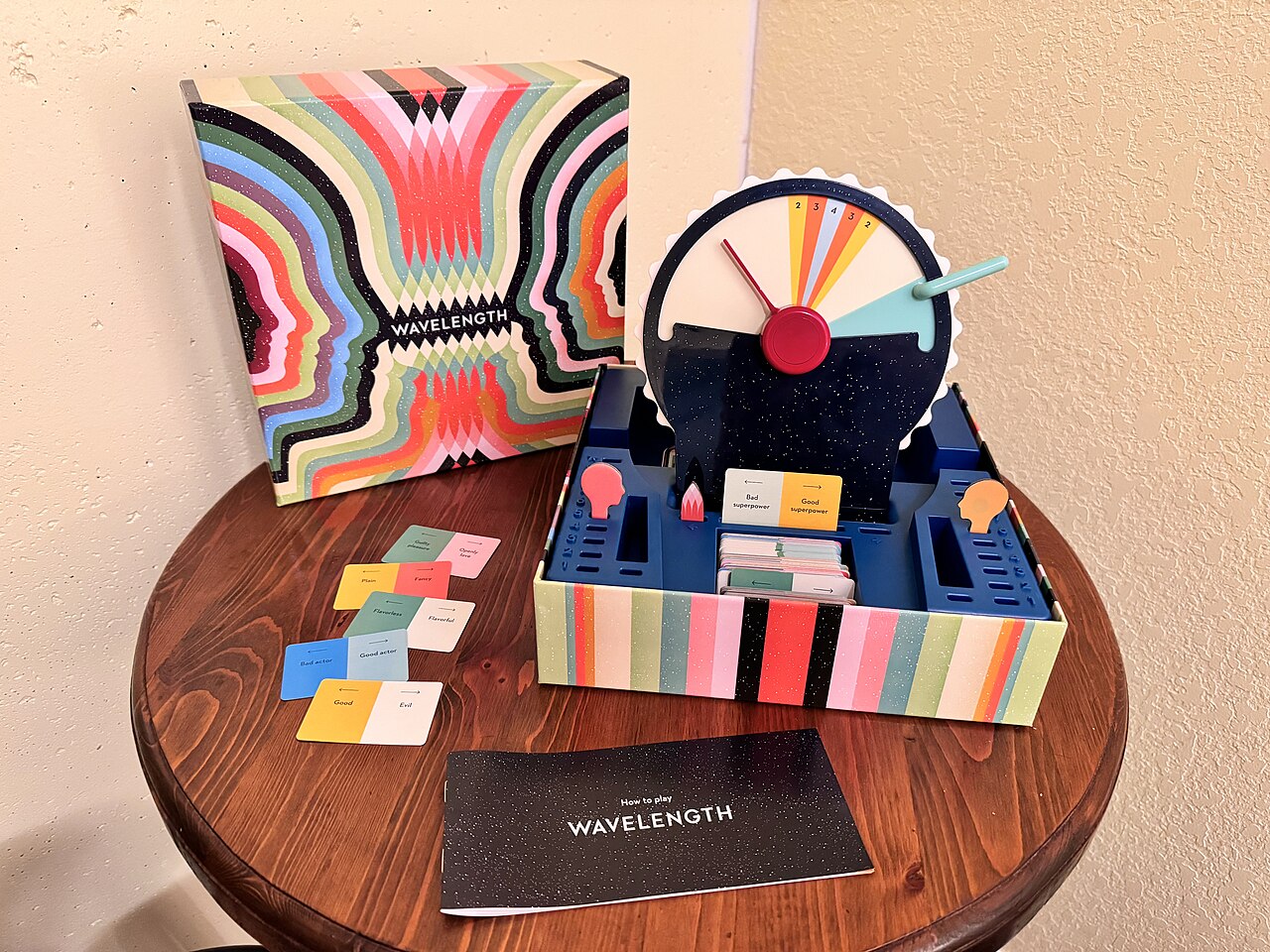
Wavelength’s dial and cards. Photo by Harrison Keely, CC BY 4.0, via Wikimedia Commons.

How It Works
Wavelength is a team guessing game played on a dial. Each round, one player on the active team is the Psychic. They spin a hidden target to a random spot on the dial, then draw a card with two opposites on it, like Hot and Cold, or Overrated and Underrated.
Only the Psychic sees where the target landed. They give one clue that sits on that spectrum at that spot, then go silent. Their team argues and turns the dial to where they think the target is.
The card says Useless to Useful, and the target is just right of center. The Psychic says “a fax machine.” Half the team thinks a fax machine is basically useless, the other half points out that doctors’ offices still use them. The dial ends up a hair left of center, and the other team bets the target is to the right.
The screen opens and the dial scores 2, 3 or 4 points depending on how close it is. The other team scores 1 point if they guessed correctly whether the target was left or right of the dial, unless the guessers hit the 4-point center. The first team to 10 wins, and a team that scores 4 while still behind takes another turn right away. Our Wavelength rules page covers every detail, including the 2-player and co-op modes.
What We Liked
- The teach is nothing. One person gives a clue, everyone else turns a dial. A new player understands it by watching one round.
- The arguments are the game. Two people who have known each other for years will discover they disagree completely about whether a hot dog is a sandwich, and that’s the best part of the night.
- The other team is never idle. Betting left or right keeps the waiting team listening to every word of the debate.
- It scales from a couple to a crowd. The box covers 2 to 12, and the co-op mode means it works at a small table too.
What We Didn’t Like
- It depends on the Psychic. A nervous or literal clue-giver can make a round fall flat, and some players dread their turn.
- The device is bulky. The dial is great at the table, but the box is bigger than most party games and not one to throw in a bag.
Who It’s For
Wavelength is for groups who already like talking to each other: friends, couples’ game nights, families with teenagers and adults. It works best when the table includes different personalities, because the fun is in finding out where everyone sits on the spectrum.
It’s also a great “first game” for people who say they don’t like board games. There’s nothing to learn and no strategy to get wrong.
Who Should Skip This Game
Skip it if your group is quiet or prefers games where you can think on your own. Wavelength is noisy by design, and a table that won’t debate gets a much smaller game. Younger kids can struggle too, since the box says 14+ and many spectrums need some general knowledge.
Who Should Buy This?
Buy it if you host game nights for six or more and want one party game that works with almost anyone. It costs more than a deck-of-cards party game because of the dial, and it’s worth it. There’s no need to try before you buy if your group likes talking games. It’s a core party game for a collection, not an occasional one.
Wavelength is the one to get. There’s only one version of the base game.
Check Wavelength price on Amazon →
Best Player Count
Wavelength is best with six to eight players, as two teams of three or four. That’s enough people on each team for a real argument about where the dial goes, and few enough that everyone gets a turn as the Psychic.
With four it still works, but each team is only two people, so the debate becomes a conversation. Above ten, rounds get loud and some players stop contributing. For two or three players, the co-op mode is the better choice than splitting into tiny teams.
Replayability
Wavelength has 84 double-sided cards, so 168 spectrums, and every spectrum plays differently with every target position. The same card can come up again with the target in a different spot and a different Psychic, and the clue will be completely different.
The real variety is the people. A new group finds new arguments, and the same group finds new ones each time. If the cards ever feel familiar, you can make up your own spectrums, and our spectrum ideas list has dozens to start with.
Awards
Wavelength was named Best Party Game of 2019 by The Dice Tower, according to Wikipedia’s Wavelength page, and it raised over $300,000 on Kickstarter before Asmodee picked it up for distribution.
Similar Games
If you like Codenames, try Wavelength — both are team clue games, but Wavelength’s clues are about degrees on a scale rather than linking words, so arguments matter more than vocabulary.
If you like Dixit, try Wavelength — both reward knowing how other people think, but Wavelength plays in teams and gets louder.
If you like Wavelength, try Coup — a very different game, but it has the same quality of turning a table of friends into a debate in minutes.
More picks are on our best social deduction games list and our best board games for adults list.
Tips and Tricks
- As the Psychic, use something everyone knows. A famous person, a well-known food or a movie beats a clever clue only you understand.
- Think about where the target sits, not just the theme. If the target is near the middle, pick something people genuinely disagree about.
- Guessers, ask what the Psychic would think, not what you think. You’re trying to read their mind, so their tastes and habits matter more than your own.
What most teams do: argue about the clue’s “correct” answer.
What actually works: argue about the Psychic. Ask how they’d rate it, then turn the dial there.
- The other team should listen for doubt. If the guessers are split, the target is probably close to the dial, so pick the side the doubters favor.
Our Wavelength strategy guide has more, and the Dice Tower’s review is a good second opinion.
Want to Go Deeper?
- How to Play Wavelength — scoring, the catch-up rule, and the 2-player and co-op modes. Read it here
- Wavelength Spectrum Ideas — homemade spectrums for adults and kids, so you can play without the cards. Read it here
- Wavelength Strategy — how to give clues your team can actually read. Read it here
The Verdict
Buy it if you host groups of four or more who like to talk. Skip it if your group is quiet or wants a thinking game. Start with the competitive mode for six or more, and the co-op mode for two or three.
Wavelength official site: wavelength.zone
Frequently Asked Questions
Is Wavelength worth buying?
Yes, for any group of four or more that likes to talk. The rules take thirty seconds, every round starts a debate, and it works with people who don’t usually play board games.
How many people can play Wavelength?
The box says 2 to 12. It’s best with six to eight as two teams, and the co-op mode works well for two or three.
How long does a game of Wavelength take?
About 30 to 45 minutes. The first team to 10 points wins, and rounds take a couple of minutes each.
Is Wavelength good for kids?
The box says 14 and up because many spectrums need general knowledge. Younger kids can play with homemade spectrums that suit their age.
Is Wavelength better than Codenames?
For a talkative group, yes. Codenames rewards vocabulary and careful clue links, while Wavelength rewards knowing how your friends think and arguing about it.
What is the hardest part of Wavelength?
Being the Psychic. You give one short clue and can’t explain it, so picking something everyone in the room understands is the main skill.
Can you play Wavelength with 2 players?
Yes, using the cooperative mode. You take turns as the Psychic and try to score as many points as you can before the cards run out.