

Bottom Line
Happy Salmon is best for families with kids and for any group of four or more that wants a game going in under a minute. Skip it if your game nights are quiet, seated, or mostly two players, because this game is loud, physical and needs at least three. Its biggest strength is that a six-year-old can beat the adults at it. Its biggest weakness is depth: there are no decisions to speak of, so it’s a warm-up, not the main event.
Happy Salmon gets 5/5 Bamboo Plants and 4/5 Pandas from us. We’ve played it 30-plus times as a family, kids included, and it’s still fun every time it comes out.
The Bamboo is a perfect 5 because the whole rulebook fits on the back of the box: shout the card, find your match, do the move. The Pandas land at 4, not 5, because a round lasts about 90 seconds and nothing you decide really changes who wins. It’s pure energy, and energy is exactly what it’s for.
Some links below are Amazon affiliate links — as an Amazon Associate, King Panda Games earns from qualifying purchases at no extra cost to you. Full disclosure.
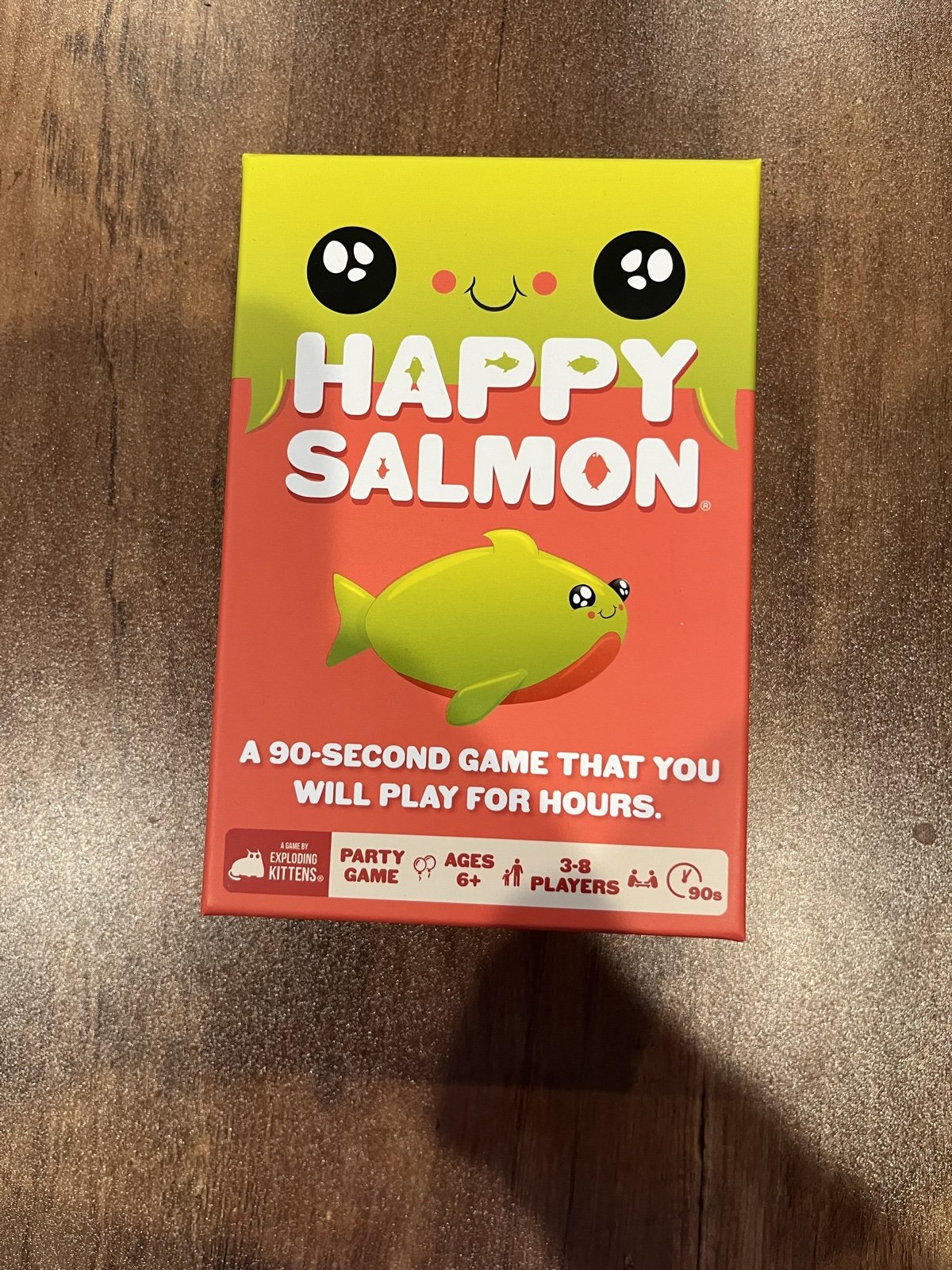
Happy Salmon is a real-time party card game with no turns. Everybody plays at once, everybody shouts at once, and the first person to get rid of 12 cards wins.
| Detail | Info |
|---|---|
| Players | 3–8 (current edition; the 2016 original was 3–6) |
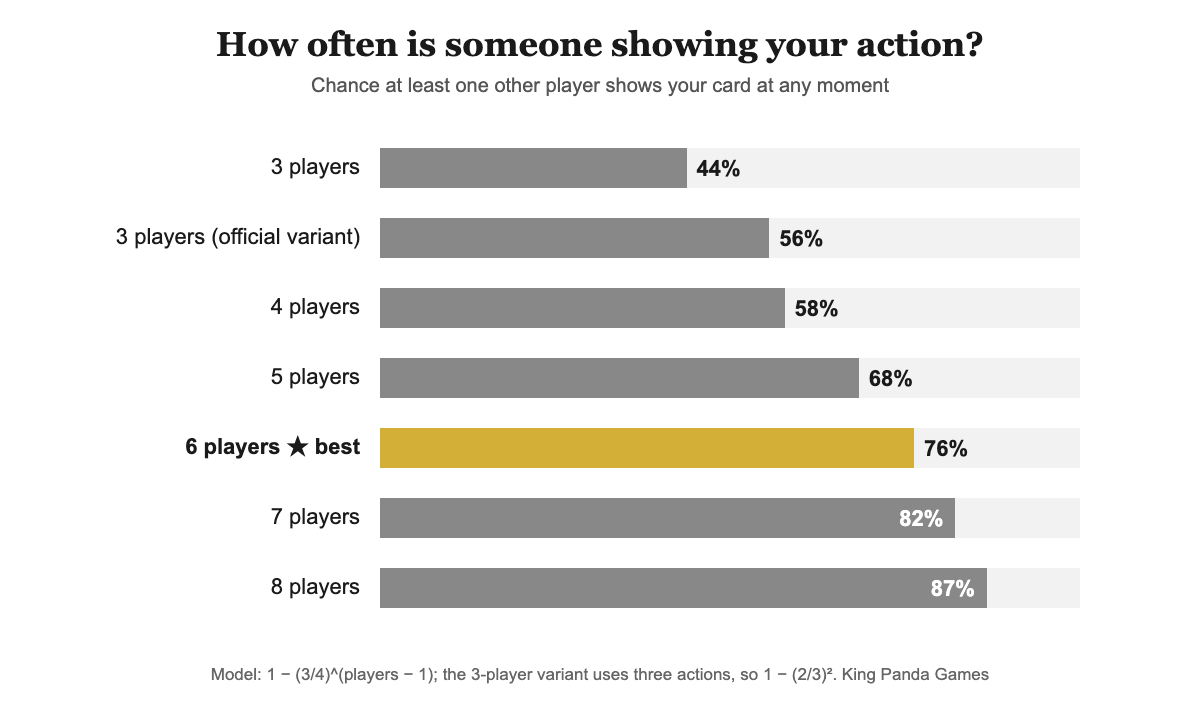
| Best Player Count | 6 — about a 76% chance someone is showing your action at any moment |
| Age | 6+ |
| Play time | About 90 seconds a round; most groups play 5–10 rounds |
| Complexity | Light |
| Solo Mode | No |
| Designer | Ken Gruhl and Quentin Weir |
| Publisher | Exploding Kittens (originally North Star Games) |
| Popular Upgrades | No |
| Bamboo Plants | 5/5 — the rules fit on the back of the box |
| Pandas | 4/5 — huge laughs, very little strategy |
| Official site | explodingkittens.com |
How Happy Salmon Works
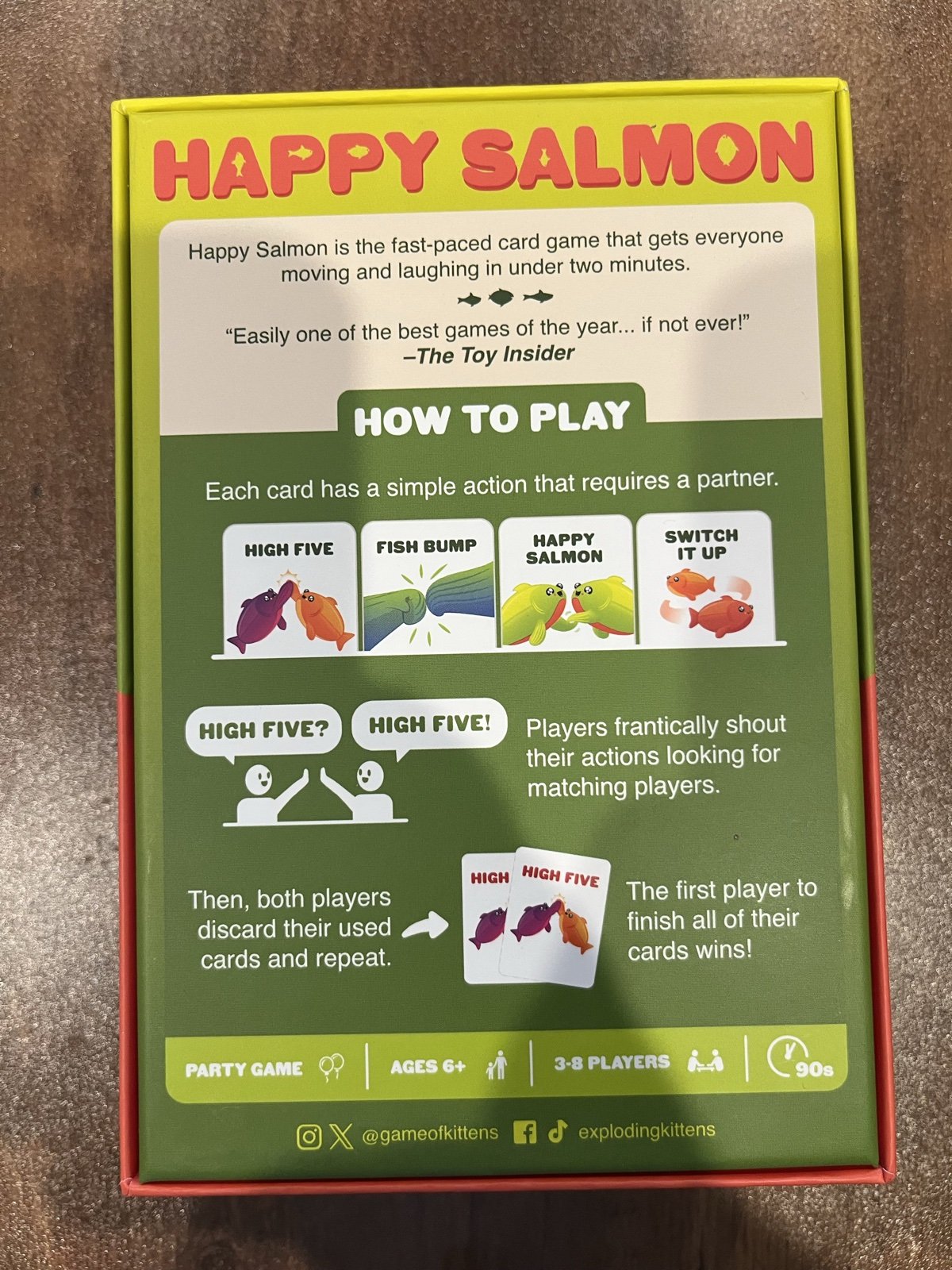
Every player gets a personal deck of 12 cards in one color. Each deck is identical: three each of High Five, Fish Bump, Happy Salmon and Switch It Up. You hold your deck face down, and on “three” everybody flips it so only the top card shows.
Designers Ken Gruhl and Quentin Weir named the game after a celebration move a friend taught them, and you can tell. It’s closer to a playground game than a card game. You can see the full credits on Happy Salmon’s BGG page.
Then you shout. You yell whatever action is on your card and listen for anyone yelling the same thing. When you find your match, you both do the move and toss your cards, and you’re straight onto the next one.
The four actions, straight from the official rulebook:
- High Five. Palm to palm. Signal it by holding a hand above your head.
- Fish Bump. Knuckles to knuckles. Signal it by holding out a fist.
- Happy Salmon. Slap each other’s forearms at least twice. Signal it by wiggling your hand like a fish.
- Switch It Up. Trade places around the table, taking your deck with you. Signal it by spinning a finger in the air.
You flip a Happy Salmon. Two people are yelling “High Five!”, one is spinning a finger for Switch It Up, and nobody is wiggling. You can keep shouting and hope someone’s next card matches, or tuck the salmon under your deck and try your luck with the next card. The rules let you do either. You still have to clear that salmon eventually, though, so burying it now just means dealing with it at the end.
That’s the only real decision in the game: keep fishing for a partner or cycle the card. There are no turns, no scoring and no hand to manage. The first person with an empty hand wins, and you shuffle and go again.
What We Liked
It teaches in about 30 seconds. You can explain Happy Salmon while people are still walking to the table, which makes it an easy yes when a younger kid wants in on game night. There’s no reading, no math and no strategy gap between a first-grader and a parent.
Kids win for real, not because you let them. Speed and volume beat experience in this game, and our six-year-old has won several rounds against the adults. That flips the usual family game night dynamic, where adults secretly throttle back so a kid can keep up.
Switch It Up is the best card in the box. Swapping places mid-round scrambles who’s standing next to whom, and the pairing you were counting on for your next High Five is suddenly across the table. It’s a tiny rule that keeps rounds from settling into a pattern.
Critics agree on this one. Tabletop Gaming’s review called it “simple, silly and joyous,” and it’s hard to improve on that.
It resets a tired room. After a long strategy game, two rounds of Happy Salmon get everyone standing, laughing and loud again. The rulebook jokes that if your heart rate is above 120, you’re doing it right, and they’re not wrong.
What We Disliked
There’s no game underneath the chaos. You can’t plan, you can’t read opponents and you can’t get meaningfully better beyond being louder and faster. Groups that want a decision in their party game will be done after three rounds.
It needs space and tolerance for noise. The rulebook tells you to stand, lose the chairs and use a table small enough that everyone can reach each other. That’s a problem in a small apartment, a restaurant or a house with a sleeping baby. There is an official Silent variant, but it’s a novelty, not the real game.
Three players is the slowest way to play. We’ve played it with three, and with only two possible partners there’s roughly a 44% chance someone is showing your action at any moment, so more of each round goes to waiting for a match. The official 3-player variant helps, but three is still the weakest way to play.
Who It’s For
Happy Salmon is for families with kids ages 6 to 12, and for any adult group that treats game night as a party first. It’s also a strong icebreaker for classrooms, youth groups and mixed crowds where half the people “don’t play board games.”
It works best as the opener or the closer. Play a few rounds while pizza is arriving, then move on to something with more to it, like Sushi Go Party! or 6 Nimmt!.
Who should skip this game: couples who mostly play two-player, since it simply doesn’t work at two. Strategy-first groups who resent any game without decisions should skip it too, along with anyone who hates being touched. The game is built on high fives and forearm slaps.
Who Should Buy This?
Buy Happy Salmon if you have kids or host big mixed groups. Exploding Kittens lists it at $12.99, it fits in a coat pocket, and it gets more use per dollar than almost anything on a family shelf.
Don’t try before you buy, because there’s no risk worth managing at this price. The one real question is whether your group will stand up and shout. If the answer is yes, Happy Salmon belongs on your shelf. It’s a situational game, not a core collection piece, but it’s one of the best situational games you can own.
Check Happy Salmon price on Amazon →
Best Player Count
Happy Salmon is best at 6. The box says 3–8, and our ranking is 6, then 5, then 7, then 4, then 8, then 3.
Our ranking comes from the odds, not from testing every player count at the table. There are four actions, so the chance that at least one other player is showing your action at any given moment is roughly 1 − (3/4)^(players − 1). That works out to about 44% at three players, 58% at four, 68% at five, 76% at six and 87% at eight. Below five, a lot of each round is spent waiting. At six, a match is usually one shout away.
Why not 8, if the odds are higher? Because eight people shouting four phrases at once gets hard to hear, and Switch It Up means walking around a crowded table. Six is the point where matches come fast and you can still hear your partner.
Three players is the weak spot, which is why the rulebook includes a 3-player variant. It removes the Fish Bumps so everyone holds only three actions, which raises the match chance to about 56%. There is no 2-player mode, and the game doesn’t work at two.
Replayability
Happy Salmon replays on energy, not variety. Every round uses the same 12 cards and the same four actions, so round 30 is mechanically the same as round one. What changes is who’s standing where, who’s loudest and who gets stuck holding the last Happy Salmon.
That’s why it lasts in a family and fades in a hobby group. Kids replay it the way they replay tag. Adults who want the game itself to change will feel it flatten out after one evening. We’ve played it more than 30 times as a family and it’s still fun, but it’s never the whole night.
There’s no true expansion. The closest thing is the old North Star Happy Salmon Blue deck, which could be combined with the original green one for up to 12 players, but it’s out of print. The versions guide covers which box to buy.
Awards
Happy Salmon won the 2017 Origins Award for Family Game of the Year, according to ICv2. It also picked up a Major Fun award in 2016.
Similar Games
If you like Exploding Kittens, try Happy Salmon. It’s from the same publisher and has the same one-minute teach. Happy Salmon holds up far better because the fun comes from the people at the table, not from jokes printed on cards. Our Exploding Kittens review gave it 2/5 Pandas for exactly that reason. The head-to-head comparison breaks it down.
If you like Throw Throw Burrito, Happy Salmon is the calmer cousin. Both are Exploding Kittens real-time games built on physical chaos. Throw Throw Burrito adds foam projectiles and a card-matching layer that drags. Happy Salmon is shorter and cleaner, and nothing ends up behind the couch.
If you want the same big-group energy with actual decisions, play Sushi Go Party! It seats eight and plays in about 25 minutes. Every turn is a real choice, which is exactly what Happy Salmon doesn’t have.
Tips & Tricks
Signal with your hands, not just your voice. Each action has an official gesture: hand up for High Five, fist out for Fish Bump, wiggle for Happy Salmon and a spinning finger for Switch It Up. In a loud room, people see a raised hand before they pick your voice out of the noise.
What most new players do: hold onto a card and keep shouting it, because giving up feels like losing time.
What actually works: if nobody answers within a couple of seconds, tuck the card under your deck and move on. You’ll have to clear it later, but by then the other players’ top cards will have changed and a match is more likely.
Watch for Switch It Up partners across the table. Because you physically trade places, a Switch It Up match is the slowest action to complete. Grab the closest person shouting it, not the first one you hear.
Don’t leave all your hard cards for the end. Everyone’s deck has three of each action, so the last few cards in a round tend to be the ones nobody could match. If you keep burying the same action, you’ll finish with a stack of it while everyone else runs out.
Worth knowing: a match is always two people. If three players all shout “High Five!” at once, pair up with whoever you lock eyes with first and let the third keep shouting. At big player counts, that eye contact saves a lot of confusion.
For kids under about seven, slow the first round down. Have everyone flip and say their card instead of shouting it, so the youngest player learns the four actions before the chaos starts.
Frequently Asked Questions
Is Happy Salmon worth buying?
Yes, especially for families with kids or anyone who hosts big groups. We rate it 5/5 Bamboo and 4/5 Pandas: it teaches in about 30 seconds, costs around $13, and is one of the few party games where young kids can genuinely beat adults.
Is Happy Salmon good for kids?
Yes. It’s rated 6+, and there’s no reading or math, just four actions to shout and act out. Because speed and volume matter more than experience, kids compete on equal terms with adults.
Can you play Happy Salmon with 2 players?
No. Happy Salmon needs at least 3 players, and the official rules include no 2-player mode. With only one other person, every card is either an instant match or a dead end, so there’s no game left.
How long does a game of Happy Salmon take?
A single round takes about 90 seconds. Most groups play several rounds back to back, so a session usually runs 5 to 15 minutes before moving on to something else.
What is the best player count for Happy Salmon?
Six players. With four actions in the deck, there’s roughly a 76% chance at six players that someone else is showing your action at any moment, so matches come quickly while the table is still small enough to hear each other.
Is Happy Salmon made by Exploding Kittens?
It is now. Ken Gruhl and Quentin Weir designed Happy Salmon, and North Star Games first published it in 2016. Exploding Kittens acquired the game in 2021 and re-released it for 3–8 players with 96 cards.
What does Switch It Up mean in Happy Salmon?
Switch It Up means you and your matching partner trade places around the table, taking your own decks with you. It’s the only action that moves people, and it reshuffles who is standing next to whom mid-round.
Want to go deeper?
- Happy Salmon vs Exploding Kittens — two party games from the same publisher, and which one to buy for your family. Read it here
- Happy Salmon versions compared — the 2016 original, the Blue deck and the current Exploding Kittens box. Read it here
- Happy Salmon rules — setup, the four actions, the 3-player variant and why there’s no 2-player mode. Read it here
Verdict
Buy it if you have kids, host groups of five or more, or want a game that gets a room moving in under a minute. Skip it if you mostly play two-player, want every game to involve real decisions, or play in places where shouting isn’t welcome. Don’t overthink it: at this price, Happy Salmon is the easiest party-game purchase on the shelf.
Happy Salmon official site: explodingkittens.com/products/happy-salmon