
Is Sea Salt & Paper Good for 2 Players?
Sea Salt & Paper plays 2–4 people, but the question isn’t whether it can be played at 2 — it’s whether it’s worth playing at 2 compared to other options. The answer is yes, with some specifics worth knowing before you sit down.
Some links below are Amazon affiliate links — as an Amazon Associate, King Panda Games earns from qualifying purchases at no extra cost to you. Full disclosure.
If you’re weighing whether to buy the game overall, start with our full Sea Salt & Paper review. This article is specifically about how the 2-player experience compares.
Sea Salt & Paper at 2 Players: The Short Version
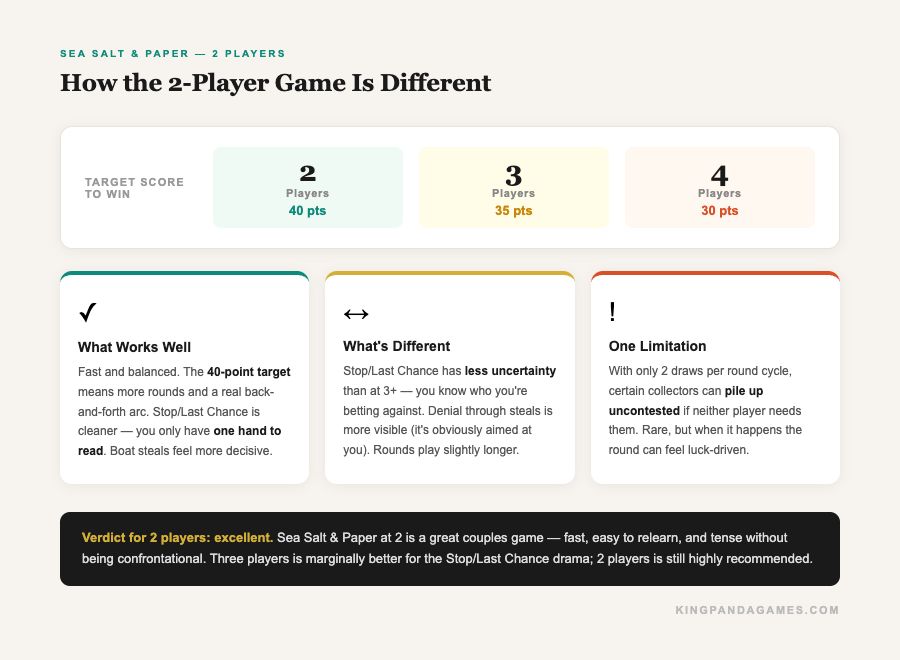
Sea Salt & Paper is a genuinely good 2-player game. It’s fast, balanced, and creates the same core tension — the Stop vs Last Chance decision — that makes the game work at any count. With only one opponent to read, that decision is slightly simpler to evaluate, which makes the game feel slightly more mechanical. But “slightly more mechanical than the best version” still leaves you with something worth playing.
The 2-player game runs to 40 points (vs 35 at 3, 30 at 4). That means more rounds per session, which balances out the faster deck cycling that happens when only two people are drawing. A full game runs 25–30 minutes, making it genuinely suitable for weeknight play or the kind of game you play twice in a row.
How the Stop/Last Chance Decision Changes at 2 Players
The Stop/Last Chance mechanic is what separates Sea Salt & Paper from other short card games, and at 2 players it changes in one important way: you only have one hand to estimate.
At 3 players, calling Stop or Last Chance requires reading two opponents — their played pairs, their discard habits, their drawing patterns — and synthesizing that into an estimate of whether either of them can beat you in one more turn. At 2 players, you only need to estimate one hand.
This is good in one sense: the decision is clearer. You’ve seen most of what your opponent has been taking. Their played pairs are face-up. Their hand is knowable if you’ve been paying attention.
At 3 players: You call Last Chance at 14 points, feeling confident. The player on your left has 9 points in played pairs and you think their hand is weak. The player on your right is a wildcard — you’ve lost track of what they’ve been taking. Last Chance fires. The wildcard opponent draws exactly the shell they needed, scores 12 points, and beats you by 2. You had no way to predict that.
At 2 players: You call Last Chance at 14 points. Your opponent has 9 in played pairs. You’ve watched them draw carefully — they’ve been chasing octopi and you’ve seen all four in the deck already. They’re not catching you in one turn. Last Chance fires. You score the bonus. This is the version where the decision rewards the attention you’ve paid.
The result: the 2-player game rewards careful tracking more directly. At 3 players, there’s always some uncertainty about the third hand. At 2, the Stop/Last Chance call is more of a skill test and less of a read under uncertainty.
Card Stealing at 2 Players
With only one opponent, the boat pair (steal any card from their hand) and the swimmer + shark pair (look at their hand, take one card) become significantly more targeted.
At 3+ players, you steal from the opponent who has the card most harmful to leave in their hand. You’re making a calculation across multiple hands. At 2 players, there’s only one hand to steal from — and they know you know that.
This creates a specific dynamic: your opponent is always aware that any boat pair you play is aimed at them. At 3 players, there’s a diffusion of threat — your boat might target anyone. At 2, it’s personal, and experienced players will adjust by building collections that are harder to disrupt (depth in collectors where they have multiple copies rather than breadth in a single color group).
Worth knowing: At 2 players, the fish pair (draw two from discard, keep one) doubles as a denial tool — you’re not just taking a card you want, you’re also removing the card your opponent was eyeing. Watch the discard pile carefully; your opponent does too.
Is Sea Salt & Paper a Good Couples Game?
Yes — and it’s near the top of its price bracket for couples specifically.
The traits that make a good couples game align with what Sea Salt & Paper does well: it’s fast (25 minutes means you can play twice without a major time commitment), it’s easy to pick up after not playing for a few weeks, and the direct competition feels like competition rather than conflict. Stealing a card isn’t personal — it’s the mechanic. That separation matters in games couples play together regularly.
The 40-point target at 2 players means you’re playing 4–6 rounds most games, which produces a natural back-and-forth narrative — someone gets ahead, someone catches up, the final round usually carries some stakes. That arc makes the game feel complete rather than arbitrary.
Sea Salt & Paper is one of the few games that works at the end of a long day when nobody wants to commit to a 90-minute session. It takes 5 minutes to explain once and 3 minutes to set up. The games are short enough that losing doesn’t feel punishing. It gets played.
For more options in this space, see our best 2-player board games list.
When to Play a Different Game Instead
Sea Salt & Paper at 2 players has one limitation worth naming: the card pool thins quickly.
At 2 players, there are more rounds per game — and across those rounds, certain collectors get depleted while others sit uncollected in the deck based on pure draw luck. In a round where both players draw away from octopi (neither needs them), octopi might pile up in the discard and create a statistical lopsidedness that doesn’t resolve cleanly.
This is rare, but it happens. When it does, the game feels like it’s fighting you rather than rewarding your decisions. At 3 players, the deck gets more evenly mined. At 2, the variance is occasionally more pronounced.
If you need something purpose-built for 2 players with zero variance overhead, Jaipur is the most common recommendation alongside Sea Salt & Paper. Both play exclusively at 2, both take under 30 minutes, and Jaipur has slightly less randomness because the market mechanic gives you more control over what’s available. They’re different enough that most couples who enjoy one enjoy the other.
Verdict for 2 Players
Sea Salt & Paper at 2 players is a very good game that’s slightly less dramatic than the 3-player version. The Stop/Last Chance decision is cleaner, the steals are more targeted, and the rounds run long enough to produce meaningful back-and-forth.
For couples: buy it. It’s one of the strongest games in its price range for regular two-player play.
For dedicated 2-player gamers who want maximum depth: add Jaipur to the list. Sea Salt & Paper is excellent; Jaipur is purpose-built for the head-to-head format in a way that shows. Owning both is reasonable.
For groups that usually play at 3+: Sea Salt & Paper works at 2, but the box says 2–4 for a reason. Play it at whatever count you have — it holds up everywhere.
Don’t own Sea Salt & Paper yet? This guide assumes the base game.
Check Sea Salt & Paper price on Amazon →
Frequently Asked Questions
Is Sea Salt & Paper good for 2 players?
Yes — Sea Salt & Paper is a genuinely good 2-player game. The head-to-head format creates direct, fast play where every stolen card and every Stop/Last Chance call has immediate impact. The target score at 2 players is 40 points, so you play more rounds than at 3 or 4. Three players is marginally better for the Stop/Last Chance tension, but 2 players is an excellent experience.
How does Sea Salt & Paper play differently at 2 players vs 3 or 4?
At 2 players, the Stop/Last Chance decision is simpler because you only have one opponent’s hand to estimate. Card denial through steals is also more visible — it’s obvious when your opponent targeted you specifically. Rounds last slightly longer because only two people are drawing from the deck. At 3–4 players, the Stop/Last Chance call is harder to read, and the color bonus competition is tighter.
Is Sea Salt & Paper a good couples game?
Yes — Sea Salt & Paper is one of the best couples games in its price range. It’s fast, easy to relearn after a break, and creates genuine competition without feeling confrontational. The 40-point game at 2 players takes about 25 minutes, plays well for a second game in a row, and is simple enough to bring out on a weeknight without setup overhead.
What is the target score at 2 players in Sea Salt & Paper?
The target score at 2 players is 40 points. At 3 players it’s 35, and at 4 players it’s 30. The higher threshold at 2 players means more rounds of play, which balances out the faster deck cycling that happens with only two people drawing from the same deck.
What are the best 2-player card games like Sea Salt & Paper?
If you enjoy Sea Salt & Paper at 2 players, similar games worth trying include Jaipur (purpose-built for 2, market trading and collection), Love Letter (fast deduction with high-stakes single-round decisions), and Lost Cities (direct card play competition over expedition routes). Each plays in under 30 minutes and rewards reading your opponent.