

Is Scythe Too Hard for Beginners?
There’s a famous Reddit post titled “I almost gave up on board games after Scythe.” Hundreds of people showed up in the comments to say some version of me too. If you’re holding the box wondering whether you’re about to spend $90 on a game that makes your friends feel dumb — that’s a fair fear, and it deserves a straight answer.
Some links below are Amazon affiliate links — as an Amazon Associate, King Panda Games earns from qualifying purchases at no extra cost to you. Full disclosure.
No, Scythe is not too hard for beginners. But it is too hard for beginner expectations, and that mismatch is what wrecks first games.
The Real Difficulty Isn’t the Turns
A Scythe turn is easier than a Catan turn. You place your token on one section of your mat, do the printed action or two, and you’re done — most turns take under a minute. There’s no hand of 12 cards, no trading negotiation, no branching decision tree.
What’s actually hard is the pile of small rules sitting around those simple turns. Rivers block movement until a specific mech ability says otherwise. Lakes are forbidden entirely, unless your faction says otherwise. Tunnels are all secretly adjacent to each other. The Factory counts as three territories, but only at scoring. Any one of these takes ten seconds to learn — the problem is meeting all of them in the same hour, at 9pm, while someone explains popularity tiers.
What new players expect: a complicated war game where the difficulty is out-thinking opponents in battle.
What’s actually difficult: movement geography and end-game scoring — the fights, when they happen, are the simplest rule in the box.
Where First Games Actually Go Wrong
The most common first-game disaster has nothing to do with rules: someone plays Scythe like a war game, spends the night building an army, and finishes last by thirty coins. Scythe scores economy, not aggression — and nobody believes that until they’ve watched a farmer beat a warlord. Our full Scythe review goes deeper on why that design works, but for a first game, just know: the mechs are guard dogs, not attack dogs. When you are ready to play that economy on purpose, our Scythe strategy guide lays out the production-first opening.
The second disaster is the three-hour first game. It’s real — ours was closer to three and a half. The teach takes 30–40 minutes, and early turns crawl while everyone re-reads their mat. This is normal, it happens to every table, and it drops to under two hours by your third play. Budget a whole evening for game one and it stops being a problem.
How to Shortcut the Learning Curve
- Learn it solo before you teach it. Scythe ships with the Automa, a genuinely good bot opponent — one solo game teaches you more than three rule-book reads, and it means game night starts with one person who’s actually played.
- Use the free official tools. Stonemaier posts quick-reference guides and the full rules for free, and the Dized app walks your table through an interactive tutorial. Print a reference sheet per player — it kills 80% of mid-game questions.
- Teach the ending first. Before explaining a single action, say: “the game stops instantly at six stars, and coins win — popularity multiplies everything.” Every rule makes more sense when players know what it’s all for.
- Skip objectives and the Factory in game one if your group is rules-shy. The game plays fine without them, and you can add both in game two once the core loop is boring — which happens fast.
Which Faction Should a Beginner Play?
Hand the newest player Nordic. Seaworthy lets their units treat lakes as normal territory, which quietly deletes the entire category of movement rules most likely to trip up a first-timer. Polania is the other friendly pick — extra encounters mean extra free stuff, and free stuff is forgiving.
Keep Rusviet and Crimea away from beginners, and not because they’re weak — the opposite. They’re widely considered the strongest factions in the game, and their power comes from combo lines a new player won’t see. A beginner piloting Rusviet just feels the complexity without the payoff. Our faction rankings break down all five.
Worth knowing: faction strength matters less than mat pairing. If you want to soft-balance a mixed table, give the experienced player Industrial Saxony and the beginner an Agricultural or Mechanical mat — the mat sets how forgiving the opening feels.
How Scythe Compares to Other “Hard” Games
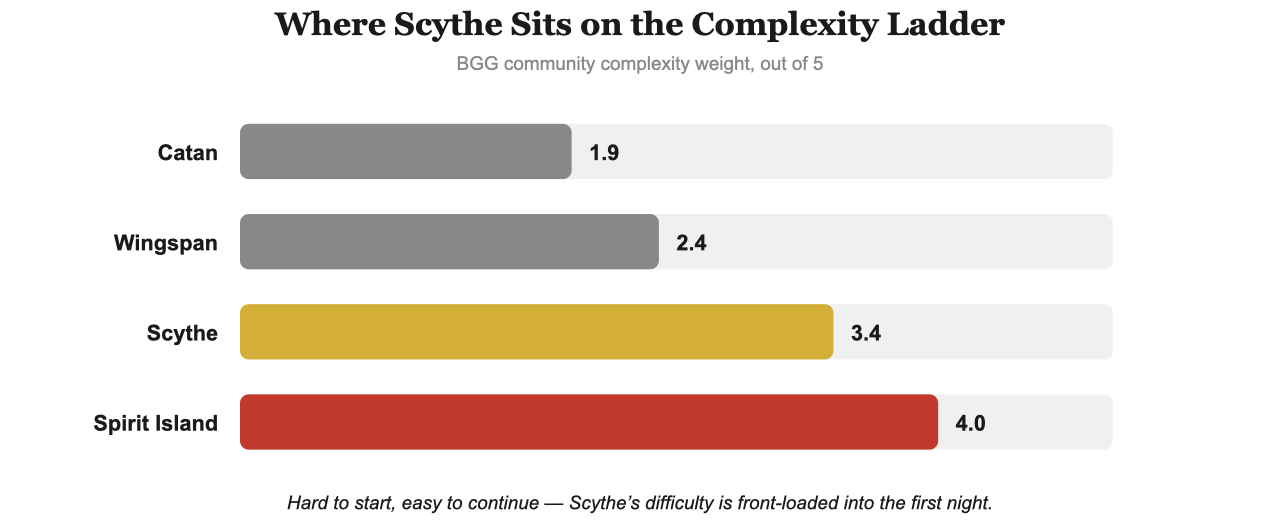
Scythe sits in the middle of the heavy-game ladder, not the top. BGG’s community rates its complexity around 3.4 out of 5 — meaningfully above Catan or Wingspan, meaningfully below true heavyweights. Spirit Island, which we also love, asks more of a new player on turn one than Scythe asks all night.
The honest framing: Scythe is a hard game to start and an easy game to continue. Games like Spirit Island are the reverse — simple to start, endlessly demanding. If your group survived the first night of any medium-weight game, they’ll survive this one.
Don’t own Scythe yet? This guide assumes the base game.
Check Scythe price on Amazon →
Frequently Asked Questions
Is Scythe hard to learn?
The teach is the hard part — 30–40 minutes of rules and a long first game. The turns themselves are simple: place your token on a mat section and take its actions. Most players are fully comfortable by game two.
How long does it take to learn Scythe?
One evening. Expect your first game to run about three hours including the teach, your second closer to two, and your third to hit the box’s 90–115 minute range. The curve is steep but short.
Can you play Scythe with non-gamers?
Not as their first modern board game — the rules overhead will bury someone whose reference point is Monopoly. Bridge them there with a gateway engine-builder like Wingspan first; after that, Scythe is a reasonable next step.
Is Scythe harder than Catan?
Yes, clearly — roughly twice the teach time and far more rules exceptions. But Scythe’s turns are actually faster and simpler than Catan’s once the game starts. The difficulty is front-loaded into the first night.
What’s the easiest faction for a new Scythe player?
Nordic. Its Seaworthy ability makes lakes normal territory, removing the movement restrictions that cause most first-game rules mistakes. Polania is a close second thanks to its bonus encounters.
Should I learn Scythe solo first?
Yes — it’s the single best way to learn the game. The included Automa bot plays a full opponent in about an hour, and teaching your group goes twice as fast when one person has actually played.
Play your first game on a weekend afternoon, not a weeknight — give it the whole runway once, and every game after that is fast.