

Scythe Player Count: Best at 4, Honest at Every Count
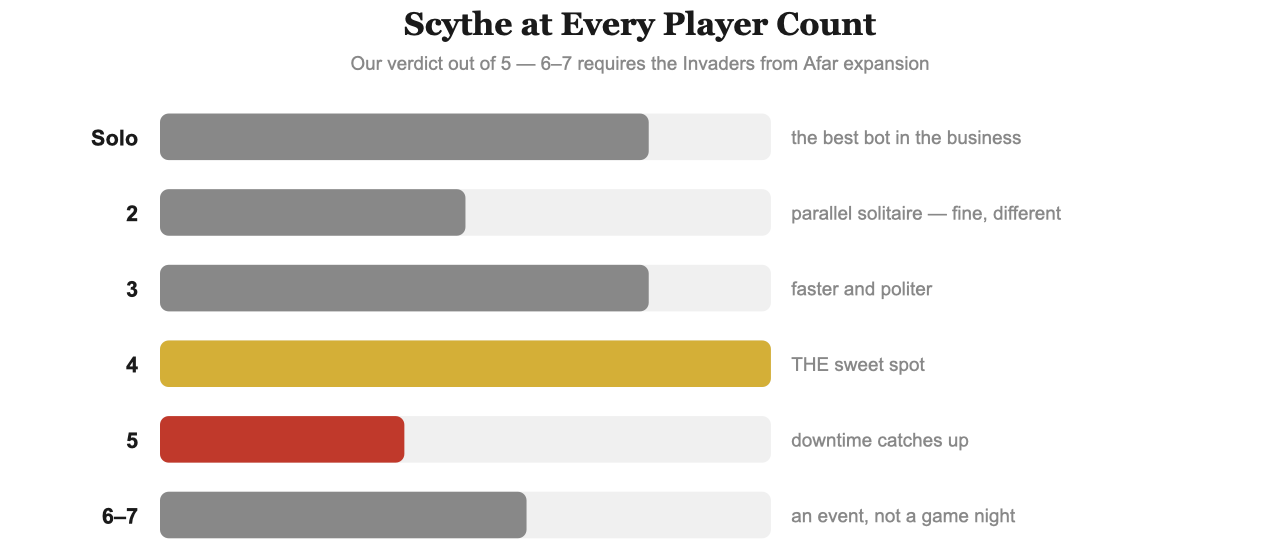
Scythe is best with 4 players. It supports 1–5 out of the box, stretches to 7 with the Invaders from Afar expansion, and the honest ranking runs 4, then 3, then solo, then 2, then 5, with 6–7 as a special event rather than a default. Here’s what each count actually plays like, so you can decide whether the game fits the table you really have — not the table on the box.
Some links below are Amazon affiliate links — as an Amazon Associate, King Panda Games earns from qualifying purchases at no extra cost to you. Full disclosure.
4 Players: Where the Game Was Balanced
At four, the map is exactly crowded enough. Every faction has a neighbor worth watching, territory genuinely runs out in the midgame, and the mechs finally justify their sculpts — not by fighting, but by making whole regions feel expensive to enter. Turns still come around fast, because Scythe’s simultaneous-adjacent flow means you’re rarely waiting more than a couple of minutes.
Four is also where the enlist mechanic — which pays you when adjacent players take certain actions — reliably has real neighbors on both sides feeding it. This is the count the design clearly assumes, and it’s the one we set up for whenever we can choose.
3 Players: Faster, Opener, Politer
Three-player Scythe trades tension for tempo. The map has slack in it, so engines run a little unmolested and fights are rarer than ever — but the game moves, finishing comfortably under two hours even with one newer player.
Is that a downgrade? Slightly, and it depends on your group’s taste. If your table treats Scythe as a competitive puzzle race, three might genuinely be your best count. If the low-simmering territorial dread is the appeal, you’ll miss the fourth player. We rank it just behind 4 and ahead of everything else.
Solo: The Best Bot in the Business
Scythe solo is not a consolation mode — the included Automa deck was built by a dedicated design team and it shows. The bot expands, threatens territory, and wins fights without you doing its bookkeeping paperwork, and a full solo game runs about an hour.
It’s also the best rules teacher the box contains. One Automa game before your first group night converts you from “person who read the rulebook” to “person who has played Scythe,” and the difference shows in the teach. We’ve said it in our beginners guide and it holds: learn solo, then teach.
2 Players: Works, But It’s a Different Game
At two, Scythe becomes a quiet engine race across an empty continent. With a full map and only two factions, you can genuinely avoid each other for the entire game — and optimal play often means you should. The tension that defines 4-player Scythe just isn’t on the board.
What couples expect: the intense head-to-head duel the two-faction setup implies.
What actually happens: parallel solitaire with occasional glancing — closer to racing side by side than fighting. Fine, even relaxing. Different.
If you’re buying primarily for two, we’d steer you to our best 2-player games list first — or play Scythe as dueling solo games, each of you against an Automa, comparing scores. We’re only half joking; it’s a great evening.
5 Players: The Count We Stopped Playing
Five-player base Scythe is where downtime finally catches up with the design. Each turn between yours is short, but there are four of them, and the crowded map produces the game’s worst pattern: the player sandwiched between two aggressive neighbors spends the night reacting while the player in the quiet corner farms to victory. Positional luck matters more at five than at any other count. If you draw the sandwich seat, the economy-first line in our Scythe strategy guide is what keeps you in the game — produce, upgrade, and let the neighbors trade punches.
It’s not broken — a five-player game with veterans who play briskly is perfectly good. But given the choice between five at one table or splitting into a Scythe four and something else, we split every time.
6–7 Players: An Event, Not a Game Night
Six and seven require Invaders from Afar and a full afternoon. The map becomes gloriously chaotic, fights actually happen because there’s nowhere to hide, and the whole thing takes three hours with the right crowd. As an occasional spectacle — a holiday table, a game-day finale — it’s genuinely fun, and if your table hits that often enough to plan for it, the expansion that raises the cap to seven is the only way there. As a regular format, everything slow about five players gets slower.
Worth knowing: at 6–7, set a timer expectation up front and use the “start your turn while the previous player finishes bookkeeping” rule aggressively — it’s legal, it’s in the rulebook, and it’s the difference between three hours and four.
Check Scythe: Invaders from Afar price on Amazon →
Frequently Asked Questions
What is the best player count for Scythe?
Four. The map is contested enough that positioning and mech deterrence matter, downtime stays low, and the adjacency-based enlist bonuses work at full strength. Three is a close second if your group prefers speed over tension.
Is Scythe good with 2 players?
It works but plays like parallel solitaire — the map is too big for two factions to pressure each other, so the territorial tension that defines the game mostly disappears. Couples who want head-to-head intensity have better options.
Is Scythe good solo?
Excellent — it’s one of the best solo experiences in board gaming. The included Automa bot plays a threatening, low-maintenance opponent in about an hour, and solo play is also the fastest way to learn the game before teaching a group.
How many players can play Scythe?
One to five with the base game, and up to seven with the Invaders from Afar expansion. The expansion is required for counts above five — there’s no way around it.
Is Scythe too slow with 5 players?
It’s noticeably slower — more downtime between turns and a crowded map that punishes whoever sits between aggressive neighbors. Veterans who play briskly can make five work, but four is better in every way that matters.
How long does Scythe take at different player counts?
Roughly 25 minutes per player once everyone knows the game: about an hour solo, 90 minutes at three, two hours at four, and two and a half or more at five. First games at any count run well beyond that.
Whatever your count, the game underneath is the same one we rated 4/5 Pandas in our full Scythe review — just know that the box’s “1–5” and the game’s real sweet spot are two different claims.