

People treat these as versions of the same game and wonder which is “better.” They aren’t versions — they’re different games that happen to share a theme. The question isn’t which is better. It’s which fits the situation you’re actually buying for.
Some links below are Amazon affiliate links — as an Amazon Associate, King Panda Games earns from qualifying purchases at no extra cost to you. Full disclosure.
The Core Difference: How Cards Are Drafted
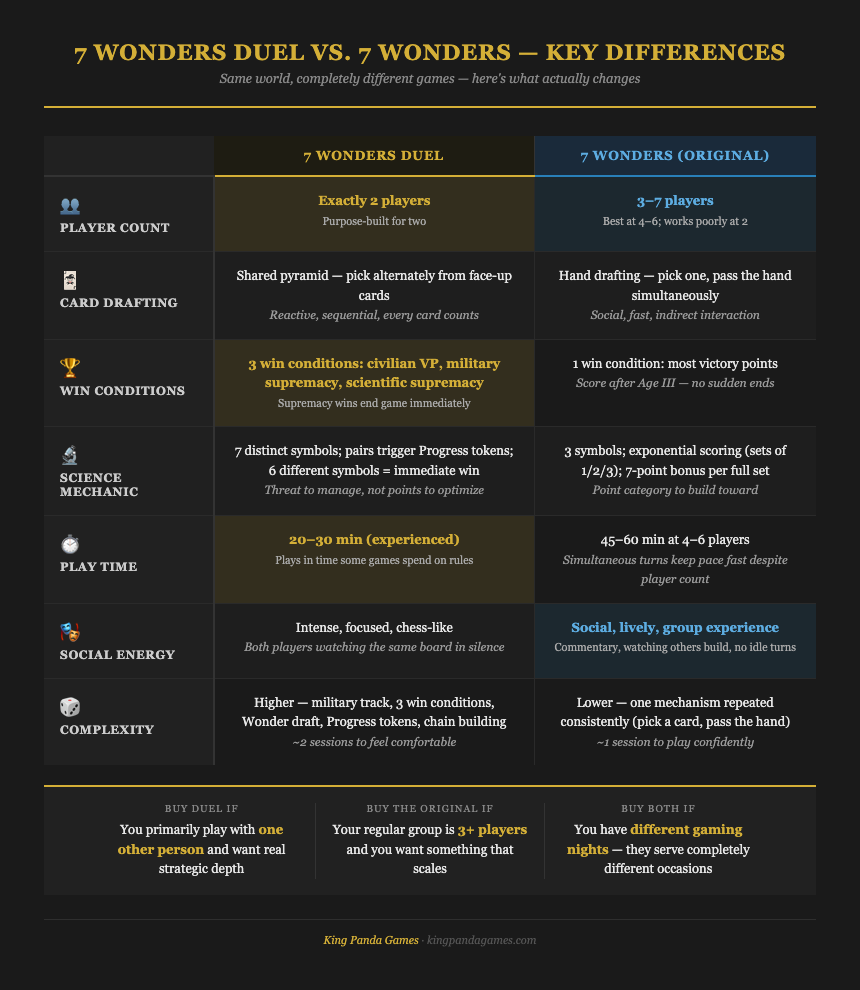
The original 7 Wonders uses simultaneous hand drafting. Every player gets a hand of cards, picks one, passes the hand to the next player, and repeats — everyone playing at the same time. This scales elegantly from 3 to 7 players and creates a social experience where you’re constantly aware of what the group is building.
7 Wonders Duel uses a completely different structure — a shared pyramid of cards that both players pick from alternately. There are no hands to pass. There’s no simultaneous play. It’s sequential, direct, and reactive. One player moves, the other responds.
7 Wonders (original): You pick a card from your hand, then pass the hand clockwise. Interaction is indirect — you’re blocking through card denial and watching what others build, but you rarely target a specific opponent directly.
7 Wonders Duel: You and your opponent are both watching the same board. Every card you take is a card they can’t. Every face-down card you flip reveals information you both react to. Interaction is direct, constant, and personal.
This structural difference changes everything. The original 7 Wonders is a group experience; Duel is a chess match.
Player Count: The Practical Decision
The original 7 Wonders plays 3–7 players. 7 Wonders Duel plays exactly 2.
If you’re buying for a game night with four friends, Duel cannot help you. If you’re buying for a regular two-player game with a partner, the original 7 Wonders can’t help you: the current Second Edition is for 3 to 7 players and has no two-player rules. Only the first edition had a dummy-player variant, which we cover in can you play 7 Wonders with 2 players.
This is the clearest buying guide possible:
– Primarily 2 players → buy 7 Wonders Duel
– Primarily 3+ players → buy the original 7 Wonders
– Both player counts regularly → ideally own both; they serve different nights entirely
Win Conditions: Simple vs. Triple
The original 7 Wonders has one win condition: most victory points. Points come from seven categories — military conflicts at age boundaries, treasury coins, wonders, science (which scores exponentially for pairs and triplets), civilian buildings, commercial income, and guilds.
7 Wonders Duel has three win conditions: civilian points, military supremacy (drive the Conflict pawn to the opponent’s capital), and scientific supremacy (collect 6 different symbols). Military and scientific supremacy end the game immediately — no waiting for Age III.
The immediate-win conditions change how every decision is weighted. In Duel, a green card is never just a science card — it’s a potential immediate win condition trigger. A red card is never just military — it might be ending the game this turn. Every card has three lenses to evaluate it through simultaneously.
The original 7 Wonders is more relaxed because there’s no immediate win threat. You’re optimizing for end-game totals, not defending against game-ending plays.
Game Length and Pace
Original 7 Wonders plays in about 45–60 minutes for an experienced group of four to six. Turn time per player is short (you’re picking one card while everyone else does too), so despite the player count, games flow quickly.
7 Wonders Duel runs 20–30 minutes with experienced players. It plays in the time some games spend explaining rules.
Worth knowing: The original 7 Wonders’ simultaneous play means more players doesn’t mean more time — everyone picks cards at the same time. A 6-player game isn’t much longer than a 3-player game.
Science in Each Version
Science works differently and this confuses players most.
In the original 7 Wonders, science scores two ways at once: each of the three symbols scores its count squared (1, 4, 9, 16), plus 7 bonus points per complete set of all three. Pure science builds can score massive points, but only your two neighbors can take the cards you need. Our 7 Wonders strategy guide has the full table.
In 7 Wonders Duel, science gives you Progress tokens on pairs and can win the game outright on six different symbols. There are 7 distinct symbols (vs. 3 in the original). The scoring is flat (1 VP per green card’s stated value), but the pair-and-supremacy mechanic makes science feel completely different — it’s a threat to manage rather than a category to optimize.
Players who loved science builds in the original often adapt poorly to Duel’s science at first, because the math is different and the goal (supremacy, not points) changes the calculus entirely.
Social Energy vs. Strategic Intensity
This is harder to quantify but easier to feel at the table.
The original 7 Wonders is social. You’re playing at a table, watching what everyone builds, commenting on strategies, occasionally trading commentary about who built what. It’s a game that happens alongside conversation. The simultaneous play means no one is sitting idle waiting for their turn.
7 Wonders Duel is intense. Both players are quiet, watching the same board, reading each other’s moves. It’s not unfriendly — but it’s not the same kind of group entertainment. It’s closer to a chess game in social energy than a party game.
Neither is better. They serve different moods, different groups, different evenings.
Which to Buy First
If you’ve never played either game, the choice comes down to player count. The original 7 Wonders is the right first purchase if your primary gaming situation involves three or more people, and our 7 Wonders review covers who it suits. 7 Wonders Duel is the right first purchase if you have a regular two-player opponent and want something with real strategic depth.
If you already own the original 7 Wonders and want to know if Duel is worth adding: yes, without question. Duel is not a replacement — it’s a companion for different occasions. Some players eventually find that Duel sees more table time precisely because it requires only one other person to play.
See our full 7 Wonders Duel review for everything you need to know about the game before deciding.
Check 7 Wonders price on Amazon →
Check 7 Wonders Duel price on Amazon →
Frequently Asked Questions
Go deeper. Our full 7 Wonders Duel review explains why it earns 5/5 Pandas, the Duel Wonder tier list ranks all 12 boards, and if you land on the original, start with the seven original Wonders ranked.
Is 7 Wonders Duel better than 7 Wonders?
Better at two players, without question. The current edition of the original 7 Wonders has no two-player rules at all. Only the first edition had a dummy-player variant. 7 Wonders Duel was purpose-built for two and is one of the best two-player games ever designed. At three or more players, the original 7 Wonders is better because Duel literally can’t accommodate more than two.
Can you play 7 Wonders Duel with the original 7 Wonders cards?
No. The two games use entirely different card sets, board layouts, tokens, and mechanics. They’re standalone games that don’t share components. Owning the original doesn’t give you anything that helps with Duel, and vice versa.
Is 7 Wonders Duel harder than the original 7 Wonders?
More complex to learn for most players, yes. The original 7 Wonders has one simple mechanism (pick a card from your hand, pass the hand), repeated consistently. Duel adds a military track, three win conditions, wonder drafting, chain building, and Progress tokens. The strategic depth of Duel is also higher — there’s more to master. That said, both are accessible within two sessions for anyone who likes board games.
Do they use the same Wonders?
Same names appear in both games, but they work differently. The original 7 Wonders has Wonders built stage by stage. In Duel, each Wonder is a single card with a single cost and effect. The thematic connection is there but the mechanics are redesigned for the two-player format. You can’t transfer Wonder cards between the two games.
Which has more replayability?
7 Wonders Duel has more replayability for a two-player household because each game’s Wonder draft, Progress token selection, and card structure produces meaningfully different games. The original 7 Wonders has more replayability at the group level because different player combinations and different science/military/civilian emphasis among seven players creates enormous variety. Both have strong replay value; the answer depends on your player count.
How does 7 Wonders compare to 7 Wonders Duel?
They share a name and a theme, and that’s about it. 7 Wonders is a 3–7 player card-drafting game where everyone plays at once and hands rotate around the table. 7 Wonders Duel is a purpose-built 2-player game where you draft from a shared pyramid of face-up and face-down cards and can win instantly through military or science. Buy the original for groups. Buy Duel for two.