


The best dice game we’ve played is King of Tokyo, our top pick, with 4/5 Pandas and 5/5 Bamboo in our review. Yahtzee gets the same two scores from us, and so do Farkle and Bunco, but King of Tokyo goes first because its review is backed by thirty-plus plays and every roll matters to the whole table.
Played & scored means we’ve played it and scored it (Bamboo is how easy it is to learn, Pandas is how much fun it is, both out of 5), and Researched means we haven’t, and the facts come from publishers, rulebooks and Wikipedia. That’s 7 played and 18 researched, 25 games in all, plus three we’d skip. We also counted every possible Farkle roll to get the exact chance of scoring nothing, and with two dice left it’s 44.4%.
Some links below are Amazon affiliate links — as an Amazon Associate, King Panda Games earns from qualifying purchases at no extra cost to you. Full disclosure.
Jump to:
- Our ranking of the dice games we’ve played
- Classic dice games for ordinary dice
- Farkle rules, scoring and odds
- Bunco rules
- Boxed dice games by type
- Dice games we’d skip
- The dice game finder
Last verified: November 2026.
Our Ranking of the Dice Games We’ve Played
These 7 are ranked by Pandas, then Bamboo. Five have full KPG reviews, and their quotes are copied from those reviews. Eric has also played Farkle and Bunco and scored both, without play notes, so those two entries stick to the rules. Where games tie on both scores, the reviewed ones go first, then the one with more decisions per roll.
1. King of Tokyo
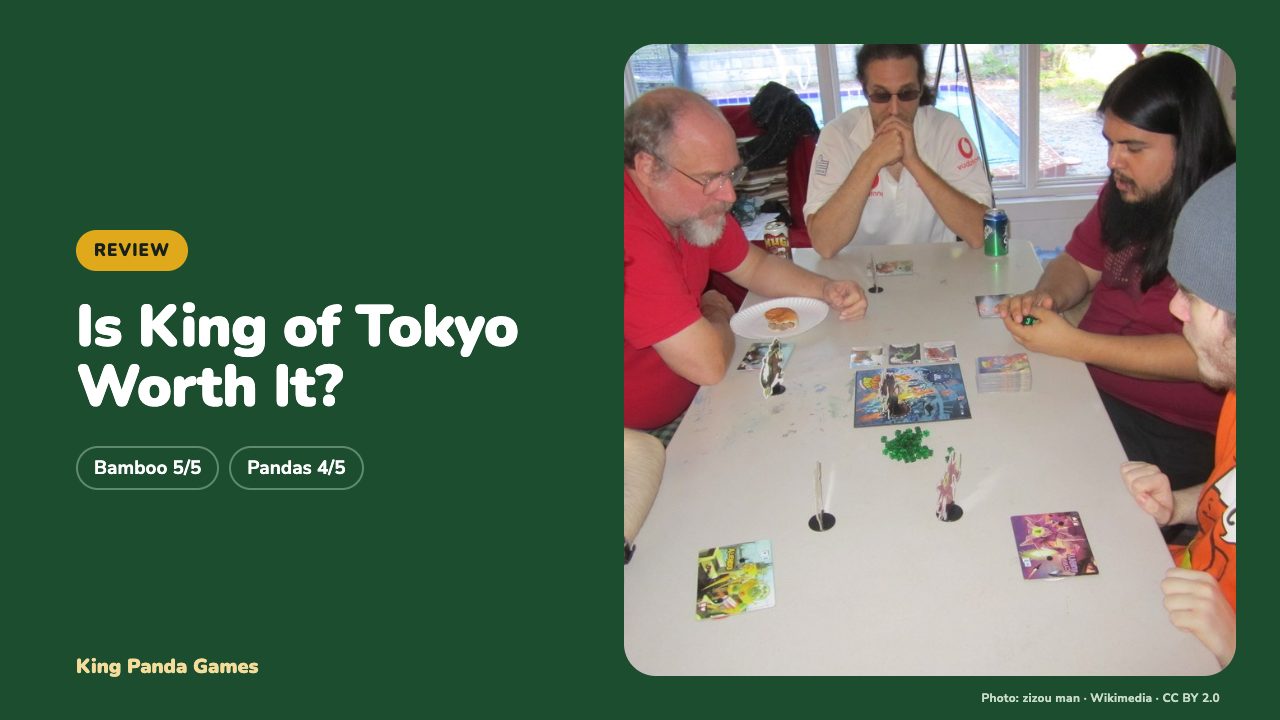
Played & scored 2–6 players · 30 min · ages 8+ · Pandas 4 · Bamboo 5.
How it plays. You roll six dice up to three times, keeping what you like between rolls, and the faces you end on give you points, energy, hearts or claws to hit the other monsters. Whoever sits in Tokyo takes hits from everyone outside it and can’t heal, so every turn ends with the same question of whether to stay or run.
Why it’s our top pick. Four of the games we’ve played tie at 4/5 Pandas and 5/5 Bamboo, and this is the one with the most behind its score. Our King of Tokyo review says “King of Tokyo gets a 5/5 Bamboo Plants and 4/5 Pandas from us — buy it,” and later, “Thirty-plus plays later, that tension hasn’t dulled.” Its reason for the score is the dice: “Its biggest strength is that the whole table cares about every single dice roll, not just their own.”
Watch for. The same review warns couples: “Its biggest weakness is that with two players, the push-your-luck standoff loses most of its bite.” Monsters can be knocked out before the end, and our King of Tokyo strategy guide covers when to leave Tokyo.
Check King of Tokyo price on Amazon →
2. Yahtzee
Played & scored 2+ (or solo) players · 13 rounds · ages 8+ · Pandas 4 · Bamboo 5.
The game. Five dice, up to three rolls a turn, and one box on your score card to fill each time, from Ones to Sixes up top and combinations such as a full house or a Yahtzee (five of a kind) below. After 13 turns every box is full, and the highest total wins.
Our verdict. “Yahtzee gets 5/5 Bamboo Plants and 4/5 Pandas from us. It’s a family favorite in our house,” says our Yahtzee review. It names the game’s strength as “the decision after every roll: keep these dice or chase something bigger, and which box to give up.” It sits second because the dice decide more than in King of Tokyo, and the review’s weakness line is plain about that: “Its biggest weakness is luck, because in our million-game simulation about 60% of games don’t produce a single Yahtzee at all.”
Going further. Our exact odds in the Yahtzee strategy guide put a Yahtzee on a single roll at 6 in 7,776. Our Yahtzee versions ranking sorts the travel, deluxe and spin-off editions, and how to play Yahtzee covers the scoring.
Check Yahtzee price on Amazon →
3. Farkle
Played & scored 2+ players · time to 10,000 points · Pandas 4 · Bamboo 5.
Eric has played Farkle and scores it 5/5 Bamboo and 4/5 Pandas, the same as Yahtzee. You need six ordinary dice and a pencil, and the rule that matters is that a roll with no scoring dice wipes out your turn. Its push is sharper than Yahtzee’s, because you can lose points you’ve already rolled. It ranks below the two reviewed games because there’s no full KPG review behind the score yet. The rules, a scoring table and our exact odds of a farkle are in the Farkle section.
4. Bunco
Played & scored Players: traditionally 12+ (tables of 4) · 30 min to hours · ages 4+ (Wikipedia) · Pandas 4 · Bamboo 5.
Bunco also gets 5/5 Bamboo and 4/5 Pandas from Eric, who has played it. It ties Farkle on both scores and goes after it because you make no choices at all: you roll three dice and count matches. It’s built for a crowd of 12 split across tables, so it’s a party night more than a game night. The Bunco section covers the rules and the table setup.
5. Catan
Played & scored 3–4 (5–6 with extension) players · 60–120 min · ages 10+ · Pandas 4 · Bamboo 4.
How a turn works. Catan is a trading game first, but two dice run it: every turn’s roll decides which hexes pay out, so where your settlements sit decides how often you get paid. Our Catan statistics page shows how often each total comes up and what that means for placement.
Our verdict. “Catan earns a 4/5 Pandas and 4/5 Bamboo Plants — and after 30 years, that verdict still holds,” says our Catan review. The review backs the Bamboo with first-hand teaching: “We’ve taught Catan to complete board game newcomers and had them playing independently by turn five.” It’s fifth because it’s one Bamboo lower than the four above.
Watch for. The dice can sink a player: “If the dice refuse to roll your numbers for four consecutive turns while your opponent’s numbers hit constantly, there’s nothing strategic you can do.”
6. Ghost Stories
Played & scored 1–4 players · 60 min · ages 12+ · Pandas 4 · Bamboo 2.
What you do. Up to four monks defend a village as ghosts arrive each turn, and you exorcise them by rolling coloured dice, needing the full set of colours the ghost card shows. The dice decide each fight, and the game is in planning who moves where so the right monk is rolling at the right ghost.
Our verdict. “Ghost Stories earns a 4/5 Pandas and 2/5 Bamboo Plants — and we mean both of those scores fully,” says our Ghost Stories review. Its 2/5 Bamboo puts it sixth, but the Pandas come from moments like this one: “It’s the kind of game where people slap the table and shout when the dice finally go right on the last possible turn.”
Watch for. It loses often by design, and the review sends groups with a low tolerance for losing elsewhere. Our Ghost Stories strategy guide helps with the early turns.
Search Ghost Stories on Amazon →
7. Here to Slay
Played & scored 2–6 players · 30–60 min · ages 10+ · Pandas 3 · Bamboo 4.
The basics. You build a party of hero cards and try to slay monsters, and almost everything you attempt, from a hero’s ability to a monster attack, is a roll of two dice against a target number.
Our verdict. “Here to Slay gets 4/5 Bamboo Plants and 3/5 Pandas from us. We’ve played it a few times,” says our Here to Slay review, and the dice are why it ranks last of the seven: “The Pandas are a 3 because the dice have too much say. Most of the Monsters need a roll of 8 or higher, which fails 58% of the time.” It’s a fit for a family with kids around 10 who like card games, and how to play Here to Slay covers the turn.
Check Here to Slay price on Amazon →
Classic Dice Games You Can Play With Ordinary Dice
All of these run on standard six-sided dice you already own, plus paper, a cup or, for two of them, a box or board. Rules vary by family, so treat each summary as the common version and agree on house rules first. If dice keep rolling off the table, our board game accessories guide covers dice trays. Farkle and Bunco, the two we’ve played, get their own sections below.
Liar’s Dice
Researched 2+ players.
Everyone rolls five dice under a cup and peeks. In turn, you raise the bid on how many dice of one face are showing under all the cups together, or call the last bidder a liar. The cups come up, whoever was wrong loses a die, and the last player with dice wins. Ones are often wild, and what counts as a higher bid varies, so agree on both before you start (Wikipedia’s rules summary lists the common versions). Each player needs an opaque cup, which is what a boxed set such as Perudo adds, and knocked-out players sit and watch.
Check Perudo (Liar’s Dice) price on Amazon →
Ship, Captain and Crew
Researched 2+ players · time under 15 min.
You get three rolls of five dice to set aside a 6 (the ship), then a 5 (the captain), then a 4 (the crew), in that order. Once all three are down, the other two dice are your cargo and their total is your score, and without a full ship you score nothing. Wikipedia’s article gives under 15 minutes a round and notes that it’s often played as a drinking or ante game, so set your own stakes for a family table.
Pig
Researched 2+ players.
Roll one die as many times as you like and add up the results, but a 1 wipes out the turn’s total. Stop and the total goes onto your score, and the first to 100 wins. It’s Farkle with one die and nothing to score but the numbers, which is why teachers use it for probability lessons. For beginners, a simple rule of holding at 20 points comes close to perfect play: Wikipedia, citing an analysis by Neller and Presser, puts it about 8% behind.
Mia and Mexico
Researched 3+ players.
Both games read two dice as a number, high die first, with 21 at the top, then doubles from 66 down to 11, then 65 down to 31. In Mia you roll secretly under a cup and announce a result that must beat the last one, true or not, and the next player either accepts it or lifts the cup; whoever was wrong loses one of six lives. Mexico drops the bluff: everyone rolls and the lowest result each round loses. Both are often played for drinks or money, and house rules vary a lot.
Yacht
Researched Players: any · 12 rounds.
Yacht is the game Yahtzee came from, and it plays the same way: five dice, up to three rolls, then one category to fill, over 12 turns. Per Wikipedia’s account of the 1938 rules, it has no upper-section bonus and no three of a kind, the Little Straight is 1 to 5, Choice works like Chance, and a Yacht (five of a kind) is worth 50. Anyone who knows Yahtzee can play it with any five dice and a hand-drawn sheet.
Balut
Researched 28 rounds.
Balut is a longer cousin of Yahtzee. You still roll five dice up to three times, but there are only seven categories (Fours, Fives, Sixes, Straight, Full House, Choice and Balut, which is five of a kind) and four boxes in each, so a game is 28 rounds and you plan where to bury bad rolls. Bonus points and a final points table decide the winner. Rule sets differ, and the free rules and scoresheet at balut.org are the ones to print.
Shut the Box
Researched 1+ (often 2–4) players · 2–3 min per player.
Roll two dice and close any open tiles that add up to the total, so an 8 could close the 8, or 7 and 1, or 5, 2 and 1. Once 7, 8 and 9 are shut you can roll one die. When you can’t close a matching set, your score is the sum of the tiles still open, lowest wins, and closing them all wins outright. You can play it with paper, but the wooden tile box is the usual way, and it works solo too.
Check Shut the Box price on Amazon →
Backgammon
Researched 2 players · 5–60 min.
Each player races 15 checkers around the board in opposite directions, moving by the two dice, with doubles moving four times. Land on a lone enemy checker and it goes to the bar and has to come back in, and you can’t land where your opponent has two or more. Once all your checkers are home you bear them off, and first to clear the board wins. It’s the one classic here that needs a board, and over a series of games the better player wins more often, which suits two players who want a real contest.
Check backgammon set prices on Amazon →
Farkle Rules, Scoring and Odds
Played & scored 2 or more players · six dice and a pencil · Pandas 4 · Bamboo 5.
Farkle goes by a lot of names, including Ten Thousand, Greed, Hot Dice and Zilch, and the scoring changes from house to house. The version below follows the standard table in Wikipedia’s Farkle article, which cites Arnold’s Playing Grandma’s Games (2000).
How to Play Farkle
- Roll all six dice.
- Set aside at least one scoring die or combination (see the table).
- Either bank your turn total or roll the dice you have left.
- If a roll has no scoring dice, that’s a farkle, and you lose everything from that turn.
- If every die you rolled scores (hot dice), you can pick up all six and keep going.
- The first player to reach 10,000 triggers one last turn for everyone else, and the highest score wins.
Farkle Scoring
| Roll | Basic scoring | Common house rule |
|---|---|---|
| Single 1 | 100 | 100 |
| Single 5 | 50 | 50 |
| Three 1s | 1,000 | 1,000 |
| Three of any other number | 100 × the number (three 4s = 400) | Same |
| Four of a kind | The triple, plus any extra 1s or 5s | 1,000 |
| Five of a kind | The triple, plus any extra 1s or 5s | 2,000 |
| Six of a kind | The triple, plus any extra 1s or 5s | 3,000 |
| Three pairs | Only the 1s and 5s score | 1,500 |
| 1-2-3-4-5-6 run | Only the 1 and 5 score | 2,500 |
The house rules column is the full table from the same Wikipedia article. Pocket Farkel, the boxed version sold since 1996, scores three 1s as 300 instead of 1,000.
The Chance of a Farkle, by Number of Dice
| Dice you roll | Basic scoring | Basic plus house combos | Odds in plain terms |
|---|---|---|---|
| 1 | 66.7% | 66.7% | 2 rolls in 3 score nothing |
| 2 | 44.4% | 44.4% | nearly a coin flip |
| 3 | 27.8% | 27.8% | a bit over 1 in 4 |
| 4 | 15.7% | 15.7% | about 1 in 6 |
| 5 | 7.7% | 7.7% | about 1 in 13 |
| 6 | 3.1% | 2.3% | 1 in 32 (1 in 43 with three pairs) |

With all six dice in hand you’ll almost always find something to score, but each die you set aside makes the next roll riskier, and with two dice left it’s nearly a coin flip at 44.4%. So rolling two dice puts the whole turn total on a 44% chance of losing it, which is a fair bet on a small total and a poor one on a big one. Only three pairs changes the odds between the two columns, and only for six dice, since every other house combo already contains a triple, a 1 or a 5.
Method: we listed every possible roll of one to six dice (from 6 outcomes for one die to 46,656 for six) and scored each one by its highest-scoring set of combos, so these are exact figures, not a simulation. Variants that score a six-dice roll with nothing in it (often 500 points) make a six-dice farkle impossible.
Check Farkle dice set price on Amazon →
How to Play Bunco
Played & scored Traditionally 12 or more players · three dice per table · Pandas 4 · Bamboo 5.
Bunco is a party format more than a board game. The rules below follow Wikipedia’s Bunco article, and groups change the details.
- Players and tables. Players sit in groups of four at each table, playing as two pairs of partners, usually 12 people across three tables. Each table needs three dice and score sheets, and a bell is traditional.
- Rounds. There are six rounds, numbered one to six. On your turn you roll all three dice and score one point for each die showing the round’s number. Three of a kind that isn’t the round’s number scores 5, and three of the round’s number is a Bunco, worth 21. You keep rolling as long as you score.
- Moving tables. A round ends when someone reaches 21 points. Winners rotate to another table.
- Winning. Whoever has won the most rounds at the end takes the game.
Wikipedia’s infobox gives an age of 4 and up and a length of 30 minutes to several hours, depending on how many sets you play. Our full Bunco guide is coming. For other games built for a crowd, our party games ranking has more.
Check Box of Bunco price on Amazon →
For the full rules, our odds of rolling a Bunco, free score sheets and party themes, see our guide to how to play Bunco.
Boxed Dice Games by Type
These are board games with dice at their centre, sorted by what the dice do. We haven’t played them, apart from King of Tokyo, and the facts come from publisher pages and Wikipedia.
Roll-and-Write Dice Games
Roll-and-writes have everyone use the same dice and mark their own sheet, so they play the same with two or five. Yahtzee is the original, and our Yahtzee versions ranking covers its editions.
Qwixx
2–5 players · 15 min · ages 8+.
Every roll, all players can use the sum of the two white dice, crossing numbers off left to right in four coloured rows. Skip too many numbers and your rows score little, wait too long and you’re stuck. Steffen Benndorf’s 2012 design was one of three nominees for the 2013 Spiel des Jahres, as Wikipedia’s Spiel des Jahres list shows (Hanabi won). Gamewright publishes it in the US, and Qwixx Deluxe and the card game are out of print, so check the listing is the base game.
That’s Pretty Clever!
1–4 players · 30 min · ages 8+.
Wolfgang Warsch’s game links several scoring areas so that one tick can set off a chain of bonuses, and the dice the active player passes over go to a “silver platter” for everyone else. It was a 2018 Kennerspiel des Jahres nominee on the same Wikipedia list. The score sheet is busier than Qwixx’s, and the English Stronghold edition no longer appears on Stronghold’s games list, so it may be hard to find. The sequels Twice as Clever and Clever Cubed are separate games.
Railroad Ink Challenge
1–4 (Challenge) players · 15–30 min · ages 8+.
Everyone draws the same rolled road and rail pieces on their own dry-erase map, trying to connect exits without leaving dead ends, which cost points. In the classic Deep Blue and Blazing Red editions it plays the same at one player or six. Horrible Guild’s US store showed both classic editions out of stock on November 26, 2026, while the newer Railroad Ink Challenge: Lush Green Edition (1 to 4 players) was in stock, so that’s the one the button below goes to.
Check Railroad Ink Challenge price on Amazon →
Dice Drafting
In a drafting game the dice are a shared pool you pick from, so what you leave behind matters as much as what you take.
Sagrada
1–4 players · 30–45 min · ages 10+.
Players draft translucent dice from a shared pool and place them in a stained-glass window grid, following colour and number limits, with no matching dice side by side. It’s a quick puzzle each pick, with little interaction beyond taking a die someone else wanted. It won Casual Game Revolution’s Best Casual Game of 2017. Floodgate sells it now as Sagrada (Remastered), and colour is the only thing that tells the dice apart, which colourblind players have found hard.
Check Sagrada price on Amazon →
Dice Building
Dice building works like deck building, except you improve the dice themselves.
Dice Forge
2–4 players · 45 min · ages 10+.
Your dice are the deck you build. You buy new die faces and physically snap them onto your dice, so your odds improve as the game goes on. Everyone rolls on every turn, so nobody sits idle. Asmodee sells it in the US for Libellud. It plays two to four with no solo mode, and swapping the small faces is fiddly for younger kids.
Check Dice Forge price on Amazon →
Dice Combat
Our top pick, King of Tokyo, is the played game in this group. Dice Throne takes the same three-roll combos and turns them into a duel.
Dice Throne
2–6 players · 20–40 min · ages 8+.
Each hero has five custom dice and an ability board, and you roll up to three times to land combos that hit your opponent, with cards to nudge your dice or theirs. It supports up to six in teams, but it’s built mainly as a one-on-one duel. The 2026 Hero Packs hold one hero each and you need two to play, so the Season One Battle Chest linked below, or a starter set, is the easier way in.
Check Dice Throne Battle Chest price on Amazon →
Push-Your-Luck Dice Games
Farkle is the classic push-your-luck dice game, and our push-your-luck games list covers the boxed ones in depth, with our own stopping odds for each. These three are the dice-only picks from it.
Can’t Stop
2–4 players · 30–40 min · ages 9+.
Sid Sackson’s 1980 game has you split four dice into two pairs and move runners up the matching columns, and you can roll again as long as each roll moves you. A roll with no legal move loses the whole turn’s climb. Eagle-Gryphon publishes the current edition, and Can’t Stop Express is a different game.
Check Can’t Stop price on Amazon →
Zombie Dice
2+ players · 10–20 min · ages 10+.
Draw three dice from the cup and roll: brains score, shotguns stack up, and three shotguns end your turn with nothing. It won the Origins Award for Best Family, Party or Children’s Game of 2010, according to Steve Jackson Games, and it fits in a pocket.
Check Zombie Dice price on Amazon →
Pickomino
2–7 players · 20–30 min · ages 8+.
Reiner Knizia’s game (Heckmeck am Bratwurmeck in German) makes you set aside every die of one face each roll, and you can’t take the same face twice, so the rolls get tight fast. Zoch’s own shop showed it out of stock on November 25, 2026, and US copies are imports, so there’s no buy button here.
Speed Dice Games
No turns here: everyone rolls at once and the fastest wins.
Tenzi
2–4 (6 with Party Pack) players · time under 1 min a round.
Everyone gets ten dice and rolls them as fast as they can, keeping matches, until one player has all ten showing the same number and shouts “Tenzi!” There’s nothing to read and nothing to teach, and the base box has four sets of dice (the Party Pack has six). Carma Games, the publisher, gives no age and calls it fun for all ages. Our travel games for kids list has it with other games that pack small.
Dice Games We’d Skip
Two of these come from our own reviews, and LCR comes from its rules.
Risk. It’s scored 4/5 Bamboo and 3/5 Pandas on our classic board games roundup, where the Pandas note is “The dice variance frustrates more than it thrills.” The roundup explains it: “You can make all the right decisions — fortify borders, build a continent bonus, manage your cards — and then lose three battles in a row because the dice decided today wasn’t your day.” Games run two to four hours, and knocked-out players wait.
Clue, as a dice game. We like Clue, and it gets 4/5 Bamboo and 4/5 Pandas in our Clue review, but don’t buy it for the dice. The review’s weakness line is about them: “Its biggest weakness is rolling dice to walk across the mansion, which can leave you stuck in a hallway while someone else solves it.”
Left Center Right (LCR). We haven’t played it. By its rules you roll one die per chip you hold (up to three) and pass chips left, right or into the centre as the dice say, and the last player with chips wins. You never make a choice, and it’s commonly played for cash. Bunco is just as easy for a big mixed-age group and at least has rounds and tables to track.
Craps is the dice game most people have heard of, but it’s a casino betting game, so it’s not on this list.
The Dice Game Finder
Every game on the page in one table: the 7 we’ve played in ranking order, the 8 classics, the boxed games, then the three we’d skip. The name jumps to its entry.
| Game | Type | Players | Time | Age | Badge | Buy |
|---|---|---|---|---|---|---|
| King of Tokyo | Dice combat | 2–6 | 30 min | 8+ | Played | Buy → |
| Yahtzee | Roll and keep | 2+ | 13 rounds | 8+ | Played | Check price → |
| Farkle | Classic (6 dice) | 2+ | To 10,000 points | Not stated | Played | See price → |
| Bunco | Classic (3 dice) | Traditionally 12+ | 30 min to hours | 4+ | Played | Buy on Amazon → |
| Catan | Board game with dice | 3–4 | 60–120 min | 10+ | Played | Amazon price → |
| Ghost Stories | Co-op with dice | 1–4 | 60 min | 12+ | Played | Price check → |
| Here to Slay | Card game with dice | 2–6 | 30–60 min | 10+ | Played | Shop on Amazon → |
| Liar’s Dice | Bluffing | 2+ | Not stated | Not stated | Researched | Shop → |
| Ship, Captain and Crew | Classic (5 dice) | 2+ | Under 15 min | Not stated | Researched | None |
| Pig | Classic (1 die) | 2+ | Not stated | Not stated | Researched | None |
| Mia and Mexico | Bluffing | 3+ | Not stated | Not stated | Researched | None |
| Yacht | Roll and keep | Any | 12 rounds | Not stated | Researched | None |
| Balut | Roll and keep | Not stated | 28 rounds | Not stated | Researched | None |
| Shut the Box | Classic (2 dice) | 1+ | 2–3 min per player | Not stated | Researched | Buy → |
| Backgammon | Classic (2 dice) | 2 | 5–60 min | Not stated | Researched | Check price → |
| Qwixx | Roll-and-write | 2–5 | 15 min | 8+ | Researched | See price → |
| That’s Pretty Clever! | Roll-and-write | 1–4 | 30 min | 8+ | Researched | None |
| Railroad Ink | Roll-and-write | 1–4 | 15–30 min | 8+ | Researched | Buy on Amazon → |
| Sagrada | Dice drafting | 1–4 | 30–45 min | 10+ | Researched | Amazon price → |
| Dice Forge | Dice building | 2–4 | 45 min | 10+ | Researched | Price check → |
| Dice Throne | Dice combat | 2–6 | 20–40 min | 8+ | Researched | Shop on Amazon → |
| Can’t Stop | Push-your-luck | 2–4 | 30–40 min | 9+ | Researched | Shop → |
| Zombie Dice | Push-your-luck | 2+ | 10–20 min | 10+ | Researched | Buy → |
| Pickomino | Push-your-luck | 2–7 | 20–30 min | 8+ | Researched | None |
| Tenzi | Speed | 2–4 | Under 1 min a round | Not stated | Researched | Check price → |
| Risk | Board game with dice | 2–6 | 2–4+ hrs | 10+ | Skip | None |
| Clue | Board game with dice | 2–6 | Not stated | 8+ | Skip | None |
| LCR | Classic (special dice) | 3+ | 15–30 min | 5+ | Skip | None |
How We Built This List and Calculated the Odds
Each game is labelled by what we know first-hand. Yahtzee, King of Tokyo, Catan, Here to Slay and Ghost Stories have full KPG reviews, and every line quoted from them is copied from the review. Eric has played Farkle and Bunco, and those scores are his, but there are no play notes behind them, so their sections stick to the rules. Risk is scored on our classics roundup and Clue in its own review.
The 18 researched games come from publisher pages, rulebooks, Wikipedia and retailer listings, checked on November 26, 2026. We kept an award only where we could link a source for it, and we left out games the publisher lists as out of print. We counted a game as a dice game when the dice decide most of what happens, which is why Catan, Ghost Stories and Here to Slay are in and games like Heat, which uses cards for speed, are out. If your group would rather spell than roll, try our word games list.
The Farkle odds come from an exact count of every possible roll under both scoring tables, described under the odds table. Our review methodology explains the scores, and About the reviewer covers who does the playing.
Frequently Asked Questions
What is the best dice game for adults?
Of the games we’ve played, King of Tokyo, our top pick, which gets 4/5 Pandas and 5/5 Bamboo in our review. The review calls it “the rare game we can teach in five minutes to an 8-year-old and still watch two 40-year-olds trash-talk each other over.” For a heavier evening, Ghost Stories is a hard co-op with 4/5 Pandas and a 12+ age on the box. With no box at all, Liar’s Dice is the classic for adults who like bluffing: five dice and a cup each, and you bid on what’s under everyone’s cups.
What is the best dice game for families?
Yahtzee is the played pick for families. Our review calls it “a family favorite in our house” and gives it 5/5 Bamboo and 4/5 Pandas, and it’s rated 8+. King of Tokyo is also 8+ and our top pick overall. Bunco suits a big mixed-age family gathering, and among the researched games Qwixx (8+) and Tenzi (no age given) take a minute to teach.
What is the best dice game for two players?
From the games we’ve played, Yahtzee. Our review notes that you mostly play your own score card, so two players lose little. Our King of Tokyo review warns that its push-your-luck standoff loses most of its bite with two. Among the researched games, Backgammon is strictly two-player and rewards skill over a series, and Dice Throne is built mainly as a one-on-one duel.
What are the odds of a farkle?
With all six dice it’s 3.1%, or 1 roll in 32, under basic scoring, and 2.3% (1 in 43) if three pairs score. The risk climbs as you set dice aside: 27.8% with three dice, 44.4% with two and 66.7% with one. We worked these out by checking every possible roll, and the Farkle section has the full table by number of dice.
What dice games need only regular dice?
Farkle (six dice), Bunco (three per table), Ship, Captain and Crew (five), Yacht (five), Balut (five per player), Pig (one) and Mexico (two) all run on ordinary dice and paper. Liar’s Dice and Mia also need a cup each to hide your roll, and Shut the Box is easier with its tile box, though paper works.
Is Yahtzee or Farkle better?
They score the same with us, 5/5 Bamboo and 4/5 Pandas, so it comes down to the kind of risk you like. Yahtzee gives everyone 13 turns and a score card to fill, and a bad turn costs you one box. Farkle has no fixed length, you play to 10,000 points, and one bad roll can wipe out a whole turn’s points, so it’s tenser and luckier. Yahtzee needs its score card or a printed sheet, and Farkle needs six dice and a pencil.