


King of Tokyo Strategy: When to Stay in Tokyo (and When to Run)
You’re in Tokyo with 5 health. Someone just rolled two claws at you. Everyone’s watching. Stay or run?
Some links below are Amazon affiliate links — as an Amazon Associate, King Panda Games earns from qualifying purchases at no extra cost to you. Full disclosure.
Get this one decision right more often than your friends and you’ll win most of your King of Tokyo games — because it’s the only decision in the game with real stakes. Everything else is dice luck and card shopping — the one box that changes that is Power Up!, whose Evolution cards give each monster its own powers instead of one shared card market. Here’s how to actually make it.
The Default Rule: Yield at 4 Health or Less
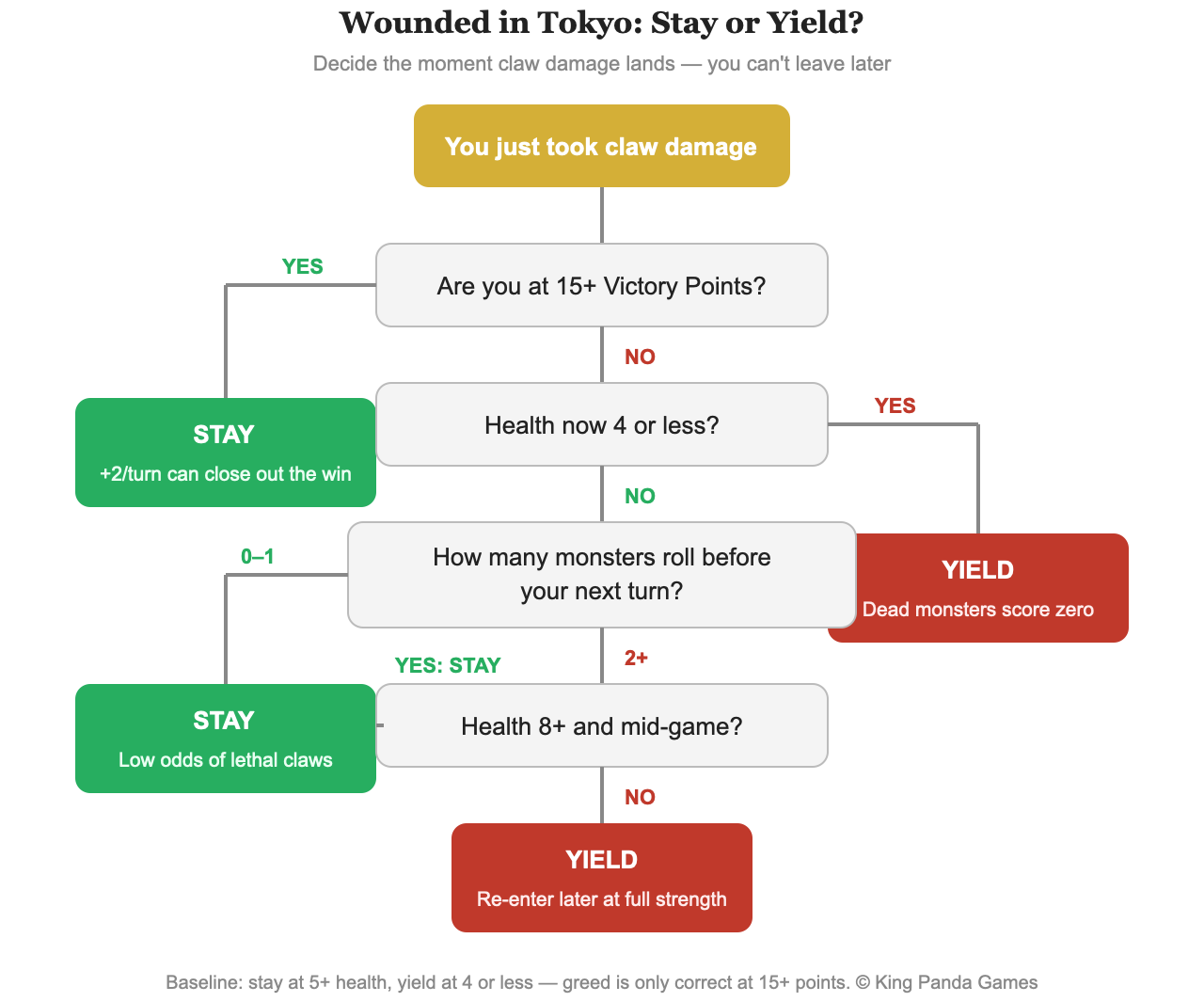
Yield Tokyo at 4 health or lower, unless you’re within striking distance of 20 points. That’s the baseline that wins over time.
The math is simple: a full table of monsters outside Tokyo will average 2–4 claws per round against you, and you cannot heal with heart dice while you’re in the city. At 4 health, you’re one bad round from elimination, and dead monsters score zero. The 2 points per turn you’re giving up feel expensive to abandon — they aren’t. You can re-enter Tokyo two turns later, usually at full strength.
The rule: below 5 health, Tokyo is rented, not owned. Take your points, take your beating, and leave the moment someone wounds you.
When Greed Is Correct
“If I stay one more turn, I start my turn in Tokyo and score 2 more points — isn’t that worth the risk?”
Sometimes, yes. Staying in Tokyo at low health is correct in exactly three situations. First: you’re at 15+ points, because two starts-of-turn in Tokyo plus an entry point can end the game before anyone finishes you. Second: it’s late in the round and the dangerous rollers have already gone — if only one monster acts before your turn, the odds they roll lethal claws are low. Third: the table is bloodied too, and your claws from inside Tokyo hit everyone outside, meaning staying makes you the fastest killer in a last-monster-standing endgame.
Notice what’s not on that list: pride. “I’ve held Tokyo for three turns” is not a strategic position, it’s a eulogy.
Count the Claws Before They Roll
It’s round 5. You’re in Tokyo at 6 health. Three monsters act before your next turn. One has Extra Head (seven dice), one has been fishing for points all game, one is at 2 health and desperate to heal. Real threat count: about nine effective attack dice, but only one monster actually hunting you. Expected claws against you: roughly 2–3. You can afford to stay — and that’s a read you can only make by watching what each player keeps.
Claw faces come up one in six per die, but players who keep claws on their first roll turn one-in-six into three-rolls-of-fishing. The threat isn’t the dice — it’s the intent. A monster that banked two claws on roll one is coming for you; a monster that kept two 3s is ignoring you completely. Track what people keep, not what they roll.
Play the Player Count, Not Just the Board
At 5–6 players, Tokyo is a meat grinder — yield early and often. With four or five monsters outside rolling claws, holding the city for more than two consecutive turns at any health is donating your monster to the cause. Take your entry point, grab one start-of-turn bonus if you’re lucky, and get out.
At 3–4 players, Tokyo is where games are won. Fewer attackers means fewer expected claws per round, and the +2 per turn compounds fast. This is where the “stay at 5+, yield at 4” baseline holds truest.
At 2 players (official variant, Tokyo gives energy), occupy Tokyo aggressively. Your opponent is the only claw source in the game, and the energy income buys you a Power card advantage that snowballs — if you want the full context on why the game changes so much at two, our full King of Tokyo review covers it.
The Outside Game: What to Do When You’re Not the King
What most players do: roll claws every turn to knock the king out of Tokyo, then reluctantly take the city themselves and get pounded in turn.
What actually works: letting someone else be the hero. Keep number dice, farm three-of-a-kinds, bank energy, and buy a Keep card — while two other monsters trade claws over the city. The quiet monster at 14 points is scarier than the loud one in Tokyo.
The counterintuitive core of King of Tokyo strategy: Tokyo points are loud, but dice points are usually faster. Three 3s plus one extra 3 is 4 points in a single turn — two full turns of Tokyo occupancy — with zero damage taken. The city is a tool for the mid-game and a closer for the endgame, not a home.
The one job you can never skip from outside: policing the leader. The moment anyone hits 15 points, every monster’s claws should point at them — whether they’re in Tokyo or not. If they’re outside the city, that means someone has to enter Tokyo just to get an attack angle on them. Games are lost at the table, not on the dice, when everyone keeps smashing the king while the real winner farms numbers in the suburbs.
Check King of Tokyo: Power Up! price on Amazon →
Frequently Asked Questions
When should you leave Tokyo in King of Tokyo?
Yield when a claw attack puts you at 4 health or lower, unless you’re within about 5 points of winning. You can’t heal while in Tokyo, so low health there compounds fast. Remember you can only yield immediately after being wounded by claw dice — not on your own turn.
Is staying in Tokyo worth it?
Yes in the mid-game at healthy life totals, and late-game when the bonus points can carry you to 20. It’s rarely worth it early — the first monster into Tokyo usually takes the most damage in the game for only a handful of points.
What’s the fastest way to get points in King of Tokyo?
Three-of-a-kind number dice, especially 3s. Three 3s score 3 points and each extra 3 adds one more, so a lucky turn can score 4–5 points — more than two full turns of holding Tokyo, with no damage taken.
Should you attack or go for points?
Pick one job per turn based on your first roll and commit. Claws are for controlling the king of the hill and stopping whoever’s near 20 points; numbers are for winning. Splitting a turn between both usually accomplishes neither.
How do you win King of Tokyo with bad dice?
Bank energy on wasted turns — lightning bolts are the best consolation prize. Cheap Keep cards convert dice-luck deficits into permanent advantages, and a sweep (2 energy to replace the three face-up cards) can find one that fits your position.
Can you win King of Tokyo without ever entering Tokyo?
No — the rules force you into Tokyo whenever the city is empty at the end of your dice resolution, so sooner or later every monster takes a turn as king. The real skill isn’t avoiding Tokyo; it’s leaving at the right time once you’re there.
Do this first next game: when you get knocked to 4 health in Tokyo, leave — even if it stings — and watch who takes your place.