


Our top played pick is King of Tokyo, which gets 5/5 Bamboo and 4/5 Pandas from us and comes down to one decision each turn: stay in Tokyo for the points or run before the other monsters finish you. A push-your-luck game, also called press-your-luck, keeps asking that kind of question: one more card, roll or step for a bigger reward, or stop and bank what you have, knowing that going too far loses it all.
Played & scored means we’ve played it and scored it in a KPG review (Bamboo is how easy it is to learn, Pandas is how much fun it is, both out of 5), and Researched means we haven’t played it and the facts come from rulebooks, publishers and retailer listings. That’s 4 played and 16 researched, 20 games in all, plus one we’d skip.
We also calculated when to stop for six of them, working from each game’s rulebook. Those odds for Flip 7, Can’t Stop, Incan Gold, Zombie Dice, Pickomino and Yahtzee are the first section below.
Some links below are Amazon affiliate links — as an Amazon Associate, King Panda Games earns from qualifying purchases at no extra cost to you. Full disclosure.
Jump to:
- When to stop, by the odds
- Our ranking of the games we’ve played
- Researched dice games
- Researched card and bluffing games
- Researched bag-draw games
- Researched adventure games
- Push-your-luck games we’d skip
- The push-your-luck finder (every game)
- How we built this list and calculated the odds
Last verified: November 2026.
When to Stop, by the Odds
These numbers are ours, worked out from each game’s rules. “Exact” means we counted every possible outcome, and “simulation” means a computer played the turn out many times (each block gives the count) and we tallied the results. Each block starts with a rule you can use at the table.

Flip 7
Stop at five or six different numbers, and sooner if they’re high ones. With five different numbers in your row, the next card busts you 37.9% of the time, and with six it’s 45.1%. Each number adds about 7.5 points of risk on average, but not equally: a 12 in your row adds about 12.5% on its own, a 2 about 1.1%, and a 0 or 1 nothing, because the deck has twelve 12s but only one 1 and one 0. Our Flip 7 strategy guide has the full table and the 25-point rule.
Method: 200,000 simulated shuffles of the 94-card deck from one player’s view, as published in our strategy guide. We rechecked it with an exact calculation over every possible hand, and the two agree within 0.1 points. Based on the Flip 7 rulebook (ruleset 3.1).
Can’t Stop
Put your runners in the middle columns and keep rolling, and on the edge columns stop after one move. With runners on 6, 7 and 8, a roll lets you move 92% of the time, which works out to about 11 good rolls before an average bust. The common 4, 7 and 10 spread works 88% of the time, about 7 rolls. On 2, 3 and 12, only 44% of rolls move you, so you can expect fewer than one good roll before you bust.
Method: exact. We checked all 1,296 rolls of four dice against each of the 165 possible sets of three columns. It assumes none of your columns is closed or topped out, either of which makes a bust more likely. Based on Eagle-Gryphon’s Can’t Stop rulesheet.
Incan Gold
Leave at the third or fourth different hazard. In round 1, with three different hazards on the path, the next card ends the round 25% of the time. With four it’s 36%, and with five it’s a coin flip. Later rounds are a little safer, because each hazard that ends a round is removed for the rest of the game, and with four hazard types thinned out, four hazards showing drops to about 28%. Leaving banks everything you’ve collected this round, and the players who leave together split the gems left lying on the path.
Method: exact, over every combination of hazard types and treasure cards on the path, weighted by how often each comes up. Based on Eagle-Gryphon’s 2024 Incan Gold rulebook, which matches the 2018 rules on hazards.
Zombie Dice
With two shotguns, stop unless all three dice you’d roll are green and you’re behind. At two shotguns, the next roll ends your turn 42% of the time even with three green dice, 65% with two greens and a red, and 88% with three reds. If you never stop, 53% of turns are over by the third roll and 75% by the fourth.
Method: the one-roll risks are exact, and the turn-by-turn figures come from a simulation of 1,000,000 turns. Based on Steve Jackson Games’ Zombie Dice rules. Steve Jackson Games confirms the number of dice of each color and the yellow and red faces, but the green split we used (three brains, two footprints, one shotgun) comes from published descriptions such as Wikipedia’s Zombie Dice entry, not the publisher’s own text.
Pickomino
Take a mid-20s tile as soon as you can get one. Played well, a turn reaches 21 or more with a worm 89% of the time, but that falls to 53% for 27 and 26% for 30. The simple habit of grabbing worms first and then the biggest number reaches 21 almost as often (86%), but reaches 27 only 42% of the time.
Method: exact, counting every possible roll of the remaining dice at every step. It’s modelled on the core dice rules that Pickomino shares with Heckmeck Deluxe, taken from Zoch’s Heckmeck Deluxe rulebook, and leaves out the Deluxe-only extras.
Yahtzee
Bank the small straight unless the large straight is your last open box. With the best keeps, a small straight comes in 61.5% of turns and a large straight in 26.1%. Going all-in for a Yahtzee works 4.6% of the time, about one turn in 22, and five of a kind on the first roll is 0.08%.
Method: exact, over every roll with the best keeps, as published in our Yahtzee strategy guide. Based on Hasbro’s Yahtzee instructions.
Our Ranking of the Push-Your-Luck Games We’ve Played
These 4 have full KPG reviews, and the scores and quotes below come from those reviews. They’re ranked by Pandas and then Bamboo. Three tie on 5/5 Bamboo and 4/5 Pandas, so we put them in order of how much of the game is the push.
1. King of Tokyo
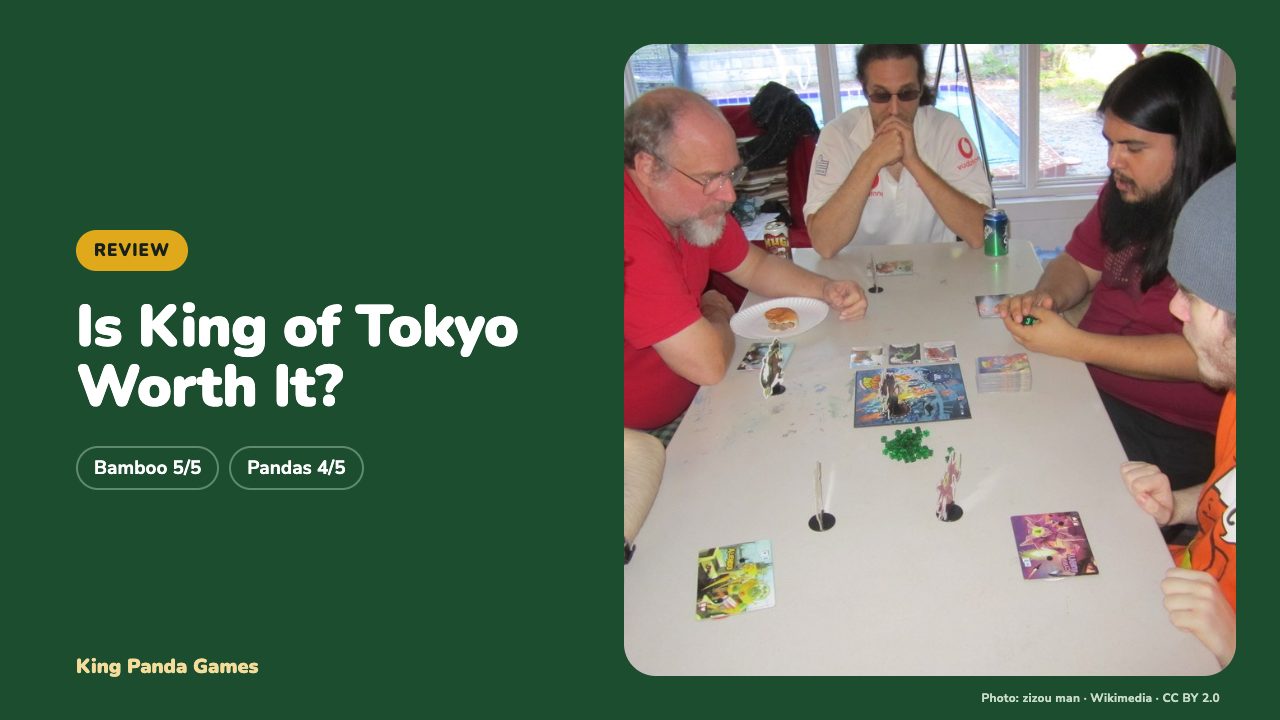
Played & scored 2–6 players · 30 min · ages 8+ · Bamboo 5/5 · Pandas 4/5.
How the push works. You roll six dice up to three times and keep what you like between rolls, so every reroll can waste the turn. The bigger gamble is Tokyo itself: staying there scores points, but every monster outside hits you and you can’t heal. Our review puts it this way: “That game taught us what King of Tokyo actually is: a nerve contest wearing a dice game costume. The math says leave Tokyo; the glory says stay.”
Our verdict. “King of Tokyo gets a 5/5 Bamboo Plants and 4/5 Pandas from us — buy it.” The same review adds that “Thirty-plus plays later, that tension hasn’t dulled,” and gives one warning for couples: “Its biggest weakness is that with two players, the push-your-luck standoff loses most of its bite.”
The odds. In the Power Up! expansion, ending a turn with three hearts earns an Evolution card. For our expansions ranking we simulated one million turns per play style (six dice, up to three rolls): a player who keeps hearts gets there 50% of the time, against 2.4% for a player rolling for claws, 3s or energy. When to leave Tokyo is covered in our King of Tokyo strategy guide, and the full King of Tokyo review has the rest.
Check King of Tokyo price on Amazon →
2. Sea Salt & Paper
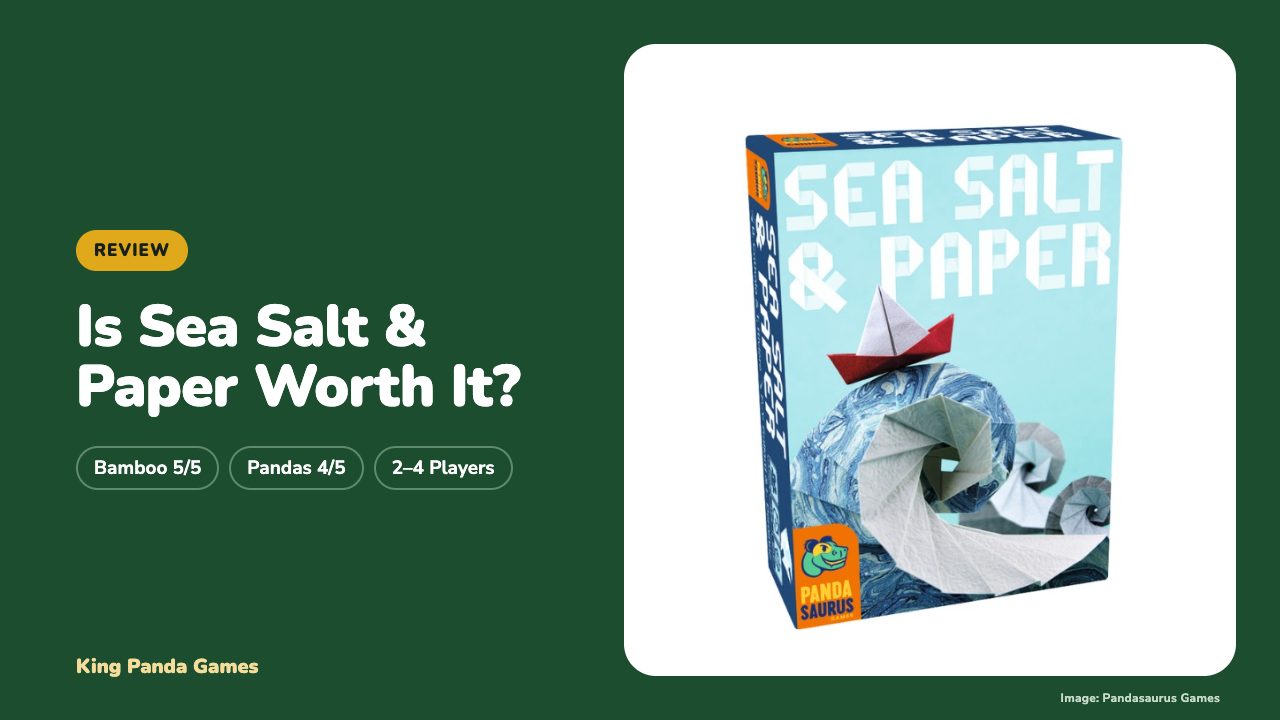
Played & scored 2–4 players · 20–30 min · ages 8+ · Bamboo 5/5 · Pandas 4/5.
The gamble. Once the cards in front of you are worth 7 points, you can end the round. Calling Stop ends it straight away. Calling Last Chance gives everyone one more turn and bets that you’ll still have the most points when it’s over; win the bet and you score far more than the others, lose it and the scoring flips against you. Our Sea Salt & Paper strategy guide covers when to make each call.
Our verdict. It earns 5/5 Bamboo and 4/5 Pandas in our Sea Salt & Paper review, which says “Its biggest strength is the Stop vs Last Chance mechanic, which turns a simple card game into a nerve-wracking read-your-opponents exercise.” The push here is a read of the other players’ hands, so there’s no fixed number to calculate.
For two. Our two-player guide says “Three players is marginally better for the Stop/Last Chance tension, but 2 players is an excellent experience.”
Check Sea Salt & Paper price on Amazon →
3. Yahtzee
Played & scored 2+ players (or solo) · 13 rounds · ages 8+ · Bamboo 5/5 · Pandas 4/5.
Where the risk is. You roll five dice up to three times, keeping any you like, and then you have to fill one box on your card. Every reroll is a choice between a sure score now and a bigger combination that might leave you writing a zero. Our Yahtzee review names this as the game’s strength: “Its biggest strength is the decision after every roll: keep these dice or chase something bigger, and which box to give up.”
Our verdict. “Yahtzee gets 5/5 Bamboo Plants and 4/5 Pandas from us. It’s a family favorite in our house”. The 4 for fun reflects how much the dice decide.
The odds. Our exact calculation for the Yahtzee strategy guide found that going all-in for a Yahtzee works 4.6% of the time, about one turn in 22, so the chase is usually a box you’ll have to sacrifice. The same guide’s 500,000-game simulation per strategy shows that playing for the upper bonus lifts the average from 205.2 to 209.2. New to it? How to play Yahtzee covers scoring.
Check Yahtzee price on Amazon →
4. Flip 7
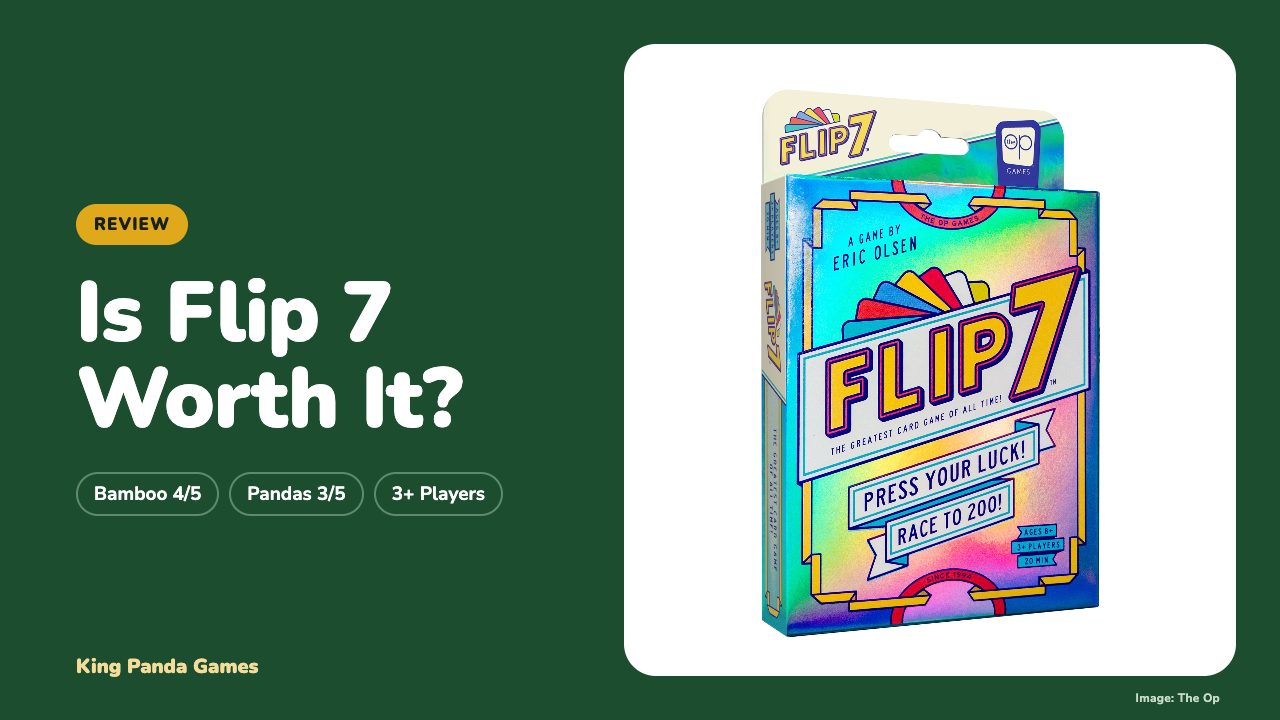
Played & scored 3+ players · 20 min · ages 8+ · Bamboo 4/5 · Pandas 3/5.
How you push. On your turn you flip the top card into your row or stay and bank what you have. Flip a number you already hold and you bust and score nothing for the round, while seven different numbers end the round with a 15-point bonus. Our review: “The next flip is tense every time. Watching someone weigh one more card at 30 points is the best part of the game, and the whole table feels it.”
Our verdict. It earns 4/5 Bamboo and 3/5 Pandas in our Flip 7 review: “It’s worth buying as a cheap filler for big groups and families, and worth skipping if you already own a push-your-luck game you love.” It ranks last of our four because that tension stays the same all game, and a full game to 200 can drag.
The odds. Its stopping math is simple enough to use mid-round, and it’s the first block in the odds section. Our Flip 7 strategy guide has the full bust table and the card-by-card risks, and how to play Flip 7 covers the action cards.
Check Flip 7 price on Amazon →
Two We’ve Played With Only a Little Push
These come up in push-your-luck searches, and we’ve reviewed both, but the risk is a small part of each game, so they aren’t in the ranking.
Hot Streak (4/5 Bamboo, 4/5 Pandas) is a betting race for kids and adults. Each ticket you draft goes on its safe or its risky side, and our review’s advice is “Take risky on a mascot bet only when your own card is already in.” After that the race deck runs itself, so there’s no stop-or-continue choice.
Play Nine (3/5 Bamboo, 3/5 Pandas) is a golf card game. Its one push is that “With one face-down card left, the rules let you skip turns: draw, discard, and leave that last card alone until you like what you see.” Our Play Nine strategy guide works out how often the next card helps.
Researched Push-Your-Luck Dice Games
Dice games are the classic form, since every roll is a fresh gamble and the odds are easy to work out. Can’t Stop, Zombie Dice and Pickomino all have their stopping odds in the section above.
Can’t Stop
Researched 2–4 players · 30–40 min · ages 9+.
The stop-or-go choice. Roll four dice, split them into two pairs, and move a temporary runner up the column for each pair’s sum. You can keep rolling as long as each roll moves one of your three runners. Roll something none of them can use and you lose everything from that turn; stop and the runners become permanent markers.
Why it’s here. It’s Sid Sackson’s 1980 design, and the math is easy to see on the board: 7s are common, so the 7 column is the tallest, and 2s and 12s are rare, so those columns are short. Our odds for choosing columns are in the section above.
In print: yes, from Eagle-Gryphon Games, with a mat and wooden runners in place of the old plastic board. Can’t Stop Express is a different game.
Check Can’t Stop price on Amazon →
Zombie Dice
Researched 2+ players · 10–20 min · ages 10+.
The push. Draw three dice from the cup and roll. Brains and shotguns stay on the table, and footprints are rerolled with fresh dice to make three. You can stop and bank your brains any time, but your third shotgun ends the turn with nothing.
Why we list it. It teaches in a minute and the colors show the risk: green dice are the safe ones and red the dangerous ones, so everyone can see the odds change as reds come out. It won the Origins Award for Best Family, Party or Children’s Game of 2010, as listed on Steve Jackson Games’ Zombie Dice page. It’s light, so treat it as a filler. The publisher lists no box age, and the 10+ comes from a distributor listing.
In print: yes, from Steve Jackson Games. Deluxe and Horde editions cost more.
Check Zombie Dice price on Amazon →
Pickomino (Heckmeck am Bratwurmeck)
Researched 2–7 players · 20–30 min · ages 8+.
How the push works. Roll eight dice and set aside every die showing one value. Then roll the rest, but each time you must take a value you haven’t taken before, and you need at least one worm to score. When you stop, you take the grill tile that matches your total (or the next lower one), or steal another player’s top tile if your total matches it exactly. A roll with nothing new fails the turn, and you hand back your top tile.
What it does well. Reiner Knizia’s dice game asks a real choice on every roll, and it plays up to seven. The German association Jung und Alt spielt gave Heckmeck its Generationenspiel seal, as Spielpunkt reported in September 2021, with the jury saying it brings every generation to one table. Stealing tiles can sting younger players.
In print: uncertain in the US. Zoch still makes Heckmeck, but we found no US English edition, so expect an import.
Cubitos
Researched 2–4 players · 30–45 min · ages 8+ to 14+ (listings disagree).
The gamble. You roll your dice, move every hit to your active zone, and then choose to reroll the misses or pass. Once three dice are active you can bust: a reroll that’s all misses sends your active dice to the discard pile, though you still take a small step on the track.
Why it made the list. It’s a race where you also buy new dice, so the push decides how far you move and how much you can spend. Because busting still pays a little, it encourages bigger risks. It’s a heavier game than the other dice picks, with a longer first teach than the box time suggests. AEG’s own pages list different ages.
In print: yes, from AEG, and a Fowl Play expansion takes it to six players.
King of New York
Researched 2–6 players · 30–40 min · ages 8+.
Where the risk is. It’s King of Tokyo’s roll-and-keep system with six dice and three rolls, except you can reroll dice you kept earlier. Holding Manhattan earns points and energy each turn, but you can’t heal there, and the Ouch! faces can bring the army down on you when you chase a result.
The appeal. It’s the step up for players who like the one we rank first. We haven’t played it, and our King of Tokyo vs King of New York page sets out the rule differences. IELLO lists it at 8+, though some retailers say 10+. Player elimination is possible, and it plays best with four or more.
In print: uncertain. IELLO still lists it, but some retailers show it sold out.
Check King of New York stock on Amazon →
Pass the Pigs
Researched 2+ players · 15–30 min · ages 7+.
How you push. Toss two rubber pigs, score points for how they land, and keep tossing or bank your points. If the pigs land on opposite sides, that turn’s points are gone, and if they touch, you lose your whole score.
Why it’s here. There’s nothing to read and almost no rules, so it works as a party toy for kids and non-gamers, and the throw itself gets the table watching. It has almost no strategy: the only decision is when to stop. Several editions exist, so check you’re buying the classic two-pig set.
In print: yes, from Winning Moves.
Check Pass the Pigs price on Amazon →
Researched Card and Bluffing Games
In card games the deck remembers what’s gone, so the risk changes as you go. Skull is played with discs, and its risk comes from other players’ bluffs.
Port Royal
Researched 2–5 players · 20–50 min · ages 8+.
The stop-or-go choice. On your turn you flip cards into the harbor one at a time and stop whenever you like to trade and hire. Flip a ship whose flag already sits in the harbor, and fail to fight it off, and your turn ends with nothing.
Why we list it. It’s a push-your-luck card game for gamers who want a little building on top. Every other player can buy from the harbor you flipped and pays you a coin to do it, so nobody sits idle during your push. Long sessions can feel the same, and a hot run of cards can snowball.
In print: uncertain in the US. The Steve Jackson Games US edition is out of print, and Pegasus publishes an English Big Box edition.
Check Port Royal Big Box on Amazon →
Mystic Vale
Researched 2–4 players · 45 min · ages 14+.
The push. You keep turning cards from your deck into your field to add their mana. Your next card sits face up before you commit, and AEG’s rulebook says that if four or more decay symbols are showing across your field and that card (each growth symbol cancels one), you spoil and buy nothing that turn.
What it does well. You build your own deck by sliding clear upgrade cards into sleeves, so you’re also deciding how risky your future turns will be. It won Card Game of the Year at the Origins Awards presented in 2017, per ICv2’s list of winners. The 14+ age and the icons make it a hobby game, not a family filler.
In print: yes, as AEG’s Essential Edition with three expansions included. We found no Amazon listing for the base game, so the button searches.
Search Amazon for Mystic Vale →
Skull
Researched 3–6 players · 30 min · ages 10+.
How the push works. Everyone hides flowers and one skull in a stack of discs. Bidding goes up one disc at a time, and the winner has to flip that many without hitting a skull, starting with their own stack. Reveal a skull and you lose a disc.
Why it made the list. It’s a bluffing game, and the risk comes from the other players rather than from dice or a deck. Every player starts with the same discs, so there’s almost no luck. It won the 2011 As d’Or as Skull & Roses, per the Spieleautorenzunft’s report of the Cannes winners. It needs a group that likes to bluff, and quiet tables can find it flat.
In print: yes, in Space Cowboys’ current pink edition, which adds a Last Chance disc to soften elimination.
Researched Bag-Draw Games
In these the push is a blind draw from a bag. In Quacks you also choose what goes into your bag between rounds, so you shape your own risk, and in Ra the bag feeds an auction.
The Quacks of Quedlinburg (now Quacks)
Researched 2–4 players · 45 min · ages 10+.
The gamble. Every player draws ingredient chips from their own bag at the same time and adds them to a pot. Draw too many white cherry bombs and the pot explodes, and for that round you have to choose between scoring points and buying new ingredients. You can stop any time to keep a safe result.
The appeal. Everyone pushes at once, so there’s no waiting for another player. Between rounds you buy better chips for your bag, and trailing players get a catch-up bonus. It won the 2018 Kennerspiel des Jahres, the German prize for more involved games, and was a 2019 American Tabletop Awards winner in the Casual Games category.
In print: yes. CMYK’s 2025 edition is now titled Quacks and has new art, which some fans dislike.
Check Quacks price on Amazon →
Ra
Researched 2–5 players · 45–60 min · ages 12+.
Where the risk is. On your turn you draw a tile from the bag to grow the lot or call Ra to auction it. Ra tiles move the Ra track, and when it fills the epoch ends at once with no auction, so letting the lot grow risks being left with suns you never spent.
Why it’s here. It’s Reiner Knizia’s 1999 auction game, and every draw is a gamble the whole table shares. It took second place in the 1999 Deutscher Spiele Preis, won the 1999 Meeples’ Choice Award and joined the BoardGameGeek Hall of Fame in 2025, per Knizia’s own awards list. It’s an auction game first, so dice fans may be surprised, and the scoring is hard to teach to casual players.
In print: yes, from 25th Century Games. Ra The Dice Game is a different box.
Researched Push-Your-Luck Adventure Games
Adventure games put the push on a map or a path: go deeper for better treasure and hope you get back out.
Incan Gold (Diamant)
Researched 3–8 players · 20–40 min · ages 8+.
How you push. Each turn everyone still in the temple secretly chooses to stay or head back to camp. Then a card is turned: treasure is split among the players still inside, and a second copy of any hazard sends them all running and they lose that round’s haul. Players who leave share whatever gems were left on the path.
Why we list it. Up to eight people decide at the same moment, so it’s as much about reading the table as reading the odds, and it plays in 20 to 40 minutes. In Europe it’s sold as Diamant, without the artifact cards. Our odds for when to leave are above. It needs three or more players.
In print: yes, from Eagle-Gryphon Games, whose current edition is dated 2024. The artifact values differ between editions.
Check Incan Gold price on Amazon →
Deep Sea Adventure
Researched 2–6 players · 30 min · ages 8+.
The stop-or-go choice. All the divers share one air tank, and it drops at the start of your turn by the number of treasures you carry. Each treasure also slows you down, and anyone still underwater when the air runs out drops everything.
What it does well. One greedy diver hurts everyone, which makes for a lot of table talk from a pocket-size box, and the rules take two minutes to teach. It placed fourth in the 2015 Japan Board Game Prize and won a 2016 Major Fun Award, per Oink Games’ Deep Sea Adventure page. It’s light and luck-heavy.
In print: uncertain for the original. Oink sells Deep Sea Adventure Boost, which includes the original dice so the original rules still work, and that’s the version the button finds.
See Deep Sea Adventure Boost on Amazon →
Celestia
Researched 2–6 players · 30 min · ages 8+.
The push. The captain rolls hazard dice for the next leg of the flight. Each passenger then decides to stay aboard or jump off with a treasure from the current city. If the captain can’t play a card to match every hazard, the ship crashes and nobody still aboard gets anything, and cities further on hold better treasure.
Why it made the list. Your treasure depends on another player’s hidden hand, so you’re betting on their bluff. It plays up to six in about half an hour. Some reviewers find the choices thin, and it’s better with more players.
In print: yes, in a 2025 reprint from BLAM!.
Check Celestia price on Amazon →
Clank! A Deck-Building Adventure
Researched 2–4 players · 30–60 min · ages 12+.
How the push works. Noisy cards add your cubes to the Clank! area, and dragon attacks pull cubes from a bag that hurt whoever they belong to. Get knocked out before you grab an artifact and climb out of the depths and you score nothing, so every extra room you loot is a bet that you can still get back.
The appeal. It’s a race with a map: you can see how far you are from the exit, and deck-building gives you something to plan between dragon draws. It’s one of the heavier games here, and new deck-builders may need a game to get it.
In print: yes. Dire Wolf announced the Master Thief Edition in April 2026 with updated endgame rules, so check which edition you’re buying. The button finds the original edition.
Check Clank! price on Amazon →
Dungeon Roll
Researched 1–4 players · 15–30 min · ages 8+.
The gamble. After you clear a level of the dungeon you either retire to the tavern and take points equal to the level, or go one level deeper against more monster dice. Fail to beat the monsters or the dragon and you flee with nothing.
Why it’s here. It’s a plain stop-or-go-deeper loop with a fantasy theme, and it plays solo too. Turns are mostly solitaire, so downtime grows at four players.
In print: probably not. Tasty Minstrel Games was reported to have declared “virtual bankruptcy” in 2021 and we found no reprint, so the Amazon listing is likely old stock.
Check Dungeon Roll stock on Amazon →
Push-Your-Luck Games We’d Skip
Exploding Kittens makes you push on every turn, and it gets 5/5 Bamboo but only 2/5 Pandas from us. You must draw to end your turn, so the only real push is when to spend a Skip or an Attack instead. Our review calls it “a luck engine with a few take-that cards sprinkled in,” though it admits that “Every game has two or three genuinely fun beats where someone slides a Kitten back with a grin and the next player sweats the draw.”
Player count changes the risk a lot. Using the Original Edition setup, our player-count page works out that a random card in the draw pile is a Kitten about 3% of the time with two players and 25% with five, and at five there’s an 82% chance someone draws one in the first lap if nobody plays a card. If you like the draw-and-sweat moment, the same review points to Sea Salt & Paper, where “your choices genuinely decide games.”
A few other games turn up on push-your-luck lists, and we left them off because the push is small or missing. Las Vegas and That’s Pretty Clever are dice games where nothing busts, Camel Up is a betting game, Machi Koro’s only dice choice is whether to roll one die or two, and Bomb Busters is cooperative deduction. Farkle and Pig need nothing but dice, so there’s nothing to buy, and Wikipedia’s Farkle entry has the rules. No Thanks! and Qwixx have a gentler take-it-or-wait tension, and they’re next on our list to research.
The Push-Your-Luck Finder
Every game on the page in one table: the 4 we ranked, then the researched ones by type, then the three we’ve played but didn’t rank. The name jumps to its entry.
| Game | Type | Players | Time | Age | Badge | Buy |
|---|---|---|---|---|---|---|
| King of Tokyo | Dice | 2–6 | 30 min | 8+ | Our pick (played) | Buy → |
| Sea Salt & Paper | Cards | 2–4 | 20–30 min | 8+ | Our pick (played) | Check price → |
| Yahtzee | Dice | 2+ | 13 rounds | 8+ | Our pick (played) | See price → |
| Flip 7 | Cards | 3+ | 20 min | 8+ | Our pick (played) | Buy on Amazon → |
| Can’t Stop | Dice | 2–4 | 30–40 min | 9+ | Researched option | Amazon price → |
| Zombie Dice | Dice | 2+ | 10–20 min | 10+ | Researched option | Price check → |
| Pickomino | Dice | 2–7 | 20–30 min | 8+ | Researched option | Shop on Amazon → |
| Cubitos | Dice | 2–4 | 30–45 min | 8+ to 14+ | Researched option | Shop → |
| King of New York | Dice | 2–6 | 30–40 min | 8+ | Researched option | Buy → |
| Pass the Pigs | Dice | 2+ | 15–30 min | 7+ | Researched option | Check price → |
| Port Royal | Cards | 2–5 | 20–50 min | 8+ | Researched option | See price → |
| Mystic Vale | Cards | 2–4 | 45 min | 14+ | Researched option | Buy on Amazon → |
| Skull | Bluffing | 3–6 | 30 min | 10+ | Researched option | Amazon price → |
| Quacks | Bag-building | 2–4 | 45 min | 10+ | Researched option | Price check → |
| Ra | Auction | 2–5 | 45–60 min | 12+ | Researched option | Shop on Amazon → |
| Incan Gold | Adventure | 3–8 | 20–40 min | 8+ | Researched option | Shop → |
| Deep Sea Adventure | Adventure | 2–6 | 30 min | 8+ | Researched option | Buy → |
| Celestia | Adventure | 2–6 | 30 min | 8+ | Researched option | Check price → |
| Clank! | Adventure | 2–4 | 30–60 min | 12+ | Researched option | See price → |
| Dungeon Roll | Adventure | 1–4 | 15–30 min | 8+ | Researched option | Buy on Amazon → |
| Hot Streak | Betting | 3–8 | 20 min | 6+ | Played, light push | Amazon price → |
| Play Nine | Cards | 2–6 | 45 min | 8+ | Played, light push | Price check → |
| Exploding Kittens | Cards | 2–5 | 15 min | 7+ | Played, we’d skip | None |
How We Built This List and Calculated the Odds
Every game here is either played or researched, and the page never mixes the two. The 4 ranked games each have a full KPG review with Bamboo and Pandas scores, and every line quoted from a review is copied from that review. We also reviewed Hot Streak, Play Nine and Exploding Kittens, which is why they get a note and not a ranking. We also looked at Monopoly Deal, Five Crowns, Throw Throw Burrito and Love Letter, which we’ve reviewed. Each has luck in the draw, but none is built around a repeated choice to keep going or stop, so they’re left out. The 16 researched games come from rulebooks, publisher pages, retailer listings and Wikipedia, checked on Nov 25, 2026. We kept an award only when we could link a source for it, and where sources disagree on an age, the entry says so.
The odds come from the rules alone. For each game we wrote down the components and the bust rule from the rulebook linked in its block, then either counted every possible outcome (Flip 7, Can’t Stop, Incan Gold, Pickomino, Yahtzee and the one-roll Zombie Dice risks) or simulated a million turns (Zombie Dice turn by turn). Two models carry a caveat, and each block states it: the green Zombie Dice faces come from published descriptions, not the publisher’s own text, and Pickomino is modelled on the core rules it shares with Heckmeck Deluxe. Flip 7, Yahtzee, King of Tokyo and Exploding Kittens reuse numbers already published on our own guides, and our Catan statistics use the same simulate-and-count approach over 10,000 games. Our review methodology explains the scoring, and About the reviewer covers who does the playing.
Many of these games run on dice. Our best dice games list covers 25, with the exact odds of a Farkle by number of dice.
Frequently Asked Questions
What is a push-your-luck game?
It’s a game that keeps asking whether you’ll go on for a bigger reward or stop and bank what you have, where going too far loses the lot. People also call it press-your-luck. The next card in Flip 7, the next roll in Can’t Stop and the next step into the temple in Incan Gold are all that same question. The skill is knowing the odds well enough to stop at the right moment, which is why we calculated them for six of the games on this page.
What is the best push-your-luck game for families?
Our pick for families is Yahtzee, which gets 5/5 Bamboo and 4/5 Pandas from us and which our review calls a family favorite in our house. It’s rated 8+, and the review says everyone from an 8-year-old to a grandparent can play from the first roll. For a bigger family group, Flip 7 is the played option, since the box has no upper player count. Among the researched options, Incan Gold takes up to eight players from age 8, and Pass the Pigs works from 7.
What is the best two-player push-your-luck game?
Of the games we’ve played, Sea Salt & Paper is the one our reviews back at two. Our two-player page calls two players an excellent experience and says three is only marginally better. King of Tokyo, our top pick overall, loses most of its push with two players, by our own review’s account. Researched options that work at two include Can’t Stop, Pickomino and Zombie Dice.
What is the best push-your-luck dice game?
King of Tokyo is the dice game we score highest (5/5 Bamboo, 4/5 Pandas), and Yahtzee has the same scores but less push. For a plain stop-or-roll dice game, Can’t Stop is the researched option we’d try first. Our odds show that a roll moves you 92% of the time with runners on 6, 7 and 8, against 44% on 2, 3 and 12, so where you put your runners decides how long you can keep going.
When should you stop in Flip 7?
Stop once your row is worth about 25 points. Our Flip 7 strategy guide found that under 20 points another flip gains on average in every situation we tested, and at 25 or more it loses on average every time. With six different numbers already showing, flipping is worth it up to 34 points, and at 35 or more it’s a loss nine times out of ten. The bust risk climbs about 7.5 points per card, to 37.9% with five numbers in your row and 45.1% with six, and each 12 you hold adds about 12.5% on its own.
Is push-your-luck just luck?
The dice or cards decide each roll, but stopping well is a skill, and our odds put a number on it. In Pickomino, playing every roll well reaches a 27-point tile 52.5% of the time, against 41.8% for the simple habit of grabbing worms first and then the biggest number. In Can’t Stop, runners on 6, 7 and 8 give you about 11 good rolls before an average bust, against fewer than one on 2, 3 and 12. Exploding Kittens is the exception on this page, and our review found little to decide in it.
For a bigger crowd, our party games ranking includes several push-your-luck games among its picks. Our best card games list covers card games of every kind, and our board games for kids sorts picks by age.