

Sea Salt & Paper Review: Is It Worth It?
Bottom Line
Sea Salt & Paper is the best card game under $20 you can buy right now. It’s for families, couples, and anyone who wants a game that teaches in five minutes and still creates genuine tension twenty minutes in. Skip it if you need strategic depth that scales with dozens of hours of play — this rewards reading the table, not calculating positions. Its biggest strength is the Stop vs Last Chance mechanic, which turns a simple card game into a nerve-wracking read-your-opponents exercise. Its biggest weakness is draw variance — occasionally a round ends before you’ve had the cards to compete.
Sea Salt & Paper earns a 5/5 Bamboo Plants and a 4/5 Pandas. The Bamboo Plants is the easiest rating we’ve given: you can fully explain this game in the time it takes to shuffle the cards. The Pandas rating is more interesting — this is a better, more tensioned game than its small box suggests, but the draw variance keeps it just below perfect.
Some links below are Amazon affiliate links — as an Amazon Associate, King Panda Games earns from qualifying purchases at no extra cost to you. Full disclosure.
| Detail | Info |
|---|---|
| Players | 2–4 |
| Best Player Count | 3 — Stop/Last Chance reads best with 2 opponents |
| Age | 8+ |
| Play time | 20–30 min |
| Complexity | Light |
| Solo Mode | No |
| Designer | Bruno Cathala & Théo Rivière |
| Publisher | Bombyx / Pandasaurus |
| Popular Upgrades | No |
| Bamboo Plants | 5/5 — explains itself in under 5 minutes |
| Pandas | 4/5 — genuinely tense, limited by draw variance |
| Official site | pandasaurusgames.com |
How It Works
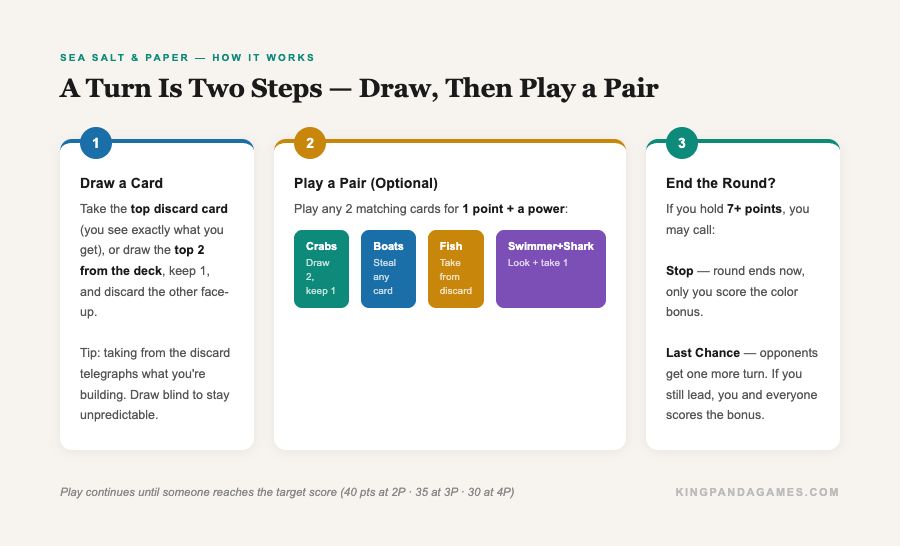
Your turn is two steps: draw, then optionally play a pair.
For the draw, you can take the top card of the discard pile (you see exactly what you’re getting) or take the top two cards from the deck, keep one, and put the other face-up on the discard. Simple choice, meaningful consequence — the discard is visible to everyone, so taking the top card telegraphs what you’re building.
After drawing, you can play a Duo pair from your hand: any two matching cards placed face-up in front of you earn 1 point and trigger a power. Crabs let you draw two more cards and keep one. Boats let you steal any card from another player’s hand. Fish let you take the top two cards from the discard pile and keep one. Swimmer + Shark lets you look at a player’s hand and take one card. These powers are where the table interaction happens — a boat steal at the right moment can collapse someone’s hand and swing a round.
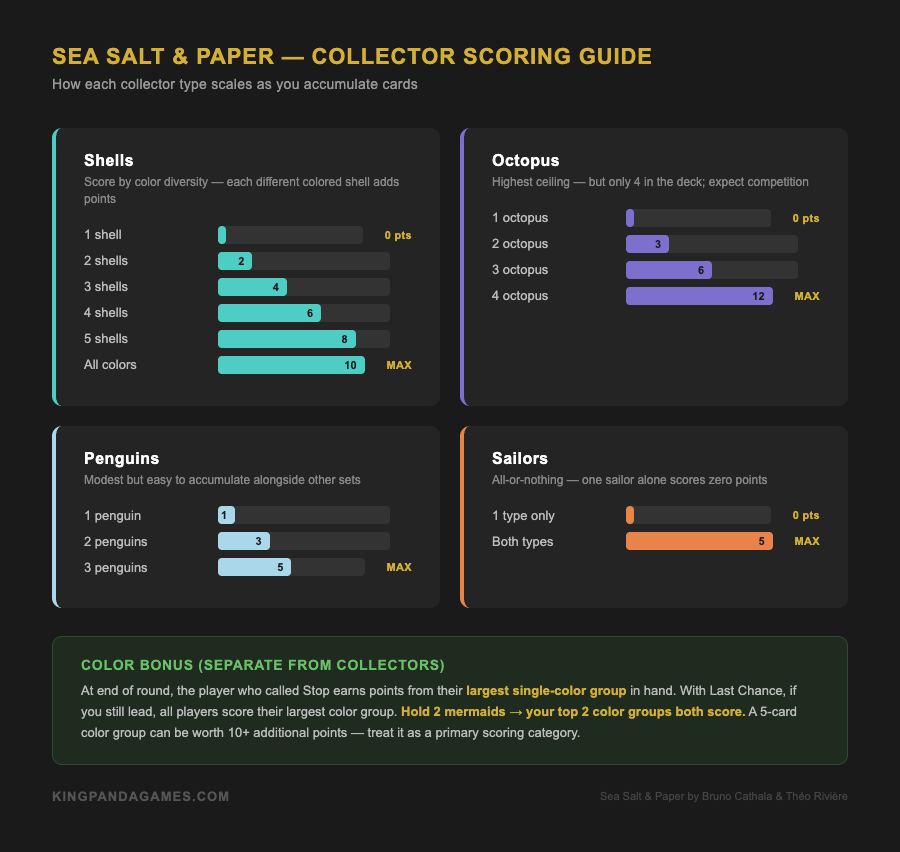
The cards in your hand score based on collection. Shells score 0, 2, 4, 6, 8, or 10 depending on how many different colored shells you have. Octopi score 0, 3, 6, 9, or 12. Penguins score 1, 3, or 5. Sailors score 0 or 5 depending on whether you have both types. Mermaids are the wild card — collect all four for an instant win.
It’s round 2. You’ve just played your second pair of crabs, bringing you to 9 points in played pairs. In your hand: three shells (different colors — worth 4 points), two penguins (worth 3), and a yellow sailor. That’s 16 points total. Your color bonus — largest group of same-colored cards — is 3 yellow cards. You do the math. You’re ahead of both opponents. Do you call Stop and bank it, or call Last Chance and risk one more turn from each of them? The player to your right has been drawing heavily. You don’t know what’s in their hand. This is the moment Sea Salt & Paper was designed around.
The Stop vs Last Chance decision triggers when you hold 7 or more points in your hand. Stop ends the round immediately — you get the color bonus (the points from your largest same-colored group), and everyone scores their hand. Last Chance gives each other player one more turn. If you still have the most points after their turns, you get the color bonus and everyone else scores their color bonus too. If someone surpasses you, you lose the advantage.
Play continues round by round until someone hits the threshold: 40 points at 2 players, 35 at 3, 30 at 4.
Pros
- The Stop vs Last Chance decision is one of the best micro-tension moments in card gaming. It forces you to read the table — not just count your points, but estimate whether the player who’s been quietly hoarding blue cards can beat you in one turn. Every time you call it, there’s a moment of held breath around the table.
- Truly portable. The box is the size of a deck of cards. Setup is shuffling. Teardown is picking up cards. There’s no game that packs more tension per square inch of table space.
- The artwork earns its own conversation. Origami-inspired illustrations — folded paper crabs, sailors, mermaids — are beautiful in a way that makes people reach across and pick up the box. In a hobby full of dragons and medieval siege weapons, this stands out.
- The collector scaling rewards attention. Players who track what opponents are building and deny them key cards through boat steals and draws win more often. The strategy is light but real.
- Easy to teach anyone. The same session that introduced this game to two people who’d never played a hobby card game before ended with one of them calling Last Chance at 11 points and winning by 4. The rules get out of the way fast.
Cons
- Draw variance can strand you. If the shells you need appear late in the deck, and the player going before you keeps snapping them off the discard pile, you can spend an entire round building nothing useful. That’s rare, but it happens — and when it does, the round feels over before it starts.
- At 4 players, rounds end faster than you’d like. More players means the deck depletes quicker and someone hits the calling threshold before slower-drawing players have built a competitive hand. The 4-player game is still fun; it’s just less about planning and more about luck.
- Strategic ceiling is visible fairly quickly. After 10–15 plays, experienced gamers will feel they’ve seen most of what the decision space has to offer. The expansions extend this somewhat, but Sea Salt & Paper is a short game, not a deep one.
Who It’s For
Families get the most out of Sea Salt & Paper. The rules fit on one page, turns never drag, and the art style skews warm rather than intimidating. Kids who can read can play this — the scoring table is the only thing worth laminating for reference.
Couples looking for a two-player game that’s actually good: this is your answer. Most couples’ games fall into two failure modes — either too simple to feel engaging (basic trick-taking variants) or too strategic to enjoy casually (chess-adjacent games). Sea Salt & Paper lands between them.
Experienced gamers will enjoy it as a filler — the 25 minutes between sessions when someone is setting up the heavier game. It’s not a replacement for a meaty euro, but it’s a genuinely good game, not just something to kill time.
Who Should Skip This Game
Solo players: no solo mode exists, and this game’s tension is entirely social. Don’t buy it if you game alone.
Gamers who want to sink their teeth in: if you’re comparing Sea Salt & Paper to Root or Terraforming Mars, you’re comparing the wrong things. This is a 25-minute card game, not a strategic experience that rewards optimization. If you need something you can deeply study and improve at over 100 hours, look elsewhere.
Minimalists who hate randomness: the draw is random. You can mitigate it — watching the discard, timing your steals, knowing when to draw blind vs. take a visible card — but the variance is real. Players who find any element of luck frustrating won’t be satisfied here.
Who Should Buy This?
Buy Sea Salt & Paper if you want a reliable 25-minute game that you’ll actually bring out. At around $15, it’s priced below almost every comparable card game in its weight class. For families, it’s an immediate buy — this replaces games that aren’t as good and cost more. For couples, it’s the best game at this price point for regular two-player play.
Don’t buy it expecting it to be your main event. It’s a filler, a travel game, and a table opener — and it’s exceptional at all three. If your collection is missing something short, beautiful, and reliably fun, this is the gap-filler you’re looking for.
Try before you buy if you’re an experienced gamer and aren’t sure whether the light complexity is right for you. The depth is real but modest — know what you’re getting into.
Check Sea Salt & Paper price on Amazon →
Best Player Count
Three players is where Sea Salt & Paper is best.
At 3 players, the Stop vs Last Chance decision is as tense as the game gets. You’re reading two opponents instead of one, which means more uncertainty about what they’re holding, more possible turn outcomes during Last Chance, and a higher chance that the player you weren’t watching is sitting on enough to beat you. The color bonus calculation gets trickier too — three players means three potential color groups in play, and denying opponents their key cards through steals becomes more meaningful.
The box says 2–4, and the game genuinely works at every count, but 3 is where the mechanics lock into place.
At 2 players, Sea Salt & Paper is excellent — fast, back-and-forth, great for couples. The Stop/Last Chance decision is simpler because you only have one hand to estimate, which makes the game feel slightly more mechanical. Still highly recommended. Just don’t expect the same drama as 3.
At 4 players, rounds end faster because there are more draws happening and the threshold arrives sooner. This produces a slight randomness tax — players who drew late don’t get the same setup time. Fun, but the least sharp version of the game.
Replayability
Sea Salt & Paper plays quickly enough that replaying it doesn’t feel like a commitment. Most sessions end with at least one “again?” from someone at the table — the rounds are short, the scores are close, and someone always feels like they nearly had it.
Variability comes from a few places: which collectors cluster in the deck, how the discard pile plays out, and which pairs hit the table early. No two rounds feel identical, and the different game lengths at 2 vs 3 vs 4 players produce genuinely different experiences.
The strategic ceiling is modest but real. Experienced players pick up the timing instincts — when to stop drawing from the deck and take a visible card, when to steal rather than build, when to force Last Chance from behind — in about 5–8 plays. After that, the game settles into a comfortable rhythm rather than a challenge.
Two expansions exist if you want to extend it: Extra Salt adds 8 new card types, including duo pairs with new powers that add variety to the interaction layer. Extra Pepper introduces an event deck that fires random effects between rounds, adding a chaotic element that’s fun with groups who like a little unpredictability. Neither is necessary — the base game is complete on its own — but Extra Salt in particular is worth picking up after you’ve played a dozen times.
Awards
Sea Salt & Paper was a Spiel des Jahres nominee and has been recognized on multiple board game site “best of” lists since its release. The Spiel des Jahres committee — which rarely gives the nod to games this small — putting it on their radar is the clearest signal the hobby can send that this is more than a novelty.
Similar Games
If you like Sushi Go, try Sea Salt & Paper — both are fast, colorful set-collection card games that play in 20–30 minutes. The difference is meaningful agency: Sushi Go is mostly about drafting luck; Sea Salt & Paper gives you a real decision every round with the Stop vs Last Chance call. If Sushi Go ever left you feeling like you had no control, Sea Salt & Paper fixes that.
If you like Love Letter, try Sea Salt & Paper — both prove that a tiny box can create genuine tension. Love Letter is a deduction game where you’re eliminating opponents; Sea Salt & Paper is set collection where you’re building toward a stop. They scratch different itches, but the DNA is similar: short, portable, surprisingly layered.
If you like Coloretto, try Sea Salt & Paper — both reward reading the table and timing your collection decisions. Coloretto’s “take it or end it” row mechanic maps directly to Sea Salt & Paper’s Stop/Last Chance. If you’ve enjoyed one, the other is a near-certain hit.
Sea Salt & Paper is also a natural recommendation alongside our picks in best card games for adults and best board games under $30.
Tips & Tricks
Watch the discard pile more than your own hand. New players stare at their cards trying to figure out what to build. Experienced players watch what opponents are taking from the discard — that tells you what they’re building. If someone takes every blue octopus that surfaces, start pulling blue cards before they complete the set. Denial is a legitimate strategy.
What most players do with the Stop/Last Chance decision: Check their own point total, decide it’s high enough, and call Stop. They’re thinking about their score, not the table.
What actually wins: Check your point total last. First, count the face-up pairs in front of each opponent (those are locked points). Then estimate their hand value from what you’ve seen them take. If you can’t beat them with their current known points plus a good round, calling Stop on a 12-point hand means nothing — you’ve handed them the color bonus and given up. Wait, or call Last Chance knowing the risk.
Prioritize the color bonus before stopping. The color bonus — largest single-color group in your hand — can be worth 6–10 points at end game. Players who call Stop with three different one-card colors leave massive points on the table. Before you call anything, count your color groups. If you’re one blue card away from a 5-card color group worth 10 points, that one card might be worth another turn even if you’re already at 9 total points.
Use boat steals strategically, not impulsively. A boat pair lets you steal any card from an opponent’s hand. New players use this to grab a card they want. Experienced players use it to break up a collection that’s about to score big. If someone has four shells and is one card away from a 10-point set, stealing any one of those shells costs them 6 points and costs you nothing — you can discard the stolen card if it’s useless to you.
Worth knowing: The two mermaids = color bonus for top 2 colors rule is easy to forget and often decisive. If you’re holding 2 mermaids, you’re not just chasing an instant win — you’re also getting your second-largest color group scored. That can add 4–8 points to your total that opponents didn’t budget for.
Frequently Asked Questions
Is Sea Salt & Paper worth buying?
Yes — Sea Salt & Paper is one of the best card games under $20 available right now. It teaches in five minutes, plays in 25, and generates genuine tension through the Stop vs Last Chance mechanic. It’s especially worth it for families, couples, or as a filler game between longer sessions.
How do you win Sea Salt & Paper?
Win by being the first player to accumulate the required points across multiple rounds: 40 points at 2 players, 35 at 3, 30 at 4. Within each round, score points by collecting sets of shell, octopus, penguin, and sailor cards, plus the color bonus from your largest same-colored group. Calling Stop when you have the most points — and protecting that lead — is the core skill.
What is the difference between Stop and Last Chance in Sea Salt & Paper?
Stop ends the round immediately and gives only you the color bonus. Last Chance gives all other players one more turn — if you still have the most points, you get the color bonus plus everyone scores their color bonuses too. If someone surpasses you during Last Chance, you lose the color advantage. Stop is safer; Last Chance is higher-risk, higher-reward.
How long does Sea Salt & Paper take to play?
A full game takes 20–30 minutes for most groups, including the time to explain the rules. With experienced players, expect 15–20 minutes. It plays across multiple rounds until someone hits the point threshold, so the length varies slightly based on how aggressively players end rounds.
Is Sea Salt & Paper good for 2 players?
Yes — Sea Salt & Paper plays well at 2 players and is especially strong for couples. The Stop/Last Chance tension is slightly simpler at 2 (only one hand to read), but the game is fast, balanced, and satisfying. Three players is marginally better for the drama; two is still excellent.
How difficult is Sea Salt & Paper to learn?
Very easy — it earns a 5/5 on our Bamboo Plants scale. Your turn is two steps: draw a card, then optionally play a pair. The only rule that takes one round to internalize is the Stop vs Last Chance decision. Most groups are playing confidently by the end of round one.
Does Sea Salt & Paper have expansions?
Two small expansions are available: Extra Salt (8 new card types with new duo pairs and collectors) and Extra Pepper (an event deck that triggers effects between rounds). Both integrate cleanly with the base game. Extra Salt is the better add-on — it adds mechanical variety rather than randomness. Neither is necessary; the base game is complete.
What is the best player count for Sea Salt & Paper?
Three players. The Stop vs Last Chance decision carries the most weight at 3 — you’re reading two opponents instead of one, the color bonus competition is tighter, and the denial strategies through card steals are more meaningful. Two players is excellent; four works but produces more variance.
Want to Go Deeper?
- How to Win at Sea Salt & Paper — stop/last chance timing, denial strategy, and the color group math most players miss. Read it here
- Sea Salt & Paper vs. Sushi Go: Which Should You Buy? — same genre, very different games. Here’s which one fits your group. Read it here
- Is Sea Salt & Paper Good for 2 Players? — honest breakdown of how the game changes head-to-head and whether it’s the right couples’ game. Read it here
Verdict
Buy it if you want a reliable 25-minute card game that works with almost any group and travels anywhere. Sea Salt & Paper is the kind of game you bring on vacation, pull out between sessions, and never regret owning.
Skip it if you need something to obsess over strategically — this is a light card game, and it knows it.
Try before you buy if you’re a heavy gamer unsure whether the complexity level is right for you. It’s genuinely good, but it’s a filler, not a feature.
Sea Salt & Paper official site: pandasaurusgames.com