To play Hues and Cues, one player draws a color card and describes one of its colors with a one-word cue. Everyone else places a cone on the board, then the cue giver adds a two-word cue and everyone places a second cone. The scoring frame shows who was closest.
Need rules for another game? Browse official rulebooks for 49 games, straight from the publishers.
Some links below are Amazon affiliate links — as an Amazon Associate, King Panda Games earns from qualifying purchases at no extra cost to you. Full disclosure.
This guide follows The Op’s official Hues and Cues rules. The game is for 3 to 10 players, ages 8 and up, and takes about 30 minutes, according to The Op’s Hues and Cues page. We’ve played it about a dozen times; our verdict is in the Hues and Cues review.
Check Hues and Cues price on Amazon →
What’s in the Box
- One game board of 480 colored squares, each with a letter-and-number coordinate.
- 100 color cards, each showing four colors with their coordinates.
- 30 cones, three each in ten colors.
- One scoring frame, a cardboard square you assemble once and can store built.
Setup
- Put the board in the middle of the table.
- Give each player the three cones of one color. One goes beside the score track; you keep the other two for guessing.
- Shuffle the color cards into a face-down pile.
- Set the scoring frame to one side.
The player wearing the most colorful outfit is the first cue giver.
How a Round Works
Every round has five steps.
- Draw a card. The cue giver draws the top card, picks one of its four colors, and keeps it secret.
- Give a one-word cue. Describe the color in a single word.
- First guesses. Going clockwise, each other player puts a cone on the square they think matches.
- Give a two-word cue. The cue giver adds a two-word cue. They can also give another one-word cue, or pass.
- Second guesses. Going counterclockwise this time, each player puts their second cone on any empty square.
The rule: only one cone per square. Once a color has a cone on it, nobody else can guess it.
What Cues Are Banned
Your cue can be almost any word, with three exceptions:
- No common color names. Red, blue, green, yellow and orange are out. Abstract color names like lavender, chartreuse and golden are fine.
- No pointing at the board’s position. You can’t mention the letters, numbers or where a color sits.
- No objects in the room. You can’t say “the couch” or point at someone’s shirt.
Scoring
The cue giver places the scoring frame on the board so the chosen color sits in its center, using the coordinates on the card.
| Who | What scores | Points |
|---|---|---|
| Guesser | Cone on the exact color | 3 |
| Guesser | Cone elsewhere inside the frame | 2 |
| Guesser | Cone touching the outside of the frame (diagonals count) | 1 |
| Cue giver | Each cone inside the frame | 1 |
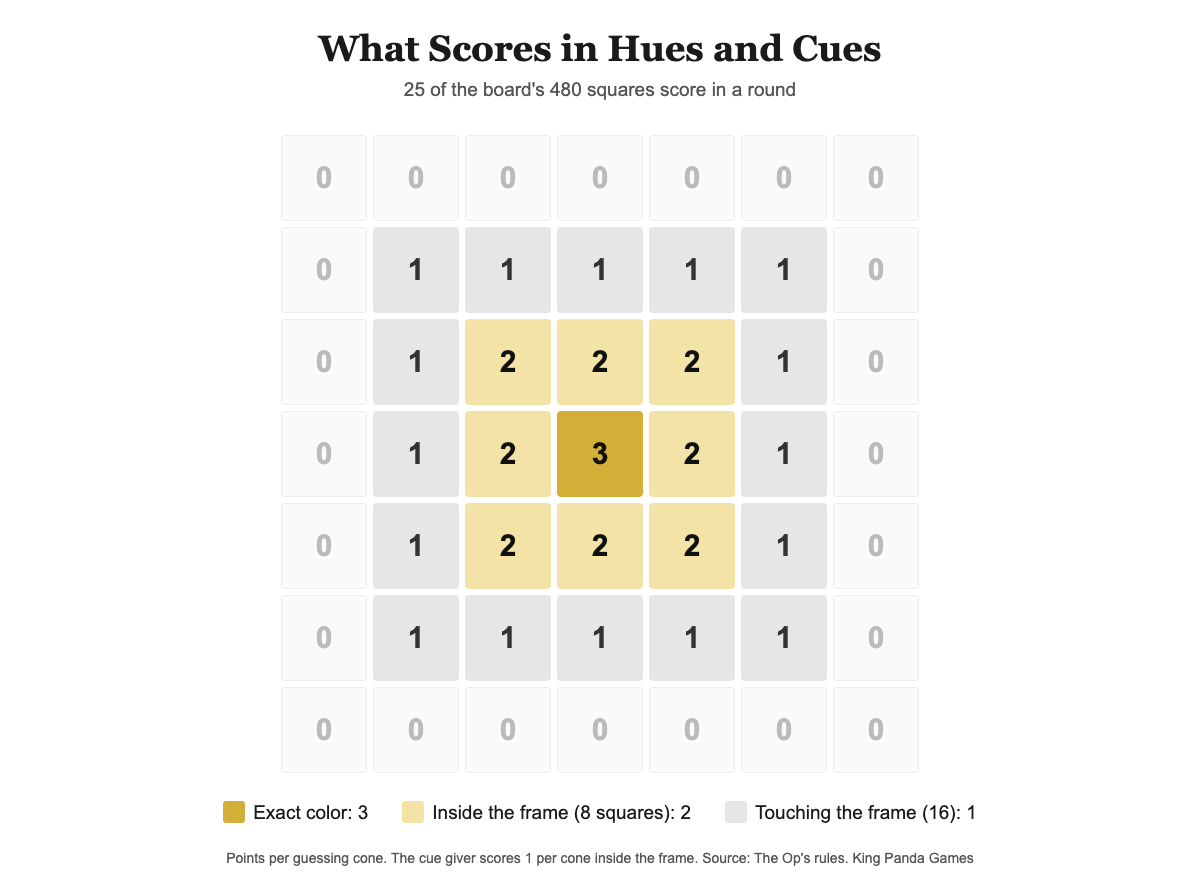
A guesser can score at most 5 in a round, and the cue giver at most 9. Move your score cone along the track, return the guessing cones, and the next player clockwise becomes the cue giver.
“Can the cue giver skip the second cue?” Yes. If the first guesses are close enough, the cue giver can pass on the second cue. Nobody places a second cone, and scoring happens straight away.
How Many Rounds to Play
The game length depends on the player count.
| Players | Times each player gives cues | Rounds |
|---|---|---|
| 4–6 | Twice | 8–12 |
| 7–10 | Once | 7–10 |
The player with the most points wins. BoardGameGeek’s Hues and Cues page has the game’s community ratings and player-count poll. If there’s a tie, the tied player who was cue giver most recently wins.
Worth knowing: the rulebook doesn’t say how many rounds to play with exactly 3 players. Most groups follow the 4–6 rule and have everyone give cues twice, which makes six rounds.
Variant for Younger Players
The rules include an easier version for kids. Instead of drawing a card, the cue giver picks any square on the board and writes down its letter and number in secret. That lets them choose a color they know how to describe.
Can You Play With 2 Players?
Not by the official rules. Hues and Cues needs at least three: one cue giver and at least two guessers competing for squares. With two, there’s only one guesser and nothing to compete over.
For two players, a game built for two works better; our best 2-player games list has plenty. Wavelength also has a cooperative mode for two, covered in our Wavelength rules guide.
For three or more, Hues and Cues is the easiest party game we know to teach. For tips on giving better cues, read our Hues and Cues strategy guide.
Frequently Asked Questions
How do you score in Hues and Cues?
Guessers score 3 for the exact color, 2 for a cone inside the 3×3 frame and 1 for a cone touching the frame from outside. The cue giver scores 1 for every cone inside the frame.
What words can’t you say in Hues and Cues?
Common color names like red, blue or green, anything about the board’s letters, numbers or positions, and any object in the room. Abstract color names like lavender are allowed.
How many rounds are in Hues and Cues?
With 4 to 6 players, everyone gives cues twice. With 7 or more, everyone gives cues once. The rulebook doesn’t cover 3 players; most groups play two rounds each.
Can two players guess the same color in Hues and Cues?
No. Each square can hold only one cone, so once a color is taken, later guessers must choose another square.
Who goes first in Hues and Cues?
The rules say the player wearing the most colorful outfit is the first cue giver. After that, the role passes clockwise.
What happens if your color is on the edge of the board?
Scoring works the same way, but the frame hangs off the edge, so fewer squares can score. That also lowers the most the cue giver can earn that round.
Can you play Hues and Cues with 2 players?
Not by the official rules, which need at least 3. With one guesser there’s no competition for squares.