

Two players is the version of The Crew most people ask about and the one the box hides on page 21. It is not a stripped-down variant — you play the same 32 missions, with the same task cards, with a third crew member the rulebook calls Tonoja.
She is not an AI opponent in any meaningful sense. She is 14 cards in a double row, half of them face up, and your captain plays them. That one design choice changes what the game is about, and whether you’ll like it depends on which part of the full game you value.
The Exact 2 Player Setup
The rulebook’s setup runs to six steps, and the card counts are easy to get wrong:
- Set aside the submarine card with a value of 4.
- From the remaining 39 cards, deal seven face down in a row, then place seven face up on top of them. That double row of 14 is Tonoja.
- Shuffle the submarine 4 back into the remaining cards and deal them out evenly: 13 cards each.
- Each player takes one reminder card and sets their sonar token green side up.
- Place the distress signal token face down.
- Shuffle the 96 task cards and keep them face down in a pile.
The submarine 4 is set aside at the start purely so it can’t land in Tonoja’s row — it goes back in the deck before the deal, so one of you still holds the strongest card in the game, and that player is the captain.
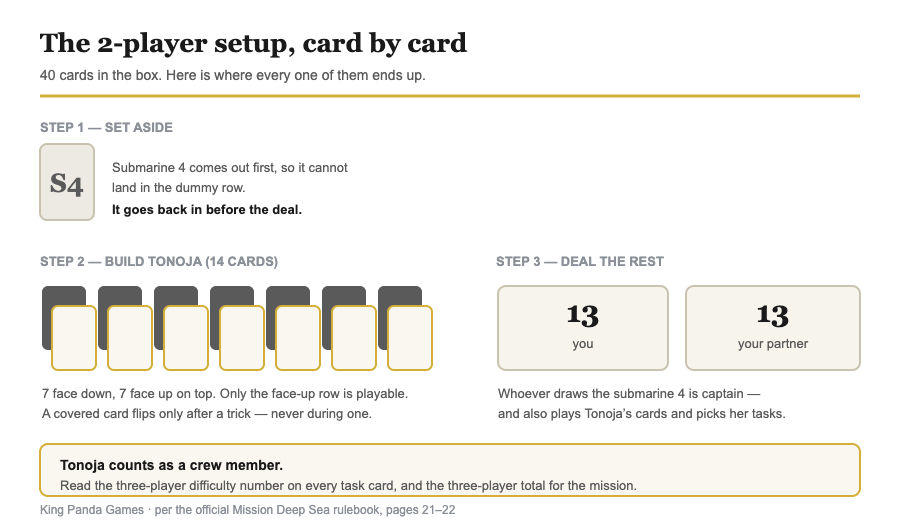
Worth knowing: Tonoja counts as a crew member for task difficulty, so you always read the three-player number on a task card and the three-player total for the mission — even though only two humans are playing.
What Tonoja Can and Cannot Do
Tonoja only ever plays a face-up card. When one of her face-up cards is played, the card beneath it is revealed — but only after a trick has finished, never during one. So her available options shrink and refresh as the hand goes on, and you always know exactly seven of the cards she could play next.
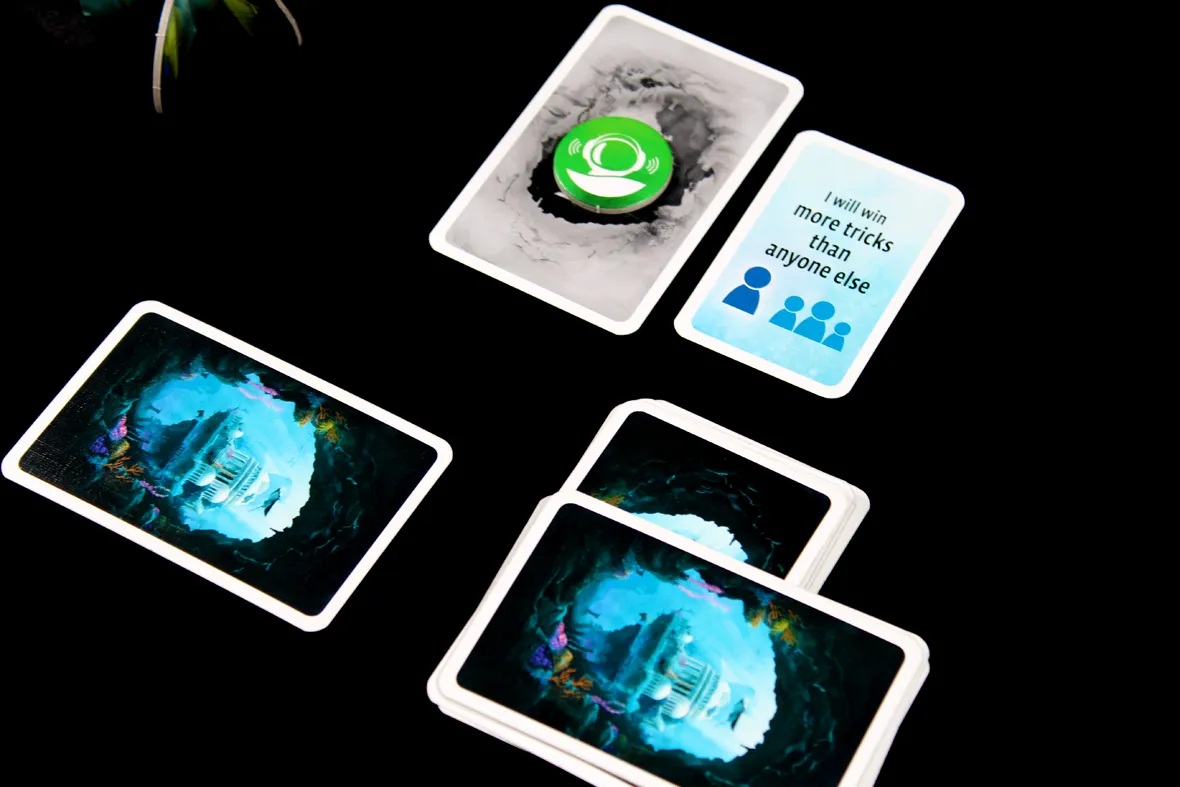
Your captain decides everything for her: which tasks she takes, whether she passes, and which of her face-up cards goes into each trick. The second player does not get a vote on any of it, and the usual rule still holds — nothing concrete may be revealed about your own hand while you argue for a plan.
That makes the captain’s seat materially different at two players. In a full game the captain just opens the first trick. Here they are running half the table.
The Trade You Are Making
What most players expect: a smaller version of the same deduction game.
What most players do: treat Tonoja as a third brain and try to read her the way they would read a person, waiting for signals that never come.
What actually works: treat her as a resource you spend. Her face-up cards are a public toolkit — the question is never what she has, it’s which of her seven visible cards you burn now and which one you keep for the trick you know is coming.
That is the honest trade. The full-count game is about extracting meaning from a sonar token and a pattern of play. Two players replaces half of that with an open-information puzzle, because seven cards — a sixth of the deck — sit face up on the table from the start, with another seven waiting underneath them.
You still get the part where you desperately want to say something and cannot. With one other human and one silent dummy, though, the information you’re missing is narrower: a single hand of 13 cards, not two or three.
When the Two Player Game Shines
Our two-player notes come from the rulebook rather than a long two-player campaign, so take the following as reasoning about the structure rather than a session report.
The structure favours the harder missions. Once a mission demands three or four tasks in a particular order, a partly visible hand you can steer is what makes the puzzle tractable at all — and the early missions, built to teach a table of four, have fewer moving parts to steer.
One practical consequence of the rules: the captain runs Tonoja, and the captain is whoever drew the submarine 4. If that keeps landing with the same player, the other player spends the mission with less to decide, so it is worth redealing rather than pushing through several missions in a row that way.
Is It Worth Playing at Two?
Yes, with a caveat. If Mission Deep Sea is already in your house and you’re a couple who plays cards, the two-player mode is a real game and not a consolation prize — it keeps the tension and the mission structure intact.
If you’re buying a game specifically for two players, buy something built for two. The deduction that makes this game special needs hidden hands to deduce about, and at two there is only one of those. Our best 2 player games list has options designed for the count, and 7 Wonders Duel in particular does at two what The Crew does at four.
For everything else about the game — what the missions feel like, how the sonar rule works, whether it’s worth the money — see our full review of The Crew Mission Deep Sea.
Frequently Asked Questions
How does the 2 player mode in The Crew Mission Deep Sea work?
You set aside the submarine 4, build a third crew member called Tonoja from 14 cards in a double row, then shuffle the submarine 4 back and deal the rest so both players hold 13 cards. The captain chooses Tonoja’s tasks and plays her cards.
Which cards can Tonoja play?
Only her seven face-up cards. A face-down card is revealed when the face-up card covering it has been played, and only between tricks, never in the middle of one.
Who is the captain in a 2 player game?
Whichever player holds the submarine 4 after the deal, exactly as in a normal game. That player also manages Tonoja, which means choosing her tasks and deciding which of her face-up cards to play.
Do you use the three player or four player task difficulty at 2 players?
Three. Tonoja counts as a crew member, so the three-player difficulty number on each task card is the one that matters, and the mission’s difficulty total is the three-player one.
Can you communicate with sonar tokens at 2 players?
Yes. Each player still gets one sonar token per mission attempt and the usual highest, only, or lowest rule applies. Tonoja never communicates, which is part of what makes the two-player game harder to read.
Is The Crew Mission Deep Sea good with 2 players?
It is good, but it is a different game. You lose the deduction between hidden hands, which is the heart of the full-count version, and you gain a puzzle about steering a partly visible dummy hand. Couples who want pure deduction may prefer a dedicated two-player game.
Treat Tonoja’s seven face-up cards as a budget rather than a mystery, and expect the back half of the logbook to give the variant more to chew on than the opening missions do. The official rulebook lays out the variant on pages 21 and 22 if you want the diagrams, and the BoardGameGeek forums are where two-player groups compare house rules for running Tonoja.