


This article contains affiliate links — if you buy through them, we may earn a small commission at no extra cost to you. Full disclosure.
Apples to Apples Review: The Party Game With Nothing Inside
Bottom Line
Apples to Apples invented the judge-picks-a-card party genre in 1999, and every game it inspired — including the ones we’ve panned — improved on it. It asks players to match noun cards to adjective cards for a judge whose choice is, by official rule, pure whim; there are no decisions, no jokes on the cards, and no tension anywhere in the box. It was a genuinely important game once. Today it’s the beige original hanging behind its louder descendants, and we can’t find a table it serves better than something else does.
Some links below are Amazon affiliate links — as an Amazon Associate, King Panda Games earns from qualifying purchases at no extra cost to you. Full disclosure.
Apples to Apples gets a 5/5 Bamboo Plants and a 1/5 Pandas from us — the first one-Panda score we’ve ever given. We don’t hand that out for being broken; the game functions exactly as designed. We hand it out because nothing happens. Play “Alfred Hitchcock” on the card that says “Scary,” watch the judge pick “My First Kiss” instead for a chuckle, and repeat until someone has collected enough green cards to make it stop.
The Bamboo 5 is genuine — this may be the single easiest party game ever to teach, and its family-safety is total. The Pandas 1 is just as considered: every quality this game pioneered now exists elsewhere in a form that’s funnier, smarter, or both, and what remains when you subtract its descendants is a deck of nouns.
| Detail | Info |
|---|---|
| Players | 4–10 |
| Best Player Count | 6–7 — enough card spread to fake variety |
| Age | 12+ (works younger; a Junior edition exists) |
| Play time | 30–45 min |
| Complexity | Light |
| Solo Mode | No |
| Designer | Matthew Kirby, Mark Alan Osterhaus (1999) |
| Publisher | Mattel (originally Out of the Box) |
| Bamboo Plants | 5/5 — teaches itself, offends no one |
| Pandas | 1/5 — the genre’s rough draft, still in print |
| Official site | mattel.com |
| Official rules | Download the rules PDF |
How Apples to Apples Works
Each player holds seven red apple cards — nouns, ranging from “New Orleans” to “Atomic Bombs” to “Alfred Hitchcock.” The rotating judge flips a green apple card bearing an adjective (“Scary,” “Delightful,” “Slimy”), and everyone plays the red card from their hand that best matches. The judge picks their favorite; that player keeps the green card. Collect enough greens (eight at four players, sliding to four at a full table) and you win.
The official rules are admirably honest about the engine: the judge picks whichever card they prefer, for any reason — accuracy, comedy, personal bias, bribery via flattery. That whim is the game. There is nothing else in the box.
What We Liked
It’s completely safe, and that used to matter more. Apples to Apples was for years the only judge-style party game you could put on a table with grandparents, coworkers, and a nine-year-old simultaneously. Zero content risk, zero rules risk. That safety built the family-party category, and we respect the service record.
The history is genuinely important. This unassuming box invented the compare-cards-for-a-judge mechanic that Cards Against Humanity photocopied and What Do You Meme photocopied again. Party gaming as it exists owes this game a royalty check.
And the occasional absurd pairing — “Grandma” played on “Radioactive” — really does produce a laugh now and then. About one per game, in our experience. We counted.
What We Disliked
What the box promises: “The Game of Hilarious Comparisons!”
What the game delivers: comparisons. The hilarity was always meant to be supplied by the players, but the cards — dry nouns with encyclopedia captions — give them nothing to work with. CAH at least prints punchlines; Apples to Apples hands you “Paying Taxes” and wishes you luck.
- There are no decisions, even by party-game standards. Your hand either contains an obviously best match or it doesn’t, and the judge’s whim erases even that distinction. We’ve watched players win rounds with cards played at random, face down, unlooked-at — as a bit, and it worked. When “not looking at your cards” is a viable strategy, the game has left the building.
- The judge’s whim is the whole engine, and whim isn’t interesting. CAH’s judge at least picks the funniest submission. Apples to Apples’ judge picks… something, on unknowable criteria, and the official rules celebrate this. Rounds are lotteries with a social veneer.
- The deck has aged into a museum. Alfred Hitchcock, 1980s celebrities, references old enough that the game’s own instruction sheet reads like a trivia flashback. Younger players today recognize fewer cards each year — the same decay killing What Do You Meme, three decades earlier.
- It outlasts its welcome by design. Eight green cards at four players means dozens of identical rounds with no arc, no escalation, and no reason the last round differs from the first. Every game of Apples to Apples ends the same way: someone checks the winning condition and mercifully announces it’s been met.
Who It’s For
Honestly? Almost nobody, anymore — and that’s the review. The one real remaining niche: very mixed groups where absolute content safety is non-negotiable and Codenames somehow isn’t available — church socials, multigenerational reunions, classrooms. In those rooms it still functions as a pleasant time-filler, the board game equivalent of instrumental lobby music.
The Junior edition retains slightly more purpose as a vocabulary exercise for kids, where “match the noun to the adjective” is legitimately educational.
Who should skip this game
Everyone with access to the last fifteen years of party games. If your group wants funny, Codenames generates real laughs from your own people. If they want judged comparisons, literally any descendant does it with more spark. If they want safe and simple for all ages, Sushi Go Party! and Love Letter are just as clean with actual games inside. There is no table left where this box is the best available answer.
Who Should Buy This?
Nobody should buy Apples to Apples in 2026 — not as a hot take, but as a plain shopping conclusion. Its one historic advantage, total safety, is now shared by better games at the same price. If you find it at a thrift store for $3 and run a church game closet, sure. At retail, every dollar has a better home one shelf over.
If you own it already: it’s a fine donation. Somewhere a summer camp needs a wet-day option, and this game was built to be exactly that.
Best Player Count
Six or seven, where enough different red cards hit the table each round to create the illusion of variety, and the green-card win target drops low enough to end the game before the concept fully wears through. At four players, the win condition stretches to eight greens and the experience overstays badly; at nine or ten, rounds drag and half the table is playing cards nobody will read aloud.
Replayability
The lowest we’ve scored, and it’s structural. Apples to Apples combines the depleting-deck problem of its descendants (the strongest card pairings stop surprising anyone within a few games) with a flaw all its own: it wasn’t very engaging on the first play. Games that start at “pleasant” and decay from there don’t leave much runway.
The telltale sign, which we invite you to verify in any home that owns it: the box is pristine. Nobody’s copy of Apples to Apples is worn out. That’s not care — that’s testimony.
Play This Instead
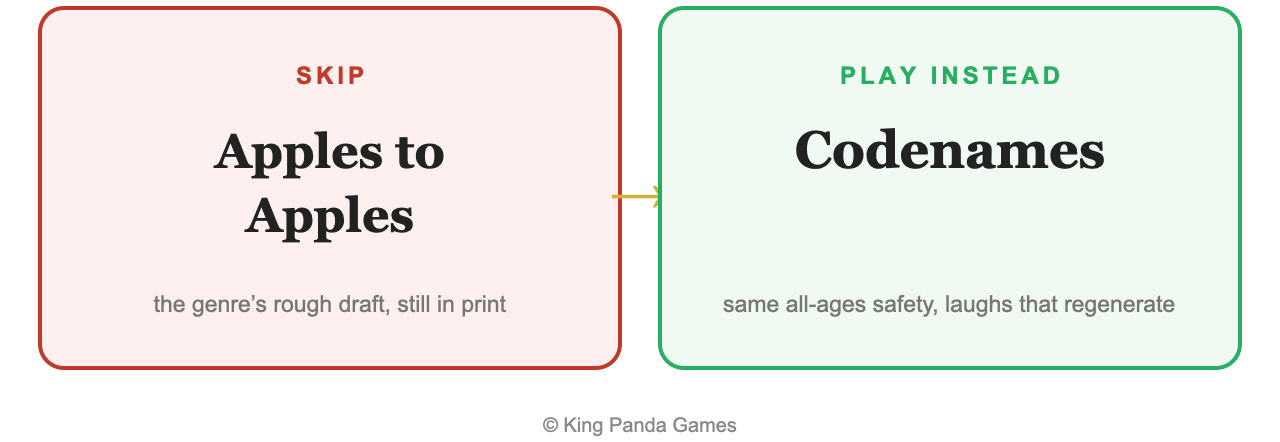
For the same all-ages table: Codenames — equally safe, equally simple to teach, and the laughs are generated fresh by your own group every single game. This is the direct upgrade, full stop.
For judged creativity that actually sparkles: Dixit — the judge mechanic reborn with gorgeous surreal art and real cleverness in the clues. What Apples to Apples wanted to be when it grew up. (our Dixit review.)
For families who want a game game: King of Tokyo or Love Letter — dice-chucking chaos or five-minute deduction, both clean enough for any table and infinitely more alive.
Frequently Asked Questions
Is Apples to Apples still a good game?
No — it was groundbreaking in 1999 and has been comprehensively surpassed by its own descendants. The judging mechanic it invented lives on in better games, while the original offers no decisions, no humor on the cards, and rounds decided by pure judge whim.
Is Apples to Apples the same as Cards Against Humanity?
It’s the clean original that CAH copied — same judge-picks-a-card engine, with dry noun cards instead of shock-humor punchlines. CAH is cruder but funnier for one night; neither survives repeat play well, and Codenames beats both.
What ages is Apples to Apples for?
The main game says 12+, mostly for card-reading and dated references; the Junior edition works from about 9 and has mild educational value as vocabulary practice. Content-wise the game is completely safe at any age — that was always its selling point.
How do you win Apples to Apples?
Collect green apple cards by having the judge pick your red card — the target slides from 8 greens with four players down to 4 greens with eight or more. Rotating judges pick on any criteria they like; the official rules explicitly endorse judging on whim.
Why did Apples to Apples get so popular?
Timing and safety — in 1999 there was no party game this easy, this scalable, and this family-proof, and it won major awards and sold millions before the genre it created matured. Its popularity was earned; its shelf-life wasn’t.
What should I play instead of Apples to Apples?
Codenames for the same all-ages safety with regenerating laughs, Dixit for the judging mechanic done beautifully, and King of Tokyo or Love Letter for clean family games with real decisions. All fit the exact table Apples to Apples was bought for.
Verdict
Skip it — our first unqualified skip. Not because Apples to Apples fails at what it does, but because everything it does now exists somewhere better, and what’s left in this box is a historically important stack of nouns. Respect it on the way past, though: every judged party game you’ve ever laughed at started here. And if one lives in your closet — it’s a lovely donation, and Codenames fits perfectly in the space it leaves.
Apples to Apples official site: https://www.mattel.com/
Official rules (PDF): Download it here