


Dominion Review: Is It Worth It?
Bottom Line
Dominion is the game that invented deck building, and seventeen years later it’s still the cleanest version of the idea — buy it if you like games where your brain hums and your engine grows every turn. Skip it if you need theme, table talk, or direct conflict, because Dominion has almost none of the three. Its biggest strength is that no two games play the same: 26 kingdom cards, 10 used per game, means the puzzle resets every time you sit down. Its biggest weakness is that it’s essentially multiplayer solitaire — you’re racing the other players, not really playing them.
Dominion gets a 4/5 Bamboo Plants and 4/5 Pandas from us — buy it if the phrase “build a little machine out of cards” makes your eye twitch with joy. This is the deck builder every other deck builder copied, and the copies still haven’t beaten it.
The Bamboo sits at 4, not 5, because while the turn structure teaches in ten minutes — Action, Buy, Clean-up, “ABC” — your first game involves reading 10 different card texts, and that’s a real speed bump for non-gamers. The Pandas sit at 4 because the fun is cerebral rather than social: our table goes quiet during Dominion in a way it never does during King of Tokyo, and some players love that hush while others check their phones.
Some links below are Amazon affiliate links — as an Amazon Associate, King Panda Games earns from qualifying purchases at no extra cost to you. Full disclosure.
| Detail | Info |
|---|---|
| Players | 2–4 |
| Best Player Count | 2 — fastest turns, tightest race, no downtime |
| Age | 13+ (sharp 10-year-olds do fine) |
| Play time | 30 min |
| Complexity | Medium |
| Solo Mode | No |
| Designer | Donald X. Vaccarino |
| Publisher | Rio Grande Games |
| Popular Upgrades | Yes |
| Bamboo Plants | 4/5 — simple turns, wordy first game |
| Pandas | 4/5 — deeply satisfying, quietly antisocial |
| Official site | riograndegames.com/games/dominion |
| Official rulebook | Download the rules PDF |
How Dominion Works
Every player starts with the same pathetic deck: 7 Coppers and 3 Estates. Ten cards of nothing. By the end of the game, that deck will be a purring machine that draws itself, generates piles of money, and vacuums up victory points — and building it is the entire game. It lands at #15 on our best board games of 2026 list.
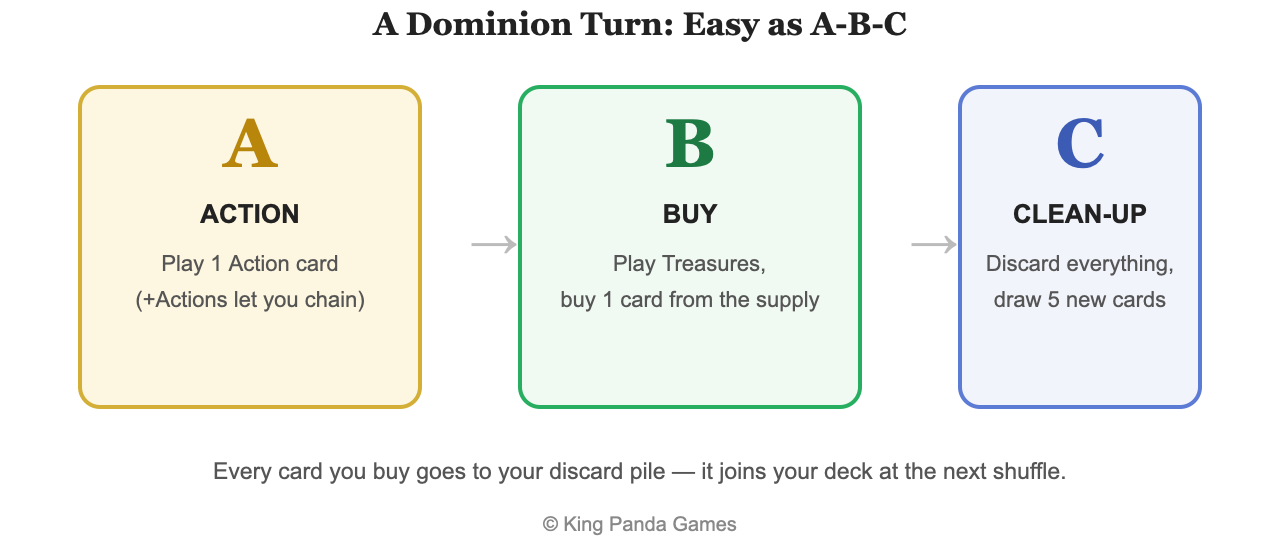
Your turn is three phases — A, B, C. Action: play one Action card from your hand (Villages and Markets give you more Actions, which is how the combos start). Buy: play your Treasure cards and buy one card from the supply. Clean-up: discard everything, draw five new cards. That’s it. No board, no pieces, just cards flowing from the supply into your deck.
Mid-game, you draw a hand of Village, Smithy, Market, Copper, Copper. Village gives +2 Actions, so you play it, then Smithy draws three more cards, then Market draws another and adds a coin and a Buy — suddenly your five-card hand is nine cards, six coins, and two purchases. Three turns ago this deck could barely afford a Silver. That escalation is Dominion’s whole pitch, and it never stops feeling great.
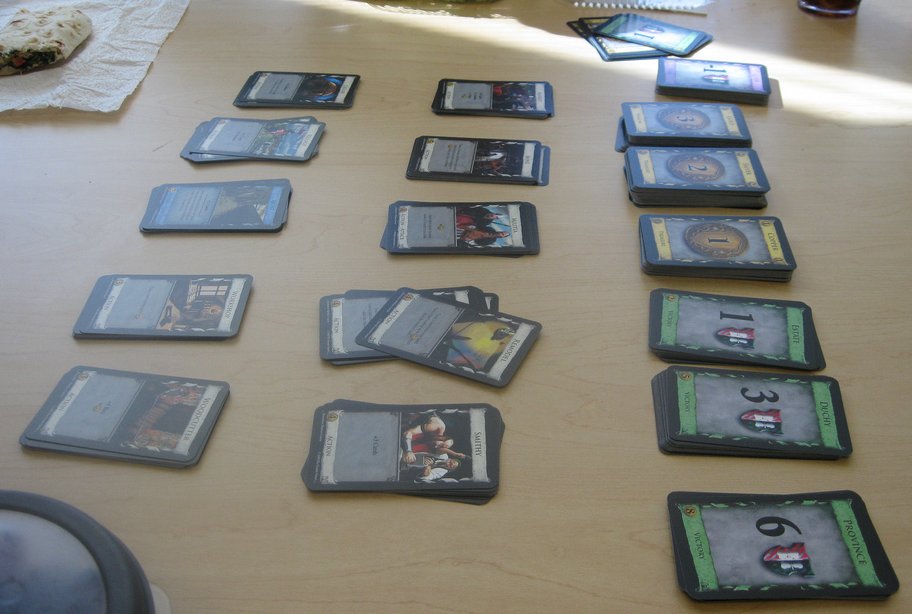
The supply has 10 kingdom card piles chosen from 26 in the box (plus the always-present Coppers, Silvers, Golds, Estates, Duchies, Provinces). The game ends when the Province pile empties — or any three piles do — and whoever’s deck holds the most victory points wins.
The genius twist: victory cards are dead weight while you play. Every Estate you buy clogs a future hand. Timing when to pivot from building your engine to buying points is the sharpest decision in the game, and misjudging it by two turns loses games.
What We Liked
The engine escalation is the best feeling in card games. Turn one you buy a Silver and feel poor. Turn twelve you chain five Actions, draw your whole deck, and buy a Province with change left over. Dominion delivers a growth curve per half-hour that most games need a campaign to produce.
The variable setup is doing exactly what it promises. Ten kingdom piles from 26 cards means the “right” strategy changes every single game — a Witch on the table warps everything, a board with no +Actions demands a totally different deck. We’re 40+ plays in and still hitting setups that make us re-think openings.
Chapel is the best tutorial in game design. A 2-cost card that trashes your bad cards teaches new players Dominion’s deepest lesson — a smaller, sharper deck beats a big bloated one — better than any strategy article could. Watching a new player discover thin-deck religion mid-game is a genuine joy.
Worth knowing: games really do finish in 30 minutes. Dominion has almost no downtime at 2 players because turns overlap — you plan your hand while your opponent shuffles. It’s one of the most replayable 30 minutes in the hobby.
It made an entire genre. Star Realms, Clank!, Aeon’s End, half your Steam library — they all descend from this box. Playing Dominion is like hearing the original recording of a song you’ve only known from covers, and the original holds up.
What We Disliked
- The theme is wallpaper. You’re a monarch buying “a bigger and more pleasant kingdom,” which translates to zero table talk about anything but card names. If your group plays for laughs and stories, Dominion won’t produce either.
- Interaction is thin. Outside of Attack cards like Militia and Witch, you’re playing parallel solitaire and comparing scores at the end. There’s no negotiation, no alliances, no direct conflict over anything but the card piles.
- The shuffling is constant. You’ll re-shuffle your deck every couple of turns all game, and with sleeved cards or small tables it gets genuinely tedious. It’s the physical tax on the deck-building fun.
Who It’s For
Dominion is for players who love optimizing systems: the spreadsheet-brained friend, the Magic: The Gathering refugee who doesn’t want to buy boosters, the couple that wants a fast nightly duel with real depth. It’s also the single best on-ramp to modern hobby gaming for card-game people — anyone who grew up on Rummy or poker understands “draw hand, play cards, improve deck” instantly.
It’s the thinking cousin to our other gateway picks. Where Catan teaches negotiation and Ticket to Ride teaches route planning, Dominion teaches engine building — and engine building is the mechanic the rest of the hobby runs on.
Who should skip this game
Skip Dominion if your group needs theme, laughter, or interaction to have fun — this is a quiet optimization puzzle, and no expansion fixes that. Skip it too if analysis paralysis wrecks your table: every hand offers real decisions, and one slow player stretches the game badly. And party-game-only groups should stay with King of Tokyo — Dominion will feel like homework to them.
Who Should Buy This?
Buy it — at around $45 for 500 cards and effectively infinite setups, Dominion is one of the best value-per-play boxes in board gaming. This is a core-collection game for anyone who liked any deck builder, ever: you’re buying the genre’s reference edition.
Buy the Second Edition specifically (the current printing) — it swapped six weak cards for better ones and the card organizer alone is worth the reprint. Try-before-you-buy only applies if you’ve never enjoyed any card game with combos; one free game on dominion.games (the official online client) will tell you everything.
Check Dominion price on Amazon →
Best Player Count
Dominion is best with 2 players. The box says 2–4 and all counts work mechanically, but the game is a race, and races are tensest head-to-head: turns come twice as fast, the Province split (8 per side) creates razor-thin endgames, and there’s zero downtime.
At 3–4 players, games stay good but stretch toward 45 minutes, attack cards like Witch hit harder (three Curse-slingers can bury you), and you spend more time waiting than deciding. Four is our ceiling and our least favorite — the engine you built fires half as often, and Dominion’s joy is firing the engine.
This is also why Dominion quietly belongs on every couples’ shelf next to 7 Wonders Duel — it’s a legitimate top-five two-player game hiding inside a 2–4 player box.
Replayability
Dominion’s replayability is effectively unlimited — there are over 5 million possible ten-pile setups from the base box alone, and the strategy genuinely changes with each one. This isn’t marketing math: a board with Chapel plays nothing like a board with Gardens, and the randomizer deck ensures you keep seeing new combinations for years.
The first ten games teach you the cards; the next fifty teach you the matchups between them. That second layer — recognizing that Militia is weak on a board full of cheap draw, or that Gardens flips the whole game into a buying race — is where Dominion stops being a good game and becomes a hobby.
And if you ever do exhaust the base set, the expansion line is the deepest in board gaming — we rank all of them in our expansions guide.
Accessories & Upgrades
Dominion has one of the biggest aftermarkets in the hobby, mostly aimed at its two annoyances: storage and shuffling.
- Card sleeves (Dragon Shield or similar, ~$30 for the base set) — Dominion cards get shuffled more than any game you own and unsleeved copies wear visibly within a year. The one upgrade we call necessary for regular players.
- Broken Token / Folded Space organizer ($25–40) — the Second Edition’s plastic tray is genuinely good for the base game, so this only matters once you own an expansion or two. Then it becomes essential.
- Playmats (Etsy, $15–30) — pure comfort, but the marked zones (deck / discard / play area) actually help new players keep the phases straight.
Check Dominion card sleeves price on Amazon →
Awards
Dominion won the 2009 Spiel des Jahres — the hobby’s biggest award — plus the Deutscher Spiele Preis the same year, and its designer effectively created the deck-building genre with this one box. Few games have a stronger pedigree.
Similar Games
If you like Star Realms, Dominion is the deeper original — Star Realms adds direct combat and shrinks to a $15 pocket duel, but Dominion’s fixed ten-pile supply rewards planning where Star Realms’ random card row rewards adapting. We break down the full matchup in Dominion vs. Star Realms.
If you like Wingspan, Dominion is the same engine-building joy with the theme stripped out — Wingspan wraps the “make your machine bigger” loop in birds and beauty; Dominion serves it raw, faster, and with more strategic variety per game.
If you like Everdell, Dominion is the 30-minute espresso shot version — Everdell builds one gorgeous tableau over 90 minutes; Dominion builds and rebuilds a deck three times in the same evening.
Tips & Tricks
Buy Silver early, and stop buying Copper forever. The most common beginner mistake in Dominion is treating Copper as a fine purchase — it isn’t. Every Copper you add dilutes your deck. In your first few turns, Silver and a cheap Action are almost always right.
What most players do: buy an exciting Action card every single turn, because Actions are the fun part.
What actually works: a deck with 3–5 well-chosen Action cards and strong Treasure. If you can’t reliably draw your Actions together, they’re just expensive Coppers. Count your deck; don’t collect.
- Trash your starting Estates if Chapel or Remodel is on the table — a 10-card deck that’s all engine beats a 20-card deck that’s half junk.
- Watch the Province math. When a 2-player game reaches the last 3–4 Provinces, stop building — every turn you spend improving your engine instead of buying points is usually a turn your opponent banks a Province.
- Don’t ignore Duchies late. A Duchy is 3 points for 5 coins, and endgames are routinely decided by a player who grabbed two “boring” Duchies while their opponent fished for one more Province hand.
One habit that will win you more games than any card knowledge: before your first buy, look at all ten kingdom piles and name your plan out loud in your head — “thin with Chapel, draw with Smithy, finish on Provinces.” Players who shop turn-by-turn lose to players who shopped once, at the start.
Not sure whether Dominion is the right step for your group? It is number 4 of 12 on our strategy board games list, ranked easiest to hardest to learn.
Played Dominion to death? See our best deck-building games list, which compares nine against Dominion and says what each one changes.
Frequently Asked Questions
Is Dominion worth buying in 2026?
Yes — Dominion remains the best pure deck-building game you can buy, and the Second Edition is the strongest version of it. At around $45 for effectively unlimited setups, it’s one of the highest replay-value purchases in the hobby.
Is Dominion hard to learn?
The turn structure is easy — Action, Buy, Clean-up takes ten minutes to teach. The real learning curve is reading ten kingdom cards each game and judging which matter, which takes two or three plays to get comfortable with. Use the rulebook’s recommended first-game set to flatten that curve.
Is Dominion good for 2 players?
Dominion is at its best with 2 players — fast turns, a tight race for eight Provinces, and no downtime. It’s secretly one of the best couples’ games in board gaming, despite never being marketed as one.
What’s the difference between Dominion First and Second Edition?
The Second Edition (2016, refreshed 2021) replaced six weaker cards with new ones — like Harbinger, Merchant, and Sentry — updated the art, and added a far better plastic organizer. Buy the Second Edition; there’s no reason to seek out the original.
Which Dominion expansion should I buy first?
Prosperity or Seaside, depending on taste — Prosperity makes everything bigger with Platinum and Colony cards, while Seaside’s Duration cards add effects that carry into future turns. Skip Alchemy until you own several others; it’s the consensus weakest set.
Is Dominion like Magic: The Gathering?
They share card-game DNA but play very differently — Dominion has no collectible element, no attacking with creatures, and everyone builds their deck during the game from the same shared supply. Ex-Magic players tend to love Dominion precisely because all the deck-building skill applies with none of the booster-pack costs.
How long does a game of Dominion take?
About 30 minutes with 2 players, closer to 45 with 4 — plus a few minutes of setup to pick and lay out the ten kingdom piles. It’s a natural “one more game” length, and most of our sessions end up being two or three plays.
Can you play Dominion solo?
The base game has no official solo mode. Your best solo option is the official online client at dominion.games, which has bots and the full card pool — it’s also a great free way to learn before buying the physical game.
Want to go deeper?
- Dominion Strategy: Engine vs. Big Money — the two archetypes every game comes down to, and when each one wins. Read it here
- The Best Kingdom Cards in Dominion’s Base Set, Ranked — the cards that decide games, from Chapel royalty to the traps. Read it here
- Every Dominion Expansion, Ranked — which of the expansions deserve your money, in order. Read it here
- Your First Game of Dominion — the exact setup, the recommended kingdom, and the five beginner mistakes to skip. Read it here
- Dominion vs. Star Realms — the original deck builder against its scrappiest descendant. Read it here
Verdict
Buy it if engine building sounds like fun to you — Dominion invented it, still does it best, and repays hundreds of plays. Skip it if your table needs theme, laughter, or direct conflict to stay engaged; no amount of expansions turns this into a social game. Try before you buy at dominion.games if you’re unsure — one free evening online is the cheapest test drive in board gaming.
Dominion official site: https://www.riograndegames.com/games/dominion/
Official rulebook (PDF): Download it here