


Love Letter Review: Is It Worth It?
Bottom Line
Love Letter is the most game ever fit into 21 cards — a five-minute deduction duel that lives in a velvet pouch and belongs in every bag, glovebox, and vacation suitcase. Skip it if you need meaty decisions or hate being knocked out by a lucky guess, because rounds can end abruptly and luck is a real co-pilot. Its biggest strength is frictionless: it teaches in ninety seconds and plays anywhere. Its biggest weakness is that it’s a filler by design — brilliant between things, thin as a main event.
Love Letter gets a 5/5 Bamboo Plants and 4/5 Pandas from us — buy it, it costs $13 and earns its pouch space forever. Draw a card, play a card, deduce what everyone’s holding, survive. That’s the entire game, and inside that simplicity is a surprisingly sharp little knife-fight of probability and bluff.
The Bamboo is a perfect 5 — this is genuinely the easiest teach in our collection; the reference cards do half the work. The Pandas land at 4 because the fun is real but bounded: five-minute rounds mean five-minute highs, and an unlucky first-turn Guard guess can end your round before you’ve done anything.
Some links below are Amazon affiliate links — as an Amazon Associate, King Panda Games earns from qualifying purchases at no extra cost to you. Full disclosure.
| Detail | Info |
|---|---|
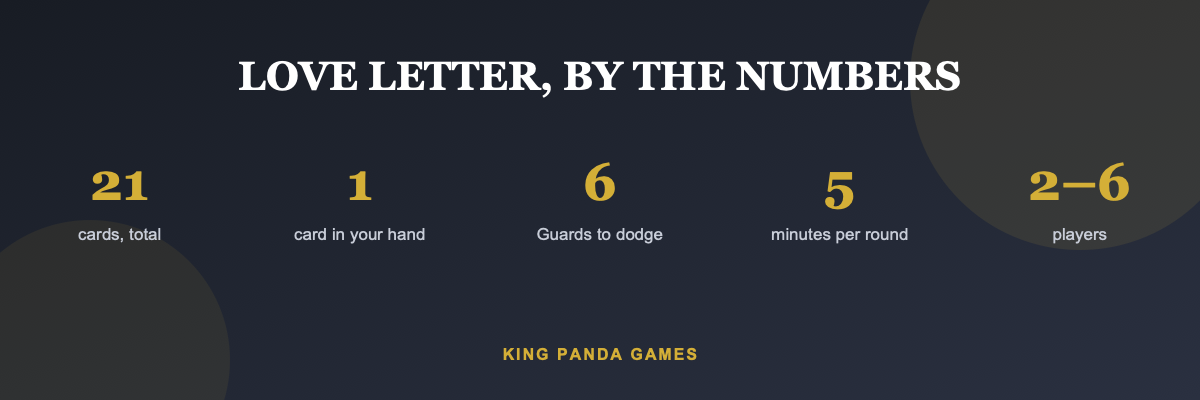
| Players | 2–6 |
| Best Player Count | 3–4 — enough hidden cards to deduce, fast enough to stay electric |
| Age | 10+ |
| Play time | 5–15 min |
| Complexity | Light |
| Solo Mode | No |
| Designer | Seiji Kanai |
| Publisher | Z-Man Games |
| Popular Upgrades | No (endless themed editions exist) |
| Bamboo Plants | 5/5 — easiest teach we own |
| Pandas | 4/5 — brilliant filler, thin main course |
| Official site | zmangames.com/game/love-letter |
| Official rulebook | Download the rules PDF |
How Love Letter Works
Everyone holds exactly one card. On your turn you draw a second, play one of the two, and do what it says. Last suitor standing — or highest card when the deck runs out — gets their love letter to the Princess and wins the round.
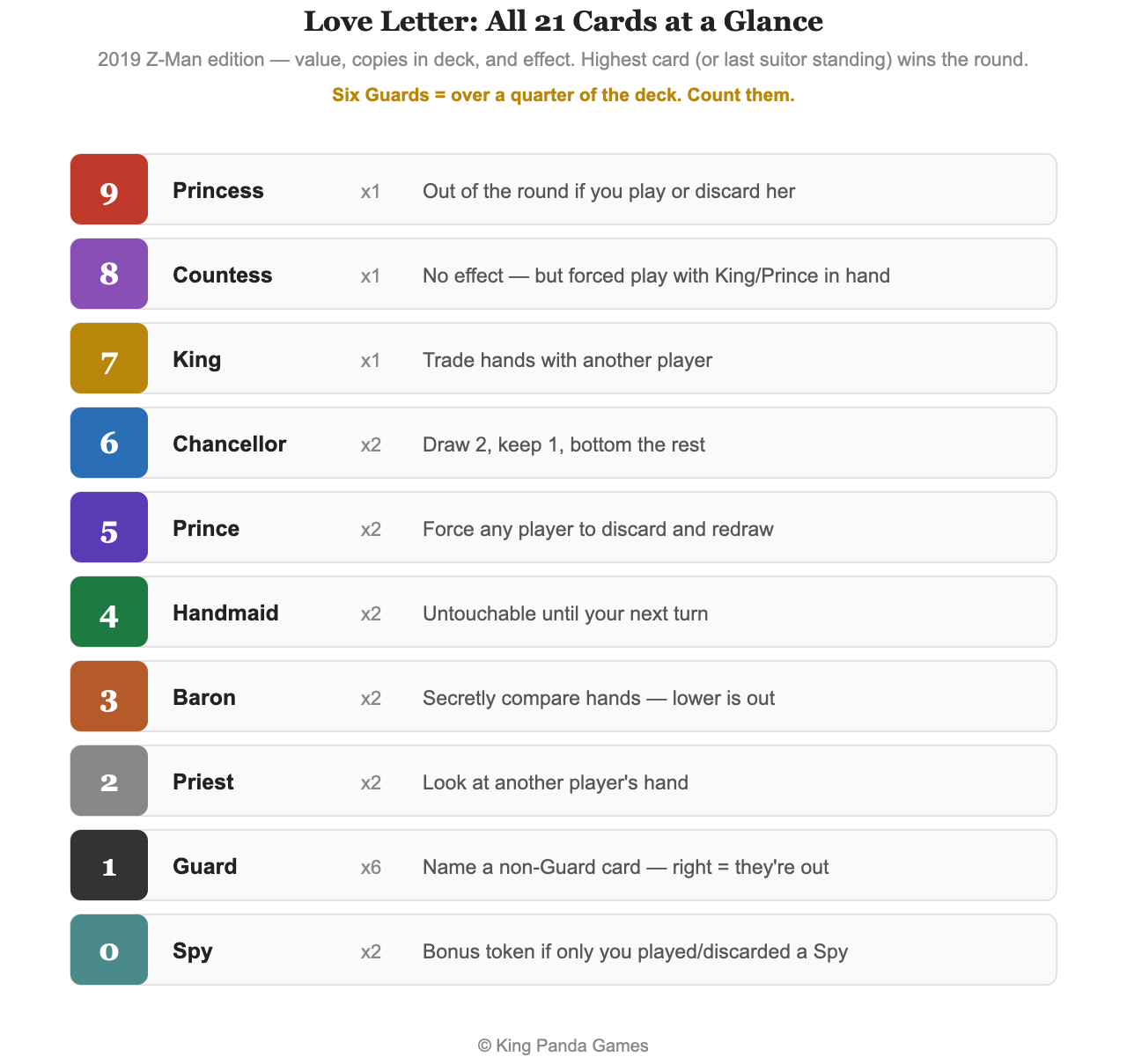
The 21-card deck is ten characters, and every one is a weapon. The Guard (six copies) names a card in someone’s hand — right, and they’re out. The Baron forces a secret hand comparison, loser eliminated. The Priest peeks, the Prince forces a discard, the King swaps hands, and the Handmaid makes you untouchable for a turn.
Three players left. You’re holding the Princess — the highest card, and instant elimination if you’re ever forced to discard her. Dana just played a Priest on you, so she knows. Next turn she’ll Guard-guess “Princess” and knock you out… unless you draw the Handmaid, or she draws something that forces her hand first. Everyone at the table knows exactly what’s happening, and the tiny five-card endgame suddenly has the tension of a poker final table.
The 2019 Z-Man edition (the one to buy) added two characters to the classic deck: the Chancellor, who digs two cards deep, and the Spy, who pays out for surviving sneakily. Win rounds, collect red favor tokens, first to the target (from 6 tokens at two players down to 3 at five or six) takes the game.
That’s everything. There is no setup beyond shuffling, no board, no table space beyond a coaster’s worth. Rounds are so short that elimination barely stings — you’re back in ninety seconds.
What We Liked
Card counting made accessible. With only 21 cards and every played card face-up, Love Letter quietly teaches deduction: two Barons gone plus a Handmaid means the odds on that Guard guess just changed. It’s the gentlest on-ramp to “counting cards” in gaming, and kids get visibly sharper at it within a session.
The Countess is a tiny masterpiece of design. She does nothing — except you must play her if caught holding the King or Prince. So when someone plays a Countess, the whole table squints: forced… or bluffing to look forced? One rule, endless mind games.
It’s the ultimate anywhere game. Waiting for food, airport gates, campsite tables, the DMV — Love Letter’s pouch has been everywhere with us. Setup is “shuffle,” teardown is “put it back in the bag.” No other game we own has this activation energy.
Rounds reset fast enough that losing is painless. Getting knocked out costs you at most a few minutes on the bench. Compare that to elimination games five times its length — Love Letter’s structure makes its harshest mechanic almost free.
What We Disliked
- Luck decides real percentages of rounds. A turn-one Guard guess can eliminate you having done nothing, and drawing the Princess early is a burden you didn’t choose. Over a full game of rounds it evens out; in any single round, it stings.
- Two players is functional, not magical. The official setup (three cards dealt face-up) helps deduction, but the game clearly wants a crowd of suspects. It lives at 3–4.
- The theme is wallpaper — nobody at the table cares about wooing the Princess, and the many themed re-skins (from Marvel to Star Wars) exist precisely because the theme is interchangeable.
Who It’s For
Love Letter is for couples and parents first — it’s the game that fits in a diaper bag and plays during a toddler’s nap — and for anyone who wants gaming’s best “while we wait” option. It’s also a stealth teaching tool: probability, memory, and read-the-room skills in a package a 10-year-old masters in one sitting.
It pairs perfectly with bigger nights, too. We deal Love Letter while the next game sets up, the way restaurants bring bread. And for gift-buyers: at $13 with a velvet pouch, it’s one of the three best stocking stuffers in the hobby — it earned its slot in our board game gift guide.
Who should skip this game
Skip Love Letter if you only enjoy games with meaty, controllable decisions — a third of your turns play themselves, and the luck will make you grind your teeth. Groups that already own Coup and want more social knife-fighting should know Love Letter is gentler and more luck-driven, not a step up. And it’s not a main-event game for anyone — that’s not what fillers are for.
Who Should Buy This?
Buy it on sight — $13 is below the price of deliberation. If you have a partner, a commute, kids, or a game shelf, Love Letter pays for itself in sheer frequency of play: cost-per-game lands at pennies within a month.
The only real buying decision is which edition. Get the current Z-Man version (red box, 21 cards) — the added Spy and Chancellor improve the classic game, and the rules include the “classic 16-card” setup if you ever want the original. The themed re-skins are fine, but buy them for the theme, not the gameplay.
Check Love Letter price on Amazon →
Best Player Count
Love Letter is best at 3–4 players. The box says 2–6, and the 2019 edition genuinely stretched it — but three and four is where deduction and pace balance: enough hidden cards that Guard guesses take real thought, few enough that your turn comes back before your read goes stale.
At two, the face-up set-aside cards keep deduction alive and it’s a fine coffee-shop duel — just thinner. At five and six, rounds get chaotic and short; fun with the right crowd, but you’re rolling dice more than reading minds. We break the counts down fully in our player count guide.
Replayability
Love Letter’s replayability comes from frequency, not variety — the same 21 cards, played three hundred times, in three hundred spare moments. That’s not a knock; it’s the design. A game this small can’t surprise you at play fifty, but it’s never once been refused when offered, which is its own kind of replay value.
The favor-token structure helps more than people notice: playing to 3–6 tokens turns throwaway rounds into a real match with comebacks and rubber games. Groups that play single rounds are getting half the game.
The endless licensed editions (Marvel, Star Wars, Adventure Time) are re-skins with light tweaks — fun as gifts, unnecessary as upgrades.
Awards
Love Letter won the 2013 Golden Geek awards for Best Card Game and Best Party Game, and its designer Seiji Kanai’s 21-card design effectively launched the entire “microgame” category. Its influence outweighs its pouch by several orders of magnitude.
Similar Games
If you like Coup, Love Letter is its gentler, luckier sibling — Coup runs on bluffing and nerve, Love Letter on deduction and probability. Same pocket size, same table drama, different muscle. We compare them head-to-head in Love Letter vs. Coup.
If you like Sea Salt & Paper, Love Letter is the deduction-flavored alternative — both are small-box card games with push-your-luck tension, but Sea Salt is about building your own tableau while Love Letter is about reading everyone else’s single card.
If you like Codenames, Love Letter is the version for when you can’t field two teams — the same “read minds, take social risks” pleasure, scaled down to any headcount and any table.
If you like Love Letter but your table keeps growing, Sushi Go Party! is the upgrade — same two-minute teach and the same small box, except it seats eight and everyone drafts at once, so nobody sits knocked out watching the round finish. See our Sushi Go Party! review.
Tips & Tricks
Guard math is the whole game. Six of the 21 cards are Guards — track them. Early on, guess the mid-value cards (Prince, King) that players tend to hold; never waste a guess on a card you can see dead on the table. By the endgame, the discard piles have usually narrowed someone’s hand to two possibilities.
What most players do: play the Handmaid the moment they draw it, because safety feels good.
What actually works: saving her for when you’re actually threatened — right after someone Priests you, or when you’re holding the Princess late. A Handmaid played on turn two protects you from nothing anyone was doing.
- Holding the Princess: play everything else, hide your tension, and pray for the Handmaid. Holding the Countess with her: you’re forced into nothing — she’s the perfect bluff cover.
- The Baron is a coin you should only flip when weighted: play him when you’re holding 5+ (Prince or better), never on a naked 2 or 3.
- In the endgame, count what’s left. With four cards remaining and the King already played, that “mystery hand” has maybe two possible values — Guard accordingly.
And one table-culture tip: keep score with the favor tokens across rounds. First-to-three turns “cute filler” into genuine rivalry, and the game is twice as good for it.
Frequently Asked Questions
Is Love Letter worth buying?
Yes — at $13 for a complete, endlessly portable deduction game, it’s one of the best value purchases in board gaming. It won’t headline a game night, but no game gets played in more spare moments.
How many cards are in Love Letter?
The current Z-Man edition has 21 character cards — ten characters including the Spy and Chancellor added in 2019. The rulebook includes a “classic” variant using the original 16-card deck, marked by dots on each card.
How do you win Love Letter?
Win rounds by having the highest-value card when the deck runs out, or by being the last player standing. Each round win earns a favor token; the first player to the target — 6 tokens at two players, down to 3 at five or six — wins the game.
Is Love Letter good for 2 players?
It’s solid but not at its best — the official two-player setup deals three cards face-up to keep deduction meaningful, and it makes a fine quick duel. The game truly shines at three or four players, where there are more hands to read.
What does the Countess do in Love Letter?
Nothing when played — but you must play her if the King or a Prince is your other card. Since nobody knows whether your Countess was forced or chosen, she’s the game’s best bluffing tool despite having no effect at all.
Can kids play Love Letter?
Yes — the box says 10+, but most 8-year-olds handle it easily since turns are draw-one-play-one with reference cards listing every effect. It’s also a sneaky-good probability teacher.
Which edition of Love Letter should I buy?
The current Z-Man Games edition (red box, velvet pouch, 21 cards) — the 2019 redesign added the Spy and Chancellor, supports 2–6 players instead of 2–4, and includes the classic setup as a variant. Themed versions are re-skins; buy those for the franchise, not the gameplay.
Want to go deeper?
- Love Letter Strategy: Guard Math and Card-by-Card Tips — the probability layer hiding inside 21 cards. Read it here
- Love Letter vs. Coup: Which Pocket Game Should You Buy? — deduction versus bluffing, settled. Read it here
- Love Letter Player Counts: Is It Good with 2? — how the game changes from 2 to 6, and the official 2-player fix. Read it here
Verdict
Buy it — for $13, Love Letter is the best pound-for-pound purchase in card gaming and the filler every collection needs. Skip it only if luck-driven eliminations genuinely ruin your fun, or you need every game to be a main event. There’s no try-before-you-buy tier at pouch prices.
Love Letter official site: https://www.zmangames.com/game/love-letter/
Official rulebook (PDF): Download it here