


Love Letter Player Counts: Is It Good with 2 Players?
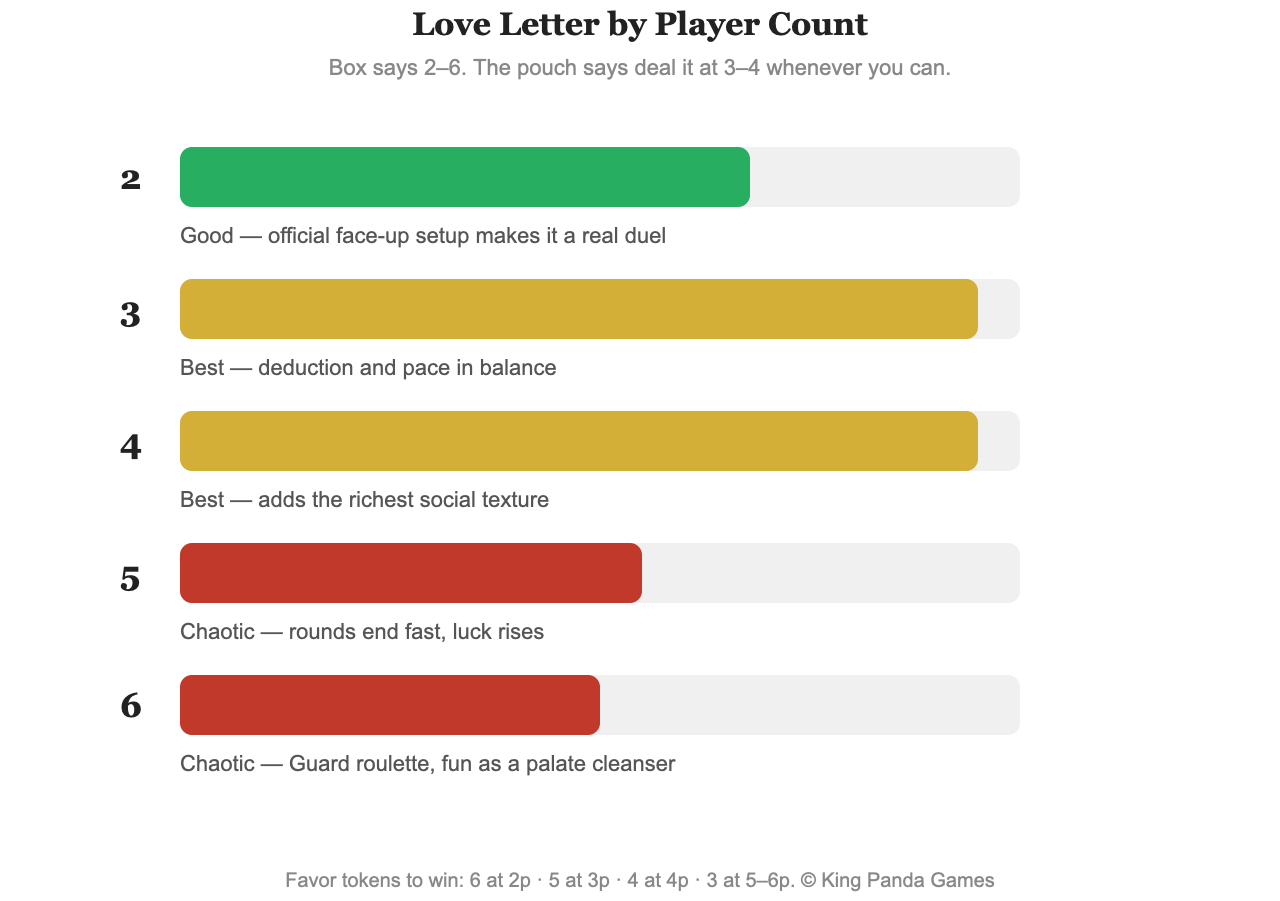
Yes, Love Letter works with 2 players — the official rules were built for it, and the fix is smarter than most people realize. But the honest ranking is: best at 3–4, good at 2, chaotic at 5–6. Here’s how each count actually plays, and how to get the most from the one you’re stuck with.
Some links below are Amazon affiliate links — as an Amazon Associate, King Panda Games earns from qualifying purchases at no extra cost to you. Full disclosure.
The 2-Player Setup (and Why It Works)
The current Z-Man rules handle two players with one elegant tweak: after setting aside the usual facedown card, you deal three more cards face-up for both players to see.
That’s a deduction transplant. Heads-up, the normal game would collapse — with one opponent and a hidden deck, Guard guesses would be nearly blind. The three face-up cards remove almost a fifth of the deck from the possibility space before the round starts, so counting actually works: if two Guards and a Baron are face-up, your reads sharpen immediately.
Two-player Love Letter plays like a quick-draw duel — five-minute rounds, first to 6 favor tokens (the highest target in the game, so a real match). It’s genuinely good for couples, coffee shops, and campsite mornings. What it lacks is the crowd: no third player to dodge behind, no table-wide paranoia, no choosing targets. Every card aims at one face.
Worth knowing: at two players, the Spy gets quietly stronger — with only one opponent to out-sneak, surviving with a Spy in your discards pays its bonus token far more often. Dump Spies early and often heads-up.
3–4 Players: The Sweet Spot
Love Letter peaks at three and four players, and it isn’t close. This is where the game’s two engines — deduction and pacing — both run at full speed. Multiple hidden hands make Guard guesses genuinely interesting; the discard pool grows fast enough to count but not so fast the round ends before reads mature; and your turn returns in under a minute, so plans survive to be executed.
Four adds the best social texture: alliances of convenience, “why did you Guard me?” grievances, and the delicious moment when two players Baron each other out and the survivors just look at each other. If you’re choosing when to pull Love Letter out of the pouch, choose the moment your table hits three or four — the strategy layer is fully alive here.
5–6 Players: Fun, But It’s a Dice Roll
What most groups expect: more players, more fun — it worked for every other party game.
What actually happens: rounds end fast and randomly. With six players burning through a 21-card deck, you might get two turns before the round resolves, eliminations chain instantly, and deduction gives way to Guard roulette. It’s still cheerful — but you’re playing a slot machine with theming.
The 2019 edition added the Chancellor and extra cards specifically to stretch to six, and it does function. Our honest advice: at five or six, either embrace the chaos as a two-minute palate cleanser between bigger games, or reach for a game built for that headcount — Coup at exactly five or six is dramatically better, and our best games for groups roundup covers the bigger-party tier.
Getting the Most from Any Count
Play the match, not the round — always. The favor-token targets (6 at two players, 5 at three, 4 at four, 3 at five or six) are tuned so a match runs 20–30 minutes at any count, and the running score is what turns light rounds into real competition.
Two more count-specific tweaks from our table: at two players, play best-of-matches and alternate who deals — first-turn advantage is mildly real heads-up. At five or six, deal the next round immediately when someone’s knocked out early; momentum is everything at that count, and Love Letter’s ninety-second rounds mean nobody waits long. Still deciding if the game earns its pouch at all? The full review settles it.
Don’t own Love Letter yet? This guide assumes the base game.
Check Love Letter price on Amazon →
Frequently Asked Questions
Is Love Letter good with 2 players?
Yes — the official rules deal three extra cards face-up in two-player games, which keeps deduction meaningful, and the first-to-6-tokens match gives it real structure. It’s a genuinely good couples’ duel, just thinner than the 3–4 player game.
What is the best player count for Love Letter?
Three or four players — enough hidden hands to make deduction interesting, fast turn cycling, and the best social dynamics. Two works well with the official setup; five and six are playable but luck-heavy.
How does the 2-player setup work in Love Letter?
Set aside one card facedown as usual, then deal three more cards face-up where both players can see them, and deal each player one card. The face-up cards shrink the possibility space so hand-guessing stays a skill instead of a blind stab.
How many favor tokens do you need to win Love Letter?
It scales by player count: 6 tokens at two players, 5 at three, 4 at four, and 3 at five or six. Each round win earns one token, so a full match runs about 20–30 minutes at any count.
Can you play Love Letter with 6 players?
Yes — the 2019 Z-Man edition expanded the deck to 21 cards specifically to support up to six. Expect short, chaotic rounds where luck outweighs deduction; it’s best treated as a quick palate cleanser at that count.
Is Love Letter or Coup better for 2 players?
Love Letter, decisively. Its two-player rules are a real design with face-up information, while Coup’s bluffing engine needs a crowd of suspects and mostly stalls head-to-head.
One-line summary for the pouch: deal it at 3–4 whenever you can, enjoy it at 2 without apology, and at 6 — deal fast and laugh.