

Five Crowns vs Phase 10 vs Rummikub: Which Family Card Game Wins?
If you want one set-and-run family game in the drawer, get Five Crowns. It’s the most forgiving, the fastest to teach, and the one least likely to strand a player having a bad night. Phase 10 and Rummikub are both excellent, but they win in narrower situations. Here’s the honest breakdown.
Some links below are Amazon affiliate links — as an Amazon Associate, King Panda Games earns from qualifying purchases at no extra cost to you. Full disclosure.
The quick verdict
Five Crowns is the best all-rounder, Phase 10 is the best for players who like a structured checklist, and Rummikub is the best for people who love hands-on tile manipulation. All three share the same DNA — make sets and runs — but they feel genuinely different at the table.
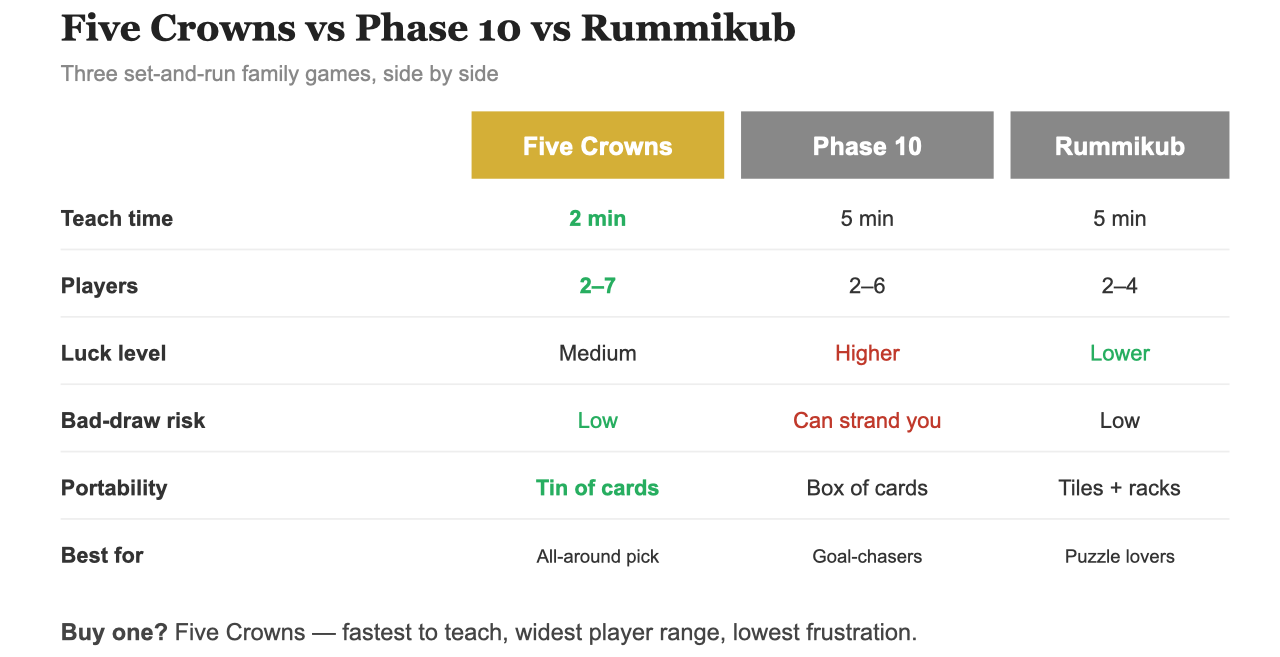
| Game | Best for | Teach time | Luck level | Players |
|---|---|---|---|---|
| Five Crowns | All-around family pick | 2 min | Medium | 2–7 |
| Phase 10 | Structured, goal-driven players | 5 min | Higher | 2–6 |
| Rummikub | Tactile, puzzle-loving players | 5 min | Lower | 2–4 |
Five Crowns vs Phase 10: forgiveness vs structure
The core difference: Phase 10 makes you complete specific phases in order, while Five Crowns lets you build whatever books and runs you want. That one design choice changes everything about how the two games feel.
In Phase 10, you have to finish “two sets of three” before you can move to “one run of seven,” and so on through ten phases. If you don’t complete your phase, you’re stuck repeating it while opponents advance — which can mean grinding the same phase for three or four rounds on a cold streak. It’s satisfying when it clicks and miserable when it doesn’t.
Five Crowns has no such trap. Every hand is a fresh, open puzzle, and the climbing wild card keeps everyone competitive. Nobody gets stranded.
Phase 10 fans say: the phase structure gives each round a clear goal and a satisfying sense of progress through the game.
Five Crowns fans say: the open hands and changing wild card mean a bad draw never locks you out, and the game moves faster.
If your group includes someone who gets frustrated falling behind, Five Crowns is the kinder choice. If your group likes a checklist to chase, Phase 10 delivers that better.
Five Crowns vs Rummikub: cards vs tiles
Rummikub is the most strategic and the least luck-driven of the three, but it’s also the slowest and tops out at four players. It’s a tile game where the genius is that you can rearrange everyone’s melds on the table to play your own tiles — a level of hands-on manipulation neither card game offers.
That table-manipulation is Rummikub’s whole magic and its main barrier. Turns can take a while as players break apart and rebuild the entire board to squeeze out a play, and analysis-paralysis-prone groups will feel it.
Five Crowns is faster, more social, and far more portable — it’s a tin of cards versus a box of tiles and racks. Rummikub rewards the most patient, calculating player; Five Crowns keeps a noisy table of seven moving.
Which should you buy first?
Buy Five Crowns first. It teaches fastest, plays the widest range of players, travels best, and has the lowest frustration floor — there’s no phase to get stuck on and no slow board to rebuild. It’s the safest first purchase for a mixed family.
Check Five Crowns price on Amazon →
Buy Phase 10 if your group specifically enjoys working through a structured list of escalating challenges and doesn’t mind the occasional stranded round. Buy Rummikub if your crew leans strategic, plays in smaller groups, and loves the tactile puzzle of reorganizing tiles on the table.
Check Phase 10 price on Amazon →
Check Rummikub price on Amazon →
Honestly, these three play well as a set — they scratch similar itches at different speeds. But if it’s one game for the drawer, it’s Five Crowns. If what you actually want is the opposite — a cheap number-card filler that seats ten and teaches in a minute — that argument is 6 Nimmt! vs. No Thanks!.
If you want the full breakdown on the winner here, read our complete Five Crowns review, and if you’re new to it, start with how to play Five Crowns. For more options in this lane, see our best card games for adults.
Frequently Asked Questions
Is Five Crowns better than Phase 10?
For most families, yes. Five Crowns is more forgiving because you can build any books and runs you want, while Phase 10 can strand you repeating the same phase for several rounds. Phase 10 is better only if your group specifically enjoys completing a structured checklist of escalating goals.
What’s the difference between Five Crowns and Rummikub?
Five Crowns is a card game; Rummikub is a tile game. Rummikub is more strategic and less luck-driven because you can rearrange every meld on the table, but it’s slower and caps at four players. Five Crowns is faster, more social, more portable, and plays up to seven.
Which is the easiest to learn — Five Crowns, Phase 10, or Rummikub?
Five Crowns is the easiest to learn, teachable in about two minutes if anyone at the table knows rummy. Phase 10 and Rummikub both take a few minutes more because of their phase list and tile-manipulation rules respectively.
Which family card game is best for big groups?
Five Crowns, because it plays 2 to 7 players. Phase 10 tops out at 6 and Rummikub at 4. For a loud table of six or seven, Five Crowns is the clear pick — though expect some downtime in the late, big-card hands.
Is Five Crowns more luck or skill compared to Phase 10?
Both have meaningful luck, but Five Crowns rewards skill a bit more consistently because open hands let a good player adapt to any draw. Phase 10’s rigid phase requirements mean a cold streak of cards can hold you back regardless of skill. Rummikub is the most skill-driven of the three.
Can you play all three with the same group?
Yes, and they complement each other well. Five Crowns for fast, social, big-group nights; Phase 10 when people want a structured goal to chase; Rummikub for smaller, more strategic sessions. They share set-and-run DNA but feel distinct enough to all earn a spot.
Buy one, buy Five Crowns. Buy all three over time and you’ll have a set-and-run game for every mood and group size — but the tin of Five Crowns is the one that’ll leave the drawer the most.